Waterhousea floribunda
Weeping Lilly Pilly
Every Waterhousea floribunda on HortOS in one place: the plain species and 8 varieties. Pick a size to see it across all of them.
Part of Waterhousea: see them all
73 growers · 28 sizes · from $1.55 ex GST
- Type
- Tree
- Height
- 10 m
- Spread
- 8 m
- Flowers
- White, late winter to mid spring
- In Australia
- Native
Some growers show prices to verified trade buyers. Sign in or sign up with your ABN to see them and order.
Also grown by 23 nurseries (no sizes or prices listed)
Enquire with them for sizes and prices.
- Blerick Tree FarmNeerim Junction, VIC
- Burringbar Rainforest NurseryBurringbar, NSW
- Cabbage Tree NurseryDural, NSW
- City Farm NurseryWindsor, QLD
- Eastern Forest Nursery Pty LtdSouth Gundurimba, NSW
- Ellenby Tree FarmGnangara, WA
- Firewheel NurseryDorroughby, NSW
- Florafolia (Alstonville Plants)Alstonville, NSW
- ForsterianaDarawank, NSW
- Hinterhub - Native Plants and Artisan GiftsQLD
- Lakewood PropagationPalmwoods, QLD
- Maclean Landcare GroupTownsend, NSW
- Overland NurseriesArcadia, NSW
- Plant Haven NurseryTamaree, QLD
- Plants MelbourneReservoir, VIC
- Plants WhitsundayQLD
- Port Macquarie Landcare Community NurseryPort Macquarie, NSW
- Rainbow RegenThe Pocket, NSW
- SOWN NurseryThe Gap, QLD
- Speciality TreesVIC
- Sydney Wildflower NurseryHeathcote, NSW
- The Tree ShopSurrey Hills, VIC
- Wirin Wirra - Native NurseryTomerong, NSW
Growing weeping lilly pilly
Where it grows. The New South Wales flora calls it widespread in riverine rainforest, often lining stream banks, north from the Hunter Valley. The CSIRO rainforest key places it in gallery forests and rainforests along creeks and rivers, from central-east Queensland south to near Newcastle and from sea level to 600 m, and says it is cultivated north of Townsville and elsewhere. The Atlas of Living Australia holds records from New South Wales, Queensland, Victoria and the Australian Capital Territory.
Conditions. No reference read gives the species a sun, soil, water, drought or frost rating, so this page claims none. The one nursery sheet read is written for the Green Avenue selection, not the species: it lists that selection as tolerant of most soils in full sun to part shade and of occasional wet conditions, and it is the only text read that uses the word evergreen, again of the selection.
Size and form. The flora describes a small to large tree with dark grey, somewhat flaky bark, more or less fissured. In the forest the CSIRO key records trees to 30 m tall and 80 cm through the trunk, frequently smaller and without buttresses. The planted figure, 10 m by 8 m, is Camden Council's, quoted in the HortOS car park shade tree guide with the council's note that its heights and widths are a guide that may differ from one situation to another.
Propagation and disease. The CSIRO key gives a seed germination time of 10 days. The tree is in the Myrtaceae, the family myrtle rust infects; the cautions below say what the biosecurity page does and does not say.
Using weeping lilly pilly
Four of the HortOS guides show what the trade does with it. The street trees and canopy guide names it among the species that dominate at 100 litres and counts it among the native exceptions on a list that is mostly exotic. The car park shade tree guide takes its table from one council's street tree list, where the tree is 10 m tall and 8 m wide. The guide to shade trees for schools sets it out as one tree at two sizes, the 300 mm pot and the 100 litre bag. The hedge cost guide counts it among the seven hedge species the Australian trade grows most and describes it as a tall soft screen and, unclipped, a tree; for a hedge that guide's calculator allows 0.6 m between plants at 200 mm, 0.8 m at 300 mm and 1.0 m at 45 L. For a street or a park the tree planting guide says to space trees for the mature canopy, not the size on the day. The named selections, Green Avenue among them, have their own pages.
What to check before you buy
Read growers' lists for both names. The listings on this page sit under the common name with Waterhousea floribunda; other lists use Syzygium, the genus the Census accepts, and the school shade guide notes that HortOS keeps a separate page under that name and does not add the two together. The table above shows the sizes listed. For a street or park order the guide to specifying and procuring trees gives the clause to write, from calliper and clear stem to the inspection right, and the plant quality guide covers roots, stem, pests and hardening off. Stock crossing a state border travels under the state and territory biosecurity rules. The gap to know: no reference read gives the species a drought or frost rating.
Cautions
Weeping lilly pilly is in the Myrtaceae, the family the Australian Government's biosecurity page says myrtle rust infects; the page names lilly pillies among that family's plants and names no species. It says the strain that reached Australia in 2010 has spread across the eastern states, Tasmania and parts of the north. Written about the exotic strains of the rust, it gives the first sign of infection as tiny pustules on new growth that erupt into yellow spores.
Prices are set by each grower and shown ex GST. Availability is confirmed by the grower at order.
Common questions
- Who grows Waterhousea floribunda wholesale in Australia?
- 73 wholesale growers list Waterhousea floribunda on HortOS right now, each with their own pot sizes and trade prices. They are in Queensland, Victoria, New South Wales and Western Australia. The growers are named on this page.
- What pot sizes does Waterhousea floribunda come in?
- Growers on HortOS list Waterhousea floribunda in NT50 tube, Tube, 50mm, 140mm, 143mm, 200mm, 250mm, 300mm, 330mm, 400mm and 18 more sizes.
- What does Waterhousea floribunda cost wholesale?
- The median trade price in a 300 mm pot is $57.00 ex GST, across 13 growers who price it. Prices by pot size and state are on its trade price page.
- How do I order Waterhousea floribunda from these growers?
- HortOS is for the trade. Add the lines you want to a list and send it: each grower gets their part of the order by email, confirms what they have and quotes freight, and nothing is bought until you approve it. Listing, searching and ordering are free.
- Is weeping lilly pilly a cultivar or the species?
- The species. Weeping Lilly Pilly is the common name the Atlas of Living Australia and the CSIRO rainforest key give Syzygium floribundum, the name both file this tree under, with Waterhousea floribunda as its synonym. The named selections, Green Avenue among them, are listed separately.
- Is Waterhousea floribunda the same tree as Syzygium floribundum?
- Yes. The Australian Plant Census accepts Syzygium floribundum and gives Waterhousea floribunda as a synonym of it, with the remark that the tree is treated as Waterhousea floribunda in Queensland and New South Wales. GBIF and the CSIRO rainforest key use Syzygium too, and the New South Wales flora page is headed Waterhousea. A grower's list under either name means this tree.
- How big does a weeping lilly pilly get?
- Camden Council's street tree list, quoted in the HortOS car park shade tree guide, gives 10 m tall and 8 m wide, and the council calls its figures a guide. In the forest the CSIRO rainforest key records trees to 30 m and 80 cm through the trunk, frequently smaller.
- Is weeping lilly pilly an Australian native?
- Yes. The CSIRO rainforest key has it from central-east Queensland south to near Newcastle in New South Wales, along creeks and rivers from sea level to 600 m, and the New South Wales flora has it north from the Hunter Valley. The Atlas of Living Australia also holds records from Victoria and the Australian Capital Territory.
- When does weeping lilly pilly flower and fruit?
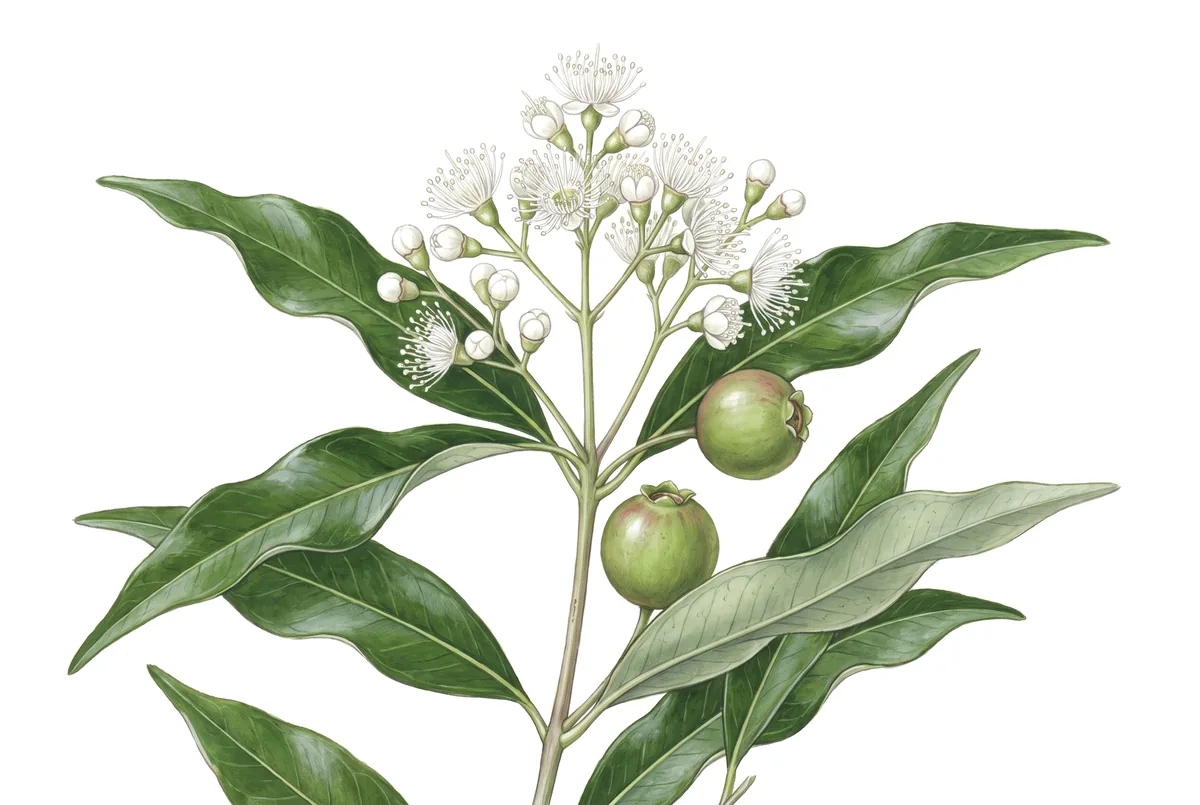
- The New South Wales flora gives flowering from late winter to mid spring: many-flowered panicles of small flowers whose white petals, 1.5 to 2 mm long, cohere and are shed together, with stamens 3 to 7 mm long. The fruit is round, 15 to 20 mm across, green with a pink or reddish tinge at maturity, and crowned by the small persistent rim of the calyx tube.
- Can weeping lilly pilly be used as a hedge?
- The HortOS hedge cost guide counts it among the seven hedge species the Australian trade grows most and calls it a tall soft screen. The nursery sheet read for the Green Avenue selection lists that selection for hedging and says it responds well to pruning; no flora read says how the species takes clipping.
- What soil does weeping lilly pilly need?
- No reference read gives the species a soil or water rating. The floras find it in riverine rainforest and gallery forest, often on stream banks; the nursery sheet for the Green Avenue selection lists that selection as tolerant of most soils and of occasional wet conditions.
- Does weeping lilly pilly get myrtle rust?
- It belongs to the family the rust infects. The Australian Government's biosecurity page says myrtle rust infects plants of the Myrtaceae, a family that includes the lilly pillies, and names no species; no reference read names this tree as a host or says how susceptible it is.
Sources
- GBIF species match API (Waterhousea floribunda, a synonym of Syzygium floribundum)
- GBIF species match API (Syzygium floribundum, the accepted name)
- Australian Plant Census taxon concepts for Syzygium floribundum and Waterhousea floribunda, read through the Atlas of Living Australia species web service (the Census accepts Syzygium floribundum F.Muell., gives Waterhousea floribunda (F.Muell.) B.Hyland as a synonym of it and remarks that the tree is treated as Waterhousea floribunda in Queensland and New South Wales)
- PlantNET, the New South Wales flora online (Royal Botanic Garden Sydney)
- Australian Tropical Rainforest Plants, online edition (CSIRO): Syzygium floribundum
- Atlas of Living Australia (Syzygium floribundum)
- Australian Government, Department of Agriculture, Fisheries and Forestry: Myrtle rust (biosecurity)
- The HortOS guides (parking-shade-tree-rules, quoting Camden Council's Tree and Landscape Species List for the 10 m by 8 m size; street-trees-and-canopy; shade-trees-for-schools-and-playgrounds; hedge-cost, for the hedge spacing its calculator uses; specifying-and-procuring-trees)
- The HortOS catalogue and guides (the listing name Waterhousea floribunda Weeping Lilly Pilly; parking-shade-tree-rules, quoting Camden Council's Tree and Landscape Species List for the 10 m by 8 m size; street-trees-and-canopy; shade-trees-for-schools-and-playgrounds; hedge-cost; tree-planting-events-sizes-spacing-and-aftercare; specifying-and-procuring-trees; judging-nursery-plant-quality)
- Speciality Trees (a Victorian wholesale tree nursery): published sheet for the Green Avenue selection, Waterhousea floribunda 'Green Avenue' (the nursery's own claims, written for that selection and not for the species)
The growers, sizes and prices above are live and change as lists arrive. Cite this page: HortOS, Weeping lilly pilly (Waterhousea floribunda), https://au.hortosapp.com/plants/waterhousea-floribunda.
Found a fact that is wrong? Tell us and it is checked against its source.