What a Hedge Costs at the Farm Gate in Australia
The plants for a hedge have a knowable wholesale price before freight, planting and margin are added. This page gives the September 2026 farm-gate medians for the seven hedge species the Australian trade grows most, at three pot sizes, with the spacing rule and worked costs for 10, 20 and 30 metre hedges.
Updated 25 September 2026. Figures from the HortOS Plant Price Index, September 2026 edition.
On this page
A hedge quote arrives as one number, and the reader cannot tell how much of it is plants. Yet the plants are the one part with a knowable wholesale price, because growers publish trade lists, and once that line is known the rest (freight, planting, soil, irrigation and margin) can be judged on its own merits.
This page gives the farm-gate medians for the seven hedge species the Australian trade grows most, at 200 mm, 300 mm and 45 L, from the HortOS Plant Price Index for September 2026, compiled from growers' published availability and trade price lists. It adds the Index calculator's spacing rule, worked examples for 10, 20 and 30 metres, the spread across states and growers from the price pages, and weed notes from Brisbane City Council and NSW WeedWise. It is not a retail price or a quote, and it excludes freight, planting, GST and margin.
Quick facts
| Item | Fact |
|---|---|
| What the number is | Median farm-gate trade price, ex GST, one price per grower, before freight, planting and margin (HortOS Plant Price Index, September 2026). |
| Spacing the Index calculator uses | 0.6 m between plants at 200 mm, 0.8 m at 300 mm, 1.0 m at 45 L. |
| Plants for 10 metres | 17 at 200 mm, 13 at 300 mm, 10 at 45 L, rounded up. |
| A 30 metre lilly pilly hedge | Lilly pilly 'Resilience' (Syzygium australe Resilience): $636 at 200 mm (50 plants), $1,596 at 300 mm (38 plants), $3,000 at 45 L (30 plants). |
| Median range across the seven species | $11.50 to $17.88 at 200 mm, $39.00 to $55.00 at 300 mm, $99.88 to $155.00 at 45 L. |
| Spread across growers, one plant, one size | 'Resilience' at 300 mm runs $35 to $50 across 33 growers, a 1.4 times spread. |
What a farm-gate price is, and what it leaves out
A farm-gate price is what a grower asks on a trade list for a plant collected from the nursery. The Index defines it as the wholesale price at the grower's location, excluding freight, planting and GST, counts one price per grower, and reports the median, the middle value across all growers listing a plant at a size, so one outlying list cannot move it.
It is a trade price. A homeowner cannot buy 38 plants at it, and most growers do not sell to the public; it tells you what the plants cost the person quoting you. On top sit, each as its own line:
- Freight. A 45 L plant takes far more truck space per metre of hedge than a 200 mm one.
- Planting labour. A morning with a spade for 200 mm plants; an excavator and stakes for 45 L rootballs.
- Soil, mulch and irrigation. Cost the same whether the plants were cheap or dear.
- GST and margin. Added on materials to cover ordering, collection and replacing plants that fail in the first season.
A landscaper uses the median as the baseline for the materials line of a quote; a homeowner uses it to see what share of a quote is plants, usually less than they expect.
Pot size, spacing and the plant count
Spacing widens with pot size because a bigger plant has the width to close the gap. The Index calculator uses 0.6 m between plants at 200 mm, 0.8 m at 300 mm and 1.0 m at 45 L, and the count is length divided by spacing, rounded up, because a hedge with a gap at one end is not finished.
For the plant count on a run, Plant Drop's guide to how many plants a hedge needs spaces by mature width rather than by the size the plant arrives at.
Per metre, the September 2026 'Resilience' medians come to $12.72 / 0.6 m = $21.20 at 200 mm, $42.00 / 0.8 m = $52.50 at 300 mm and $100.00 at 45 L: going to 300 mm multiplies the plant bill by roughly two and a half, and going to 45 L by nearly five. The extra money buys time. A 200 mm plant grows almost all its height in the ground; a 45 L plant arrives close to hedge height and only has to knit together.
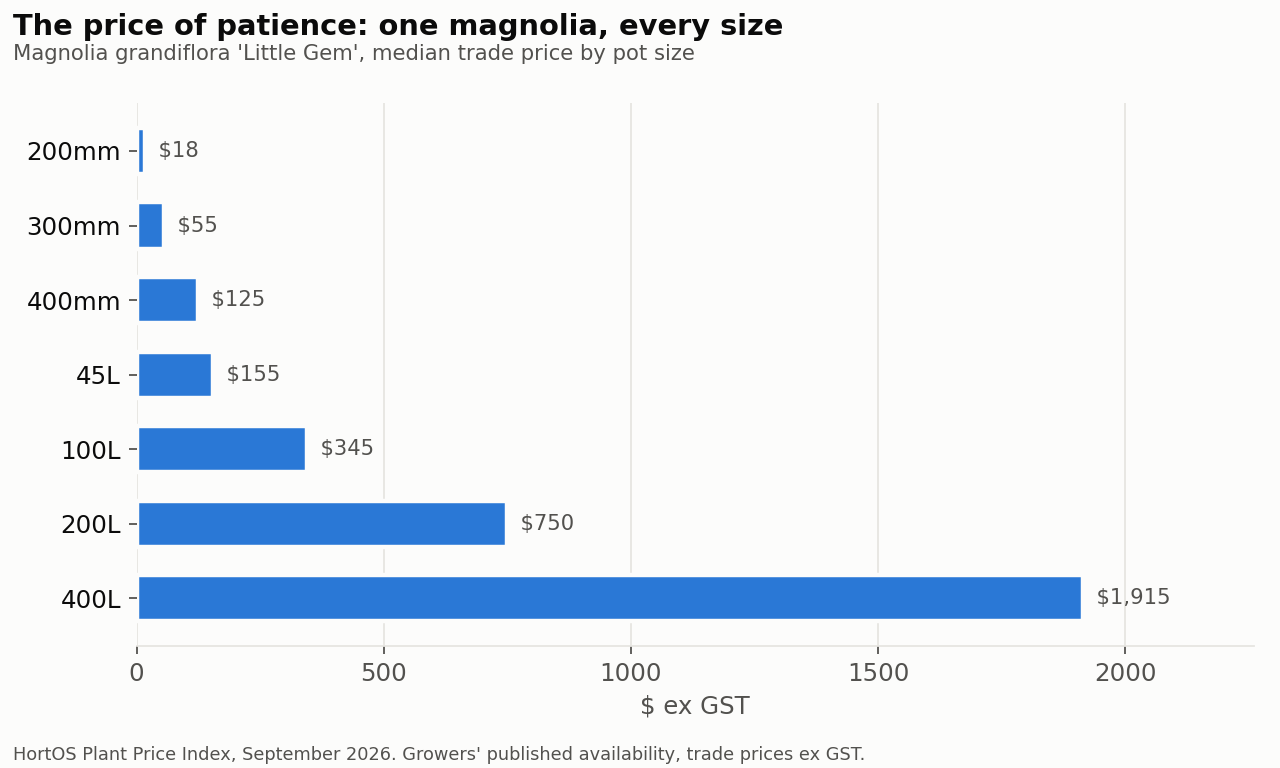
The Index chart of price climbing with pot size, the price of patience, shows the same shape market-wide: a national median of $14.00 at 200 mm, $50.00 at 300 mm and $120.00 at 45 L, with the middle half of growers at 45 L between $100.00 and $150.00. Six of the seven hedge lines sit below the national median at every size because many nurseries grow them in volume; the exception is magnolia 'Little Gem' (Magnolia grandiflora Little Gem), a slower plant.
Worked examples: 10, 20 and 30 metres
Lilly pilly 'Resilience' at the September 2026 medians of $12.72 at 200 mm, $42.00 at 300 mm and $100.00 at 45 L, ex GST:
| Hedge length | 200 mm at 0.6 m | 300 mm at 0.8 m | 45 L at 1.0 m |
|---|---|---|---|
| 10 m | 10 / 0.6 = 16.7, so 17 × $12.72 = $216.24 | 10 / 0.8 = 12.5, so 13 × $42.00 = $546.00 | 10 / 1.0 = 10, so 10 × $100.00 = $1,000.00 |
| 20 m | 20 / 0.6 = 33.3, so 34 × $12.72 = $432.48 | 20 / 0.8 = 25, so 25 × $42.00 = $1,050.00 | 20 / 1.0 = 20, so 20 × $100.00 = $2,000.00 |
| 30 m | 30 / 0.6 = 50, so 50 × $12.72 = $636.00 | 30 / 0.8 = 37.5, so 38 × $42.00 = $1,596.00 | 30 / 1.0 = 30, so 30 × $100.00 = $3,000.00 |
The 30 metre row matches the Index's own "What a 30-metre hedge costs at the farm gate" section. For another species, keep the count and swap the median: 34 murraya (Murraya paniculata) at 200 mm are 34 × $11.65 = $396.10, 25 photinia 'Red Robin' (Photinia fraserii Red Robin) at 300 mm are 25 × $39.00 = $975.00, and 20 'Little Gem' at 45 L are 20 × $155.00 = $3,100.00.
At residential scale, The Hedge Guys sell advanced lilly pilly hedging supplied and installed from South East Queensland to Sydney.
Same plant, different price: states and growers
A median hides a spread, and a hedge buys in multiples. The Index finds 'Resilience' at 300 mm priced from $35 to $50 across 33 growers, a 1.4 times spread; on 38 plants that is 38 × $35 = $1,330 against 38 × $50 = $1,900.
The weeping lilly pilly (Waterhousea floribunda Weeping Lilly Pilly) page gives a 300 mm median of $40.45 across 26 growers, and state medians of $34.00 in Queensland, $44.50 in New South Wales and $58.25 in Victoria, so 25 plants are 25 × $34.00 = $850.00, 25 × $44.50 = $1,112.50 or 25 × $58.25 = $1,456.25.
Victoria is usually dearest for a warm-climate hedge plant, but the order of the other two depends on the line: the murraya page has 200 mm medians of $10.70 in New South Wales, $12.25 in Queensland and $13.00 in Victoria (41 growers). The reasons are ordinary:
- Growing time. A lilly pilly fills a 300 mm pot faster through a Queensland winter than a Victorian one.
- Who buys. Nurseries supplying landscape contracts price for volume, and where many grow a line prices converge; murraya and sweet viburnum (Viburnum odoratissimum), each priced by 41 growers at 200 mm, are the two cheapest at that size.
- Grade. One grower's 300 mm may be a taller, older plant than another's; the higher list is not always the worse deal.
The seven hedge species and their September 2026 medians
Median farm-gate trade price ex GST at each size, growers in brackets, from the HortOS Plant Price Index, September 2026; 'Allyn Magic' was not priced at 45 L.
| Hedge plant | 200 mm | 300 mm | 45 L | Notes |
|---|---|---|---|---|
| Lilly pilly 'Resilience' (Syzygium australe) | $12.72 (22) | $42.00 (33) | $100.00 (13) | Default clipped screen in NSW and Queensland. |
| Weeping lilly pilly (Waterhousea floribunda) | $12.00 (18) | $40.45 (26) | $100.00 (15) | Tall soft screen; a tree unclipped. |
| Murraya (Murraya paniculata) | $11.65 (41) | $40.00 (40) | $109.75 (7) | Scented formal hedge; see weed note. |
| Sweet viburnum (Viburnum odoratissimum) | $11.50 (41) | $42.95 (36) | $99.88 (4) | Fast and tolerant; cheapest at 200 mm and 45 L. |
| Photinia 'Red Robin' (Photinia fraserii) | $11.88 (26) | $39.00 (21) | $112.50 (6) | Red new growth; cheapest at 300 mm. |
| Magnolia 'Little Gem' (Magnolia grandiflora) | $17.88 (16) | $55.00 (24) | $155.00 (12) | Tall flowering screen; dearest at every size. |
| Lilly pilly 'Allyn Magic' (Acmena smithii minor) | $11.88 (18) | $44.38 (4) | Not priced | Compact form for low hedges. |
Down the 200 mm column, six of the seven sit within $1.22 of each other, from $11.50 to $12.72, with only 'Little Gem' at $17.88 apart. Choosing between the common lines on price is a small decision; choosing the pot size is the big one. Treat the 45 L medians for sweet viburnum (4 growers), photinia (6) and murraya (7) as indicative, since one list update can move them.
What to watch for
- Reading the median as a retail price. A trade buyer pays it at the nursery, ex GST; a garden centre adds freight and margin and sells well above it.
- Counting at the wrong spacing. Forty-five litre plants at 0.6 m means two thirds more plants than the calculator would buy; 200 mm plants at 1.0 m take years to close. Ask which spacing the count assumes.
- Murraya and Indian hawthorn in the wrong place. NSW WeedWise says Murraya paniculata is regarded as an environmental weed in parts of New South Wales, its seed spread by birds into bushland, and Brisbane City Council lists it as Council Pest Vegetation under its Natural Assets Local Law. Indian hawthorn (Rhaphiolepis indica) is regarded by WeedWise as an environmental weed in NSW and Queensland and is also Council Pest Vegetation in Brisbane. Both remain on trade lists, but near bushland or anywhere in Brisbane a lilly pilly or a viburnum is the safer choice, and WeedWise reminds anyone dealing with a plant in NSW of the general biosecurity duty.
- Ignoring what is under the ground. A boundary hedge often sits over a sewer, stormwater line or cable. Before You Dig Australia provides free plans of underground infrastructure at a site; read them before you trench.
Getting it right
- Choose the pot size first. Decide whether the money buys time (45 L) or the plants grow into it (200 mm); the count and the bill follow.
- Check the live page. The price pages carry the low, high and state medians and move as growers update; the price check tests one quoted plant price against the current range.
- Ask for the plant line on its own. Species, pot size, count and unit price, with freight, planting, soil, mulch and irrigation each on their own line.
- Price the next state on a long run. State medians can differ by enough to be worth pricing freight across the border; the grower directory lists nurseries by state with their published availability.
- Prepare the ground once. Dig the full trench, improve the soil along the run, lay the dripline before the mulch and water through the first summer; none of it is in the farm-gate number and all of it decides whether the plants live.
A word of caution
These figures are medians of published trade lists compiled on 12 September 2026; the live price pages move as growers update, so counts may differ slightly from what you see today. They are a baseline for judging the plant line in a quote, not a price anyone is obliged to sell at, and say nothing about the height or health of the plant behind a list. For an installed cost, ask two or three landscapers to quote the same species, size and spacing; for whether a species suits your site, ask the council's weed officer or a nursery that grows it.
Sources
- NSW WeedWise: Murraya (Murraya paniculata): environmental weed status, spread, biosecurity duty.
- Brisbane City Council: Mock orange: Council Pest Vegetation listing and description.
- NSW WeedWise: Indian hawthorn (Rhaphiolepis indica): environmental weed status in NSW and Queensland.
- Brisbane City Council: Indian hawthorn: Council Pest Vegetation listing and description.
- Before You Dig Australia: free plans of underground services.
- Gramina, Garden Costs Explained: What Is Most Expensive in a Garden?: where planting sits in a whole garden budget, from pools down to lawn.
More guides
What Australian studies found about street trees and house prices
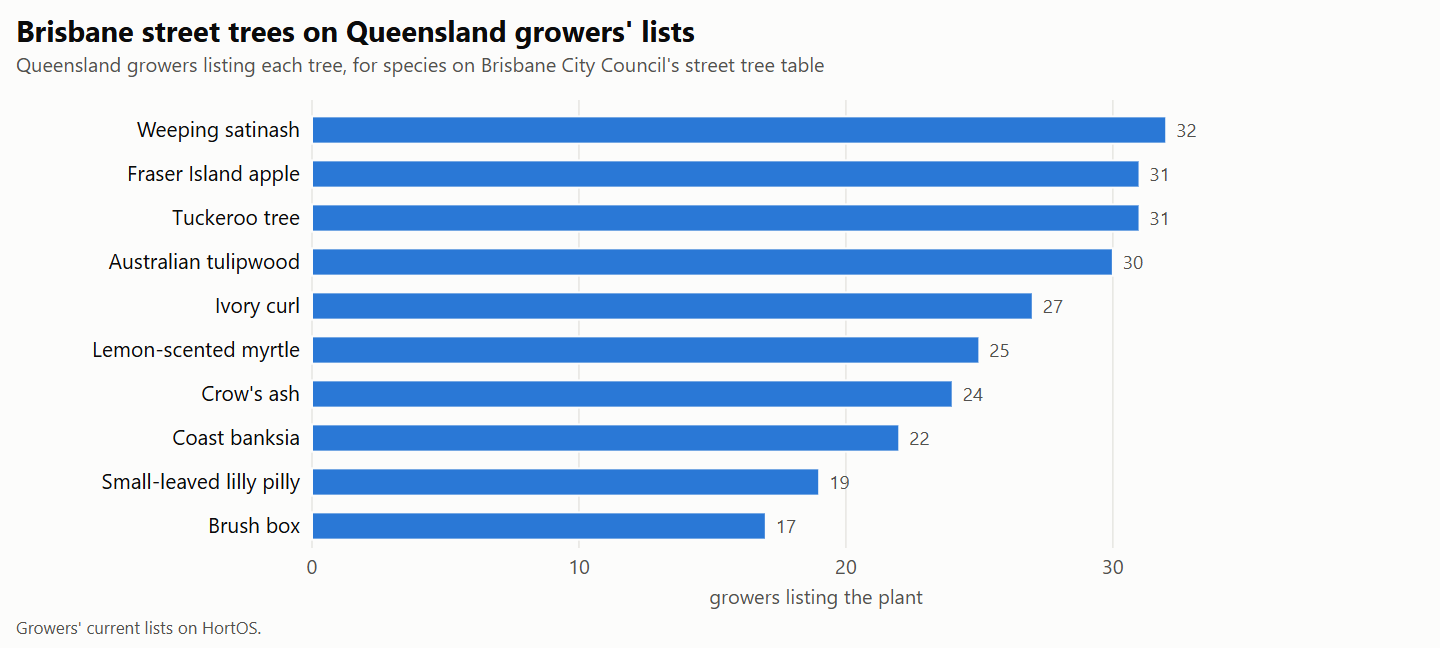
A study by study account of what Australian sale price research found for street trees and canopy near a house, in Perth, Brisbane and Sydney, with each document's method. It reports what two councils say on who plants the verge, and gives Queensland grower counts and trade medians for species on Brisbane City Council's street tree table.
The Most Grown Native Plants in Australia, by State
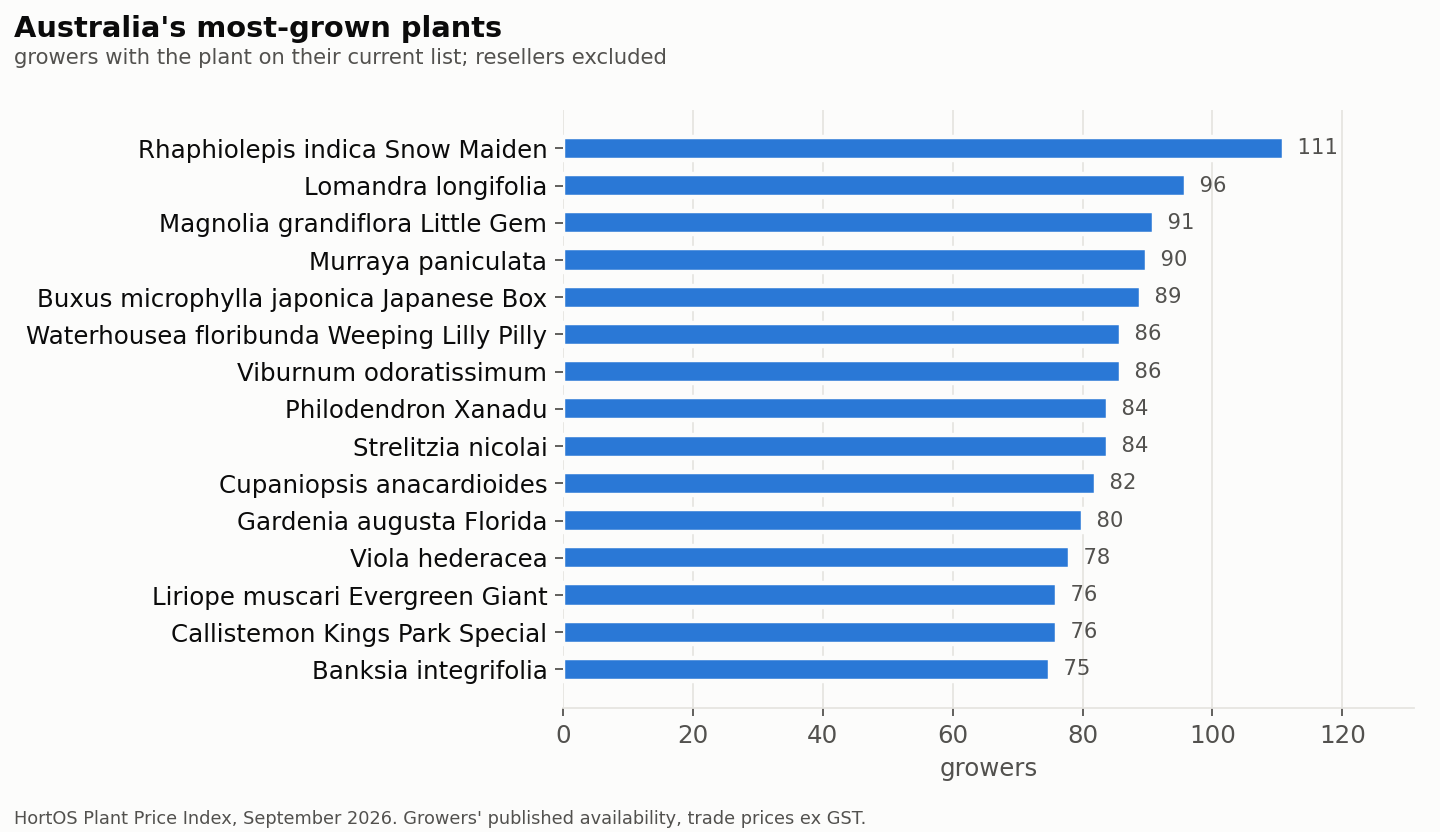
A data page, not an essay: the Australian native plants held by the most wholesale growers, counted grower by grower and state by state from growers' current lists on HortOS, with the median trade price at the size most growers price. Two paragraphs on what the tables show and what they do not, then the tables, refreshed each edition.
Trees and shrubs for planting near powerlines, and who lists them
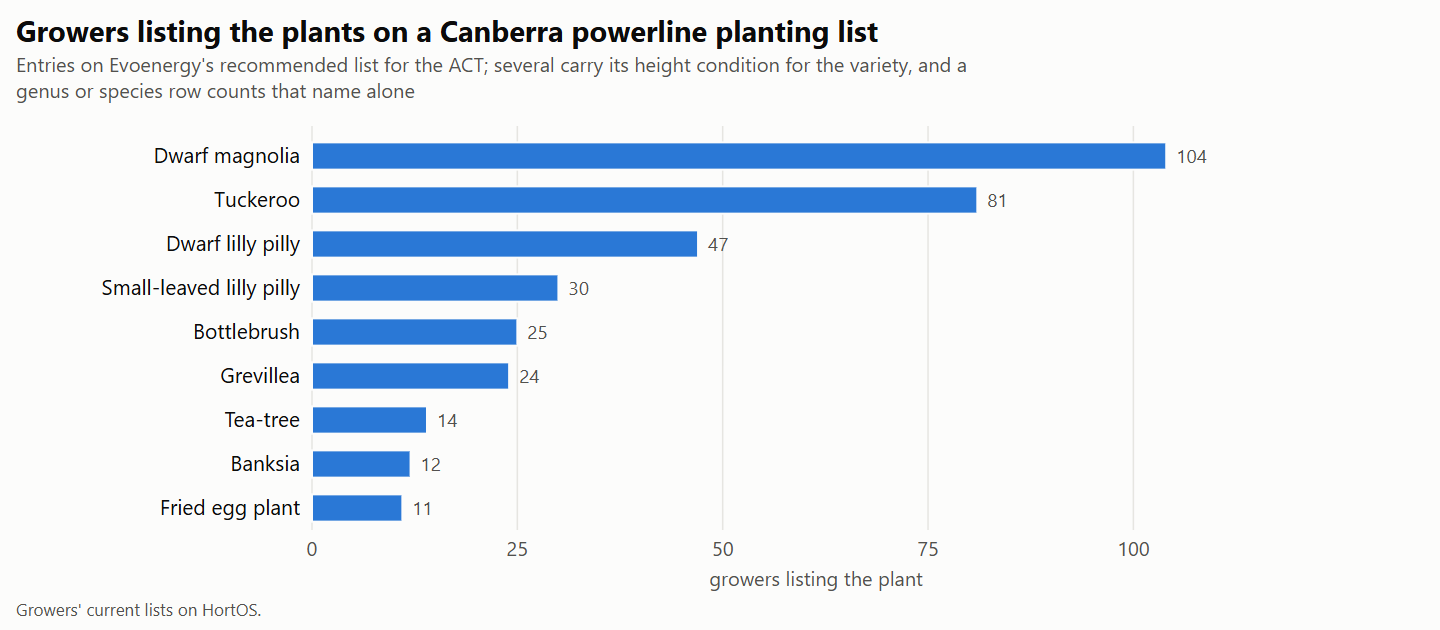
What Australian network operators, a regulator and a state department publish about trees near overhead powerlines, set side by side with each body's state and date. Two plant tables then count the growers listing the plants named on Evoenergy's list for the ACT and in a Queensland council's table, with a trade median for the plants enough growers price.