Trees and shrubs for planting near powerlines, and who lists them
What Australian network operators, a regulator and a state department publish about trees near overhead powerlines, set side by side with each body's state and date. Two plant tables then count the growers listing the plants named on Evoenergy's list for the ACT and in a Queensland council's table, with a trade median for the plants enough growers price.
Updated 21 October 2026. Figures are what the live au.hortosapp.com price and plant pages printed.
On this page
A landscaper planting beneath the wires asks one thing: what can grow there without being cut back every few years. Near a powerline the question is how tall the plant will be at maturity, and each network operator or regulator answers it for its own network or state only. Evoenergy's list for the ACT asks, beside several of its plants, for varieties that stay at 6 metres or under, while TasNetworks' guide for Tasmania is 3.5 metres (both read in October 2026).
This page reports what network operators, a regulator, a state department and one Queensland council publish about trees near overhead lines. It then counts the growers listing the plants two of those documents name, using HortOS, a free directory of Australian wholesale plant growers with their published availability and trade prices. It is not advice on pruning or on working near a line: the network operator for the reader's own address is the one to ask what may be planted there.
Quick facts
| The height on the ACT list | Evoenergy (network operator, ACT; page read October 2026) notes beside several plants on its recommended list that the variety chosen must stay at 6 metres or under. |
|---|---|
| Under a line on Endeavour Energy's network | Endeavour Energy's Tree Management Plan (New South Wales, January 2023) says only trees that stay under 3 metres will reduce later pruning beneath overhead powerlines. |
| The guide in Tasmania | TasNetworks (network operator, Tasmania; page read October 2026) says, as a guide, that a plant able to pass 3.5 metres does not belong under powerlines. |
| The exemption in South Australia | The Department for Energy and Mining's page (South Australia, updated November 2025) says vegetation that matures at 2 metres or under is exempt from the planting restrictions it sets out. |
| The minimum distances in the ACT | Evoenergy's page (ACT, read October 2026) puts the minimum for most vegetation at 1 metre from a service line and 1.5 metres from a powerline. |
| Growers listing one plant from the ACT list | Tuckeroo (Cupaniopsis anacardioides), which Evoenergy's list gives as 5 to 8 metres with its 6 metre condition (ACT, read October 2026), was listed by 81 growers on HortOS, in any size. |
Each network's own figure
None of the bodies read for this page gives a national rule: each publishes guidance for its own network or state. The table below sets 12 of their statements side by side, from one or two bodies in each state or territory it covers. Each row is one statement in this page's words. The table does not take in every network operator, and a rule holds only for the area of the body that publishes it.
| State or territory | Body and date | What it says about trees near overhead lines |
|---|---|---|
| Australian Capital Territory | Evoenergy (network operator), page read October 2026 | Notes beside several of its recommended plants ask for varieties that mature at 6 metres or less. |
| Australian Capital Territory | Evoenergy (network operator), page read October 2026 | Suggests a gap of 2.5 metres between vegetation and powerlines, enough for three years of regrowth. |
| New South Wales | Endeavour Energy (network operator), Tree Management Plan, January 2023 | Says only trees able to reach under 3 metres will lessen later pruning beneath a line. |
| New South Wales | Endeavour Energy (network operator), Tree Management Plan, January 2023 | Sets a taller tree as far from the line as it will be tall: 10 metres away for a 10 metre tree. |
| Northern Territory | Power and Water Corporation (network operator), page read October 2026 | Prefers native species that mature at 3 metres or less. |
| Northern Territory | Power and Water Corporation (network operator), page read October 2026 | Puts a taller tree its own mature height from the line, and palms 5 metres away. |
| South Australia | Department for Energy and Mining, page updated November 2025 | Exempts vegetation that matures at 2 metres or under from the planting limits. |
| Tasmania | TasNetworks (network operator), page read October 2026 | As a guide, nothing that grows above 3.5 metres beneath a line. |
| Tasmania | TasNetworks (network operator), page read October 2026 | Advises against any tree or shrub able to reach within 3 metres of a line. |
| Victoria | Energy Safe Victoria (regulator), page reviewed January 2026 | Low-growing species only near a line; says to ask the local distribution company for its list of suitable species. |
| Victoria | United Energy (network operator), page read October 2026 | Far enough away that a falling tree would miss the line, with 3 metres between the line and the tree at its widest. |
| Western Australia (regional) | Horizon Power (network operator), page read October 2026 | Works to a general rule that trees stay 5 metres or more from powerlines, with the minimum set region by region. |
Read down the last column and three kinds of answer appear. One limits the plant under or beside the line, usually by its mature height. One is a setback for a taller tree. The third is a distance kept clear, which is a different thing from a planting height.
The clearances differ too. Evoenergy's page (ACT, read October 2026) puts the minimum for most vegetation at 1 metre from a service line and 1.5 metres from a powerline, rising to 2 metres for higher voltage lines and in bushfire prone areas. Ausgrid (New South Wales, read October 2026) gives trimming clearances of 0.5 to 6 metres, depending on the species, the wire, the location and the bushfire risk. In residential areas Ausgrid's figure around bare low voltage powerlines is generally 1 metre (New South Wales, 2026). Horizon Power's general rule of 5 metres (regional Western Australia, read October 2026) is on its tree trimming page: it concerns distance from a line, not plant choice, and its local office gives the minimum for each region.
South Australia works differently again: its Department for Energy and Mining (page updated November 2025) ties how close a tree may be planted to its mature height and to the voltage of the line. The Department measures each of those planting distances from the line's centre (South Australia, November 2025). The Department's table of prescribed distances gives 6.5 metres for a 66 kV line and 6.0 metres for all other voltages, beside rows for 132 kV and 330 kV lines (South Australia, November 2025).
Who keeps the clearance once the plant is in
The height matters because someone has to keep the clearance for the life of the plant. In the ACT, Evoenergy's page (read October 2026) says the owner or occupier is responsible for keeping a property's trees clear of powerlines. The same Evoenergy page (ACT, 2026) says penalties may apply to an owner or occupier who fails to trim, or who tries to trim vegetation that is already too close.
South Australia's Department for Energy and Mining (page updated November 2025) says whoever lives at a private property, tenants included, must keep vegetation they planted out of the clearance zones around their private supply lines. Where that is not done, the Department's page (South Australia, November 2025) says the network operator may do the clearing and the occupier pays for the work. The Department's page names the Electricity (Principles of Vegetation Clearance) Regulations 2021 as its legislation (South Australia, November 2025).
Endeavour Energy's Tree Management Plan (New South Wales, January 2023) says the Electricity Supply Act 1995 enables it to prune at the property owner's cost where an owner or occupier has not kept the clearances around new plantings. Endeavour Energy's plan calls planting directly under overhead powerlines not advisable, and says that where it is done only trees that stay under 3 metres will reduce later pruning (New South Wales, 2023). Street planting by councils is the subject of the guide to street trees and canopy, which looks at advanced trees in the larger container sizes.
The plants on Canberra's network list
Evoenergy's page goes further than a height and names plants. Evoenergy asks first how tall the plant is expected to grow, which it says a planter should know before planting near powerlines (ACT, read October 2026). It sets out recommended plants, each with a height in metres, and a separate set it calls unsuitable, also by height. Evoenergy says the examples apply to its own infrastructure only, and that planters should always check the current listing of declared plant pests kept by Transport Canberra and City Services before choosing (ACT, read October 2026).
The list works by variety, not by name alone. Evoenergy (ACT, read October 2026) recommends the dwarf magnolia 'Little Gem' and a dwarf lilly pilly at 3 to 4 metres each, while its unsuitable set enters Acmena species as a group at 7 metres and over. Evoenergy accepts grevilleas where the variety stays at 6 metres or under, but says Grevillea robusta is not to be used and enters that tree, silky oak, as unsuitable at 14 metres and over (ACT, 2026). Evoenergy names crepe myrtle, bottlebrush and banksia as genera, and tuckeroo as a species, each with the same 6 metre condition (ACT, 2026).
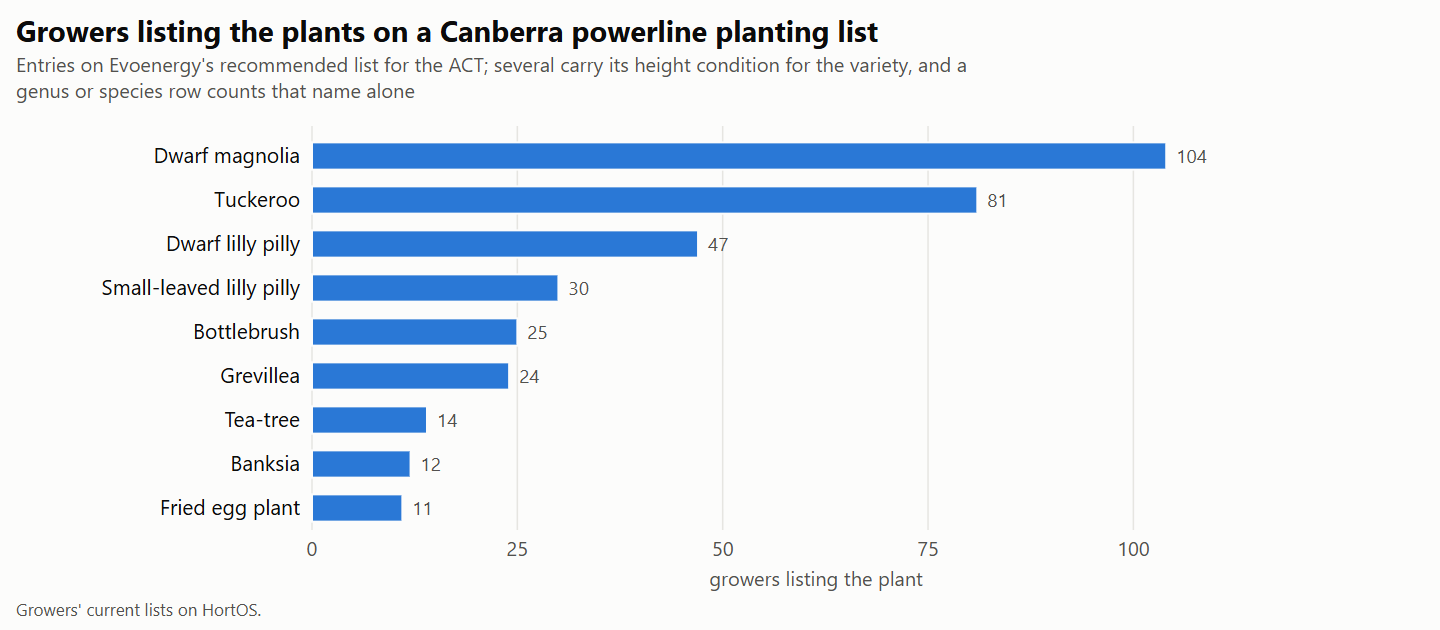
The table below takes the entries of Evoenergy's recommended list that match a plant page on HortOS for the same species, genus or named variety: 13 rows, with the other 5 entries not shown. Rows run from the plant most growers list to the least. Grower counts are the growers listing each plant on HortOS, in any size. A count here is growers listing the plant, not how many plants exist or how well it suits a site.
| Plant | Growers listing it | States with most growers |
|---|---|---|
| Dwarf magnolia (Magnolia grandiflora 'Little Gem') | 104 | Victoria 38, New South Wales 37, Queensland 18 |
| Tuckeroo (Cupaniopsis anacardioides) | 81 | New South Wales 36, Queensland 31, South Australia 6 |
| Dwarf lilly pilly (Acmena smithii 'Minor') | 47 | New South Wales 19, Victoria 15, Queensland 10 |
| Small-leaved lilly pilly (Syzygium luehmannii) | 30 | Queensland 19, New South Wales 10, Victoria 1 |
| Bottlebrush (Callistemon species) | 25 | Victoria 12, Queensland 8, New South Wales 3 |
| Grevillea (Grevillea species) | 24 | New South Wales 7, Queensland 7, Victoria 5 |
| Tea-tree (Leptospermum species) | 14 | Queensland 5, Victoria 4, New South Wales 4 |
| Banksia (Banksia species) | 12 | Victoria 4, New South Wales 4, Queensland 2 |
| Fried egg plant (Gordonia axillaris) | 11 | New South Wales 5, Queensland 4, Victoria 2 |
| Sasanqua camellia (Camellia sasanqua) | 10 | New South Wales 8, Victoria 1, Queensland 1 |
| Japanese camellia (Camellia japonica) | 9 | Victoria 4, New South Wales 4, Western Australia 1 |
| Crepe myrtle (Lagerstroemia species) | 9 | Queensland 3, South Australia 2, Western Australia 2 |
| Dwarf apple (Angophora hispida) | 2 | New South Wales 2 |
The last column names the states with the most growers listing each plant, three at most, and stops where states tie for the next place.
The bottlebrush, grevillea, tea-tree, banksia and crepe myrtle rows are whole genera. Each counts the growers listing a plant under the genus name alone, not the varieties within it, and not the varieties that would stay within an operator's limit. The two camellia rows are counted the same way: each is the growers listing the species name alone, not its named varieties. The limit is the operator's to set; the grower is the one to ask for a variety's name and its mature height.
Neither plant table carries a price column: a median is shown only where three or more growers price the same pot size, and in each table more than a third of the rows have no such size. The text gives a median only for a species or named variety whose most priced pot size is priced by five or more growers. Prices are medians across growers' current trade lists on HortOS: one price per grower, ex GST, freight not included, with the number of growers pricing each size in brackets. Dwarf magnolia has a median of $60 (27) at the 300 mm size. Tuckeroo has a median of $46.50 (22) at the 300 mm size. Dwarf lilly pilly has a median of $50 (13) at the 300 mm size. Small-leaved lilly pilly has a median of $2.05 (10) at the Tube size. Each is a national median, not the price in any one state or territory. Anyone can see the prices on HortOS, and only the trade can order.
A Queensland council's powerline planting table
The second set of plants comes from a council, not a network operator. South Burnett Regional Council (Queensland; planting guidelines, undated, read October 2026) prints a table it calls powerline friendly plantings for its region, recording each plant's growth rate, longevity and height by spread. South Burnett's guidelines also say bamboo, some vigorous climbers, palms and large trees are not appropriate near powerlines and other essential services, because of the risk they pose to infrastructure, particularly in storms (Queensland, read October 2026).
The table below shows 9 of the plants in the council's table, each matched to a HortOS page for the same species or named variety; its other 12 entries are not shown. Counts are on the same basis and date as the table above, and 2 of the rows rest on a single grower each.
| Plant | Growers listing it | States with most growers |
|---|---|---|
| Westringia 'Wynyabbie Gem' | 68 | Victoria 36, Queensland 15, New South Wales 8 |
| Wild iris (Dietes grandiflora) | 61 | Victoria 21, Queensland 21, New South Wales 11 |
| Agonis flexuosa 'Burgundy' | 37 | Victoria 29, New South Wales 3 |
| Forest hop bush (Dodonaea triquetra) | 23 | New South Wales 13, Queensland 10 |
| Sweet-scented wattle (Acacia suaveolens) | 19 | Queensland 7, New South Wales 6, Victoria 5 |
| Scarlet fuchsia (Graptophyllum excelsum) | 3 | Queensland 3 |
| Flat-leaved grass tree (Xanthorrhoea latifolia) | 2 | Queensland 2 |
| Geraldton wax (Chamelaucium uncinatum 'Purple Pride') | 1 | Victoria 1 |
| Peach-flowered tea tree (Leptospermum squarrosum) | 1 | New South Wales 1 |
The last column names the states with the most growers listing each plant, three at most, and stops where states tie for the next place.
Two bodies can treat one group of plants differently, each for its own area. Evoenergy's unsuitable set (ACT, read October 2026) enters wattles as a group at 6 metres and over, while the Queensland council's table (read October 2026) includes one wattle species, sweet-scented wattle.
On the same price basis and date, the rows of this table that meet the test for a median are these. Westringia 'Wynyabbie Gem' has a median of $6.55 (26) at the 140 mm size, the smaller of its two most priced sizes. Wild iris has a median of $6.45 (34) at the 140 mm size. Agonis flexuosa 'Burgundy' has a median of $15 (13) at the 200 mm size, the smaller of its two most priced sizes. Forest hop bush has a median of $1.80 (14) at the Tube size. Sweet-scented wattle has a median of $2.50 (11) at the Tube size.
What the grower counts leave out
The directory records what growers list. It shows no mature height for any line, so it cannot say whether a listed plant stays under an operator's figure, or whether a line under a genus or species name is the variety an operator means. A count takes in every pot size and says nothing about delivery to a given address. Every count is national, while Evoenergy's list is written for the ACT and the council's table for one Queensland region. Listings on HortOS are thin in Western Australia, South Australia, Tasmania and the Northern Territory. No row of the first plant table has the ACT among its leading states.
Not every body recommends plants. Endeavour Energy's plan (New South Wales, January 2023) recommends no species to plant: it says the varied conditions across its network make species very hard to recommend for every situation. Endeavour Energy's plan asks for a low mature height among other qualities, and strongly recommends asking the local nursery or council (New South Wales, 2023).
What the directory lacks, a grower can be asked for: the full name of the variety, the mature height and width it expects, and the pot sizes on its current list. The guides to reading a wholesale availability list and buying from a wholesale grower explain a grower's list and who a grower sells to.
What to watch for
- Carrying one network's figure to another. Evoenergy's 6 metres is for the ACT (read October 2026). TasNetworks' guide for Tasmania is 3.5 metres (read October 2026), and Endeavour Energy's plan for its own network in New South Wales says under 3 metres (January 2023).
- Reading a genus name as a plant that fits. Evoenergy (ACT, read October 2026) names crepe myrtle and bottlebrush only as genera and asks for a variety that stays at 6 metres or under. A list line that gives no variety does not answer that.
- Measuring height and forgetting width and fall. United Energy (Victoria, read October 2026) asks that a tree stand far enough from the lines to miss them if it fell, and that at its widest it still sits 3 metres from the powerline.
- Treating a palm as a shrub. Power and Water Corporation (Northern Territory, read October 2026) puts palms 5 metres from the lines in every case.
- Working from a withdrawn list. SA Power Networks (South Australia, page read October 2026) says the species list it drew up in 2018 was revoked in 2025 and is not to be used.
Getting it right
- Find out which network operator owns the line at the address and read its planting page. The operator is the one to ask what may be planted near its lines. Energy Safe Victoria (reviewed January 2026) tells Victorians to ask their electricity distribution company for its list of suitable species.
- Ask the operator which line it is: a service line to the building or a powerline in the street, and at what voltage.
- Ask the grower, in writing, for the full variety name and the mature height and width it expects.
- Shortlist growers from the plant pages linked in the tables and from the directory, state by state: New South Wales, Victoria, Queensland, South Australia, Tasmania and Western Australia. Ask each grower whether it delivers to the site.
- For a nature strip, the council is the one to ask. Endeavour Energy's plan (New South Wales, January 2023) says council approval comes before anything is planted on the nature strip.
A word of caution
Every height and distance on this page is one body's published figure for its own network or state, on the date given beside it, and none is a national rule. This page reports what Evoenergy, Endeavour Energy, TasNetworks and the other bodies in its Sources publish, and does not set out the Acts and Regulations they name. The network operator for the address, or the regulator its page names, is the one to ask what may be planted near its lines. Grower counts and medians are what HortOS showed on one day, and nothing here is guidance on pruning or working near a line.
Sources
- Evoenergy, Suitable plants to grow near powerlines: recommended and unsuitable plants, heights.
- Evoenergy, Trees and powerlines: minimum distances, who is responsible.
- Government of South Australia (Department for Energy and Mining), Safe clearances distances between vegetation and powerlines: planting limits, clearance zones, responsibility.
- SA Power Networks, Responsibilities around tree trimming and planting: its planting list withdrawn in 2025.
- TasNetworks, Trees near powerlines: planting heights and clearance zone.
- Endeavour Energy, Tree Management Plan (January 2023): planting guidelines and pruning costs.
- Energy Safe Victoria, Managing trees near powerlines: the regulator's planting tips.
- United Energy, Vegetation management: planting tips for private gardens.
- Power and Water Corporation, Safety around trees and powerlines: preferred heights, distances and palms.
- Horizon Power, Tree trimming: its general clearance rule.
- Ausgrid, How we trim trees: trimming clearances by situation.
- South Burnett Regional Council, Planting Guidelines: the council's powerline planting table.
More guides

Street Trees and Canopy: What Advanced Stock Costs and Who Holds It
The advanced-tree story from the HortOS Plant Price Index as a standing page: the trees the trade grows for streets and parks, the farm-gate median at 45, 100 and 200 litres, how many growers in each state hold advanced stock, why lead times run to years, and what a council pays for a street tree against a giveaway.
Reading a Wholesale Availability List and Pricing a Quote
For landscapers, designers, estimators and students: what each column of a wholesale availability list means, how much the same plant at the same size varies between growers and states, how the low, median and high on the price pages are built, and how to carry the plant line of a quote from the list to the client.
Buying From a Wholesale Grower When You Are Not in the Trade
Landcare groups, schools, friends groups and landholders can buy from wholesale growers when they order like the trade: in quantity, ahead of the season, on the grower's terms. This page explains who sells to whom, what an ABN and GST change, minimum orders and pooling, tubestock against pots, provenance, lead times, freight and state borders.