Reading a Wholesale Availability List and Pricing a Quote
For landscapers, designers, estimators and students: what each column of a wholesale availability list means, how much the same plant at the same size varies between growers and states, how the low, median and high on the price pages are built, and how to carry the plant line of a quote from the list to the client.
Updated 25 September 2026. Figures from the HortOS Plant Price Index, September 2026 edition, and the live price pages' own method.
On this page
A wholesale availability list is the most useful document in landscaping and the least explained. It is a spreadsheet of a few hundred lines, each a plant, a size, a count and a price ex GST, published by a grower for the trade and refreshed as stock sells through, and every plant line on every quote a landscaper, designer or estimator writes is priced from one. The idea that matters most is that a single list is one grower's price on one day, and the only way to know whether it is a good price is to set it beside the other growers' lists for the same plant at the same size.
This page explains what each column of a grower's list means, why the same plant at the same size varies from grower to grower and state to state, how the low, median and high on the HortOS price pages are built from those lists, how many growers to price a line against, and how to carry the plant line of a quote from the list to the client. It draws on the HortOS Plant Price Index, September 2026, on the specification worksections NATSPEC and AUS-SPEC publish for planting and plant procurement, and on the Australian Taxation Office on GST. It is written for the landscaper, the designer, the estimator and the student, and it summarises rather than replaces the specifier's documents.
Quick facts
| The columns | Plant name, size, quantity, price ex GST, a note, and the date the list was updated. POA means price on application. A size is the container, not the plant. |
|---|---|
| Ex GST | Every trade list price and every HortOS figure is ex GST. Add 10 per cent before comparing with a quote that includes it; a business must register for GST at $75,000 of turnover (Australian Taxation Office). |
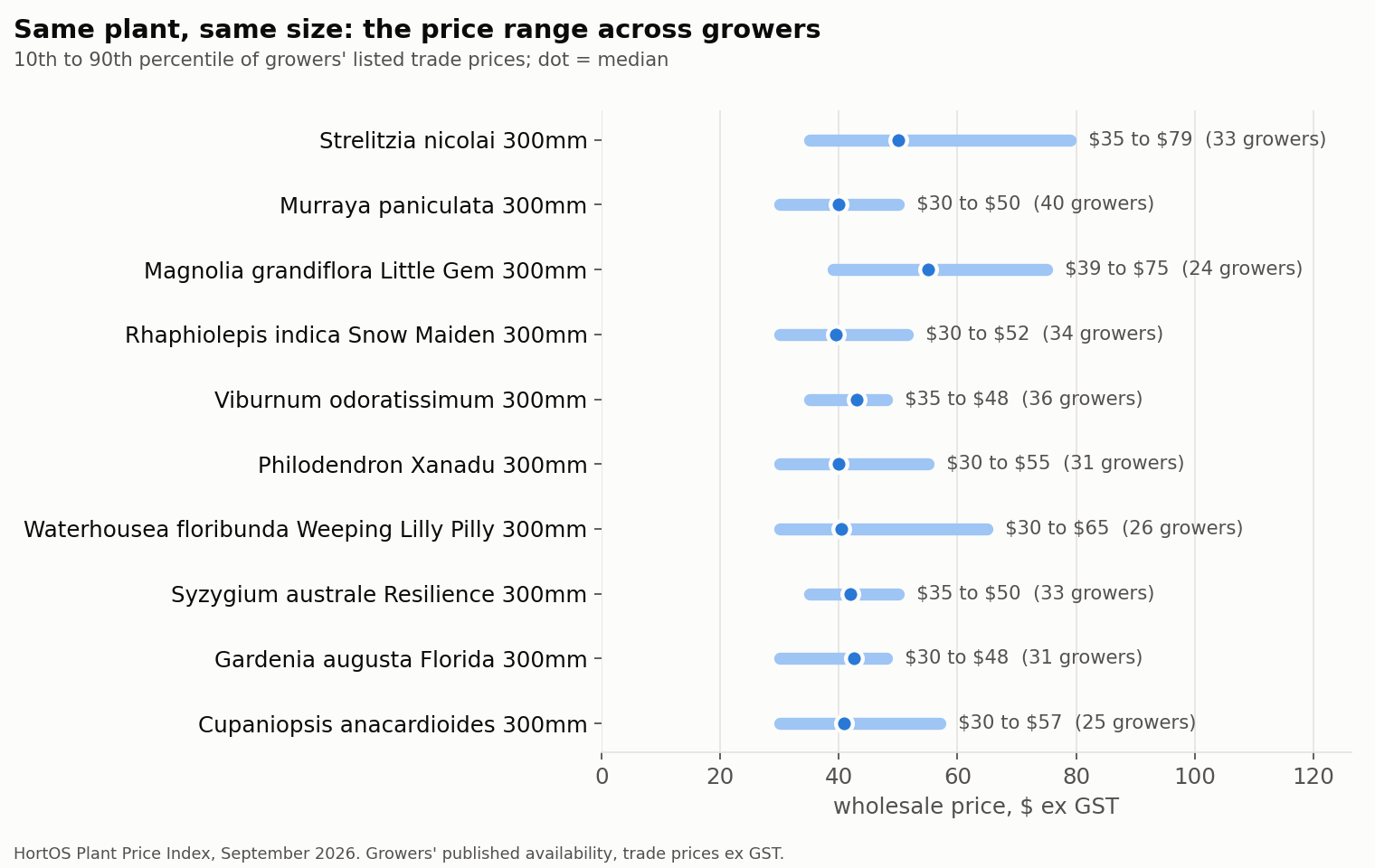
| How much prices vary | At 300 mm the September 2026 Index found a spread from the 10th to the 90th percentile of $35 to $79 for a giant white bird of paradise across 33 growers and $30 to $65 for weeping lilly pilly across 26, while sweet viburnum ran $35 to $48 across 36. |
| The state effect | New South Wales ran 22 per cent above Victoria at 140 mm across 107 matched lines and 13 per cent below it at 300 mm across 20 (September 2026 Index). The premium flips with pot size. |
| How the median is built | One price per grower, the lowest; trade lists only; a median once three growers price a size; a range from the 10th to the 90th percentile once five do; a state median once three growers in that state price it. |
| The rule of three | Price a line against at least three growers in your state at the size specified. Below three the median does not exist and a quote rests on one list. |
What each column means
| Column | What it means | What to check |
|---|---|---|
| Plant | Botanical name, usually with the cultivar; sometimes a common name or a breeder's code. | Whether the schedule names the species or a selection; a cultivar is not a substitute for its species and the reverse. |
| Size | The container: tube, 140 mm, 200 mm, 300 mm, 400 mm, then litres from 25 L up, then ex-ground. The pot sizes guide gives the ladder. | Height and potting date, which the size does not say; AS 2303 assessment for trees. |
| Quantity | What the grower holds today, or a blank where it does not publish counts. | Whether the count covers the order, and whether a line says a minimum quantity applies or is ordered in set multiples. |
| Price | Ex GST, per plant, at the farm gate. POA means the grower prices the line by the job, usually advanced stock and large quantities. | Freight, which is never in it, and the date, because a price from a list months old is a guide, not an offer. |
| Note | The grower's own words: a minimum, a multiple, a state it cannot send to, a height, a form. | Read it. Compiled from growers' current lists on HortOS in September 2026, about one trade line in thirteen carries a minimum quantity note and about one in fifty is ordered in set multiples. |
| Updated | When the grower last sent the list. | A list updated this week is an offer; one months old is a guide to what that grower grows. |
Why the same plant costs different amounts
Two growers price the same plant at the same size differently because their costs, their stock ages and their customers differ, and the difference is larger than most estimators assume. The HortOS Plant Price Index for September 2026 measured it for the ten most-priced lines at 300 mm as the spread from the 10th to the 90th percentile across growers, one price per grower. Giant white bird of paradise (Strelitzia nicolai) ran from $35 to $79 across 33 growers, a ratio of 2.26; weeping lilly pilly (Waterhousea floribunda) from $30 to $65 across 26; Little Gem magnolia (Magnolia grandiflora Little Gem) from $39 to $75 across 24; tuckeroo (Cupaniopsis anacardioides) from $30 to $57 across 25. At the tight end, sweet viburnum (Viburnum odoratissimum) ran $35 to $48 across 36 growers and orange jessamine (Murraya paniculata) $30 to $50 across 40. A quote priced from the dearest list on the first plant and the cheapest on the second would be wrong by half on both.
The state matters too, and not in the direction most people expect. The Index compared growers state against state on the same plant and size, line by line, and found New South Wales 22 per cent dearer than Victoria at 140 mm across 107 matched lines, with New South Wales dearer on 102 of them, but 13 per cent cheaper at 300 mm across 20 lines; Queensland was 18 per cent dearer than Victoria at 140 mm and 27 per cent cheaper at 300 mm. The Index's reference table shows it plant by plant: orange jessamine at 300 mm had a median of $37.25 in Queensland, $40.00 in New South Wales and $50.00 in Victoria across 38 growers, and giant white bird of paradise at 300 mm $39.98, $50.00 and $66.00. Price the line in the state the job is in, at the size the schedule says.
How the low, median and high are built
Every HortOS price page prints, for each size with enough growers, the median trade price, a low and a high, and a median for each state, and it prints how they were made. One price per grower: a grower listing the same line twice counts once, at the lowest. Trade lists only: prices taken from public websites, which may be retail, and lines from resellers never enter a statistic. A median is shown once three growers price a size; the low and high are the 10th and 90th percentile once five growers price it and the full range below that; a state median appears once three growers in that state price the size. POA lines are counted as growers holding the plant but never priced. Freight is not included. The Index applies the same rules to a whole month of lists and adds a plausibility check that removes the occasional data-entry slip.
Those rules are why a median is a safer reference than any single list: no one grower can move it, and a grower's outlier price, high or low, sits in the range where an estimator can see it rather than in the middle where it would mislead. They are also why some cells are empty. A size three growers do not price has no median, and a line one grower holds has a price and no reference, which the Index found is the case for two in three plants on Australian lists.
How many growers to price a line against
Three is the floor, because it is the number at which a median exists and the number at which one grower's stock age, one grower's freight zone and one grower's sale stop deciding the quote. Five is better, because the low and high become the 10th and 90th percentile rather than the extremes. Beyond that the median hardly moves, and the estimator's time is better spent on the lines that carry the money: the advanced trees and the long hedges, where one grower's price against another's is hundreds of dollars a plant rather than cents.
The price check does the arithmetic. Paste a quote or a schedule, and each line is set against the current median at that size with the number of growers behind it, so a line that sits above the 90th percentile or below the 10th shows itself before the quote goes out. A line the check cannot price is a line fewer than three growers price, and that is worth knowing too: it is a line to ring about, not to assume.
Pricing the plant line of a quote
A plant line has five parts: the plant as the schedule names it, the size, the quantity from the spacing, the trade price, and the conditions. The Index's hedge story works the first four for a 30 metre lilly pilly hedge: at 200 mm and 0.6 metre spacing, 50 plants and about $636 in plants; at 300 mm and 0.8 metres, 38 plants and about $1,596; at 45 litres and one metre, 30 plants and about $3,000, all ex GST at the September 2026 medians. The same worked example at the national medians for a bed of 100 mat rush at 140 mm is $650, and for a feature tree at 100 L $295, at 200 L $650.
The fifth part is what the list price leaves out, and the specification worksections are the place it is settled. NATSPEC's BUILDING Landscape package carries a planting worksection, 0253, a plant procurement worksection, 0255, and an establishment worksection, 0256; the procurement worksection covers the supply of plant material, including shrubs and trees, and allows plant material to be supplied as a separate forward order contract or as part of the head contract, which is how advanced stock the grower does not hold today is booked. AUS-SPEC, the local government specification, adds a road reserves and street trees worksection, 0257. Whatever the contract calls up, the quote's plant line should say ex GST, name the size and the assessment standard for trees, exclude freight or price it, and carry the list date.
What to watch for
- Pricing from one list. The dearest and cheapest grower on the same plant can differ by half. Three lists or the median.
- Reading the size as the plant. A 300 mm pot is a container; two growers' 300 mm plants can differ by a season. Ask for height and potting date.
- Mixing GST bases. A trade list is ex GST; a retail price includes it. Compare like with like and say which on the quote.
- Pricing the other state. A Victorian 140 mm median under a Sydney job, or a Queensland 300 mm median under a Melbourne one, is wrong by a fifth or more.
- Ignoring the note. A minimum quantity, a set multiple or a cannot-send-to-Western-Australia note turns a priced line into an unavailable one.
- Trusting an old list. A line last updated months ago may be sold out or grown on to the next size.
Getting it right
- Take the plant, size and quantity from the schedule, and the spacing from the specification, not from the list.
- Open each plant's price page, read the median at the schedule's size for the job's state, and note the number of growers behind it.
- Price the line at the median for the estimate, then get written quotes from three growers in the state for the tender.
- Run the finished schedule through the price check and ring about every line it cannot price.
- Write the plant line ex GST with the size, the standard for trees, the freight basis and the list date, and forward order what no grower holds today.
A word of caution
The medians on this page are aggregates of growers' published lists on one date; the live price pages change as lists arrive, so a figure there may differ from the September 2026 edition. The worksection numbers are NATSPEC's and AUS-SPEC's and their content is theirs to sell; a contract needs the specifier's own documents. GST is the Australian Taxation Office's rule and an accountant's question. On stock, sizes and dispatch dates, the grower's word is the one that counts.
Sources
- NATSPEC, BUILDING Landscape: the planting, procurement and establishment worksections.
- NATSPEC, worksection abstracts: what 0255 plant procurement covers.
- AUS-SPEC, urban and open spaces: the local government package and 0257.
- Australian Taxation Office, registering for GST: the threshold.
- NATSPEC, Specifying Trees: the tree stock standard AS 2303.
More guides

Nursery Pot Sizes Explained: Millimetres, Litres and Gallons
Australian growers name a pot by its rim diameter up to 400 mm and by its volume in litres above that, while American growers use gallon classes. This guide explains each step of the ladder, the approximate height and age behind it, how to convert between systems, and what the trade pays at every size.
Buying From a Wholesale Grower When You Are Not in the Trade
Landcare groups, schools, friends groups and landholders can buy from wholesale growers when they order like the trade: in quantity, ahead of the season, on the grower's terms. This page explains who sells to whom, what an ABN and GST change, minimum orders and pooling, tubestock against pots, provenance, lead times, freight and state borders.
Buying Plants in Bulk for a Community Group
Garden clubs, community gardens, schools and friends groups can buy plants by the tray and the trolley from wholesale growers when they order like the trade. This page explains what bulk means to a grower, the three ways a group buys, how to turn a plan into quantities, what a quote request needs and how collection day works.