Buying Plants in Bulk for a Community Group
Garden clubs, community gardens, schools and friends groups can buy plants by the tray and the trolley from wholesale growers when they order like the trade. This page explains what bulk means to a grower, the three ways a group buys, how to turn a plan into quantities, what a quote request needs and how collection day works.
Updated 24 October 2026. Grower counts from the live au.hortosapp.com state hubs on 24 September 2026; median trade prices from the HortOS Plant Price Index, September 2026 edition.
On this page
A garden club with a shared bed to fill, a community garden adding a hedge, a friends group planting a reserve, a school with a bare fence line: each works out that it needs two hundred plants, not twelve. The garden centre price of two hundred plants is more than the grant. The one idea that matters most is that a wholesale grower sells by the tray, the trolley and the pallet to whoever orders like the trade, and that a community group can order like the trade if it plans a season ahead.
This page explains what bulk means to a grower, the three ways a group buys, how to turn a planting plan into quantities, what to put in a request for a quote and how collection day works. It draws on HortOS, a free directory of Australian wholesale plant growers with their published availability and trade prices, on more than 3,500 growers that sell plants to the trade listed there, and on what the Australian Taxation Office and the industry's national body publish. It is a guide to the process, not a substitute for asking the grower.
Quick facts
| What bulk means | A tray of tubestock holds 40 to 60 plants, and a grower sells the tray. Larger pots go by the trolley or the pallet. An order that fills whole trays and whole trolleys is the one a grower prices best. |
|---|---|
| Who can buy | Each grower sets its own terms. Many sell to a group that holds a trade account or orders through one; the grower's page on HortOS shows any minimum it has set. |
| The price basis | Trade prices are quoted ex GST and never include freight. In the September 2026 edition of the HortOS Plant Price Index the median trade price was $7.00 for a 140 mm pot, $14.00 for a 200 mm pot and $50.00 for a 300 mm pot, ex GST, one price per grower. |
| The minimum | On 24 September 2026, 7.5 per cent of the trade lines on HortOS carried a minimum quantity note and 1.9 per cent were sold in set multiples; the rest set no minimum on the line itself. That leaves the grower's order minimum as the one to ask about. |
| Lead time | Most of the trade's planting is done in autumn and spring; a grower's spring tubestock was sown or struck the summer before. Order the season ahead and confirm a month out. |
| Where the growers are | Every grower is on its state hub: New South Wales, Victoria, Queensland, South Australia. |
What bulk means to a grower
A production nursery grows in batches. Seed or cuttings go into a tray of tubes, the tray is grown on as one unit, and the plants that are potted on move together into the next size. Pulling six plants out of a tray for one buyer costs more in handling than six plants earn, which is why a grower's price list reads by the tray at the small end and by the plant only from about a 200 mm pot up.
The same logic sets the delivery floor. A grower's truck run or a freight pallet has a fixed cost, so an order below a certain value is not worth sending, and that value becomes the minimum on the grower's page. On 24 September 2026, 7.5 per cent of the trade lines on HortOS carried a minimum quantity note and 1.9 per cent were sold in set multiples; the rest set no minimum on the line itself. That leaves the grower's order minimum as the one to ask about.
For a group the practical rule is to order in the grower's units: whole trays of tubes, whole trolley shelves of pots, and quantities rounded up to the grower's multiple. A plan for 190 plants becomes an order for 200, and the spare ten replace the losses of the first summer.
Three ways a group buys
- Direct, on a trade account. The group applies to the grower with its registration number, delivery address and a contact, and the grower sets terms: payment before dispatch for a new account, an invoice on terms once the group is known. Reading HortOS needs no account; ordering through it needs a trade sign-up, and every order goes to the grower to confirm. Trade prices are quoted ex GST and the grower adds GST at 10 per cent on the invoice; the Australian Taxation Office's GST pages say which organisations must register and how a registered body claims the tax back.
- Through a trade buyer. A landscaper, a council parks team or a community nursery that already holds accounts can add the group's lines to its own order. The group pays that buyer, who may add a handling charge, and the grower sees one order rather than five.
- Through a pooled order. Several groups in one district order together once a season and collect from one point. On 24 September 2026, 45 growers in New South Wales, 43 in Victoria and 37 in Queensland listed tubestock on HortOS, and every state hub lists its growers by town.
Which way suits a group depends on its size and its treasurer. A club ordering twenty trays a year is worth a grower's trade account. A school ordering one tray every second spring is better served through the council or a nearby community nursery.
Working out quantities
Most planting plans are written as areas and lengths, and a grower's list is written in plants. The conversion is spacing. A plant at 500 mm centres needs four to the square metre; at one metre centres, one to the square metre; a hedge at 600 mm spacing needs seventeen plants for ten metres. The table gives the counts a committee can check on the back of the plan.
| Spacing | Plants per 10 m row | Plants per 100 square metres | Typical use |
|---|---|---|---|
| 300 mm | 34 | 1,111 | groundcovers, grasses, meadow |
| 500 mm | 21 | 400 | shrub mass planting, revegetation tubes |
| 750 mm | 14 | 178 | medium shrubs, informal hedges |
| 1 m | 11 | 100 | large shrubs, screen planting |
| 1.5 m | 8 | 44 | small trees, orchard rows |
| 3 m | 4 | 11 | shade and street trees |
Round every count up to the grower's tray or multiple, and add five to ten per cent for losses. Decide the size before asking for prices: a tube of about 50 mm, then 140 mm, 200 mm and 300 mm pots, then 45 litre, 100 litre and larger bags. The smaller the plant, the cheaper the tray and the longer the wait for cover, and a volunteer planting day gets through more tubes than pots.
Asking for a quote
A grower answers a clear request quickly and a vague one slowly. Send the species list with the size against each line, the quantity, the planting date, the delivery address or the word pickup, who will hold the account, and whether the group is registered for GST. Ask for a written quote ex GST with a dispatch date, and ask three growers so the quotes can be compared on the same lines.
The plant pages on HortOS show which growers list each plant and in which sizes, and the price check compares the lines of a quote against the prices growers publish. Median trade prices in this guide are from the HortOS Plant Price Index, September 2026 edition: one price per grower, ex GST, freight not included, a median only where three or more growers price a size. Reading a grower's price list and trade terms explains the words a quote uses, and lead times, pre-orders and contract growing explains why the dispatch date matters more than the price.
Collection day and the first week
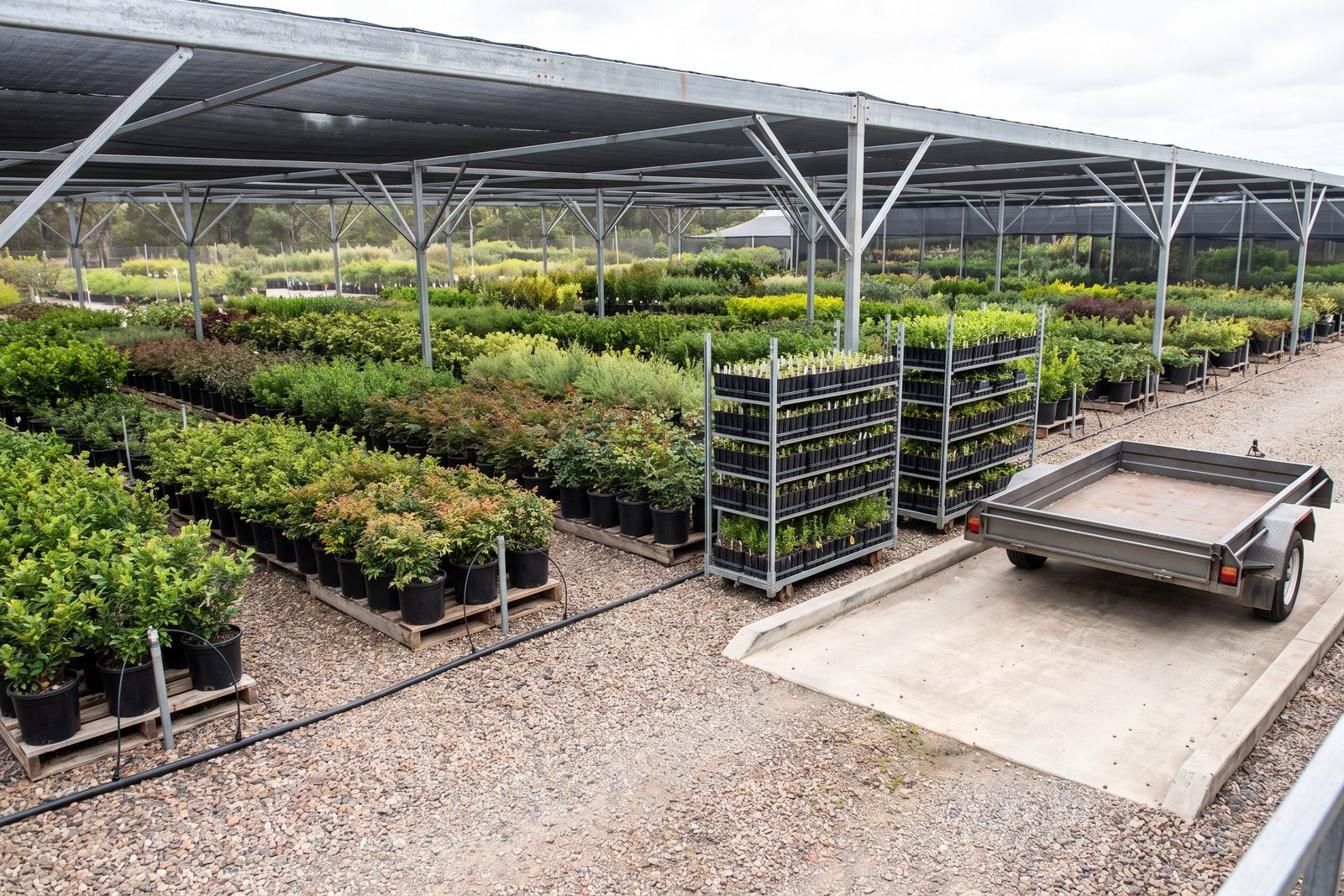
- Pick up where you can. Trade prices never include freight, and small plants travel well in their own trays over a short distance. A trailer with a cage and a tarpaulin carries twenty trays; a station wagon carries six.
- Check the count at the gate. Count trays, not plants, against the dispatch docket, and look at a sample from each line before the trailer leaves. A short line is fixed at the nursery, not a week later.
- Shade and water. Plants that left an irrigated bench need water the day they arrive and shade until they are in the ground. A planting day more than four days after collection needs someone to water in between.
- Keep the docket. The dispatch docket and the invoice are the records the treasurer and the grant acquitter need, and the invoice shows the GST line the treasurer asked about.
What to watch for
- Pricing from the list, not the quote. A published trade price is the start of the arithmetic. Add GST unless the group recovers it, then freight, then stakes, guards, mulch and water. The plants are often the smaller half of the budget.
- Ordering in the planting season. Spring stock was sown the summer before. An order placed the month of the planting day buys what is left on the lists, in the sizes nobody else wanted.
- Asking for six plants. Below the minimum the group is asking a wholesale business for retail service. Pool the order or buy the six at a garden centre.
- Taking the size on trust. A pot size is a container, not a plant height. Ask for the height and the potting date, and look at a sample before the order leaves.
- Leaving the account in one person's name. A trade account held by the treasurer of the day is lost when the treasurer changes. Open it in the group's name with two contacts.
Getting it right
- Settle the species list and the sizes, then convert the plan to quantities with the spacing table and round up to trays.
- Shortlist growers on the state hub and the plant pages: near enough to collect from, listing the sizes the plan needs, with a list updated recently.
- Ask the treasurer how GST applies to the group, and decide whether to open a trade account or order through a trade buyer.
- Send the same request to three growers and ask for a written quote ex GST with a dispatch date.
- Order the season ahead, with stakes, guards and mulch in the same order where the grower sells them.
- Confirm the count and the date a week before collection, and check the trays at the gate.
A word of caution
The grower counts on this page are what the HortOS hubs printed on 24 September 2026, and the live pages change as lists arrive. Tax is the Australian Taxation Office's to rule on and the group's treasurer or accountant should confirm how it applies. On stock, terms, minimums and dates, the grower's word is the one that counts, and HortOS never answers on a grower's behalf.
Sources
- Australian Taxation Office, GST: when a body registers and claims GST.
- Greenlife Industry Australia: the nursery industry's national body.
- Landcare Australia: community groups, grants and projects.
- Australian Interstate Quarantine: moving plants between states.
More guides
Reading a Grower's Price List and Trade Terms
A grower's price list is an offer written in shorthand, and the terms are part of the price. This page reads a trade list column by column and term by term, from the tax and freight basis to minimums, price on application, holds, substitutions, payment and claims, and turns two quotes into landed costs.
When to Order: Lead Times, Pre-Orders and Contract Growing
Every plant on a grower's list is a decision made a season or more ago. This page explains how long each grade takes to grow, the three ways a buyer secures stock ahead of the season, what a growing contract contains, the planting calendar in this market and how to read a current list for the year ahead.

Nursery Pot Sizes Explained: Millimetres, Litres and Gallons
Australian growers name a pot by its rim diameter up to 400 mm and by its volume in litres above that, while American growers use gallon classes. This guide explains each step of the ladder, the approximate height and age behind it, how to convert between systems, and what the trade pays at every size.