Buying From a Wholesale Grower When You Are Not in the Trade
Landcare groups, schools, friends groups and landholders can buy from wholesale growers when they order like the trade: in quantity, ahead of the season, on the grower's terms. This page explains who sells to whom, what an ABN and GST change, minimum orders and pooling, tubestock against pots, provenance, lead times, freight and state borders.
Updated 25 September 2026. Figures from the HortOS Plant Price Index, September 2026 edition, and the live price pages on 24 September 2026.
On this page
- Quick facts
- Who sells to whom, and how to tell
- The ABN, GST and what a trade account changes
- Minimum orders, set multiples and pooling an order
- Tubestock or pots: why revegetation buys tubes
- Provenance: asking for local stock
- Lead times, freight, pickup and state borders
- What to watch for
- Getting it right
- A word of caution
- Sources
A Landcare group with a creek line to plant, a school with a bare boundary, a friends group restoring a reserve, a landholder with two hundred metres of fence to shelter: each finds a wholesale grower's list, sees a tube priced at two dollars and a 140 mm pot at seven, and asks the same question. Can we buy from these people, and how? The answer that matters most is that a wholesale grower sells to whoever behaves like the trade: orders in quantity, orders ahead of the season, collects or arranges freight, and pays on the grower's terms. Whether you hold an ABN matters less than whether your order is worth a grower's morning.
This page gathers what the Australian Taxation Office and the Australian Business Register say about ABNs and GST, what the Australian Interstate Quarantine site says about moving plants between states, what revegetation guides from Rivers of Carbon, Landcare Tasmania and Greening Australia say about ordering and provenance, and what community nurseries and the Australian Native Plants Society say about who sells to whom. It adds the prices and grower counts printed on HortOS, a free directory of Australian wholesale plant growers with their published availability and trade prices. It summarises that advice and is not a substitute for asking the grower or your accountant.
Quick facts
| Who can buy | Each grower sets its own terms: some sell to anyone who orders in quantity, some to trade accounts only, most sit between. The grower's page and list say which; if neither does, ask. |
|---|---|
| The ABN | Needed to sign up and order on HortOS and for most trade accounts. An incorporated association carrying on an enterprise is entitled to one, and so is an unincorporated group with a common interest (Australian Business Register). |
| GST | Trade list prices are ex GST. Add 10 per cent unless your organisation is GST registered and claims it back. Registration is compulsory at $75,000 of turnover, or $150,000 for a non-profit organisation (Australian Taxation Office). |
| Tubestock | The revegetation size. On the live price pages on 24 September 2026 the commonest natives sat at $1.40 to $2.20 a tube, against $6.00 to $7.50 in a 140 mm pot. |
| Lead time | Pre-order tubestock at least six months ahead (Rivers of Carbon); order seedlings a year ahead of a large planting (Landcare Tasmania). Contract growing is how you get your own provenance. |
| State borders | Nursery stock moving interstate must meet the destination state's quarantine entry conditions and may need a plant health certificate (Australian Interstate Quarantine). |
Who sells to whom, and how to tell
The trade divides nurseries into production nurseries, which grow plants, and retail nurseries, which sell them to the public. The Australian Native Plants Society keeps its nursery list to those that sell direct to home gardeners and leaves larger wholesale or production nurseries out. The line is real but it is not a wall: many production growers sell to a school, a council or a Landcare group at the price they charge a landscaper, provided the order clears their minimum, and the community nurseries on Landcare NSW's list grow local provenance stock for members and the public.
On HortOS, three places tell you where a grower stands.
- The grower's page. Every grower in the directory has a page with its contact details and its current list. A grower that has set a minimum order shows it there as a dollar figure ex GST.
- The list itself. Lines can carry a note that a minimum quantity applies, or that a line is ordered in set multiples. Compiled from growers' current trade lists on HortOS in September 2026, about one trade line in thirteen carries a minimum quantity note and about one in fifty is ordered in set multiples.
- The plant page. Every plant page shows who lists that plant, by state and by size, with the date each list was last updated. The page for spiny-headed mat rush (Lomandra longifolia) showed 104 growers on 24 September 2026, 34 of them in New South Wales, 34 in Victoria and 28 in Queensland, with 40 listing it as a tube.
If a grower's page says nothing about who it sells to, email and ask three things: whether it sells outside the trade, what the minimum is, and whether you can collect. HortOS itself is a trade platform. Reading the directory and the prices needs no account; ordering through it needs a trade sign-up with an ABN, and every order goes to the grower to confirm. The terms are each grower's own, and HortOS never answers about stock or terms on a grower's behalf.
The ABN, GST and what a trade account changes
The Australian Business Register says an entity is entitled to an ABN if it is carrying on or starting an enterprise in Australia, making supplies connected with Australia's indirect tax zone, or is a Corporations Act company. Its page on companies and other entities lists, among those entitled if carrying on an enterprise, an incorporated association registered with a state or territory authority, an unincorporated association consisting of a group of individuals with a common interest, and a not-for-profit organisation. Most Landcare networks, friends groups and school parent bodies already hold one; ABN Lookup shows whether yours does, and whether it is registered for GST.
GST is the part that changes the arithmetic. The Australian Taxation Office says you must register when your GST turnover reaches $75,000, or $150,000 for a non-profit organisation; below that, registration is optional. Trade lists and the HortOS price pages quote prices ex GST. A registered organisation pays the GST and claims it back on its activity statement; an unregistered group pays it and keeps the receipt. So a tube listed at $2.00 costs an unregistered group $2.20 before freight, and a 300 mm plant at the September 2026 Index median of $50.00 costs $55.00.
A trade account with a grower is usually an application form with your ABN, delivery address and a contact, followed by the grower's terms: payment before dispatch for a new account, an invoice on terms once you are known, and the minimum. Signing up on HortOS asks for the ABN and checks it against the Australian Business Register. Neither costs anything, and neither changes the list price; what changes is the grower's willingness to hold stock and invoice you.
Minimum orders, set multiples and pooling an order
A grower's minimum is not a snub. Tubes are grown as a batch in a tray, and a line listed as a forestry tube, a Hiko cell or a 105 cell is telling you the unit it was grown in. Pulling six tubes out of a tray for one buyer costs more in handling than the six tubes earn, which is why a line reads ordered in set multiples. A delivery run has a floor too, and that floor becomes the minimum order value on the grower's page.
The answer for a small buyer is to pool: a Landcare group orders for several landholders in one consignment, a friends group for a season of working bees, a school as part of a council planting order. Rivers of Carbon's riparian tubestock guide recommends a nursery local to your area, often a Landcare group's own, with plants grown in the same conditions as your property, and ordering guards and stakes at the same time as the tubes. One of the community nurseries on Landcare NSW's list says a large order can be grown for you if you liaise with the staff.
The table shows what pooling buys: the native plants most often listed as tubes on HortOS, the number of growers listing each plant in any size, and the median trade price ex GST at tube and at 140 mm as printed on the live price pages on 24 September 2026. One price per grower, resellers and website prices excluded, freight not included.
| Plant | Growers listing it | Tube median (growers pricing) | 140 mm median (growers pricing) |
|---|---|---|---|
| Spiny-headed mat rush (Lomandra longifolia) | 104 | $1.50 (37) | $6.50 (47) |
| Tall sedge (Carex appressa) | 74 | $1.45 (36) | $6.10 (22) |
| Common tussock grass (Poa labillardieri) | 66 | $1.60 (27) | $6.21 (27) |
| Knobby club rush (Ficinia nodosa) | 58 | $1.77 (28) | $6.50 (24) |
| River sheoak (Casuarina cunninghamiana) | 51 | $2.00 (25) | Fewer than five growers |
| Common rush (Juncus usitatus) | 45 | $1.40 (24) | $6.25 (12) |
| Blackwood (Acacia melanoxylon) | 41 | $2.00 (18) | Fewer than five growers |
| Blue flax lily (Dianella caerulea) | 36 | $2.00 (15) | $6.50 (14) |
| Coast banksia (Banksia integrifolia) | 79 | $2.18 (12) | $7.50 (13) |
The tube is a quarter or less of the 140 mm price for the same plant, and the grasses, sedges and rushes that make up most of a riparian order are the cheapest lines on the list. A pooled order of a thousand tubes across those species, at the medians above, is a plant bill of roughly $1,500 to $2,000 ex GST before guards, stakes and freight.
Tubestock or pots: why revegetation buys tubes
Price is only half the reason. The Knox Environment Society, a Victorian community nursery, prefers to sell in tubes because plants have a higher survival rate when planted from tubestock than from pots: a potted plant is older, has spent longer in the easy conditions of a nursery, takes longer to adapt to the site, and is more likely to be root bound. Landcare Tasmania's revegetation guide plans on trees and shrubs 2 to 3 metres apart with grasses and herbs clumped between, and says site preparation should begin twelve months before planting, because poor weed control is the commonest cause of failure.
Pots earn their place where a planting has to look planted on day one: a school entrance, a car park verge, a street tree. The HortOS Plant Price Index for September 2026 puts the national median trade price at $7.00 for 140 mm, $14.00 for 200 mm, $50.00 for 300 mm, $120 for 45 L and $295 for 100 L, ex GST. What each size means is explained at nursery pot sizes explained.
Provenance: asking for local stock
A native plant is not necessarily a local plant. Greening Australia's 2021 review of native seed transfer zones found that state agencies differ on how far seed may travel: the expectation of locally collected seed is strongest in Tasmania, South Australia and the Northern Territory, Victoria was moving to a combination approach that folds a climate-adjusted strategy into local provenance, and the definition of local ranged from as close as possible to the site to the whole catchment. The same review names the Florabank Guidelines as the guidance the native seed sector refers to most.
For a buyer that means three questions to the grower: where did the seed for this line come from, can you supply the collection zone or seed lot, and can you grow to order from seed we collect or specify. A community nursery will often answer all three, because growing local provenance is its purpose; a production nursery growing a statewide range may buy seed from a merchant and cannot always say. A shelterbelt on a farm can take a robust provenance; a planting on a reserve beside remnant bush is where the state guidance and the funding agreement are likely to insist on local seed. Contract growing solves it: you or the nursery collect seed in season, the nursery sows it, and the tubes are ready for the following planting window.
Lead times, freight, pickup and state borders
- Order ahead. Rivers of Carbon says tubestock needs to be pre-ordered, generally at least six months in advance, so the nursery can ensure it has the species and size you need. Landcare Tasmania says to choose species and quantities and order seedlings a year ahead of planting. A grower's list on HortOS shows what it holds today, useful for a top-up order and no guide to next winter.
- Read the date. Every line on HortOS shows when the grower's list was last updated. A list updated today is an offer; a list months old is a guide to what that grower grows.
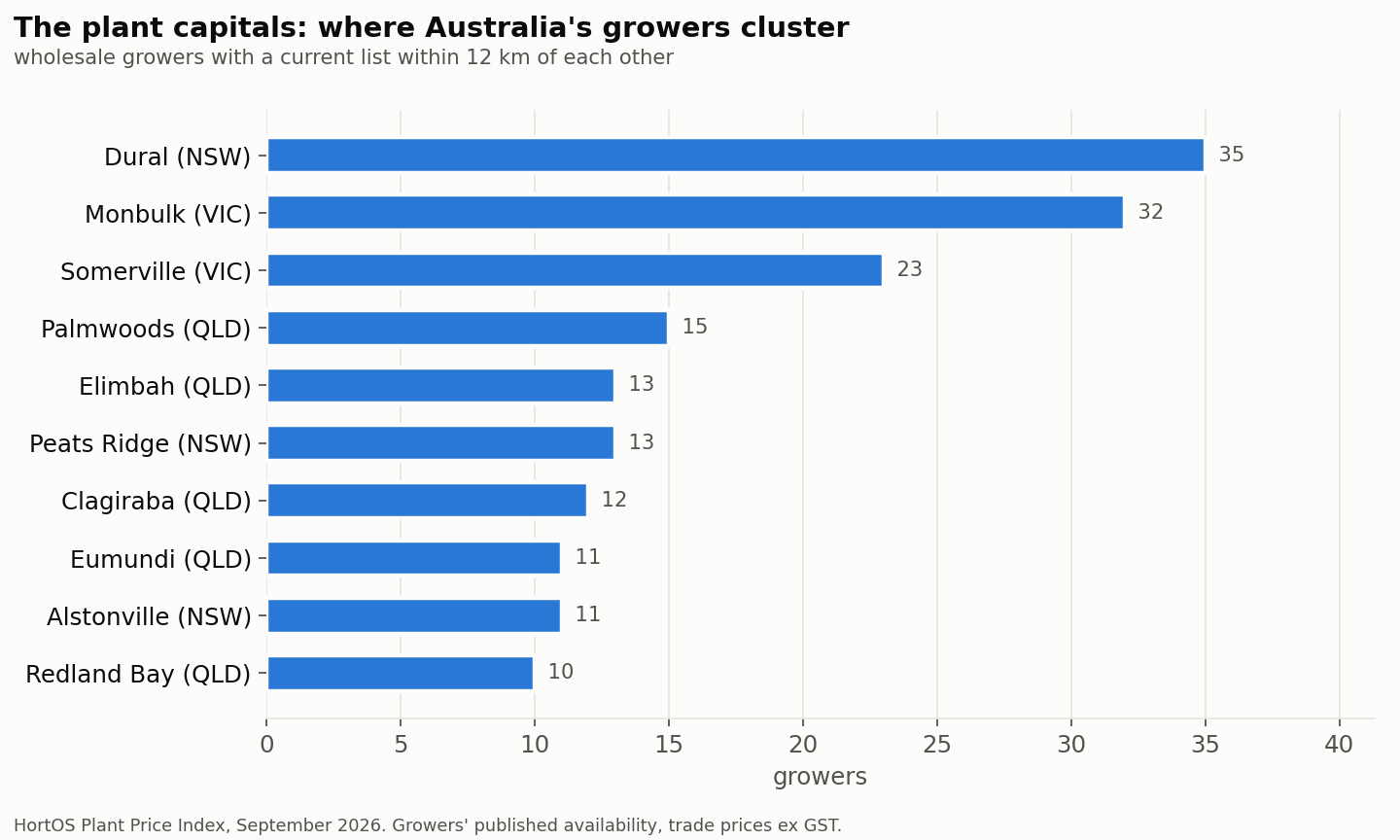
- Collect where you can. Trade prices never include freight, and tubes travel best in their own trays over a short distance. Growers cluster: the September 2026 Index counted 35 growers within 12 kilometres of Dural, 32 around Monbulk, 23 around Somerville and 15 around Palmwoods, so one trip with a trailer can collect from several. The state hubs for New South Wales, Victoria, Queensland, South Australia, Western Australia and Tasmania list growers by town.
- Mind the border. The Australian Interstate Quarantine site says plant quarantine entry conditions apply to the movement of nursery stock between states, that restricted material needs a Plant Health Certificate, a Plant Health Assurance Certificate or a BioSecure HACCP certificate, and that the Interstate Certification Assurance scheme accredits a business to certify its own consignments. An accredited grower sends interstate as routine; one that is not may decline, and some lines on HortOS carry the grower's own note that they cannot go to Western Australia, Tasmania or South Australia. Check the destination state's conditions before ordering across a border.
What to watch for
- Treating the list price as the delivered price. Add GST if you are not registered, then freight, then guards and stakes; the plants can be the smaller half of a revegetation budget.
- Ordering in the planting season. Autumn tubes were sown the previous spring. An order placed in April buys what is left.
- Reading native as local. A tube from a statewide grower may carry seed from another region. Ask, and specify, if provenance matters to the site or the funder.
- Asking a grower for six plants. Below the minimum you are asking for retail service from a business that does not offer it. Pool, or buy the six from a retail nursery.
- Crossing a border unchecked. A consignment turned back at a Western Australian checkpoint is a dead consignment.
Getting it right
- Settle the species list against your region's planting guide or Which Plant Where, and set quantities from the spacing rule for the site.
- Shortlist growers on the state hub and the plant pages: in your state, listing tubes, with a list updated recently.
- Check your organisation's ABN and GST status on ABN Lookup, then sign up on HortOS or apply for the grower's own account.
- Check the median for each line on the price pages, then email three growers with species, quantities, provenance requirement, planting date and whether you will collect, and ask each for a written quote ex GST with a dispatch date. The price check tests a quote against the current medians.
- Order six to twelve months ahead, with guards and stakes at the same time.
- Confirm the count and the date a week before collection, and check the trays before they leave.
A word of caution
The medians on this page are aggregates of growers' published lists on one date; the live price pages change as lists arrive, so a figure there may differ from the ones quoted here. ABN and GST rules are the Australian Business Register's and the Australian Taxation Office's, and an accountant or the organisation's treasurer should confirm how they apply to you. Quarantine entry conditions are the destination state's to set and change. On stock, terms and provenance, the grower's word is the one that counts.
Sources
- Australian Business Register, ABN entitlement: who may hold an ABN.
- Australian Business Register, companies and other entities: associations and not-for-profits.
- Australian Taxation Office, registering for GST: the turnover thresholds.
- Rivers of Carbon, riparian management tubestock guide: ordering, guards and planting.
- Landcare Tasmania, site preparation for revegetation: timing, spacing and weed control.
- Knox Environment Society, tubestock vs pots: survival from tubes.
- Greening Australia, native seed transfer zones in Australia (2021): provenance expectations by state.
- Florabank Guidelines: native seed collection and use.
- Australian Interstate Quarantine, moving plant goods: entry conditions and certificates.
- Australian Interstate Quarantine, Interstate Certification Assurance: accredited growers.
- Australian Native Plants Society, native plant nurseries: retail against production nurseries.
- Landcare NSW, member nurseries: community nurseries and large orders.
- Which Plant Where: species selection by climate.
More guides

Nursery Pot Sizes Explained: Millimetres, Litres and Gallons
Australian growers name a pot by its rim diameter up to 400 mm and by its volume in litres above that, while American growers use gallon classes. This guide explains each step of the ladder, the approximate height and age behind it, how to convert between systems, and what the trade pays at every size.
Reading a Wholesale Availability List and Pricing a Quote
For landscapers, designers, estimators and students: what each column of a wholesale availability list means, how much the same plant at the same size varies between growers and states, how the low, median and high on the price pages are built, and how to carry the plant line of a quote from the list to the client.
Buying Plants in Bulk for a Community Group
Garden clubs, community gardens, schools and friends groups can buy plants by the tray and the trolley from wholesale growers when they order like the trade. This page explains what bulk means to a grower, the three ways a group buys, how to turn a plan into quantities, what a quote request needs and how collection day works.