The Most Grown Native Plants in Australia, by State
A data page, not an essay: the Australian native plants held by the most wholesale growers, counted grower by grower and state by state from growers' current lists on HortOS, with the median trade price at the size most growers price. Two paragraphs on what the tables show and what they do not, then the tables, refreshed each edition.
Updated 25 September 2026. Counts and medians from the live au.hortosapp.com plant and price pages on 24 September 2026, built with the HortOS Plant Price Index method (September 2026 edition); refreshed each edition.
On this page
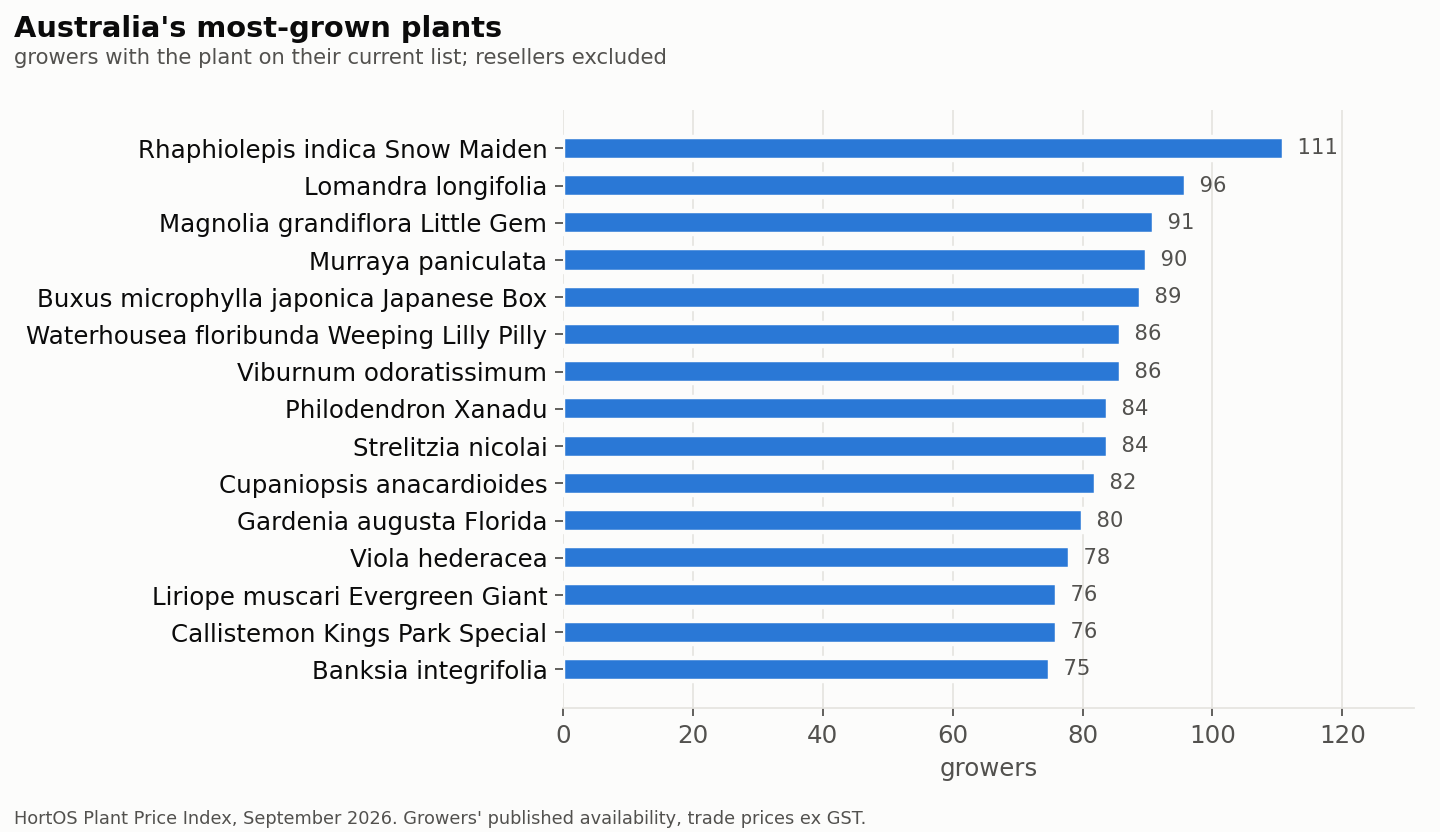
Ask which native plants Australian growers actually produce and the answer on most pages is a list of what someone thinks they should. This page is the other thing: what the wholesale trade holds on its current lists, counted grower by grower and state by state, with the trade price at the size most growers sell. The one idea to hold on to is that a plant's rank here measures how many growers list it, not how many pots exist or how well it suits any particular site, and that the list is dominated by the plants landscapers order by the thousand: mat rushes, tussock grasses, sedges, lilly pillies, bottlebrushes and coastal rosemary.
The counts come from growers' current lists on HortOS, a free directory of Australian wholesale plant growers with their published availability and trade prices, as the live plant pages printed them on 24 September 2026, and the prices from the live price pages the same day, built the way the HortOS Plant Price Index builds them: one price per grower, trade lists only, a median only where three or more growers price a size. A plant counts as native when its species occurs naturally in Australia in the Australian Plant Census sense; cultivars and selections follow their species, and a hybrid counts only where every parent is native. The tables are refreshed with each edition of the Index. They summarise what growers list and are not a planting guide.
Quick facts
| Most listed native | Spiny-headed mat rush (Lomandra longifolia), 104 growers on 24 September 2026, with a 140 mm median of $6.50 ex GST across 47 pricing growers. |
|---|---|
| Native share | 45 of the 100 most listed plants on Australian growers' lists are Australian natives by species (compiled September 2026); the other 55 are exotics such as Indian hawthorn, box, magnolia and viburnum. |
| What a rank means | Growers with the plant on their current list, in any size. It says nothing about volume, quality or suitability for a site. |
| Prices | Median trade price ex GST at the size most growers price, one price per grower, resellers and website prices excluded, freight not included; a state median needs three growers in that state. |
| Where the growers are | New South Wales, Victoria and Queensland hold nearly every grower with a current list; South Australia and Western Australia have a handful each, so their tables are short and their counts small. |
| Native is not local | A species native to Australia may be from another state or climate. Provenance is a separate question, answered by the grower, not by this table. |
What the tables show, and what they do not
They show demand as growers see it. A grower lists a plant because customers order it, so the plants at the top are the ones landscapers, councils and revegetation contractors buy most: strappy plants and ground covers for mass planting, screening lilly pillies, street and park trees such as tuckeroo and the flame tree, and the sedges and rushes of a wet edge. Ornamental natives sold in small numbers, and the local species a community nursery grows for one catchment, sit far down the list or off it, because few production growers carry them. The HortOS Plant Price Index for September 2026 found that two in three plants on Australian lists are held by a single grower; most natives are in that long tail.
They do not show what is native to a place. Spiny-headed mat rush is listed by growers in every mainland state and grown from seed of many provenances; the table cannot tell a Victorian buyer whether a particular grower's stock is Victorian. They do not show quantity: a grower with ten thousand tubes and a grower with a tray count the same. And they do not show price for a size fewer than three growers price, which is why some cells read fewer than three growers.
They do show where a buyer can go. Every plant name links to its price page, which prints the median, low and high at every size with enough growers, and the plant page behind it lists every grower holding the plant, by state and size, with the date each list was updated. The state hubs for New South Wales, Victoria, Queensland, South Australia and Western Australia list the growers by town.
The most listed native plants, Australia
The 25 native plants listed by the most growers on 24 September 2026, with the container size most growers price and the national median trade price ex GST at that size, and in brackets the number of growers pricing it.
For growing any of these at home, Nursery Near Me's plant care guides cover most of the list, species by species.
New South Wales
The ten native plants listed by the most New South Wales growers, with the national median at the size most growers price and the New South Wales median where three or more growers in the state price it.
| Plant | Growers in NSW | Size most growers price | National median | NSW median |
|---|---|---|---|---|
| Cupaniopsis anacardioides | 36 | 300mm | $40 (22) | $42 |
| Doryanthes excelsa | 35 | 300mm | $43.50 (24) | $41 |
| Lomandra longifolia | 34 | 140mm | $6.50 (47) | $6.50 |
| Syzygium australe Resilience | 32 | 300mm | $42 (32) | $43.90 |
| Dichondra repens | 30 | 140mm | $6.38 (24) | $7.10 |
| Banksia integrifolia | 27 | 200mm | $12.13 (18) | $11.75 |
| Cyathea cooperi | 27 | 200mm | $18.75 (14) | $19.70 |
| Archontophoenix cunninghamiana Bangalow Palm | 26 | 300mm | $47 (13) | $48.50 |
| Viola hederacea | 26 | 140mm | $6.50 (43) | $7.19 |
| Waterhousea floribunda Weeping Lilly Pilly | 25 | 300mm | $42 (26) | $45.70 |
Victoria
Victoria's list is the most temperate of the three: tussock grass, tall sedge, coastal rosemary, white correa and lightwood, with the lilly pillies and mat rushes shared with the other states.
| Plant | Growers in VIC | Size most growers price | National median | VIC median |
|---|---|---|---|---|
| Callistemon Kings Park Special | 38 | 140mm | $6.40 (27) | $5.50 |
| Lomandra longifolia | 34 | 140mm | $6.50 (47) | $5.50 |
| Carex appressa | 33 | Tube | $1.45 (36) | $1.60 |
| Westringia Wynyabbie Gem | 33 | 140mm | $6.50 (24) | $5.50 |
| Poa labillardieri | 32 | Tube | $1.60 (27) | $1.75 |
| Viola hederacea | 32 | 140mm | $6.50 (43) | $5.50 |
| Waterhousea floribunda Weeping Lilly Pilly | 31 | 300mm | $42 (26) | $65 |
| Correa alba | 30 | 140mm | $6.38 (24) | $5.80 |
| Acacia implexa | 29 | Tube | $2.18 (14) | $1.88 |
| Banksia integrifolia | 27 | 200mm | $12.13 (18) | $12 |
Queensland
Queensland's list is the most subtropical: the screening lilly pillies, tuckeroo, tulipwood, lemon myrtle, the beach acronychia and the Alexandra palm, with the mat rushes shared with the south.
| Plant | Growers in QLD | Size most growers price | National median | QLD median |
|---|---|---|---|---|
| Syzygium australe Resilience | 36 | 300mm | $42 (32) | $40 |
| Lomandra hystrix | 33 | 140mm | $6.50 (34) | $6.50 |
| Acronychia imperforata | 29 | 300mm | $42.50 (12) | $40 |
| Cupaniopsis anacardioides | 29 | 300mm | $40 (22) | $30 |
| Harpullia pendula | 29 | 45L | $100 (15) | $102.50 |
| Lomandra longifolia | 28 | 140mm | $6.50 (47) | $6.50 |
| Waterhousea floribunda Weeping Lilly Pilly | 27 | 300mm | $42 (26) | $34 |
| Backhousia citriodora | 25 | 400mm | $137.50 (12) | Fewer than three growers |
| Archontophoenix alexandrae | 24 | 45L | $92 (13) | $92 |
| Viola hederacea | 23 | 140mm | $6.50 (43) | $6.50 |
South Australia and Western Australia
Few growers in either state publish a list yet, so these counts are small and no state median is available; the plants are listed so a buyer can see who holds them. South Australia first, then Western Australia, where the list is entirely west-coast species such as bull banksia, marri, tuart and flooded gum.
| Plant | Growers in SA | Size most growers price | National median | SA median |
|---|---|---|---|---|
| Callistemon Little John | 6 | 140mm | $6.97 (24) | $7.50 |
| Carpobrotus rossii | 6 | 140mm | $5.75 (16) | $6.75 |
| Cupaniopsis anacardioides | 5 | 300mm | $40 (22) | Fewer than three growers |
| Ficinia nodosa Nobby Club Rush | 5 | Tube | $1.77 (28) | Fewer than three growers |
| Westringia Wynyabbie Gem | 5 | 140mm | $6.50 (24) | $6.75 |
| Plant | Growers in WA | Size most growers price | National median | WA median |
|---|---|---|---|---|
| Banksia grandis | 5 | Not enough growers | Fewer than three growers | |
| Carpobrotus virescens | 5 | Not enough growers | Fewer than three growers | |
| Agonis flexuosa Willow Myrtle | 4 | 250mm | $23 (3) | Fewer than three growers |
| Casuarina obesa | 4 | Not enough growers | Fewer than three growers | |
| Corymbia calophylla | 4 | Not enough growers | Fewer than three growers |
What to watch for
- Reading the rank as a recommendation. It is a count of growers. The plant at the top is the easiest to buy, not the best for the site.
- Reading native as local. The species is Australian; the seed may be from another state. Ask the grower for the provenance if it matters.
- Comparing medians across sizes. A tube median and a 300 mm median are different products; compare a plant with itself at one size.
- Treating a small count as a trend. A South Australian count of five growers moves when one list arrives or lapses.
- Quoting a number without its date. The live pages change as lists arrive; a figure from this page carries the date it was read.
Getting it right
- Start from your region's planting guide or Which Plant Where for the species that suit the site, then use these tables to see which of them the trade holds in quantity.
- Open the plant page for each species to see the growers in your state, their sizes and how current each list is.
- Check the median on the price page before asking for quotes, and ask each grower for the provenance of the line.
- For species low on the list or absent from it, ask a community nursery or a grower that grows to order, and order a season ahead.
A word of caution
The counts and medians on this page are what the HortOS pages printed on one date; the live pages change as lists arrive, so a figure there may differ from the ones quoted here. The native classification is by species and is a working list, not a botanical authority; the Australian Plant Census is the reference for whether a species is native, and the grower is the authority on where its seed came from. For which species suit a site, ask a local planting guide or a horticulturist.
Sources
- Australian Plant Census: accepted names, native and introduced.
- Which Plant Where: species selection by climate.
- Australian Native Plants Society, plant guides: growing Australian natives.
More guides
Trees and shrubs for planting near powerlines, and who lists them
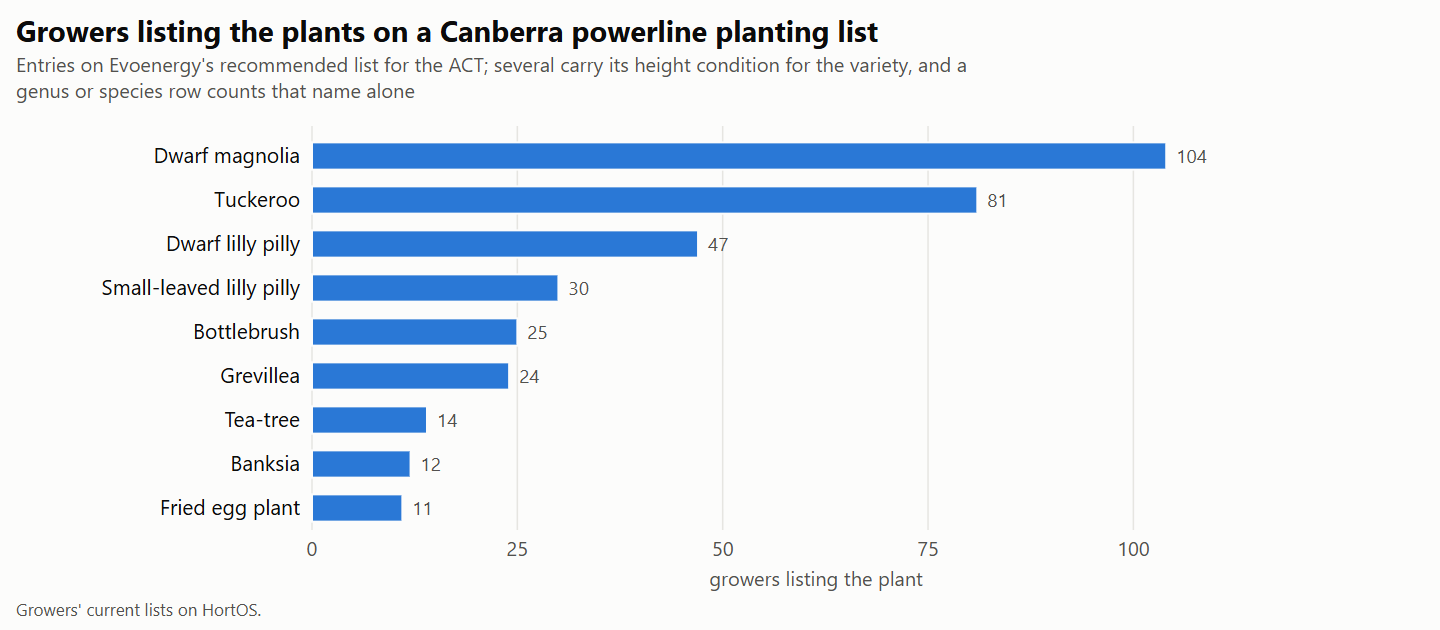
What Australian network operators, a regulator and a state department publish about trees near overhead powerlines, set side by side with each body's state and date. Two plant tables then count the growers listing the plants named on Evoenergy's list for the ACT and in a Queensland council's table, with a trade median for the plants enough growers price.
Choosing Plants for a Nature Centre or Demonstration Garden
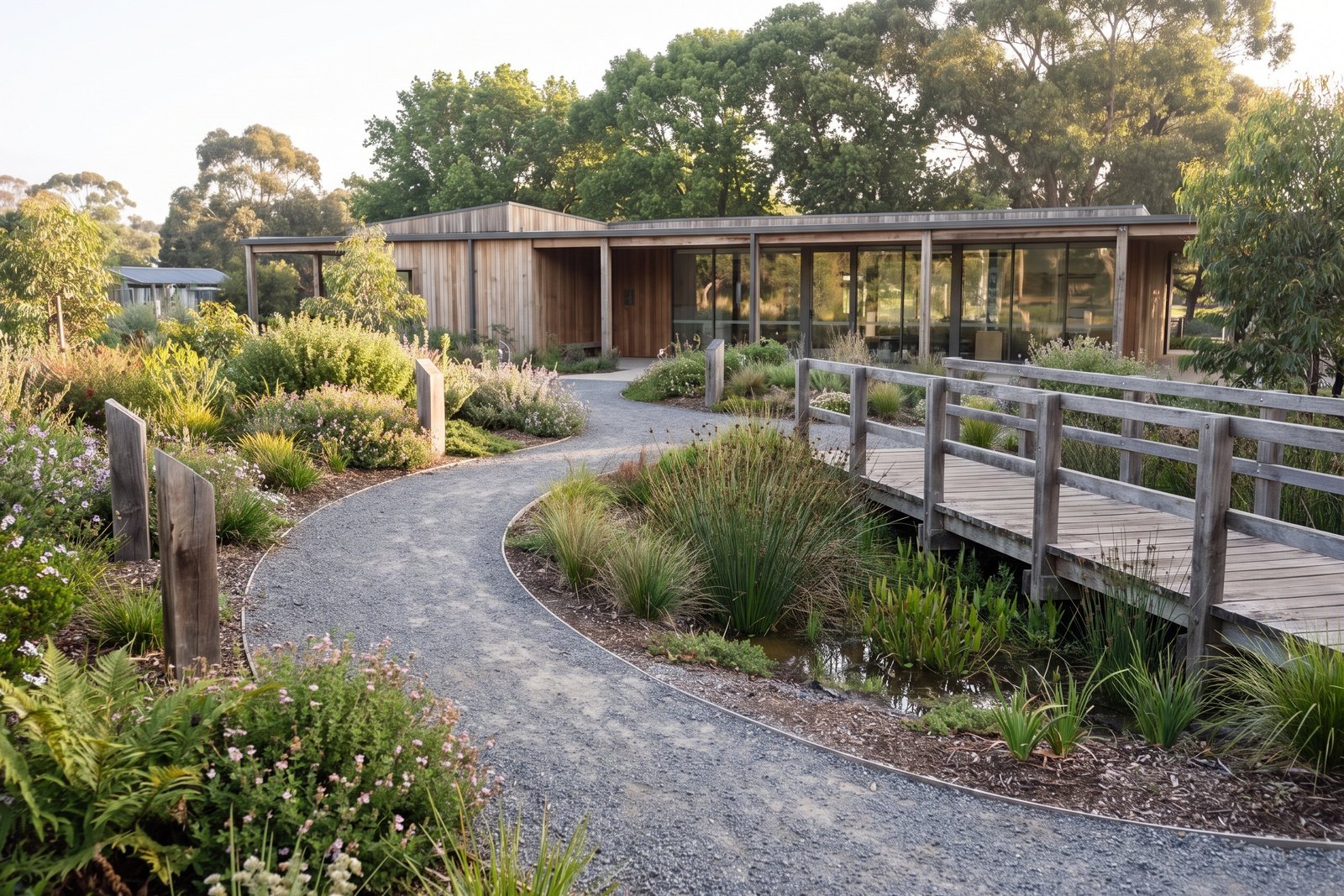
A demonstration garden should show plants visitors can find, buy and grow, at a standard of care a home can manage. This page covers choosing themes, choosing plants growers list in numbers, labels and interpretation, care at the visitor's scale, and the records that keep the garden useful.
Hedgerows and Windbreaks for Small Farms
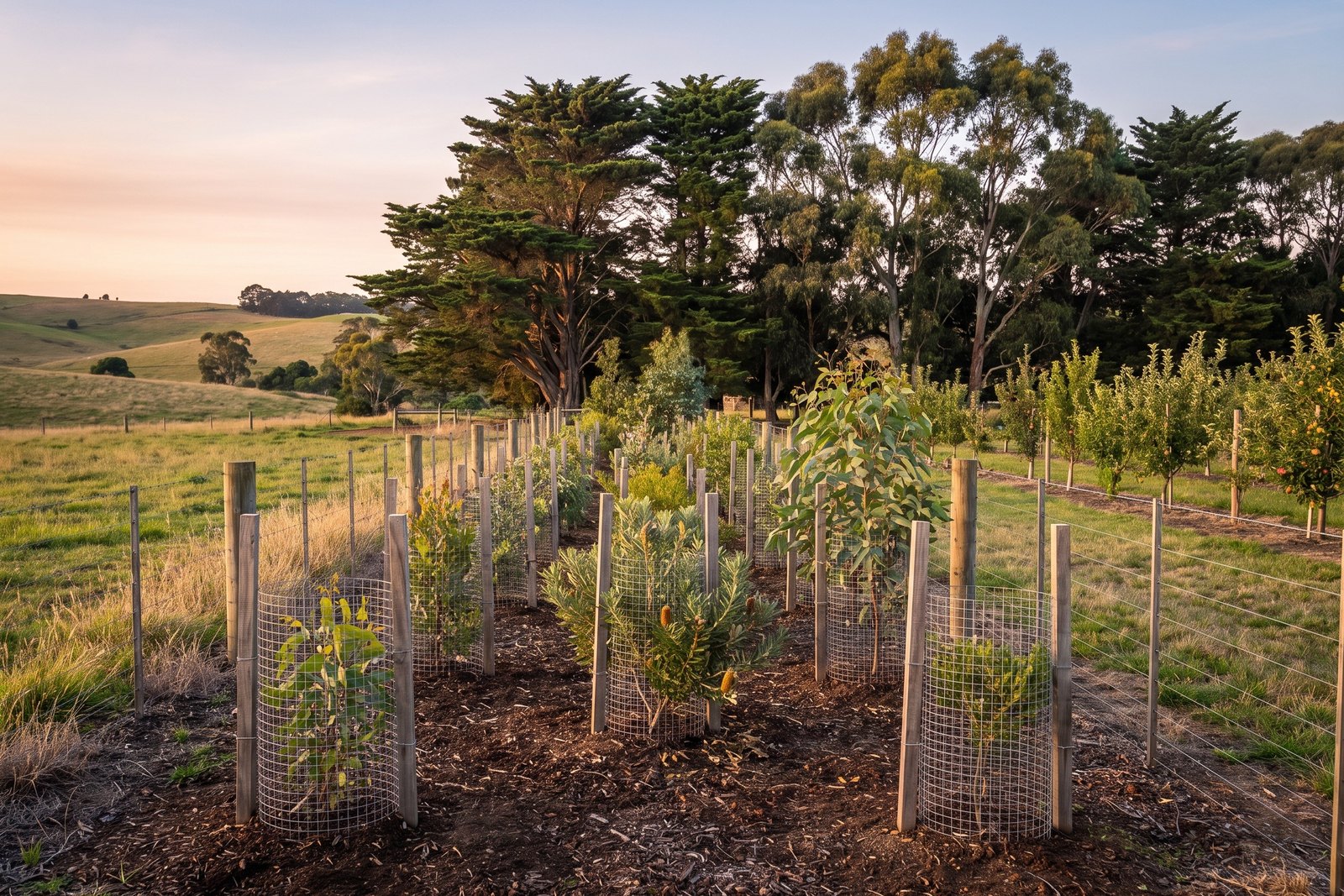
A windbreak or hedgerow protects in proportion to its height and length, and only works planted without gaps across the damaging wind. This page covers what belts do, the design rules agencies publish, species and layers, planting and protecting a belt, and where small farms find help.