Car Park Shade Tree Rules and What the Trees Cost at Trade
Car park shade tree rules in Australia are written council by council. This page sets side by side what planning documents from New South Wales, Victoria and Western Australia ask for, reports what they say a tree in paving needs, and gives trade medians for wide-crowned trees from one council's street tree list.
Updated 21 October 2026. Figures are what the live au.hortosapp.com price and plant pages printed.
On this page
A designer drawing a car park for a development application asks two things: how many shade trees will the council expect, and what do trees of that kind cost at trade. The idea that matters most is this. Car park shade tree rules in Australia are written council by council, and the documents read for this page differ in the ratio they ask for, in how firmly they ask, and in whether they name a size at planting. The answer starts with the council assessing the application.
The page draws on the NSW Department of Planning, Housing and Infrastructure, the City of Newcastle, the City of Kwinana, Melton City Council, Transport for NSW, the NSW Department of Education and Camden Council. It adds what is printed on HortOS, a free directory of Australian wholesale plant growers with their published availability and trade prices. It is not planning advice, and it works out no cost for any car park.
Quick facts
| Newcastle | The City of Newcastle's Development Control Plan 2023 (New South Wales) asks for at least one shade tree for every six parking spaces in car parks with more than six external spaces. |
|---|---|
| City of Sydney | The NSW planning department's page, updated 11 June 2026, gives one tree for each 4 car spaces in at-grade parking areas as a provision of the City of Sydney's Development Control Plan 2012. |
| Melton | Melton City Council's Off-Street Car Parking Guidelines (Victoria, version 2.0, June 2025) set a target of 35 per cent of a car park shaded by trees, put at about one tree for every 5 spaces. |
| Kwinana | The City of Kwinana's landscaping guideline (Western Australia, filed by the council under 2022) gives at least one tree for every six bays in car parks, and a 45 litre pot as the smallest for trees. |
| Apartments in NSW | The Apartment Design Guide (New South Wales, July 2015) has shade trees between every 4 to 5 spaces as design guidance where parking on grade cannot be avoided. |
| How firm the rule is | Newcastle's Development Control Plan 2023 (New South Wales) says of itself that its provisions "are not statutory requirements" and that it will be applied with flexibility. |
What six planning documents ask for
The table below sets side by side the car park tree rules of five documents from five bodies, with a sixth that sets no ratio. Newcastle's plan fills two rows, one for each of two kinds of parking. The rows are from New South Wales, Victoria and Western Australia, as read for this page on 5 October 2026. Each ratio is given in the unit its own document uses, whether a space, a car space or a bay.
| Authority and document | Where it applies | Trees for each parking space | What else it asks of the trees |
|---|---|---|---|
| NSW Department of Planning and Environment, Apartment Design Guide, 2015 | On-grade parking at apartment developments in New South Wales, where it cannot be avoided | Shade trees between every 4 to 5 spaces (design guidance) | Set beside pale or permeable paving, to cut the heat of large paved surfaces |
| City of Sydney, Sydney Development Control Plan 2012, as the NSW planning department's page describes it in 2026 | At-grade parking areas in the City of Sydney | One tree for each 4 car spaces | Canopy over 15 per cent of the site inside 10 years of completion |
| City of Newcastle, Development Control Plan 2023, section C12, part 11 | Car parks in Newcastle with more than six external spaces | At least one shade tree for each six spaces | Aim of at least 50 per cent shade, counted from crowns at 15 years; species that grow a clear trunk above 4.5 m and a crown of 50 square metres or more |
| City of Newcastle, Development Control Plan 2023, section C12, part 14 | Open ground-level parking at industrial development in Newcastle's E3, E4 and E5 zones | One shade tree for each six spaces | The trees stand inside the parking area |
| City of Kwinana (Western Australia), Landscaping Guidelines for Development Applications, undated, filed by the council under 2022 | Car parks in development applications in Kwinana | At least one tree for each six bays | Trees in pots of 45 litres or larger |
| Melton City Council (Victoria), Off-Street Car Parking Guidelines, version 2.0, 2025 | Car parks at commercial, industrial and public sites and large housing developments in Melton | About one tree for each 5 spaces | Target of 35 per cent of the area in tree shade; 15 per cent or more landscaped; single-trunk species |
| Transport for NSW, standard TS 00174 Car Parks, 2024 | Car parks at Transport for NSW stations and interchanges | No ratio set; shade trees are one thing the landscape design may include | Deep soil of 7 per cent of the site or more, where that suits the site |
These are different kinds of document. Newcastle's Development Control Plan 2023 (New South Wales) was adopted on 12 December 2023 and commenced on 1 March 2024, and it says reasonable alternatives that meet its objectives will be considered. Its shade cover of at least 50 per cent is an aim, worked out from the estimated spread of each crown at 15 years in good growing conditions. The same 2023 Newcastle control asks for species that grow a clean trunk above 4.5 m and a crown of 50 square metres or more. Those are figures for the grown tree. The control names no pot size.
The City of Sydney figure is carried here only as the NSW planning department's page describes it in 2026. That page also says the City exhibited, in late 2023, a change to section 3.5 of its plan proposing tree planting rates by type of development.
The Apartment Design Guide of 2015 (New South Wales) places its line under objective 3J-5, whose design guidance begins by saying on-grade parking should be avoided. The department's page on the guide, updated 2 July 2026, describes it as design criteria and general guidance for proposals in New South Wales.
The City of Kwinana's guideline (Western Australia) carries no date of its own; the council files it under 2022 and it was read in October 2026. Where verge parking is approved under the City's local planning policies and street trees are missing, the Kwinana guideline asks for 100 litre verge trees, one for every three bays, each in a landscaped island 2 m wide or more. The Transport for NSW standard of 2024 covers that agency's own station and interchange car parks in New South Wales and no others.
What the documents say a tree in paving needs
The documents give reasons for the trees and conditions on them. One objective of Newcastle's 2023 car park controls (New South Wales) is enough shade to cut heat and glare while the car park still works well. The NSW planning department said in 2025 that each 10 per cent rise in tree cover can lower land surface temperature by more than 1 degree Celsius.
The conditions are about what happens below and around the tree. Newcastle's Development Control Plan 2023 (New South Wales) asks landscape plans to show load-bearing root vaults under the surface, with enough rooting volume for the shade trees and passive irrigation to them. The NSW planning department's 2025 guidance says a tree needs room, water and soil that drains before it can form roots and a crown and cool as much as it is able to. It also says new trees need regular watering through their first 2 growing seasons in New South Wales.
Other lines deal with people and services. Newcastle's 2023 controls ask that car park trees and shrubs do not block sight lines or make places to hide. Melton's 2025 guidelines (Victoria) say light poles and trees should be planned together so neither harms the other. The Transport for NSW standard of 2024 says trees in its New South Wales car parks should not damage footpaths or buried services, or create slip or trip risks. The NSW Department of Education's design guide for school sites, undated and read in October 2026, says trees liable to drop large branches under stress should not go in car parks.
Wide-crowned street trees and their trade medians
No document in the first table lists species for car parks. The table below is drawn instead from one council's street tree list: the new street tree planting section of Camden Council's Tree and Landscape Species List (New South Wales, undated, read in 2026). It shows 11 trees from that section with a listed width of 8 metres or more. The other 64 entries of that section are not shown. Camden calls its heights and widths a guide that may differ from one situation to another.
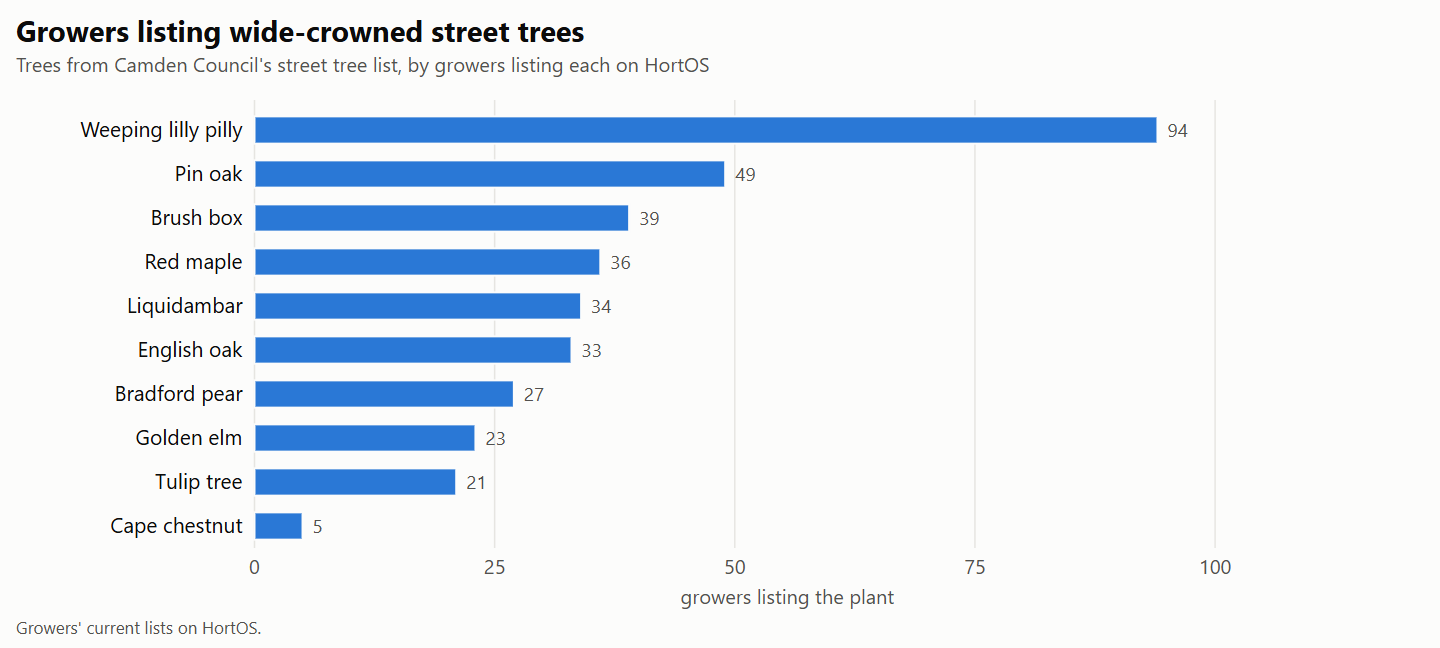
Prices are medians across growers' current trade lists on HortOS: one price per grower, ex GST, freight not included, with the number of growers pricing each size in brackets. A count here is growers listing the plant, not how many plants exist or how well it suits a site. Anyone can see the prices on HortOS, and only the trade can order.
| Plant | Height and width in Camden Council's list (read 2026) | Growers listing it | 100 L median (growers pricing) |
|---|---|---|---|
| Weeping lilly pilly (Waterhousea floribunda) | 10 m tall, 8 m wide | 94 | $250 (17) |
| Pin oak (Quercus palustris) | 15 m tall, 10 m wide | 49 | $285 (10) |
| Brush box (Lophostemon confertus) | 15 m tall, 10 m wide | 39 | $285 (4) |
| Red maple (Acer rubrum 'October Glory') | 12 m tall, 9 m wide | 36 | $297.50 (6) |
| Liquidambar (Liquidambar styraciflua) | 18 m tall, 12 m wide | 34 | $307.50 (6) |
| English oak (Quercus robur) | 11 m tall, 11 m wide | 33 | $300 (9) |
| Bradford pear (Pyrus calleryana 'Bradford') | 12 m tall, 9 m wide | 27 | $300 (5) |
| Golden elm (Ulmus glabra 'Lutescens') | 10 m tall, 12 m wide | 23 | $275 (5) |
| Tulip tree (Liriodendron tulipifera) | 12 m tall, 8 m wide | 21 | $300 (5) |
| Cape chestnut (Calodendrum capense) | 10 m tall, 8 m wide | 5 | Fewer than three growers |
| Zelkova (Zelkova serrata 'Golden Flame') | 10 m tall, 9 m wide | 3 | Fewer than three growers |
Most of the growers listing the plants in this table are in Victoria and New South Wales.
The table prints one size, the 100 litre pot, because too few of these trees have a median at 45 litres to make a column. A median needs three growers pricing a size. Weeping lilly pilly has the most growers listing it, at 94, followed by pin oak at 49. The median for brush box is thin: it rests on 4 growers.
This is one council's street tree list beside trade listings, not a list of trees any council has accepted for a car park. The guide to street trees and canopy holds the trees most growers list at three pot sizes, so that table is not repeated here.
What the tables do not show
The first table is not a census of councils. It holds the documents named in it and nothing else, so a rule for any other council or state is not on this page. A national median is not a Western Australian price.
A trade median is the price of the tree alone, in one pot size, at the grower's gate. It says nothing of planting, soil, root vaults, irrigation or the seasons of watering that follow. It does not show how long a tree takes to reach the width a list gives, or the crown a council counts shade from. The directory shows what growers list. It does not show what a council has accepted, and no tree in the second table is tied to any rule in the first.
What to watch for
- Reading a grown-tree figure as a planting size. Newcastle's 2023 control (New South Wales) describes the trunk and crown a species develops, not the tree delivered to site.
- Treating one council's ratio as another's. Each document in the first table applies only where its own row says, and the ratios are counted in different units.
- Carrying a pot size from one place to the next. The 45 litre minimum on this page is the City of Kwinana's guideline alone (Western Australia, filed under 2022).
- Counting a listing as an order. A grower's list shows what is printed on the day, and the number and size wanted for one car park is a matter for a quote.
Getting it right
- Find out which council or other consent authority assesses the application, and ask which of its documents covers car park landscaping and which version is in force.
- Ask that authority how it counts its ratio: by space or by bay, inside the parking area or around it, and at what age of tree any shade target is measured.
- Ask whether it keeps a species list and who approves the species. The NSW planning department's 2025 guidance points developers in New South Wales to their council's preferred species list.
- Ask what the landscape plan must show. The City of Kwinana's guideline (Western Australia, filed under 2022) asks for a plant schedule with each botanical name, quantity and pot size.
- Take the schedule to growers for a dated quote, since a median is not an offer. The guide to buying from a wholesale grower covers how growers take an order.
A word of caution
This page reports what the planning documents named in it and one council's street tree list said when they were read on 5 October 2026. Such documents are amended, and the City of Sydney's rate is given only as the NSW planning department describes it. The council or consent authority assessing an application decides what is required, and a landscape architect or arborist advises on species and soil for the site.
Sources
- NSW Department of Planning, Housing and Infrastructure, Delivering greening through planning controls (updated 11 June 2026): council planning controls for trees. Licensed under CC BY 4.0.
- City of Newcastle, Development Control Plan 2023, Section C12 Open space and landscaping: car park shade tree controls.
- City of Newcastle, Development Control Plan 2023, Section A1 Introduction: commencement and status of the plan.
- NSW Department of Planning and Environment, Apartment Design Guide (July 2015): design guidance for on-grade parking.
- City of Kwinana, Landscaping Guidelines for Development Applications: car park trees and pot sizes.
- Melton City Council, Off-Street Car Parking Guidelines, version 2.0: shade and landscaping targets.
- Transport for NSW, standard TS 00174 Car Parks: landscaping of the agency's car parks.
- NSW Department of Planning, Housing and Infrastructure, Greening for cooling (updated 24 April 2025): tree cover and surface temperature. Licensed under CC BY 4.0.
- NSW Department of Planning, Housing and Infrastructure, Take action with greening (2025): species choice and watering new trees. Licensed under CC BY 4.0.
- NSW Department of Education, design guide DG92 Landscape Softworks: trees near school car parks.
- Camden Council, Tree and Landscape Species List: street trees with heights and widths.
- NSW Department of Planning, Housing and Infrastructure, Apartment Design Guide web page (updated 2 July 2026): what the guide is for. Licensed under CC BY 4.0.
More guides

Street Trees and Canopy: What Advanced Stock Costs and Who Holds It
The advanced-tree story from the HortOS Plant Price Index as a standing page: the trees the trade grows for streets and parks, the farm-gate median at 45, 100 and 200 litres, how many growers in each state hold advanced stock, why lead times run to years, and what a council pays for a street tree against a giveaway.
Buying From a Wholesale Grower When You Are Not in the Trade
Landcare groups, schools, friends groups and landholders can buy from wholesale growers when they order like the trade: in quantity, ahead of the season, on the grower's terms. This page explains who sells to whom, what an ABN and GST change, minimum orders and pooling, tubestock against pots, provenance, lead times, freight and state borders.
The Most Grown Native Plants in Australia, by State
A data page, not an essay: the Australian native plants held by the most wholesale growers, counted grower by grower and state by state from growers' current lists on HortOS, with the median trade price at the size most growers price. Two paragraphs on what the tables show and what they do not, then the tables, refreshed each edition.