Shade trees for schools and playgrounds: sizes and trade prices
Cancer Council NSW's Guidelines to Shade, Victoria's school building handbook and the NSW Department of Education's design guide give three different answers on the size of shade tree to plant in a school ground. This page sets them side by side, with growers listing trees from one council's draft list and trade medians at three sizes.
Updated 18 October 2026. Figures are what the live au.hortosapp.com price and plant pages printed.
On this page
- Quick facts
- What Cancer Council NSW looks for in a shade tree, and what it says to avoid
- Three answers on the size to plant, and whom the designer is told to ask
- Trees one council's draft list calls dense, at three sizes
- Sports grounds in the school documents
- What a trade median and a street tree list cannot tell a school
- What to watch for
- Getting it right
- A word of caution
- Sources
A parents' association has money for trees beside the play equipment and asks how big to buy them. On the size of a shade tree for a school ground, three Australian documents give three different answers. Cancer Council NSW (New South Wales, 2013) says to choose younger plants. Victoria's handbook for government school building projects (2026) asks for advanced trees, unless horticulturalists advise that younger ones would outgrow them within two years. The NSW Department of Education's design guide, read in October 2026, asks for the smallest practicable size for native species.
This page reports what Cancer Council NSW, SunSmart, Victoria's education department and school building authority and the NSW Department of Education say about shade and trees in schools and other children's spaces. It adds figures from HortOS, a free directory of Australian wholesale plant growers with their published availability and trade prices: the growers listing trees that one council's draft list describes as dense, and trade medians at three sizes. It is not a planting plan and it clears no tree. The school or the centre decides.
Quick facts
| Canopy and UV | Cancer Council NSW's Guidelines to Shade (New South Wales, 2013) says that, as a general rule, a tree canopy that is thick and low to the ground protects best from direct UV. Citing a 1998 study, it says shade of good quality can cut UV exposure by as much as 75 per cent. |
|---|---|
| Size: Cancer Council NSW | Guidelines to Shade (Cancer Council NSW, New South Wales, 2013) says to choose younger plants, which as a rule settle into a new site more easily than mature ones and cost less. |
| Size: Victoria's handbook | The Victorian School Building Authority's Building Quality Standards Handbook (Victoria, dated 14 May 2026) is the handbook for Victorian government school building projects. It asks for advanced trees that shade a space at once, unless horticulturalists advise that younger trees would be the larger within two years. |
| Size: the NSW design guide | The NSW Department of Education's design guide DG92 Landscape Softworks (New South Wales, as read in October 2026) asks for the smallest practicable size for Australian native species, and for an advanced tree with a guard where the tree stands in paving. |
| One tree at two sizes | Weeping lilly pilly (Waterhousea floribunda) was listed by 94 growers on HortOS. Its national trade median was $41.45 for a 300 mm pot (24 growers pricing) and $250 for a 100 litre bag (17 growers pricing), ex GST, freight not included. |
| Hours of highest UV | Cancer Council NSW's Guidelines to Shade (New South Wales, 2013) says UV levels are highest from 10 am to 2 pm, or from 11 am to 3 pm during daylight saving. |
What Cancer Council NSW looks for in a shade tree, and what it says to avoid
Cancer Council NSW wrote its Guidelines to Shade (New South Wales, 2013) for people, organisations and councils adding shade to places such as playgrounds, sporting venues, schools and childcare centres. It says good shade can cut UV exposure by as much as 75 per cent, citing a 1998 study, and protects most when used with sun-protective clothing, a hat, sunglasses and sunscreen (Cancer Council NSW, New South Wales, 2013).
On trees the guidelines give a general rule: a canopy that is thick and sits low to the ground protects best from direct UV, and a bigger canopy protects more (Cancer Council NSW, New South Wales, 2013).
The same document says what to avoid. Cancer Council NSW (New South Wales, 2013) names plants that are toxic, that attract bees, that drop limbs, that carry thorns or spikes, or that bring on asthma or skin irritation. It cautions against trees that leave berries or seeds underfoot, roots that may get into nearby buildings, paths and drains, and big trees near powerlines or underground services (Cancer Council NSW, New South Wales, 2013). Whether a given tree fits one of those descriptions on a given site is for the school or the centre to decide.
SunSmart's school activity sheet (Victoria, undated, read October 2026) describes a shade assessment as looking closely at a space to find what shade it has, the quality of that shade and what might be improved. Cancer Council NSW (2013) says a shade audit becomes the base of a project brief, which can support a funding application or the hiring of a contractor.
Three answers on the size to plant, and whom the designer is told to ask
Cancer Council NSW (2013) says to choose younger plants: as a rule they settle into a new site more easily than mature ones, and they are cheaper. For the years of waiting, it says temporary built structures can stand in until the shade trees mature (Cancer Council NSW, 2013).
The NSW Department of Education's design guide DG92 Landscape Softworks (New South Wales, as read in October 2026) answers by species and by position. It asks for the smallest practicable size for Australian native species, and for an advanced tree with a guard where a tree is set in paving, because those areas are busy (New South Wales, read October 2026). The guide (New South Wales, read October 2026) prefers local native species where they can do what the design needs, ranking the local habitat zone first, then New South Wales, then Australian, then exotic.
For Victorian government schools the answer is in the Building Quality Standards Handbook, published by the Victorian School Building Authority and dated 14 May 2026. It is written for the designers contracted on Victorian government school and early learning projects. Whether it governs a planting that a parents' association pays for is a question for the school and Victoria's education department. The handbook (Victoria, 2026) says natural shade must be a major part of the shade at a school or early learning facility, mixed with built shade wherever possible. For added natural shade it asks for advanced trees that shade a space at once, unless horticulturalists advise that younger trees would be the larger within two years (Victoria, 2026).
For an early learning facility designed under it, the handbook (Victoria, 2026) says shade must reach sandpits, mud play and other static play areas and the outside of every space for children aged 0 to 1. It says shade must also reach at least some active play areas (Victoria, 2026).
The two school documents each tell the designer whom to ask about species. The handbook (Victoria, 2026) says the contracted landscape architect or designer should consult arborists, horticulturalists and local councils on species. Among the characteristics to consider in choosing plants, it lists a match with the council's own planting list or its guide to choosing trees, where the council has one (Victoria, 2026). The NSW design guide (New South Wales, read October 2026) sends the designer to the local council for its advice on which species suit local conditions.
The table sets these statements side by side, one to a row, in this page's own words, with the body, the year and where each applies. The handbook's temporary shade row comes from its text on early learning facilities. Its mature size row is one of the criteria for choosing a large tree species, not a size every tree must reach. The Brisbane row is about streets and parks, not school grounds. On AS 2303, this page reports only that the handbook points to it.
| Authority and year | Where it applies | What it says about shade trees or the size to plant |
|---|---|---|
| Cancer Council NSW, Guidelines to Shade, 2013 | Shade projects in New South Wales, from schools and childcare centres to playgrounds and sporting venues | Says that, as a general rule, a tree canopy that is thick and low to the ground protects best from direct UV. |
| Cancer Council NSW, Guidelines to Shade, 2013 | Shade projects in New South Wales, from schools and childcare centres to playgrounds and sporting venues | Says younger plants in general settle in more readily than mature plants, and are cheaper. |
| Cancer Council NSW, Guidelines to Shade, 2013 | Shade projects in New South Wales, from schools and childcare centres to playgrounds and sporting venues | Says temporary built shade can cover a site until its shade trees mature. |
| Victorian Department of Education, Sun and UV Protection policy, 2025 | Schools and school councils in Victoria | Says principals and school councils must make sure shade is provided for when future buildings or grounds are planned. It also says it is important to have enough shelters and trees over lunch, lesson, play and assembly areas and sporting grounds or pools. |
| Victorian School Building Authority, Building Quality Standards Handbook, 2026 | Victoria's government schools and its early learning facilities | Requires natural shade to be a major part of shade provision on school and early learning sites, mixed with built shade wherever possible. |
| Victorian School Building Authority, Building Quality Standards Handbook, 2026 | Victoria's government schools and its early learning facilities | Asks for advanced trees that give shade at once, unless horticulturalists advise that younger trees would outgrow them within two years. |
| Victorian School Building Authority, Building Quality Standards Handbook, 2026 | Early learning facilities in Victoria designed under the handbook | Requires temporary shade to keep children covered while new plantings grow. |
| Victorian School Building Authority, Building Quality Standards Handbook, 2026 | Victoria's government schools and its early learning facilities | Requires shadow diagrams of all shade, built and natural, for 11:00 am, 1:30 pm and 3:00 pm on the two solstice days. |
| Victorian School Building Authority, Building Quality Standards Handbook, 2026 | Victoria's government schools and its early learning facilities | Sets a mature size for a large tree species of at least 12 m high and 8 m wide 15 years after planting. |
| Victorian School Building Authority, Building Quality Standards Handbook, 2026 | Victoria's government schools and its early learning facilities | Says trees should be selected to Australian Standard AS 2303, Tree stock for landscape use. |
| NSW Department of Education, EFSG design guide DG92 Landscape Softworks, read October 2026 | Schools planned to the NSW Department of Education's design guide | Puts local native species first where they meet the design need and, for native species, asks for the smallest practicable size. |
| NSW Department of Education, EFSG design guide DG92 Landscape Softworks, read October 2026 | Schools planned to the NSW Department of Education's design guide | Says trees set in paving, usually near buildings, should be advanced trees with tree guards, because those areas are busy. |
| Brisbane City Council, Brisbane trees, 2026 | Brisbane's streets and parks | Says its tree planting program is aimed at suburbs that need shade trees. |
| Victorian School Building Authority, Safe Tree Program, 2025 | Government schools in Victoria | Offers financial help to plant native trees where high-risk trees have been removed. |
Trees one council's draft list calls dense, at three sizes
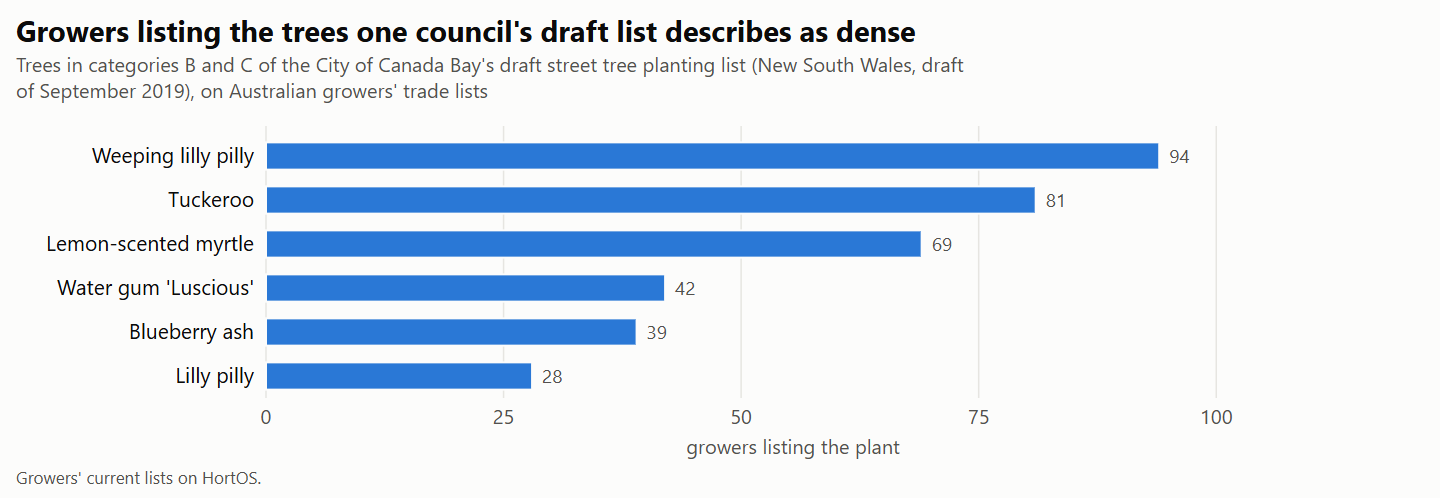
To set growers' figures beside the guidance, this page uses a list that describes canopy tree by tree: the City of Canada Bay's street tree planting list (New South Wales), a draft of September 2019. The rows are the trees that draft places in category B or C whose features entry uses the word dense or calls the tree a shade tree. A further 5 trees described in those words sit outside those two categories and are not shown.
The rows run from the tree most growers list to the least, at three of the sizes growers price: a 300 mm pot, a 45 litre bag and a 100 litre bag. Prices are medians across growers' current trade lists on HortOS: one price per grower, ex GST, freight not included, with the number of growers pricing each size in brackets. A median needs three growers pricing a size. A count here is growers listing the plant, not how many plants exist or how well it suits a site. Anyone can see the prices on HortOS, and only the trade can order.
| Plant | Growers listing it | 300 mm median (growers pricing) | 45 L median (growers pricing) | 100 L median (growers pricing) |
|---|---|---|---|---|
| Weeping lilly pilly (Waterhousea floribunda) | 94 | $41.45 (24) | $105 (15) | $250 (17) |
| Tuckeroo (Cupaniopsis anacardioides) | 81 | $46.50 (22) | $110 (16) | $285 (17) |
| Lemon-scented myrtle (Backhousia citriodora) | 69 | $55 (10) | $130 (11) | $276.50 (12) |
| Water gum 'Luscious' (Tristaniopsis laurina 'Luscious') | 42 | $71 (8) | $120 (8) | $257.50 (16) |
| Blueberry ash (Elaeocarpus reticulatus) | 39 | $51.25 (8) | $118.18 (3) | Fewer than three growers |
| Lilly pilly (Acmena smithii) | 28 | $64.50 (4) | $105 (3) | $254 (5) |
Most of the growers listing the plants in this table are in New South Wales and Queensland.
The table is not a list of trees cleared for children's spaces. The draft itself notes fruit for lilly pilly, blueberry ash and tuckeroo, and flowers for blueberry ash (City of Canada Bay, New South Wales, draft of September 2019). It describes blueberry ash, lemon-scented myrtle and tuckeroo as bird attracting (City of Canada Bay, New South Wales, draft of September 2019). Cancer Council NSW (New South Wales, 2013) cautions about plants that attract bees and about berries or seeds that fall where people walk. How much either matters beside a sandpit, a path or an oval is for the school or the centre to weigh, with its designer and its council.
Weeping lilly pilly, tuckeroo, lemon-scented myrtle, water gum 'Luscious' and lilly pilly have a median at all three sizes. Blueberry ash has none for a 100 litre bag, and its median for a 45 litre bag rests on 3 growers pricing that size. Lilly pilly's medians are thin: they rest on 4 growers for a 300 mm pot, 3 for a 45 litre bag and 5 for a 100 litre bag. A median on so few growers can move when one of them reprices.
The water gum row is the selection 'Luscious', the form the draft names; the species has its own page, water gum (Tristaniopsis laurina). The medians pool growers across the country, so none of them is the price in one state. Most of the rules in the first table are Victorian, and each state's growers are on its hub: Victoria, New South Wales and Queensland among them.
What each pot and bag size holds is set out in the guide to nursery pot sizes. The guide to street trees and canopy covers the wider range of trees grown for streets and parks.
Sports grounds in the school documents
Three of the documents speak of sports grounds. The Victorian Department of Education's Sun and UV Protection policy (Victoria, last updated 14 March 2025) names sporting grounds and pools among the spaces that should have enough shelters and trees. The handbook (Victoria, 2026) says natural shade must be maximised across outdoor areas where possible, but not near sports playing fields. The NSW design guide (New South Wales, read October 2026) asks that site planting allow for too much shadow falling across playing fields, as well as for summer shade. Where trees end and open turf begins on a given ground is a decision for whoever plans it.
What a trade median and a street tree list cannot tell a school
The medians are trade prices for one tree, ex GST, as growers list them. They are not the cost of a planting: freight, tree guards, labour and any temporary shade stand outside them. The table does not show which tree suits a given school, soil or climate, how dense a canopy will be on that site, or how many years a tree takes to give shade. Nor does it say which of its three sizes any of the three documents would count as younger, smallest practicable or advanced. In the passages read for this page, none of the three gives a pot or bag size for those words. Where growers price smaller sizes, they are on each tree's price page.
The draft list gives each tree a mature height in street tree conditions, and for the trees in the table those heights run from 3 to 12 m (City of Canada Bay, New South Wales, draft of September 2019). The handbook's criterion for a large tree species (Victoria, 2026) is a mature size of at least 12 m high and 8 m in spread 15 years after planting.
A tree on one council's list is not thereby local to another district. The handbook (Victoria, 2026) asks for locally native trees, and the NSW design guide (New South Wales, read October 2026) puts the local habitat zone first. Other councils list other trees: Brisbane City Council's street tree species list (Queensland, 2026) includes brush box (Lophostemon confertus), which 39 growers listed on HortOS.
The directory shows what each grower lists and the trade price beside it. It does not show where a grower's seed was collected, how a tree was grown, or whether it was grown to AS 2303, the standard the handbook (Victoria, 2026) says trees should be selected to. Those are questions to put to the grower.
The lilly pilly row counts listings under one name, Acmena smithii, the name the draft list uses. Growers also list lilly pilly under the name Syzygium smithii, which has its own page; the two are not added together here. The weeping lilly pilly row likewise counts listings under one name, Waterhousea floribunda. Growers also list it under the name Syzygium floribunda, which has its own page; those two are not added together either.
What to watch for
- Reading the price table as a list of trees cleared for children. It is one council's draft street tree list (City of Canada Bay, New South Wales, September 2019) set against growers' lists, and the school or the centre decides.
- Carrying one state's document across a border. The handbook is for government school and early learning projects in Victoria (2026) and the design guide is the NSW Department of Education's (read October 2026). A school elsewhere asks its own education department and council.
- Expecting shade this summer from a young tree. Cancer Council NSW (2013) says temporary built structures can give shade until the trees mature.
- Accepting a pot-bound tree. Cancer Council NSW (New South Wales, 2013) says a plant whose roots have wound into a tight mass around the inside of its pot will struggle to establish.
Getting it right
- Audit the ground before choosing a tree. Note which spaces are in use in the hours Cancer Council NSW (New South Wales, 2013) gives for the highest UV: 10 am to 2 pm, or 11 am to 3 pm in daylight saving.
- Ask the local council for its species list, which Cancer Council NSW (2013) says can often be had from a council. The handbook (Victoria, 2026) speaks of a council's planting list or its tree selection guide. Ask which trees on it are local to the district.
- Put each candidate tree to the designer, an arborist or a horticulturist, against the kinds of plant Cancer Council NSW (New South Wales, 2013) says to avoid. The school or the centre makes the decision.
- Settle the size with the same advisers. On a Victorian government school project the handbook (2026) leaves one question to horticulturalists: whether younger trees would outgrow advanced ones within two years. Under the NSW design guide (read October 2026) it turns on whether the species is native and whether the tree stands in paving.
- Read each short-listed tree's price page, then ask growers in the directory for written quotes, ex GST, with freight shown; the price check sets a quote against the current medians. The guide to buying from a wholesale grower covers how a school outside the trade orders: the ABN, minimum orders and freight.
- Plan for the years the trees take to grow. Cancer Council NSW (2013) says temporary built structures can give shade until shade trees mature. For an early learning facility designed under it, the handbook (Victoria, 2026) requires temporary shade while new plantings grow.
A word of caution
The figures on this page are what growers' trade lists on HortOS showed, and the live price pages move as lists change. The statements about UV and about plants to avoid are Cancer Council NSW's, from guidelines dated 2013. The school documents are Victoria's and the NSW Department of Education's, as read in October 2026; a school elsewhere asks its own education department. Which trees go into a school ground or a childcare centre is for the school or the centre to decide, with its designer, an arborist or horticulturist and the local council.
Sources
- Cancer Council NSW, Guidelines to Shade: a practical guide for shade development in New South Wales (PDF): shade planning, tree choice, buying plants.
- SunSmart, SunSmart shade assessment (school activity sheet, PDF): what a shade assessment is.
- Victorian Department of Education, Sun and UV Protection: Policy (Policy and Advisory Library): shade in Victorian school planning.
- Victorian School Building Authority, Building Quality Standards Handbook, 5. Technical specifications: shade areas, natural shade, trees.
- Victorian School Building Authority, Building Quality Standards Handbook, 3. Planning: criteria for choosing trees and plants.
- Victorian School Building Authority, Building Quality Standards Handbook (landing page: date and licence): the handbook's date and licence.
- NSW Department of Education, EFSG design guide DG92 Landscape Softworks: tree planting on school sites.
- Brisbane City Council, Brisbane trees: the council's street tree species.
- City of Canada Bay, Urban Canopy Street Trees: draft street tree planting list (PDF): a draft council list with canopy notes.
- Victorian School Building Authority, Safe Tree Program: help with high-risk school trees.
More guides

Nursery Pot Sizes Explained: Millimetres, Litres and Gallons
Australian growers name a pot by its rim diameter up to 400 mm and by its volume in litres above that, while American growers use gallon classes. This guide explains each step of the ladder, the approximate height and age behind it, how to convert between systems, and what the trade pays at every size.

Street Trees and Canopy: What Advanced Stock Costs and Who Holds It
The advanced-tree story from the HortOS Plant Price Index as a standing page: the trees the trade grows for streets and parks, the farm-gate median at 45, 100 and 200 litres, how many growers in each state hold advanced stock, why lead times run to years, and what a council pays for a street tree against a giveaway.
Buying From a Wholesale Grower When You Are Not in the Trade
Landcare groups, schools, friends groups and landholders can buy from wholesale growers when they order like the trade: in quantity, ahead of the season, on the grower's terms. This page explains who sells to whom, what an ABN and GST change, minimum orders and pooling, tubestock against pots, provenance, lead times, freight and state borders.