Salvia nemorosa Ostfriesland
Sage / Salvia
Part of Salvia: see them all
No grower lists this plant right now
- Type
- Deciduous perennial
- Height
- 0.1 m to 0.5 m
- Spread
- 0.1 m to 0.5 m
- Flowers
- Purple-blue, summer to autumn
- Sun
- Full sun, light part shade tolerated (the RHS)
- In Australia
- Not native
Growing woodland sage
The species. HortFlora describes woodland sage as a herbaceous perennial from Central Asia to Europe, with flower spikes to about 70 cm and leaves ovate to oblong, to 7 cm long, blunt at the tip and wrinkled at the edge. Its flowers sit six to a whorl along long, dense spikes from summer to autumn. North Carolina State Extension, an American reference, gives the species 0.45 to 0.9 m high and 0.15 to 0.6 m wide, and grey-green, toothed leaves that are aromatic when crushed.
Position and soil. The RHS gives Ostfriesland full sun, with light part shade tolerated, in a light, moderately fertile, humus-rich soil that is moist but well drained, in chalk, loam or sand of any pH. North Carolina State Extension gives the species full sun to part shade in average, moist, well-drained soil, and says it prefers sandy or gravelly ground.
Hardiness. The RHS rates Ostfriesland H6 on its British scale, and North Carolina State Extension puts the species in USDA zones 4a to 8b. North Carolina State Extension also calls the species drought-tolerant. No Australian reference read gives a frost or drought rating.
Pruning. The RHS says to cut back the flower spikes as they fade to prolong flowering. North Carolina State Extension says that once a stem has flowered and turned brown it can be cut down to the basal leaves for new flowers, and that cutting back spent blooms can bring several flushes.
Pests. The RHS lists sage leafhopper, slugs, snails and rosemary beetle, and honey fungus (rarely), powdery mildews, verticillium wilt and foot and root rots. North Carolina State Extension reports no serious problems for the species.
Using woodland sage
North Carolina State Extension suggests woodland sage for cottage and pollinator gardens and for planting in groups at the front of a border; its flowers draw bees and butterflies and are rated good for cutting. The RHS lists Ostfriesland among its plants for pollinators and suggests it for gravel, coastal, courtyard and cottage gardens, beds and borders, and pots on a patio. For the species, North Carolina State Extension gives 0.3 to 0.9 m of space to plant each one. For a pink form of the same species, see Sensation Rose.
What to check before you buy
The names are worth checking. The RHS lists Salvia x superba 'East Friesland' as a synonym, and North Carolina State Extension says the cultivar is also known as East Freeland. HortFlora warns that plants sold as Salvia nemorosa may also be listed as Salvia x superba or Salvia x sylvestris, and North Carolina State Extension says it is not always possible to tell whether a modern cultivar comes from the species or its hybrids. HortFlora files Ostfriesland under Salvia nemorosa. The guide to nursery pot sizes explains the sizes on a list, and the guide to judging nursery plant quality what to check before stock leaves the grower. The guide to buying from a wholesale grower says nursery stock sent interstate must meet the receiving state's quarantine entry conditions and may need a plant health certificate.
Prices are set by each grower and shown ex GST. Availability is confirmed by the grower at order.
Common questions
- Is Ostfriesland the same as East Friesland?
- Yes. HortFlora gives East Friesland as another form of the name, and the RHS lists Salvia x superba 'East Friesland' and Salvia nemorosa East Friesland as synonyms of Salvia nemorosa 'Ostfriesland'.
- How big does Salvia Ostfriesland grow?
- The RHS puts both its height and its spread in its 0.1 to 0.5 m band and calls it compact and bushy. North Carolina State Extension gives the species 0.45 to 0.9 m high and 0.15 to 0.6 m wide.
- What colour are the flowers?
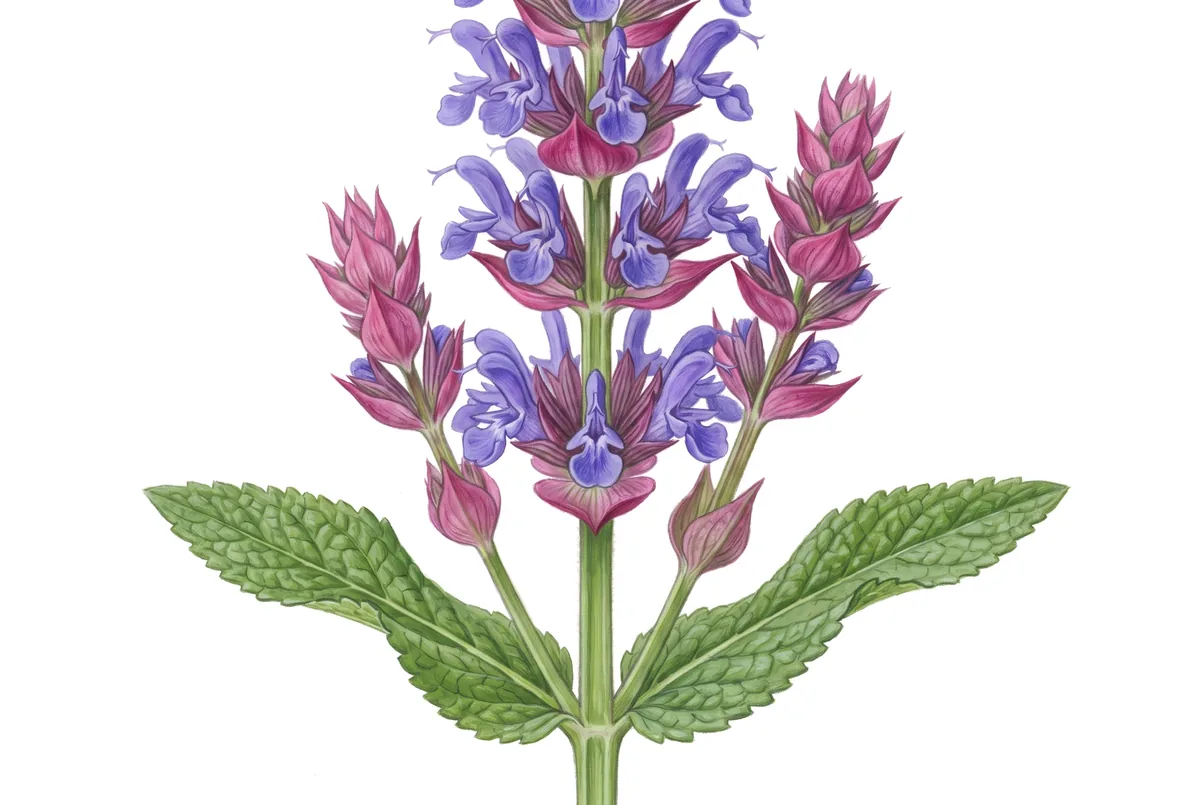
- Rich purple-blue by HortFlora, deep violet-blue with pink bracts by the RHS, and violet-blue on strong spikes by North Carolina State Extension. The RHS gives summer and autumn for flowering.
- How do you keep Ostfriesland flowering?
- The RHS says to cut back the flower spikes as they fade to prolong flowering. North Carolina State Extension says the species can often be brought into flower several times by cutting back the spent blooms.
- Where did Ostfriesland come from?
- HortFlora records it as a selection made by a German from seed supplied by a nurseryman, and gives East Friesland as another form of its name.
- Does it need full sun?
- The RHS gives full sun and says it can take light part shade. North Carolina State Extension gives the species full sun to part shade.
Sources
- GBIF species match API (Salvia nemorosa)
- Atlas of Living Australia (Salvia nemorosa)
- HortFlora, the Horticultural Flora of South-eastern Australia (Royal Botanic Gardens Victoria): Salvia nemorosa 'Ostfriesland'
- HortFlora, the Horticultural Flora of South-eastern Australia (Royal Botanic Gardens Victoria): Salvia nemorosa
- RHS Plant Profile (Royal Horticultural Society): Salvia nemorosa 'Ostfriesland'
- North Carolina State Extension Gardener Plant Toolbox: Salvia nemorosa, with its line on 'Ostfriesland'
- The HortOS guides (nursery pot sizes; judging nursery plant quality; buying from a wholesale grower)
The growers, sizes and prices above are live and change as lists arrive. Cite this page: HortOS, Woodland sage (Salvia nemorosa 'Ostfriesland'), https://au.hortosapp.com/plants/salvia-nemorosa-ostfriesland.
Found a fact that is wrong? Tell us and it is checked against its source.