Salvia
Sage / Salvia
Every Salvia on HortOS in one place: 134 plants, the species and their varieties together. Pick a size to see it across all of them.
48 growers · 27 sizes · from $1.40 ex GST
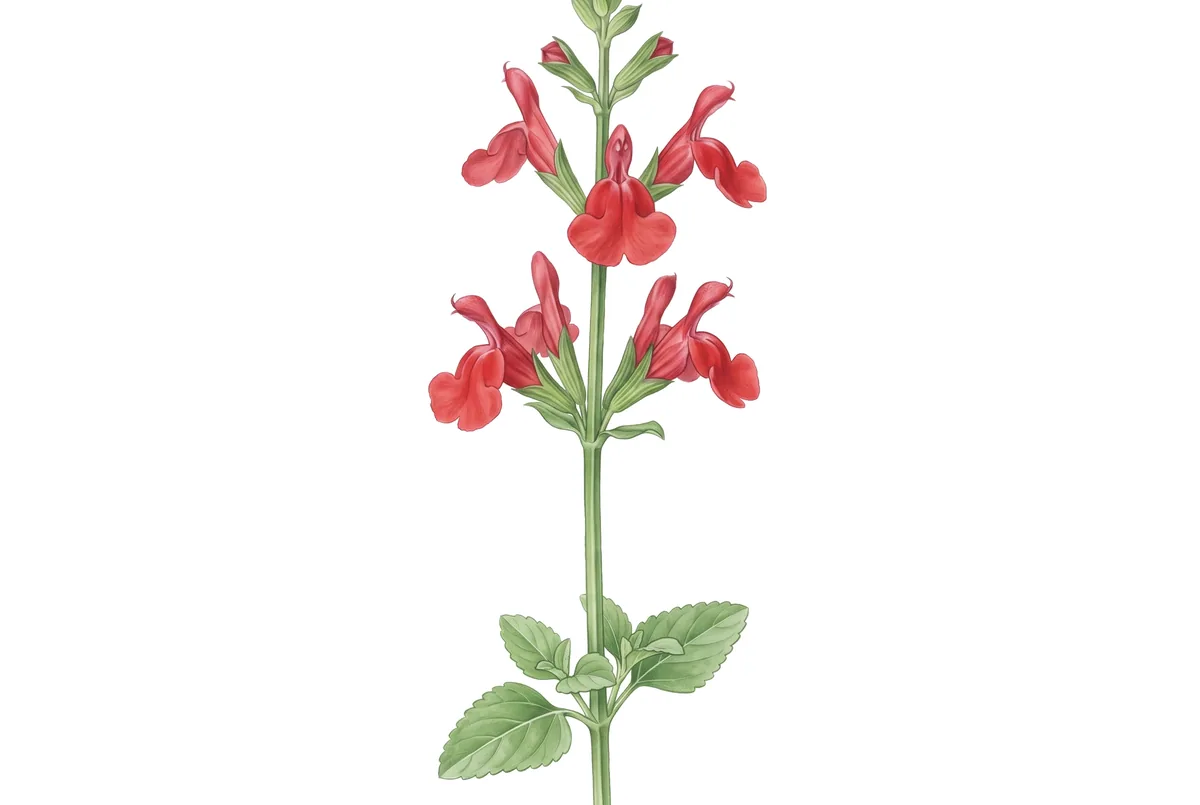
- Type
- Perennial
- Flowers
- Red, varies by group from spring to winter; a long season, sometimes almost all year
- Sun
- Full sun to partial shade
- Frost
- Varies by group: HortFlora calls the large winter-flowering shrubs from high-altitude tropical South America and Africa frost-tender
Some growers show prices to verified trade buyers. Sign in or sign up with your ABN to see them and order.
Showing 50 of 262 offers (the smallest sizes first). Show all 262 or pick a size or state above.
Also grown by 3 nurseries (no sizes or prices listed)
Enquire with them for sizes and prices.
- Aurora Perennials Online NurseryNicholls Rivulet, TAS
- Plants for SpacesMelbourne, VIC
- Trenton Cottage Pty LtdMonbulk, VIC
Growing salvia
Position and soil. The North Carolina toolbox, an American reference writing for the genus as a whole, gives full sun to partial shade and a well-drained soil, and calls sages drought- and salt-tolerant. HortFlora adds that its grey-leaved Old World shrubs, common sage among them, are intolerant of water, so read the named form's page before choosing a site.
Flowering. HortFlora groups the genus by habit and origin, and the groups flower at different times. The frost-tender shrubs of up to 3 m, mostly from the high tropics of South America and Africa, are the winter flowerers, in reds, magentas, pinks and violets. The larger woody shrubs, often pale- or grey-leaved, from dry Africa, North America and the Mediterranean bloom from midsummer into autumn, mostly in pale shades. The biennials and herbaceous perennials, mostly Old World, generally bloom from spring to the middle of summer in blues, purples, mauves, pinks and white, without reds, while the smaller clump-forming perennials flower over a long season in reds, blue-purples, oranges and yellows.
Frost. HortFlora calls the winter-flowering shrubs frost-tender. No reference read gives one frost rating for the genus.
Pests. The same American reference lists fungal leaf spot, stem rot, powdery mildew and rust among the diseases, and spider mites, mealybugs, aphids and whitefly as pests that are sometimes a problem.
Using salvia
HortFlora lists the uses: annuals as bedding plants, with Salvia splendens and Salvia farinacea extremely popular; cut flowers, the stems recut under water; common sage, Salvia officinalis, as a culinary and medicinal herb; and the nectar, which attracts bees, as a source of honey. The North Carolina toolbox puts sages in pollinator, butterfly and drought-tolerant gardens and the edible species in the herb garden. The HortOS guide to community garden planting costs lists common sage among its herbs. Growers list many salvias by a named form after the genus, such as Mystic Spires, which the toolbox describes as a smaller version of Indigo Spires with intense blue flowers. Rosemary, which GBIF and the New South Wales flora now place in Salvia, has its own page: rosemary.
What to check before you buy
A line that gives only the genus name can be any of hundreds of species or a named hybrid, so ask the grower which plant it is and compare the same plant across growers. HortFlora notes a rapid influx of new material, especially from warm parts of Central and South America, and that several species have already naturalised, so weed potential is worth checking before a new salvia is imported or planted. The guide to nursery pot sizes explains the grades growers list, and the guide to judging nursery plant quality covers roots, pests and hardening off. Stock crossing a state border moves under the state and territory biosecurity rules like any other plant.
Cautions
HortFlora warns that several species have naturalised in Australia. The most widespread, by its account, are mintweed (Salvia reflexa) in Queensland, New South Wales, Victoria and South Australia, which is known to poison stock; Salvia coccinea in Queensland and New South Wales; and wild sage (Salvia verbenaca) in southern and eastern Australia.
Prices are set by each grower and shown ex GST. Availability is confirmed by the grower at order.
Common questions
- Who grows Salvia wholesale in Australia?
- 48 wholesale growers list Salvia on HortOS right now, each with their own pot sizes and trade prices. They are in Victoria, New South Wales, Queensland, Western Australia, South Australia, Tasmania and the ACT. The growers are named on this page.
- What pot sizes does Salvia come in?
- Growers on HortOS list Salvia in Tube, 46mm, 50mm, 68mm, 70mm, 75mm, 95mm, 100mm, 110mm, 120mm and 17 more sizes.
- What does Salvia cost wholesale?
- The median trade price in a 140 mm pot is $14.48 ex GST, across 8 growers who price it. Prices by pot size and state are on its trade price page.
- How do I order Salvia from these growers?
- HortOS is for the trade. Add the lines you want to a list and send it: each grower gets their part of the order by email, confirms what they have and quotes freight, and nothing is bought until you approve it. Listing, searching and ordering are free.
- Is rosemary a salvia?
- GBIF and PlantNET put it there: GBIF gives the accepted name of Rosmarinus officinalis as Salvia rosmarinus, and PlantNET lists Rosmarinus as a synonym of Salvia. The Australian Plant Census still accepts Rosmarinus officinalis, with Salvia rosmarinus listed as its synonym, and the Atlas of Living Australia follows it; the Census notes only that Salvia as the New South Wales flora draws it includes Rosmarinus. Rosemary has its own page.
- Are salvias native to Australia?
- One is, by PlantNET and HortFlora: Salvia plebeia, which the Australian Plant Census records in Queensland, New South Wales and Victoria with no naturalised mark, although the Census's line for the genus marks every state and territory naturalised. PlantNET counts 6 species in Australia, 1 native and 5 naturalised; the Census lists 16 species names, 2 of them, Salvia pratensis and Salvia sclarea, noted as not known to be established.
- How many kinds of salvia are there?
- The references differ: about 700 species by PlantNET, about 900 by HortFlora and over 1000 by the North Carolina toolbox, which adds that there are many more hybrids and cultivars. HortFlora calls Salvia the largest genus in the mint family.
- How do you propagate salvias?
- Every species can be grown from seed, HortFlora says, but the herbaceous and woody perennials are generally raised from softwood cuttings. The North Carolina toolbox adds division and calls sages some of the easiest plants to propagate from stem cuttings.
Sources
- GBIF species match API (the genus Salvia)
- GBIF species API (the synonym record of Rosmarinus officinalis and its accepted name, Salvia rosmarinus)
- Atlas of Living Australia (the genus Salvia)
- Australian Plant Census (APC): the genus Salvia, its distribution line, comment and the species names it holds
- Australian Plant Census (APC): Salvia plebeia, its distribution line
- Australian Plant Census (APC): Salvia pratensis and Salvia sclarea, their comments (not known to be established in Australia)
- PlantNET, the New South Wales flora online (Royal Botanic Garden Sydney), Salvia plebeia
- Australian Plant Census (APC): Rosmarinus officinalis, the accepted name and its synonym Salvia rosmarinus
- Atlas of Living Australia (the rosemary species page, with the Australian Plant Census as name authority and Rosmarinus officinalis accepted)
- PlantNET, the New South Wales flora online (Royal Botanic Garden Sydney), the genus Salvia
- HortFlora, the Horticultural Flora of South-eastern Australia (Royal Botanic Gardens Victoria): the genus Salvia
- North Carolina State Extension Gardener Plant Toolbox: Salvia (the genus page)
- RHS Plant Profile (Royal Horticultural Society), the line on the genus Salvia carried on the Salvia Mystic Spires Blue ('Balsalmisp') page
- The HortOS guides (community garden planting cost) and catalogue
- North Carolina State Extension Gardener Plant Toolbox: Salvia microphylla (the species the drawing shows; saved under salvia)
The growers, sizes and prices above are live and change as lists arrive. Cite this page: HortOS, Salvia (Salvia), https://au.hortosapp.com/plants/salvia.
Found a fact that is wrong? Tell us and it is checked against its source.