What the plants for a community garden cost at trade
A council's application form can ask a community garden group to cost its planting. This guide sets out what Maitland, South Perth and Brisbane councils ask or fund, then gives median trade prices by pot size for fruit trees, bush food, herbs and native border plants that growers list on HortOS.
Updated 18 October 2026. Figures are what the live au.hortosapp.com price and plant pages printed.
On this page
A committee filling in a council's application for a community garden reaches the planting line and has to put a figure on it. What will the fruit trees, the herbs and the native border cost? Maitland City Council's 2025 application form, for one, asks a group to cost its planting and leaves the figure to the group. That figure can be built from growers' own trade lists, one plant and one pot size at a time.
The page draws on Maitland City Council's 2025 community garden page, guidelines and application form, the City of South Perth's application guidelines, and Brisbane City Council's environment grants page for 2026. Against the planting line those documents leave open, it sets the medians printed on HortOS, a free directory of Australian wholesale plant growers with their published availability and trade prices. It is not a budget, a planting plan or advice on a grant application, and each council's rules cover only its own land.
Quick facts
| The planting line | Maitland City Council's 2025 application form asks for a financial plan that includes the costs for planting out the garden. |
|---|---|
| Set-up costs | The City of South Perth's application guidelines (undated, read October 2026) list fruit trees, seeds and seedlings among a garden's primary set-up costs. |
| Insurance | Maitland City Council's 2025 guidelines list public liability insurance of at least $20 million, subject to the proposal, among the costs to consider for a garden on its own land. |
| A grant | Brisbane City Council's environment grants fund community gardens on council-owned land up to $2,500 in category 1 of the 2026 round. |
| Who applies | Maitland City Council's 2025 page asks for at least five committed members, in a group that is an incorporated association or is supported by one. |
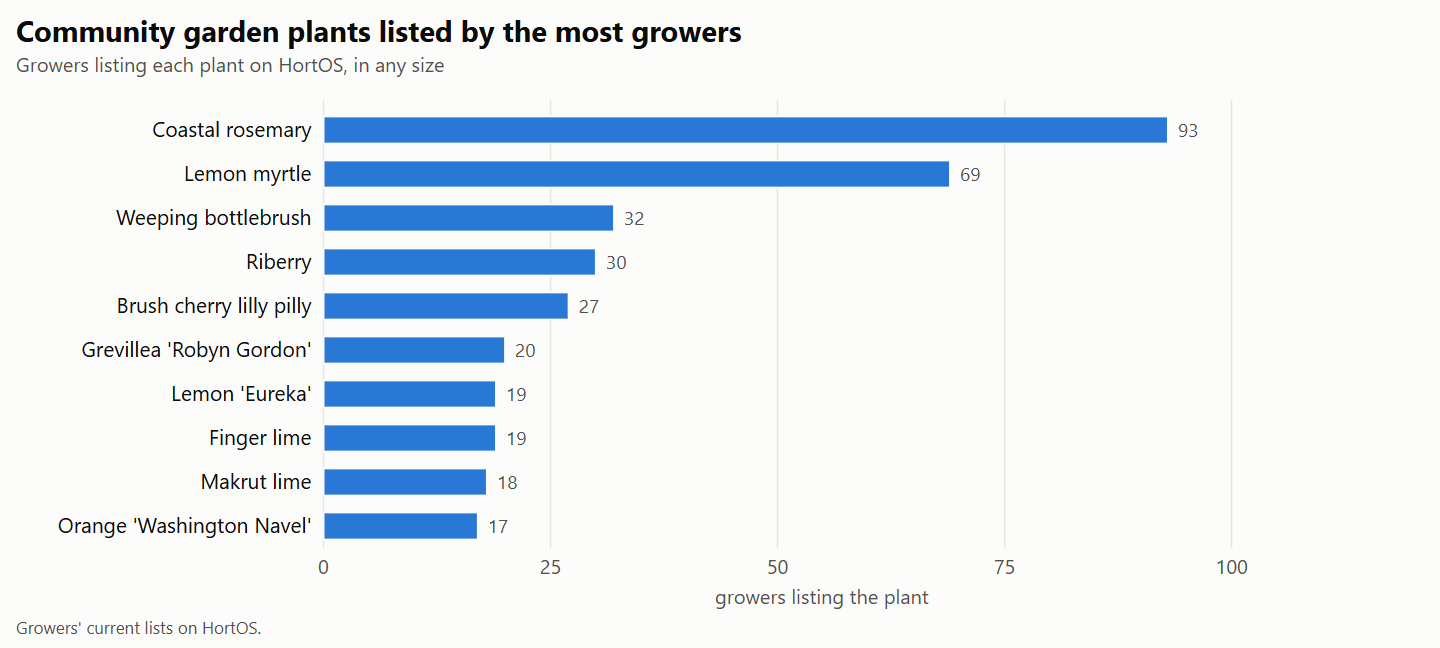
| The most listed plant here | Coastal rosemary (Westringia fruticosa) is listed by 93 growers on HortOS, more than any other plant in this page's table. |
What councils ask a group to cost
Maitland City Council's 2025 application form asks each group for a financial plan covering the costs of establishing its garden. The plan has four parts. It shows the proposed budget and funding sources for building the garden, the costs for planting it out, the ongoing maintenance costs, and the cost of annual insurances. Plants appear twice in that form, because the maintenance line names plants beside mulch, manure and tool repair.
The council's 2025 guidelines put the order of work plainly: a group with a vision and a plan then has to develop a budget and work out where the money will come from. The same guidelines say structures that need a development application add to what the group must budget for and to how long the process takes. Maitland City Council's 2025 guidelines list public liability insurance of at least $20 million, subject to the proposal, among the costs to consider, and that figure is Maitland's rule for gardens on its own land.
The City of South Perth's application guidelines (undated, read October 2026) say the amount a garden needs varies dramatically with its size, its scale of activity, its skills and its volunteer time. They say a group should write down the costs it expects and find the money for them. Fruit trees, seeds and seedlings sit among the primary set-up costs in that list, and a nursery for plant propagation sits among the other possible ones.
Brisbane City Council's environment grants fund community gardens on council-owned land up to $2,500 in category 1 of the 2026 round. The council says the category 1 grant funds materials and services used directly for the nominated project. Applications for that grant opened on 5 October 2026 and close on 2 November 2026, according to Brisbane City Council's grants page.
The table below gathers these points. Its rows are the cost and eligibility items read for this page in the councils' own documents, each with the document and the year it comes from.
| Council | What it asks or lists | Document and year |
|---|---|---|
| Maitland, NSW | Financial plan must cost the planting out | Application form, 2025 |
| Maitland, NSW | Budget and funding sources for the build | Application form, 2025 |
| Maitland, NSW | Public liability cover, minimum $20 million, subject to the proposal | Guidelines, 2025 |
| Maitland, NSW | At least five members; incorporated, or backed by an incorporated body | Council page, 2025 |
| Maitland, NSW | Existing trees and roots stay in place | Guidelines, 2025 |
| South Perth, WA | Fruit trees, seeds and seedlings as set-up costs | Application guidelines, undated |
| Brisbane, Qld | Grant of up to $2,500 for a garden | Environment grants, 2026 |
Money is only part of what a council asks. Maitland City Council's 2025 page says an application needs a management plan, a garden concept design and a risk assessment, and that a successful group enters a licence agreement with the council. The page speaks to groups interested in funding and establishing a garden on council land, and it says gardens on private land are not the council's to manage.
Trade prices for the perennial planting
Maitland City Council's 2025 guidelines carry a checklist of plant types that includes vegetables, herbs, native or Indigenous plants, berry fruit shrubs, flowers, bush food, and fruit or nut trees. The table below prices the perennial end of that checklist: fruit trees, bush food, herbs, and natives for a hedge or a border. Its 22 rows are a sample picked for this page from plants of the types named in Maitland's checklist and South Perth's cost list. Each has a price page on HortOS for the exact species or cultivar. The number of picked plants that are not shown is 0.
Prices are medians across growers' current trade lists on HortOS: one price per grower, ex GST, freight not included, with the number of growers pricing each size in brackets. Anyone can see the prices on HortOS, and only the trade can order.
| Plant | Growers listing it | Size most growers price | Median (growers pricing) |
|---|---|---|---|
| Lemon 'Eureka' (Citrus limon 'Eureka') | 19 | 400 mm | $127.50 (6) |
| Lemon 'Meyer' (Citrus limon 'Meyer') | 14 | 200 mm | $20 (3) |
| Mandarin 'Imperial' (Citrus reticulata 'Imperial') | 13 | 400 mm | $125 (3) |
| Orange 'Washington Navel' (Citrus sinensis 'Washington Navel') | 17 | 400 mm | $125 (5) |
| Makrut lime (Citrus hystrix) | 18 | 400 mm | $127.50 (4) |
| Fig 'Brown Turkey' (Ficus carica 'Brown Turkey') | 7 | 200 mm | $16 (3) |
| Fig 'Black Genoa' (Ficus carica 'Black Genoa') | 9 | 300 mm | $50 (3) |
| Pomegranate 'Wonderful' (Punica granatum 'Wonderful') | 4 | Fewer than three growers | |
| Avocado 'Hass' (Persea americana 'Hass') | 4 | Fewer than three growers | |
| Finger lime (Citrus australasica) | 19 | 140 mm | $15.50 (4) |
| Lemon myrtle (Backhousia citriodora) | 69 | 400 mm | $137.15 (15) |
| Riberry (Syzygium luehmannii) | 30 | Tube | $2.05 (10) |
| Warrigal greens (Tetragonia tetragonioides) | 11 | Tube | $2.95 (8) |
| Rosemary (Rosmarinus officinalis) | 16 | 140 mm | $7.20 (4) |
| English lavender (Lavandula angustifolia) | 15 | 140 mm | $6.78 (6) |
| Oregano (Origanum vulgare) | 10 | 100 mm | $2.60 (3) |
| Common sage (Salvia officinalis) | 10 | 100 mm | $2.60 (3) |
| Bay tree (Laurus nobilis) | 13 | 300 mm | $59 (4) |
| Brush cherry lilly pilly (Syzygium australe) | 27 | 200 mm | $18.97 (6) |
| Coastal rosemary (Westringia fruticosa) | 93 | 140 mm | $6.25 (45) |
| Weeping bottlebrush (Callistemon viminalis) | 32 | Tube | $3.50 (8) |
| Grevillea 'Robyn Gordon' | 20 | 200 mm | $14.68 (8) |
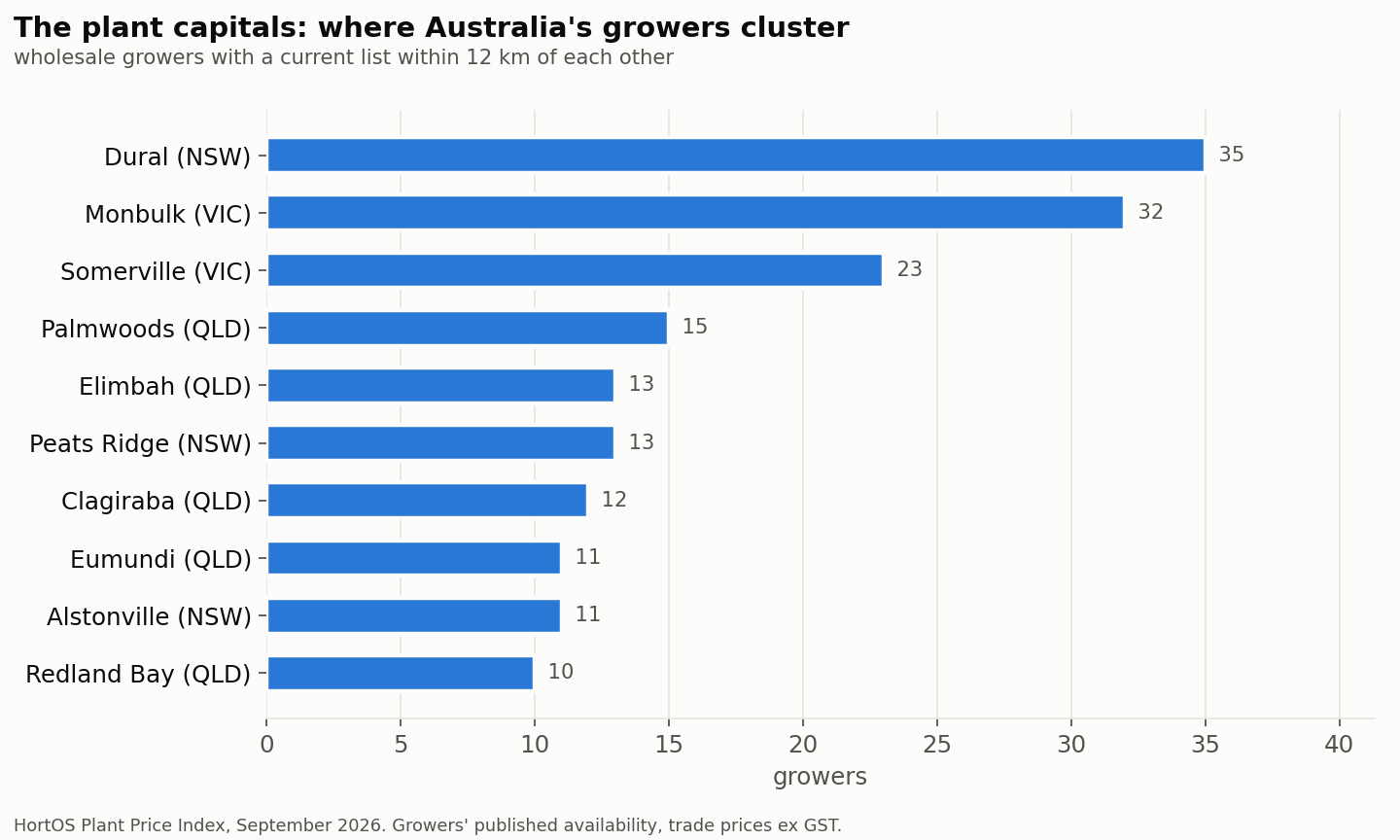
Most of the growers listing the plants in this table are in Queensland and Victoria. The size shown for each plant is the pot size most growers price; ex ground lines are not counted.
A row reads like this. Coastal rosemary (Westringia fruticosa) has a median of $6.25 in a 140 mm pot across 45 growers. Lemon myrtle (Backhousia citriodora) is listed by 69 growers, and 15 of them price the 400 mm pot at a median of $137.15.
Some brackets are small. The median for fig 'Brown Turkey' rests on 3 growers, fig 'Black Genoa' on 3, lemon 'Meyer' on 3, mandarin 'Imperial' on 3, finger lime (Citrus australasica) on 4 and bay tree (Laurus nobilis) on 4. Pomegranate 'Wonderful' and avocado 'Hass' have no size priced by three growers, so their rows show no median. A median on so few moves when one grower changes a price.
The size column matters as much as the price column. Lemon 'Eureka' is shown in a 400 mm pot and lemon 'Meyer' in a 200 mm pot, so the gap between the two rows is a gap between pot sizes and not between lemons. Each plant's price page prints every size its growers price, which lets a committee cost the size it means to plant.
Plants that arrive without an invoice
Not every plant in a community garden is bought. Maitland City Council's 2025 guidelines say in-kind support, reused resources, grants and sponsorship from local garden centres are among the ways gardens have been resourced. Among reused resources a group might look into, they name plant cuttings and heritage seed from other community gardens or neighbours. The same list names plants from local nurseries that are past their date or root bound in the pot.
The City of South Perth's guidelines (undated, read October 2026) add that a local business may give an item free or at a discount in return for advertising at the garden.
The same Maitland guidelines set limits on what goes in the ground. They say existing trees and their root systems must stay in place when the new garden goes in. They also say several plants cannot be planted in a Maitland community garden, and they point to New South Wales Government lists for which ones.
What the figures do not show
A median is the middle of what growers print on one date. It is not a quote, and it carries no freight, no GST and no minimum order. Whether a grower sells to a community group at all is the grower's decision, and the guide to buying from a wholesale grower sets out how that question is usually settled. A count here is growers listing the plant, not how many plants exist or how well it suits a site.
The table prices no vegetables, seeds or seedlings, which South Perth's guidelines list among set-up costs, and nothing for soil, mulch, beds, water or tools. It does not say how many of each plant a garden needs, and this page adds up no total. That sum belongs to the group's own concept design and to the grower's written quote.
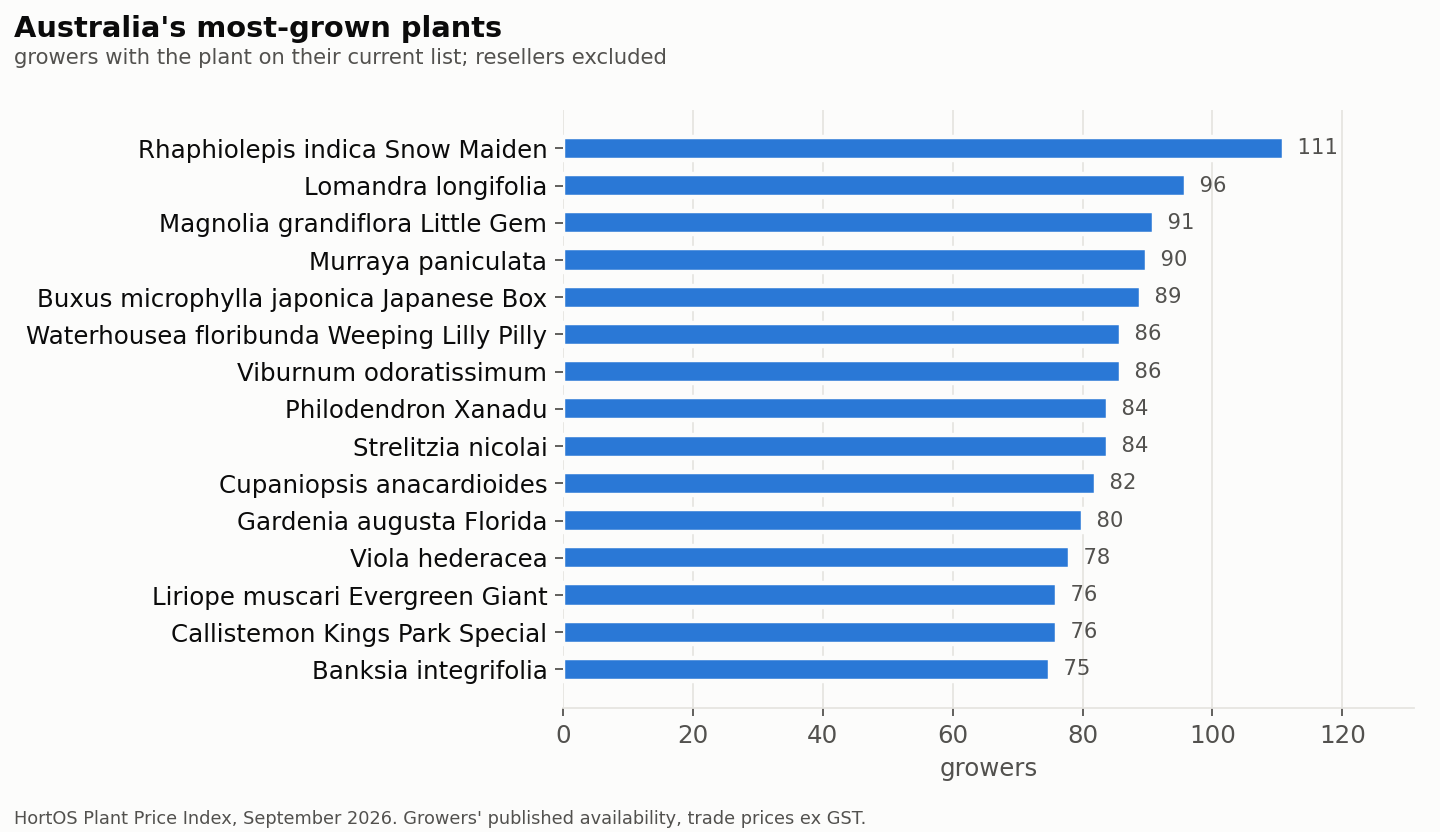
The native rows are a small sample chosen to match a council checklist. A group planning a longer native border can read grower counts for many more species in the guide to the most grown native plants.
The council facts are local too. Each was read in one council's document for one year, and none of them describes another council's land or a state rule. Each state's growers are on its hub: New South Wales for a Maitland garden, Western Australia for South Perth and Queensland for Brisbane.
What to watch for
- Reading a median as a quote. The figure is the middle of several growers' list prices on one date, before freight and GST, and a grower's own quote can sit above or below it.
- Comparing rows of different pot sizes. Each row shows the size most growers price, so two fruit trees side by side can be a small pot and a large one.
- Carrying one council's figure to another council's land. Maitland's insurance minimum, Brisbane's grant cap and South Perth's cost list each belong to that council and that document.
- Costing the planting once. Maitland City Council's 2025 form asks for ongoing maintenance costs as a separate line, and it names plants in that line.
- Taking the plant list as settled before the council reads it. Maitland City Council's 2025 guidelines say several plants cannot be planted in its community gardens.
Getting it right
- Ask the council that owns the land for its current guidelines and application form. The council decides what the financial plan has to show and which lines it reads.
- Settle the plant list inside the group's concept design, then ask the council which plants its guidelines do not allow. The council decides, not the grower.
- Open the price page of each plant on the list and note the pot sizes growers price, the number of growers behind each median and the date.
- Ask each grower in writing whether it sells to an incorporated community group, what its minimum order is, and what freight costs. The grower decides its own terms and gives the quote.
- Ask the grant program's officer what the grant pays for before plants go into a grant budget, and ask the council what insurance cover its licence requires.
A word of caution
The council requirements on this page are those of Maitland City Council, the City of South Perth and Brisbane City Council, read on the dates shown, and each council can change its documents. The council that owns the land decides what an application needs, and that council is the body to ask. The medians are what growers printed on HortOS, and the live price pages change as growers update their lists. On price, size and terms, the grower's written quote is the figure that counts.
Sources
- Maitland City Council, Starting a community garden: who applies and how.
- Maitland City Council, Community Gardens Guidelines: budget, insurance and in-kind sources.
- Maitland City Council, Community Gardens Application Form: the financial plan's four parts.
- City of South Perth, Application Guidelines for Community Gardens: set-up and upkeep cost lists.
- Brisbane City Council, Environment grants: grant amounts for community gardens.
More guides
Buying From a Wholesale Grower When You Are Not in the Trade
Landcare groups, schools, friends groups and landholders can buy from wholesale growers when they order like the trade: in quantity, ahead of the season, on the grower's terms. This page explains who sells to whom, what an ABN and GST change, minimum orders and pooling, tubestock against pots, provenance, lead times, freight and state borders.
The Most Grown Native Plants in Australia, by State
A data page, not an essay: the Australian native plants held by the most wholesale growers, counted grower by grower and state by state from growers' current lists on HortOS, with the median trade price at the size most growers price. Two paragraphs on what the tables show and what they do not, then the tables, refreshed each edition.
Shade trees for schools and playgrounds: sizes and trade prices
Cancer Council NSW's Guidelines to Shade, Victoria's school building handbook and the NSW Department of Education's design guide give three different answers on the size of shade tree to plant in a school ground. This page sets them side by side, with growers listing trees from one council's draft list and trade medians at three sizes.