Quercus palustris
Pin Oak
Every Quercus palustris on HortOS in one place: the plain species and 3 varieties. Pick a size to see it across all of them.
Part of Quercus: see them all
26 growers · 16 sizes · from $17.50 ex GST
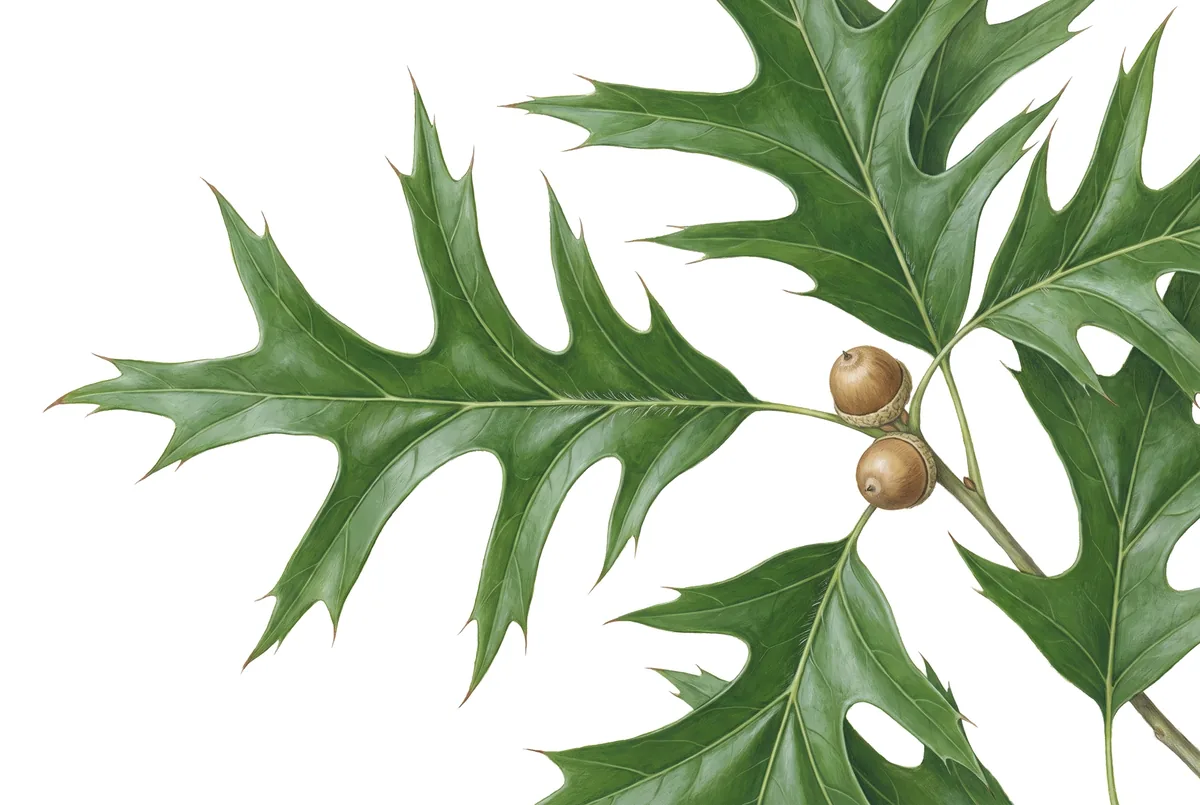
- Type
- Deciduous tree
- Height
- 15 m to 21 m
- Spread
- 8 m to 18 m
- Flowers
- Yellow-green, spring
- Sun
- Full sun to light shade
- Drought
- High
- Frost
- High frost tolerance
- In Australia
- Naturalised
Some growers show prices to verified trade buyers. Sign in or sign up with your ABN to see them and order.
Also grown by 11 nurseries (no sizes or prices listed)
Enquire with them for sizes and prices.
- Bell River NurserySpring Creek, NSW
- Ellenby Tree FarmGnangara, WA
- Established Tree Transplanters Pty LtdHoddles Creek, VIC
- Feature Trees Ballarat / Feature Trees Nursery BallaratNerrina, Ballarat, VIC
- Nightingale's Nest and NurseryKojonup, WA
- Provincial Plants and LandscapesFairbairn Avenues) Pialligo, ACT
- Small Tree FarmBalingup, WA
- The Tree ShopSurrey Hills, VIC
- Treekeepers NurseryNSW
- Westlake Nursery - TruganinaTruganina, VIC
- Yalca Fruit TreesNathalia, VIC
Growing pin oak
Climate and position. The ACT Government's tree sheet rates it very suitable for Canberra's climate, where it has performed very well, with high frost and drought tolerance, and gives it full sun to light shade. HortFlora records plantings across the ACT, New South Wales and Victoria, from Braddon to Bowral, Bathurst and Orange, and from Bright to Mount Macedon. The growing notes read come from Canberra and south-eastern Australia; none covers it in the subtropics or the tropics.
Soil and water. The ACT sheet gives it a wide range of soil types and says it tolerates all drainage conditions, and HortFlora notes that its wild home is clay floodplain soil and that it will tolerate flooding. The American references prefer moist, acid loams. Their one strong warning is alkaline soil, where chlorosis yellows the leaves and can severely damage the tree; no Australian reference read gives a pH limit.
Growth and pruning. The ACT sheet calls it long lived and slow to moderate in growth; NC State's toolbox calls its growth rapid, and a Victorian tree grower calls it fast growing. The ACT sheet says it can need formative pruning when young and removal of the lower branches as it matures.
Problems. The American references say the common oak diseases seldom attack it, though they also list insect pests such as scale, borers, sawflies and gall wasps, and diseases such as oak wilt and pin oak blight. No Australian reference read names a pest.
Using pin oak
HortFlora calls pin oak widely grown as an avenue tree and in large parks and gardens. The ACT sheet points to street plantings in Yarralumla, Braddon and Griffith, and suits it to parks and open areas where blocking winter sun is not a concern. Camden Council's street tree list (New South Wales), as quoted in the HortOS guide to car park shade tree rules, gives it 15 m tall and 10 m wide; the guide is clear that this is a street tree list, not one any council has accepted for car parks. A Victorian tree grower's sheet calls it a feature tree for large gardens and an avenue tree for its autumn colour, and the American references add shade for lawns and rain gardens. Where the space is narrow, Green Pillar is the columnar selection; where leaves hanging on through winter are the problem, EDF is the form listed for dropping them early.
What to check before you buy
Growers list the straight species as Pin Oak, Quercus palustris or both, and other forms under their own names, among them Green Pillar (also listed as Pringreen), EDF, Freefall and fastigiata: check which one a quote is for before comparing prices. The HortOS guide to street trees and canopy names pin oak among the trees listed at advanced sizes by the most growers, and the table above shows the sizes growers list. For a street or park job, the guide to specifying and procuring trees covers the Australian stock standard and the inspection at the nursery and at delivery. Stock moving between states travels under the state and territory biosecurity rules. Western Australia's Organism List gives Quercus palustris the legal status Permitted (s11) for the whole state, and permitted organisms must satisfy any import requirements that apply.
Cautions
The ASPCA lists oak (Quercus species) as toxic to horses, naming gallotannin as the toxic principle. The ACT sheet notes that it produces pollen, that falling acorns may be a nuisance where people walk, and that it needs at least 70 cubic metres of available soil; NC State's toolbox calls it shallow-rooted. The Australian Plant Census records it as naturalised in Western Australia, where Florabase lists it as alien and records it from the Harvey local government area, in the northern Jarrah Forest.
Western Australia's organism list gives Quercus palustris the legal status Permitted (s11) for the whole of the state, with no control category assigned for any local government area; permitted organisms must satisfy any import requirements that apply. (Western Australian Organism List (Department of Primary Industries and Regional Development))
Used forshadestreet and avenuespecimen
Prices are set by each grower and shown ex GST. Availability is confirmed by the grower at order.
Common questions
- Who grows Quercus palustris wholesale in Australia?
- 26 wholesale growers list Quercus palustris on HortOS right now, each with their own pot sizes and trade prices. They are in Victoria, New South Wales, Queensland, Western Australia, the ACT and South Australia. The growers are named on this page.
- What pot sizes does Quercus palustris come in?
- Growers on HortOS list Quercus palustris in 200mm, 250mm, 300mm, 330mm, 400mm, 25L, 35L, 45L, 75L, 100L and 6 more sizes.
- What does Quercus palustris cost wholesale?
- The median trade price in a 400 mm pot is $104.50 ex GST, across 8 growers who price it. Prices by pot size and state are on its trade price page.
- How do I order Quercus palustris from these growers?
- HortOS is for the trade. Add the lines you want to a list and send it: each grower gets their part of the order by email, confirms what they have and quotes freight, and nothing is bought until you approve it. Listing, searching and ordering are free.
- Is pin oak the same as Quercus palustris?
- Yes. Pin oak is the common name of Quercus palustris in the Atlas of Living Australia, the ACT Government's tree sheet and HortFlora, and Pin Oak with no cultivar name is the name of the straight species. Green Pillar and EDF are selections listed under their own names.
- How big does a pin oak grow?
- The ACT Government gives 18 m tall by 12 to 15 m wide in Canberra, Camden Council's street tree list 15 m by 10 m, and a Victorian tree grower 15 m by 8 m. The American references give 15 to 21 m tall and 12 to 18 m wide, and the Missouri Plant Finder less often about 30 m; HortFlora records a tree about 25 m tall at Mount Macedon in 1984.
- Does a pin oak keep its leaves in winter?
- Yes. The leaves turn rust-red to reddish brown in autumn and the dead brown leaves hang on through winter, on young trees above all, by the ACT sheet and HortFlora; a Victorian tree grower says they tend to cling to the shoots until spring growth starts. EDF is the selection listed for dropping its leaves early.
- Is pin oak frost and drought tolerant?
- In Canberra, yes: the ACT Government rates both its frost and its drought tolerance high and calls it very suitable for the climate. NC State's toolbox also lists it as tolerant of heat, drought and soil compaction.
- Will pin oak grow in alkaline soil?
- The American references warn against it, and the Missouri Plant Finder calls pin oak unsuitable for the alkaline soils of Missouri. The ACT sheet gives it a wide range of soil types and names no pH limit.
- Does pin oak grow in wet ground?
- Yes. HortFlora says its wild home is clay floodplain soil and that it will tolerate flooding, and the ACT sheet that it tolerates all drainage conditions; the American references list it for rain gardens and wet soil. Its species name, palustris, comes from the Latin word for marsh.
- When does a pin oak bear acorns?
- The American references say a tree may take 15 to 20 years to bear its first crop. The acorns are small and rounded, 0.6 to 1.3 cm long, in a thin saucer-like cup, and the ACT sheet notes that falling acorns may be a nuisance where people walk.
- Why is it called pin oak?
- The Missouri Plant Finder says that in the wild its shaded lower branches die and break off, leaving pin-like stubs that persist on the trunk, and that this gave the tree its common name.
Sources
- GBIF species match API
- Australian Plant Census (APC), Council of Heads of Australasian Herbaria: Quercus palustris (APC Dist.: WA, naturalised)
- Atlas of Living Australia (Quercus palustris, Pin Oak)
- ASPCA Animal Poison Control, Toxic and Non-Toxic Plants: Oak (Quercus species)
- Florabase, the Western Australian flora (Western Australian Herbarium, Department of Biodiversity, Conservation and Attractions): Quercus palustris
- Western Australian Organism List (Department of Primary Industries and Regional Development), the list of organisms declared under the Biosecurity and Agriculture Management Act 2007: Quercus palustris
- ACT Government, Transport Canberra and City Services: Design Standards for Urban Infrastructure, Plant Species for Urban Landscape Projects in Canberra, Quercus palustris (pin oak)
- HortFlora, the Horticultural Flora of South-eastern Australia (Royal Botanic Gardens Victoria): Quercus palustris, pin oak
- Missouri Botanical Garden Plant Finder: Quercus palustris
- North Carolina State Extension Gardener Plant Toolbox (Quercus palustris)
- A Victorian wholesale tree grower's fact sheet: Quercus palustris, pin oak tree (the grower's own description)
- The HortOS catalogue (the names growers list it under; the names growers list it and its selections under)
- The HortOS guides (street trees and canopy; car park shade tree rules, which quotes Camden Council's street tree list; specifying and procuring trees)
- ACT Government, Transport Canberra and City Services: Plant Species for Urban Landscape Projects in Canberra, Quercus palustris 'Pringreen' Green Pillar (written for that selection)
- A tree grower's published description: Quercus palustris FreeFall, the early defoliating or EDF pin oak (written for that selection)
The growers, sizes and prices above are live and change as lists arrive. Cite this page: HortOS, Pin oak (Quercus palustris), https://au.hortosapp.com/plants/quercus-palustris.
Found a fact that is wrong? Tell us and it is checked against its source.