- Type
- Deciduous tree
- Height
- 11 m to 21 m
- Spread
- 11 m to 25 m
- Flowers
- Yellow-green, spring
- Sun
- Full sun
- Drought
- Moderate
- Frost
- High frost tolerance
- In Australia
- Naturalised
Some growers show prices to verified trade buyers. Sign in or sign up with your ABN to see them and order.
Also grown by 9 nurseries (no sizes or prices listed)
Enquire with them for sizes and prices.
- Bell River NurserySpring Creek, NSW
- Bonsai Art NurseryHeatherton, VIC
- Coffs Harbour NurseryNSW
- Established Tree Transplanters Pty LtdHoddles Creek, VIC
- Provincial Plants and LandscapesFairbairn Avenues) Pialligo, ACT
- Small Tree FarmBalingup, WA
- Speciality TreesVIC
- Treekeepers NurseryNSW
- Woodlea Nursery PTY Ltd.Springfield, TAS
Growing english oak
Position. Full sun, by the ACT Government's sheet, the South Australian Plant Selector+ and the Missouri Plant Finder.
Soil and water. The ACT sheet says it grows in a range of soils across Canberra, tolerates waterlogging and grows better in low-lying areas that get more moisture, but not as well in loamy areas that hold less water. The Plant Selector+ ticks clay, loam and sand, acid to alkaline, lime, and minimal supplementary watering, and says it will take hot, dry conditions but is at its best in deep, moist, fertile soil.
Climate. The ACT sheet gives high frost tolerance and moderate drought tolerance; the Plant Selector+ ticks drought, moderate frost and pollution. The Missouri Plant Finder gives USDA zones 5 to 8.
Growth and care. The ACT sheet calls it long lived, faster growing when young and then moderate, and says thinning crowns on older trees may need dead wood removed; the Plant Selector+ that branches can be pruned to keep the shape.
Pests. Relatively free of pests and diseases, by the ACT sheet, though oak leaf miner and powdery mildew can affect it. American references add a long list of possible oak diseases and insects.
Using english oak
The ACT Government sheet says English oak gives excellent shade and suits parks and wide avenues, not small areas with limited space, and asks for at least 100 cubic metres of available soil. The Plant Selector+ calls it best suited to larger parks and gardens, and lists it for ornament, shade and timber. A New South Wales council's street tree list quoted in the HortOS guide to car park shade tree rules gives it 11 m tall and 11 m wide.
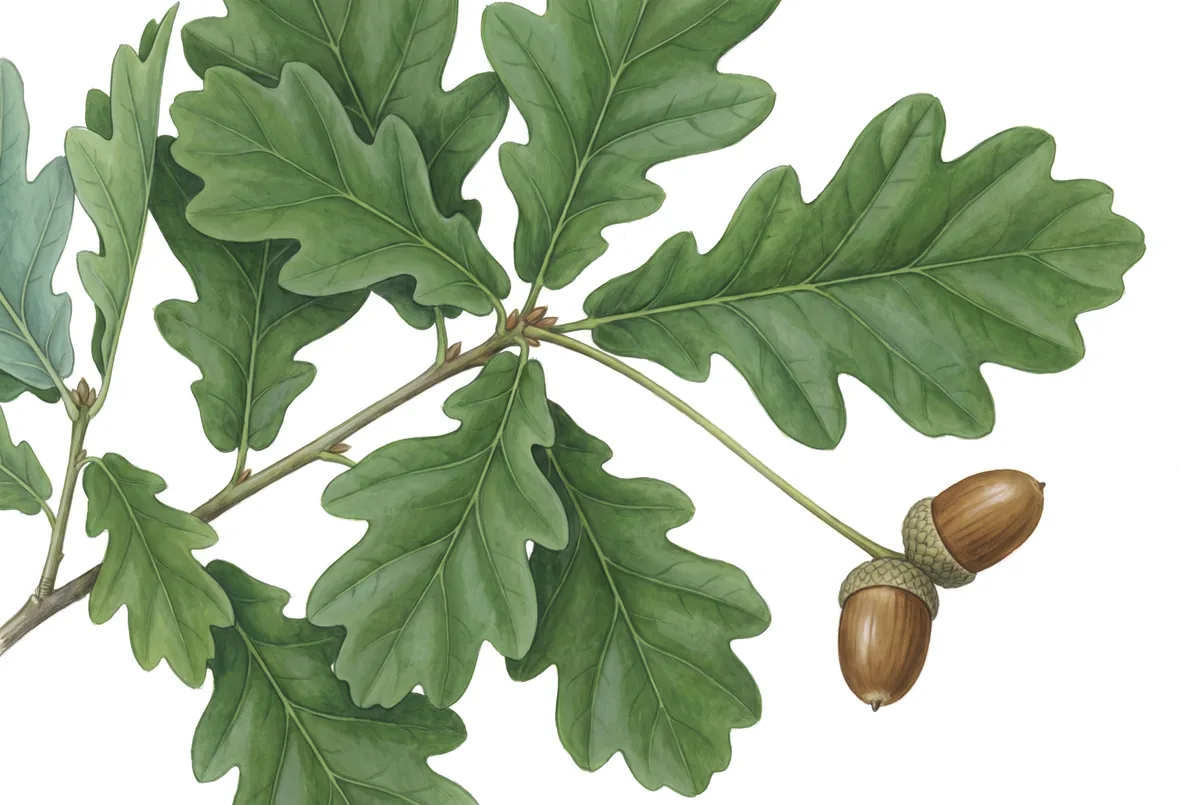
The ACT sheet rates its flammability very low. It flowers in early spring in slender yellow-green catkins, just before the leaves by the New South Wales flora and VicFlora, and VicFlora gives the acorns mostly in late summer and autumn; the Missouri Plant Finder says a tree may take 25 to 30 years to bear its first crop.
VicFlora says the columnar form 'Fastigiata' is grown as a street tree, and the ACT Government lists it for narrow spaces: see upright English oak.
What to check before you buy
For street and park work, the guide to specifying and procuring trees covers how to buy advanced trees; the table above shows the sizes growers list. Size the site for the tree: the ACT sheet's 20 by 20 to 25 m and 100 cubic metres of soil rule it out of small spaces. The ACT sheet warns that acorn drop can be a nuisance in pedestrian areas and that the tree produces pollen. Weigh the weed risk near bushland (see cautions). The guide to nursery plant quality sets out what to look for in the roots, stem and canopy. Stock crossing a state border travels under the state and territory biosecurity rules like any other plant.
Cautions
English oak can spread into bushland. The Weeds of Australia fact sheet says it has spread from plantings and is becoming regarded as an environmental weed in Victoria and the ACT, though infestations are not yet very widespread, and that Knox City in Victoria lists it as a minor environmental weed. VicFlora records it naturalised in Victoria, occasionally escaping into adjacent bush, and the New South Wales flora records it naturalised in South Australia and possibly becoming so around Canberra. The South Australian Plant Selector+ advises care when planting near native bushland or waterways, since the acorns germinate easily. The North Carolina toolbox, an American reference, lists it as poisonous to humans with a low severity if young leaves or raw acorns are eaten, and as a problem for horses.
Used forshadestreet and avenuespecimen
Prices are set by each grower and shown ex GST. Availability is confirmed by the grower at order.
Common questions
- Who grows Quercus robur wholesale in Australia?
- 16 wholesale growers list Quercus robur on HortOS right now, each with their own pot sizes and trade prices. They are in Victoria, New South Wales, South Australia and the ACT. The growers are named on this page.
- What pot sizes does Quercus robur come in?
- Growers on HortOS list Quercus robur in 90mm, 140mm, 200mm, 300mm, 400mm, 25L, 45L, 75L, 100L, 200L and 4 more sizes.
- What does Quercus robur cost wholesale?
- The median trade price in a 400 mm pot is $95.00 ex GST, across 5 growers who price it. Prices by pot size and state are on its trade price page.
- How do I order Quercus robur from these growers?
- HortOS is for the trade. Add the lines you want to a list and send it: each grower gets their part of the order by email, confirms what they have and quotes freight, and nothing is bought until you approve it. Listing, searching and ordering are free.
- How big does an English oak grow?
- The ACT Government sheet gives 20 m tall and 20 to 25 m wide. The Missouri Plant Finder gives 40 to 70 feet, about 12 to 21 m, tall and wide in cultivation, and a council list quoted in a HortOS guide 11 m by 11 m. The Plant Selector+ gives 18 to 20 m high but only 5 to 6 m across, out of line with the others.
- How fast does English oak grow?
- The ACT Government sheet says it grows faster when young and then at a moderate rate, and is long lived.
- Does English oak tolerate wet soil?
- The ACT Government sheet says it is tolerant of waterlogging and grows better in low-lying areas that get more moisture.
- Does English oak have autumn colour?
- The ACT sheet gives leaves turning yellowish brown in autumn; the Missouri Plant Finder says there is no fall colour to speak of.
- How long before an English oak drops acorns?
- The Missouri Plant Finder says it may take 25 to 30 years to bear its first crop. The ACT sheet warns that acorn drop can be a nuisance in pedestrian areas.
- Is English oak a weed in Australia?
- VicFlora records it naturalised in Victoria and occasionally escaping into adjacent bush; the New South Wales flora naturalised in South Australia and possibly around Canberra. The Plant Selector+ advises care near bushland and waterways. The Weeds of Australia fact sheet says it has spread from plantings and is becoming regarded as an environmental weed in Victoria and the ACT, though infestations are not yet very widespread, and that Knox City in Victoria lists it as a minor environmental weed.
Sources
- GBIF species match API
- PlantNET, the New South Wales flora online (Royal Botanic Garden Sydney), Flora of NSW
- VicFlora, the Flora of Victoria online (Royal Botanic Gardens Victoria)
- ACT Government, Transport Canberra and City Services: Plant Species for Urban Landscape Projects in Canberra, fact sheet: Quercus robur
- Plant Selector+, Botanic Gardens and State Herbarium of South Australia
- Missouri Botanical Garden Plant Finder
- North Carolina State Extension Gardener Plant Toolbox
- The HortOS guide: car park shade tree rules
- Weeds of Australia (Environmental Weeds of Australia fact sheets, Lucid keys): Quercus robur
The growers, sizes and prices above are live and change as lists arrive. Cite this page: HortOS, English oak (Quercus robur), https://au.hortosapp.com/plants/quercus-robur.
Found a fact that is wrong? Tell us and it is checked against its source.