- Type
- Deciduous perennial
- Height
- 0.6 m to 1.5 m
- Spread
- 0.6 m to 1.5 m
- Flowers
- White, summer to autumn
- Sun
- Full sun (the RHS); full sun to part shade by NC State
- In Australia
- Not native
Growing baby's breath
Position and soil. The RHS wants full sun and a light, sharply drained soil, preferably alkaline, on chalk, loam or sand, and says it dislikes winter wet. NC State gives full sun, or part shade on its own grading, in well-drained neutral to alkaline soil. The Missouri Botanical Garden, on its page for the cultivar 'Bristol Fairy', gives average, somewhat dry soil, slightly alkaline by preference, and warns that plants may not survive winter in wet, poorly drained ground. HortFlora's note on the genus says the name comes from the Greek for chalk-loving, after the soils most species grow on.
Roots. The RHS calls it tap-rooted, and NC State says to leave it undisturbed so its large, fleshy roots are not damaged; the Missouri Botanical Garden also advises against moving established plants.
Cold and dry. The RHS rates it H4, hardy through most of the United Kingdom. NC State says it resists salt, drought and deer. No Australian reference read gives a frost figure or a drought rating.
Pruning. The RHS advises deadheading regularly for a second flush and cutting back in autumn once the foliage has died down. NC State says to cut it back after flowering for more blooms, and warns that double-flowered cultivars grafted onto single-flowered rootstocks must not be cut below the graft union.
Pests and problems. The RHS finds it generally pest-free but open to stem rots; the Missouri Botanical Garden reports some susceptibility to botrytis and aster yellows and says the plant may need staking. NC State notes a bacterium, Pantoea agglomerans, that stops root development and troubles the floral industry.
Using baby's breath
Baby's breath is grown for its flowers, in the border and in the vase. HortFlora calls it more widely known as a florists' flower, NC State says florists use it as a filler in bouquets, roses above all, and the RHS suggests it for cut flowers and for borders and beds. NC State also suggests containers and cutting gardens, and recommends it for screening the stems left dying by spring bulbs and by early-summer flowers such as poppies. The Missouri Botanical Garden says much the same about filling gaps left by bulbs that go dormant by early summer, and that the taproot was once used as a soap. NC State adds that the flowers attract butterflies, and gives 0.3 to 0.9 m of space for each plant.
What to check before you buy
HortFlora names six cultivars of Gypsophila paniculata: 'Bristol Fairy' and 'Flore Pleno', double white; 'Flamingo', double pale pink; 'Pink Star', double pink; 'Rosy Veil', dark pink and possibly a hybrid with Gypsophila repens; and 'Snowflake', with small, often double, pure white flowers. NC State adds that some double-flowered cultivars are grafted onto single-flowered rootstock. Some lines on HortOS name only Gypsophila spp. and a colour, and another species, Gypsophila muralis, is listed under its own name, so check which plant a line names; the guide to reading an availability list covers how a line names a plant. The table above shows the sizes growers list, and the guide to nursery plant quality what to check before stock leaves the grower. The guide to buying from a wholesale grower says nursery stock sent interstate must meet the receiving state's quarantine entry conditions and may need a plant health certificate.
Cautions
NC State lists baby's breath as poisonous to humans at medium severity, with skin irritation after contact and eye, nose and sinus irritation and asthma after repeated handling. The Australian Plant Census records it as doubtfully naturalised in South Australia and formerly naturalised in Queensland. Overseas references report it as a weed: NC State in parts of the United States, a declared noxious weed in California, and the Missouri Botanical Garden says it has escaped cultivation in parts of Australia and other countries.
Used forcut flowerpots and courtyards
Prices are set by each grower and shown ex GST. Availability is confirmed by the grower at order.
Common questions
- Is baby's breath a weed in Australia?
- The Australian Plant Census records Gypsophila paniculata as doubtfully naturalised in South Australia and formerly naturalised in Queensland. The Missouri Botanical Garden says it is considered invasive in parts of Australia, among other countries.
- How big does baby's breath grow?
- The RHS gives 1 to 1.5 m high and wide. NC State gives about 0.6 to 0.9 m each way, and the Missouri Botanical Garden around the same, densely branched and rounded.
- What soil does Gypsophila paniculata need?
- Well drained above all. The RHS asks for light, sharply drained, preferably alkaline soil and says it dislikes winter wet; NC State gives neutral to alkaline soil. The genus name means chalk-loving, by HortFlora.
- When does baby's breath flower?
- From early summer to early autumn by NC State, and from summer into autumn by the Missouri Botanical Garden. The RHS says regular deadheading brings a second flush.
- What are the flowers like?
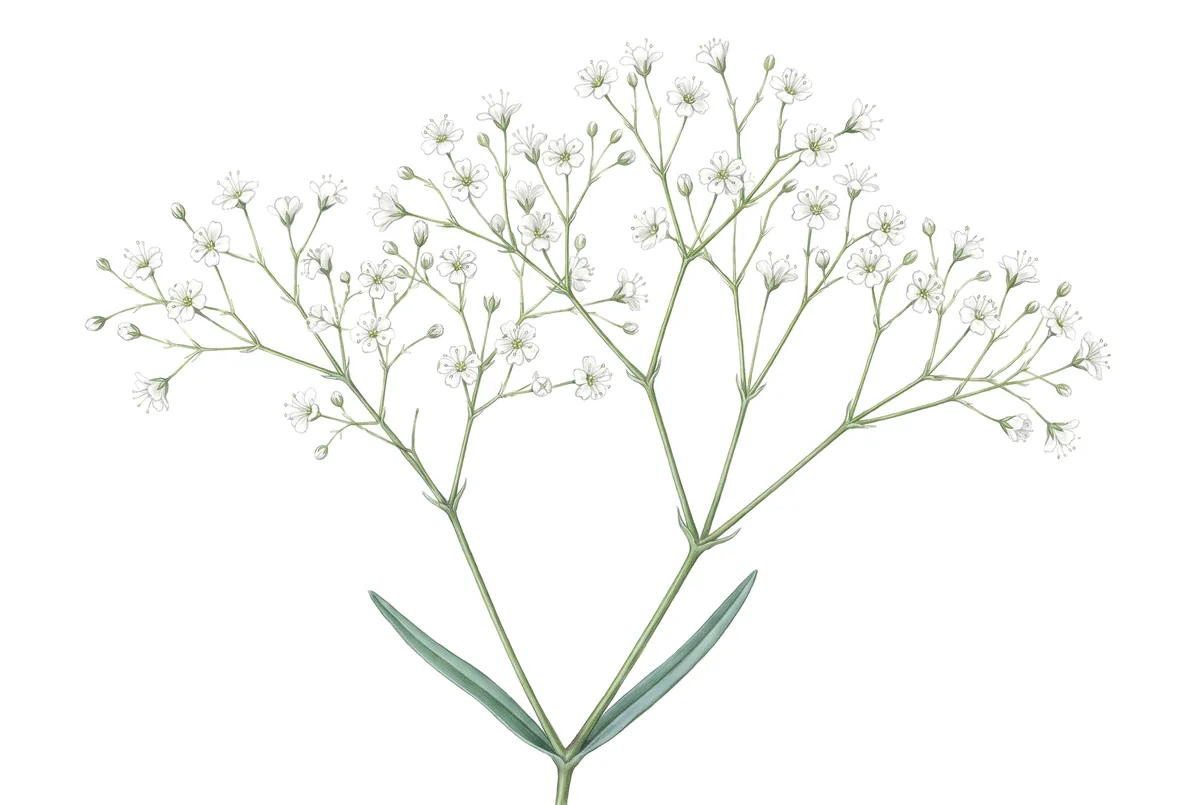
- Numerous and extremely small, the sepals and petals 1 to 2 mm long, carried in loose, much-branched open clusters on fine stems, by HortFlora. NC State gives white, sometimes double; the named cultivars include double white and pink forms.
- Can baby's breath be moved once planted?
- The references advise against it. NC State says to leave it undisturbed to avoid damaging its large, fleshy roots, and the Missouri Botanical Garden to avoid root disturbance or transplanting once established. The RHS calls it tap-rooted.
- Is baby's breath harmful to handle?
- NC State lists it as causing contact dermatitis, with eye, nose and sinus irritation and asthma after repeated handling, at medium severity.
Sources
- GBIF species match API (Gypsophila paniculata)
- Australian Plant Census (APC), Gypsophila paniculata
- Atlas of Living Australia (Gypsophila paniculata)
- HortFlora, the Horticultural Flora of South-eastern Australia (Royal Botanic Gardens Victoria): Gypsophila paniculata
- HortFlora, the Horticultural Flora of South-eastern Australia (Royal Botanic Gardens Victoria): the cultivars of Gypsophila paniculata
- HortFlora, the Horticultural Flora of South-eastern Australia (Royal Botanic Gardens Victoria): Gypsophila, the genus
- Royal Horticultural Society (RHS) plant profile: Gypsophila paniculata
- North Carolina State Extension Gardener Plant Toolbox: Gypsophila paniculata
- Missouri Botanical Garden Plant Finder: Gypsophila paniculata 'Bristol Fairy', and its notes on the species
- The HortOS catalogue (the gypsophila lines growers list)
- The HortOS guides (reading an availability list; judging nursery plant quality; buying from a wholesale grower)
The growers, sizes and prices above are live and change as lists arrive. Cite this page: HortOS, Baby's breath (Gypsophila paniculata), https://au.hortosapp.com/plants/gypsophila-paniculata.
Found a fact that is wrong? Tell us and it is checked against its source.