Dypsis cabadae
Golden Cane Palm
Every Dypsis cabadae on HortOS in one place: the plain species and 1 variety. Pick a size to see it across all of them.
Part of Dypsis: see them all
7 growers · 8 sizes · from $30.00 ex GST
- Type
- Palm
- Height
- 8 m to 9 m
- Sun
- Full sun to light shade (the Palm and Cycad Societies of Australia)
- In Australia
- Not native
| Size | Grower | PricePrice ex GST | ||
|---|---|---|---|---|
| Tube | Troppo Propagation'Blue Cane Palm'Tube | $430.00 | ||
| 180mm | Bamboo Land Pty Ltd'Blue Cane Palm'180mm | $30.00 | ||
| 200mm | Bamboo Land Pty Ltd'Blue Cane Palm'200mm | $40.00 | ||
| 250mm | ILandscape Sunshine Coast Nursery & Garden Centre'Blue Cane Palm'250mm | $125.00 | ||
| 250mm | Eumundi Palms – by Philip Redhead250mm | Price on application. Sign in to ask the grower. | ||
| 300mm | Bamboo Land Pty Ltd'Blue Cane Palm'300mm | $80.00 | ||
| 300mm | ILandscape.com.au300mm | $110.00 | ||
| 300mm | Eumundi Palms – by Philip Redhead300mm | Price on application. Sign in to ask the grower. | ||
| 400mm | ILandscape.com.au400mm | $300.00 | ||
| 400mm | ILandscape Sunshine Coast Nursery & Garden Centre'Blue Cane Palm'400mm | $350.00 | ||
| 45L | Plant Connections45L | $100.00 | ||
| 100L | Plant Connections100L | $180.00 | ||
| 100L | Bamboo South Coast100L | $650.00 |
Growing cabada palm
Climate. No reference read gives a frost figure. Cultivated Palms of the World, a book published in Sydney and quoted in the Hawai'i Pacific Weed Risk Assessment, says it prefers warm temperate to tropical climates and has moderate to high light needs, and An Encyclopedia of Cultivated Palms, quoted in the same assessment, calls it tender to cold and adaptable only to USDA zones 10b and 11, with mature palms in the most favoured spots of zone 10a.
Position, soil and water. The Palm and Cycad Societies of Australia give the same conditions as for the golden cane palm: full sun or light shade and moist, well-drained soil. They add that it is quite commonly grown.
Growth. The same society names its main drawback: it grows much more slowly than the golden cane palm. The encyclopedia, as quoted, says it never makes a dense clump and often takes several years to start suckering.
Problems. The encyclopedia, quoted in the assessment, calls it slightly susceptible to lethal yellowing disease. No Australian reference read gives its pests.
Propagation. Floridata, as quoted in the assessment, gives seed or suckers taken from the base, the seed taking 1 to 2 months to germinate; Cultivated Palms of the World, quoted there too, gives 2 to 4 months for fresh seed.
Using cabada palm
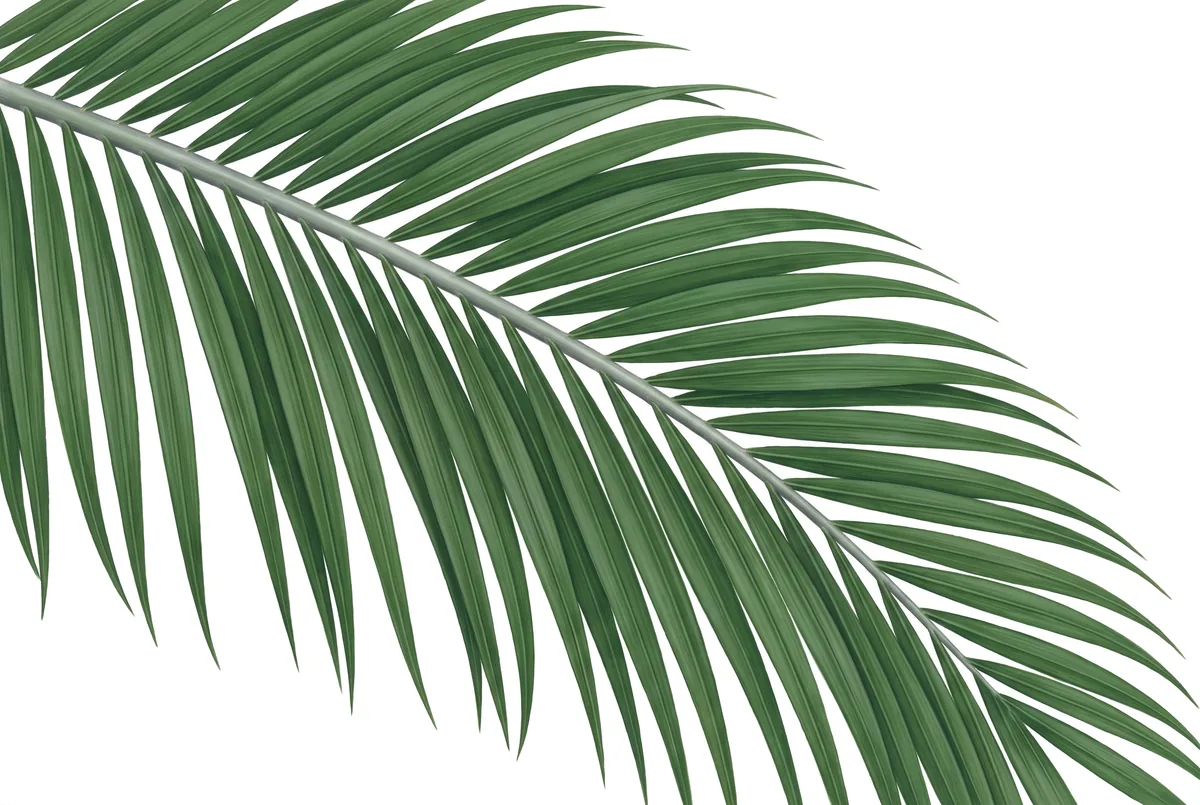
The references read give no Australian uses or planting distances, so what can be said comes from its form. It is a clumping palm with a sparse crown of arching feather leaves on trunks of medium height, by Cultivated Palms of the World as quoted in the weed risk assessment, and the trunks are its feature: smooth and green, ringed in whitish grey like bamboo, which Floridata, quoted there, singles out above everything else about it, and which Fairchild Tropical Botanic Garden admires as bamboo-like stems under arching leaves. Floridata gives each stem 6 to 10 deep green leaves, 2.4 to 3 m long, held a little more stiffly than those of the golden cane palm, and a long grey-green crownshaft.
What to check before you buy
On a grower's list the double name is a label, not a form: Dypsis cabadae and Chrysalidocarpus cabadae are one palm, the epithet cabadae is what identifies it, and the table above shows the sizes growers list under this name. Read past the genus to the epithet on the label. The Palm and Cycad Societies of Australia call it very similar to the golden cane palm, Dypsis lutescens, but without the gold colour. Weigh its pace too: it can take several years to start suckering, by the encyclopedia. The HortOS guide to judging nursery plant quality sets out what to check before stock leaves the grower. Stock that crosses a state border moves under the state and territory biosecurity rules on plants and soil.
Prices are set by each grower and shown ex GST. Availability is confirmed by the grower at order.
Common questions
- Who grows Dypsis cabadae wholesale in Australia?
- 7 wholesale growers list Dypsis cabadae on HortOS right now, each with their own pot sizes and trade prices. They are in Queensland and New South Wales. The growers are named on this page.
- What pot sizes does Dypsis cabadae come in?
- Growers on HortOS list Dypsis cabadae in Tube, 180mm, 200mm, 250mm, 300mm, 400mm, 45L and 100L.
- How do I order Dypsis cabadae from these growers?
- HortOS is for the trade. Add the lines you want to a list and send it: each grower gets their part of the order by email, confirms what they have and quotes freight, and nothing is bought until you approve it. Listing, searching and ordering are free.
- Is Chrysalidocarpus cabadae the same palm as Dypsis cabadae?
- Yes. GBIF accepts Dypsis cabadae, while World Flora Online now places the palm in Chrysalidocarpus, as Chrysalidocarpus cabadae. A line under either name is the cabada palm.
- How is cabada palm different from golden cane palm?
- It lacks the gold colour, and it grows more slowly, by the Palm and Cycad Societies of Australia. Floridata, as quoted in the Hawai'i Pacific Weed Risk Assessment, says its leaves are held a little more stiffly and that it grows taller, up to 9 m against 6 m.
- How tall does cabada palm grow?
- The Palm and Cycad Societies of Australia give about 8 m, and Floridata, as quoted in the weed risk assessment, up to 9 m. Its leaves are 2.4 to 3 m long by Floridata.
- Where does cabada palm come from?
- Fairchild Tropical Botanic Garden and the Palm and Cycad Societies of Australia give the Comoros Islands, between the northern tip of Madagascar and mainland Africa, where the society says it was rediscovered after only cultivated plants had been known. An Encyclopedia of Cultivated Palms and Cultivated Palms of the World, as quoted in the Hawai'i Pacific Weed Risk Assessment, presume or believe it came from Madagascar, and the encyclopedia says plants were first identified growing in Cuba.
- Are the fruits an irritant?
- Floridata, as quoted in the weed risk assessment, says the red fruits, about 1 cm long, are not a skin irritant as some palm fruits are. The Palms of Madagascar, quoted there too, describes them as ellipsoid and scarlet, 9 to 12 mm long, and the encyclopedia as rounded and red, about 1.3 cm wide.
Sources
- GBIF species match API: Dypsis cabadae
- World Flora Online: Dypsis cabadae, placed in Chrysalidocarpus
- Palm and Cycad Societies of Australia (PACSOA): Dypsis cabadae
- Fairchild Tropical Botanic Garden: Cabada palm, Dypsis cabadae
- Plant Pono (Hawai'i Invasive Species Council), Hawai'i Pacific Weed Risk Assessment: Dypsis cabadae
- The HortOS listing (the names growers list the palm under)
The growers, sizes and prices above are live and change as lists arrive. Cite this page: HortOS, Cabada palm (Dypsis cabadae), https://au.hortosapp.com/plants/dypsis-cabadae.
Found a fact that is wrong? Tell us and it is checked against its source.