Artichoke - Green Globe Cynara scolymus
No grower lists this plant right now
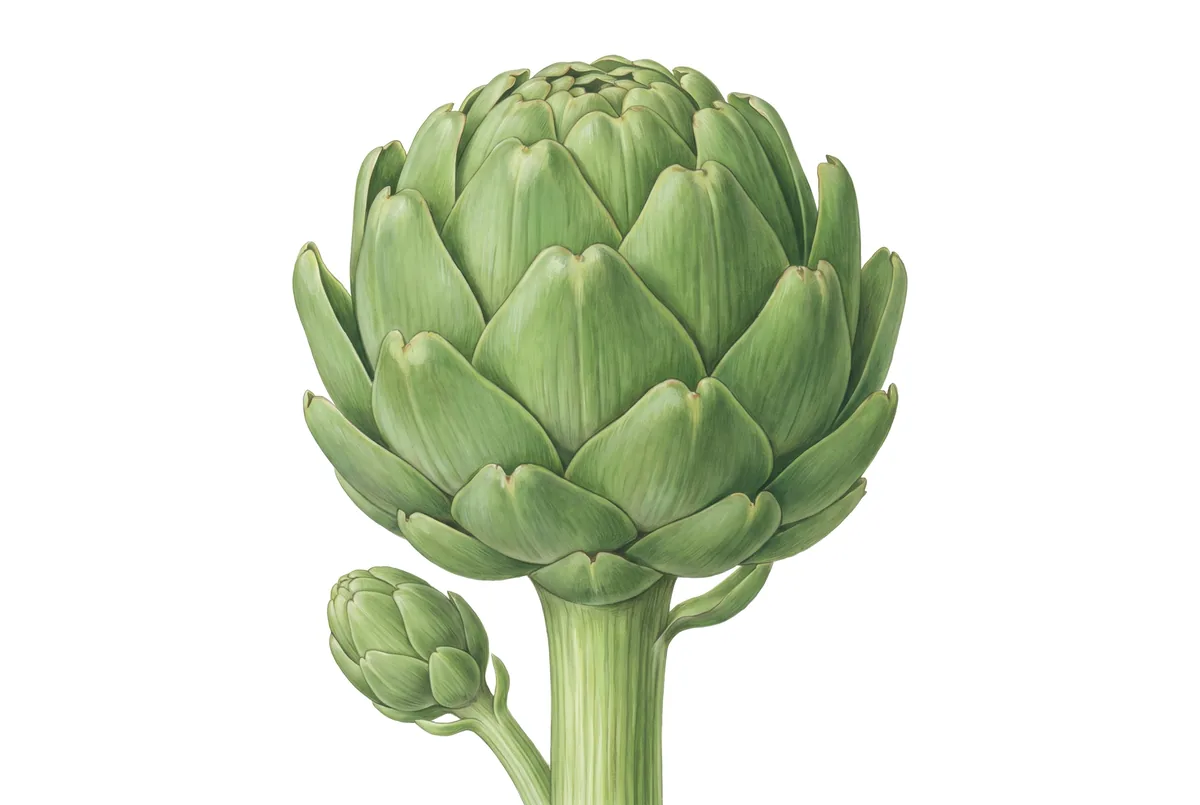
- Type
- Perennial
- Height
- 0.9 m to 2 m
- Spread
- 0.6 m to 1.5 m
- Flowers
- Purplish blue, summer to autumn (NC State); buds from early spring to early summer (Sustainable Gardening Australia)
- Sun
- Full sun (Sustainable Gardening Australia: a sunny spot)
- In Australia
- Not native
Growing green Globe artichoke
Climate and season. Sustainable Gardening Australia says globe artichokes, which come from the Mediterranean and Central Asia, grow in many parts of Australia, and that warmer subtropical and tropical climates give smaller flowers. It plants them from August to November in warm and temperate areas, and from September to November in cool to cold areas. No Australian reference read gives a frost rating.
Position and soil. Sustainable Gardening Australia asks for a sunny spot with plenty of space and rich, well-drained soil with plenty of compost: outer leaves that droop, it says, point to waterlogging in winter or drying out in summer, and compost helps against both. One Gardening Australia segment wants well-drained soil with good structure, not too much clay or sand; another says globe artichokes love sandy soil but grow in any kind, and feeds them sheep manure and potash, the potash to bring on more buds.
Water. Gardening Australia calls the plants very tough but says they benefit from regular watering and feeding, and mulches them to keep down weeds and stop the soil drying out.
Pruning. Sustainable Gardening Australia cuts the plants back to 30 cm high in autumn, then in winter leaves the four strongest shoots to flower the following spring.
Pests and problems. Crown rot, by Sustainable Gardening Australia in a humid climate, and by Gardening Australia in warmer climates, where good drainage and soil preparation ease it. The RHS, a British reference, adds slugs and snails on young plants and aphids on the buds and leaves.
Using green Globe artichoke
The crop is the unopened flower bud. Gardening Australia gives 12 to 14 weeks to harvest and cuts the buds with some stem once they are fully developed but while the fleshy outer scales are still tightly wrapped. Sustainable Gardening Australia picks them before they open, while the stem below is still pliable, leaving a few centimetres of stalk, and says seed-raised plants do not flower until their second year. Gardening Australia removes the first buds of young plants to bring on more, and says the plants can be picked nearly all year round. Heads left to dry on the plant suit dried arrangements, by Sustainable Gardening Australia, which also calls raised beds perfect for the plant. HortFlora says most of Australia's globe artichoke crop is grown at Werribee South in Victoria.
What to check before you buy
Growers list this variety as Artichoke - Green Globe Cynara scolymus, and list globe artichoke under Artichoke - Green and plain Artichoke too. HortFlora's other major Australian variety is Dark Purple Globe, with elongated purple heads and hooked scales, late in the season, and it lists Imperial Star as a Californian variety that may be grown under licence. The RHS describes a separate selection, 'Green Globe Improved', with large green buds and thick, fleshy scales. Gardening Australia says plants grown from seed can be very variable and are best sourced as divisions, and the RHS says plants raised by division or from offsets are clones of the parent. The guide to reading an availability list says to check whether a line names the species or a selection. Nursery stock moving interstate must meet the destination state's quarantine entry conditions; the guide to buying from a wholesale grower explains.
Cautions
For artichoke thistle, Cynara cardunculus, under which the Australian Plant Census files Cynara scolymus, the Tasmanian declared weeds index, as read, gives a declared weed whose importation, sale and distribution Tasmania prohibits; a Landscape South Australia fact sheet calls it a declared weed under the Landscapes South Australia Act 2019; VicFlora says it is declared a noxious weed in Victoria; and the Weeds Australia profile lists it as declared in South Australia, Tasmania and Victoria. North Carolina State Extension, an American reference, says globe artichoke may cause contact dermatitis.
Used foredible
Prices are set by each grower and shown ex GST. Availability is confirmed by the grower at order.
Common questions
- Is Green Globe a globe artichoke?
- Yes. HortFlora describes Green Globe as one of the two major globe artichoke varieties grown in Australia, with a globular, greenish head, early to mid-season. Gardening Australia lists it among its proven varieties.
- Is globe artichoke the same as Jerusalem artichoke?
- No. Sustainable Gardening Australia says the two are unrelated: the globe artichoke is a thistle whose flower bud is eaten, and the Jerusalem artichoke, Helianthus tuberosus, is a sunflower grown for its tuber.
- Is Cynara scolymus the same species as Cynara cardunculus?
- The references differ. GBIF accepts Cynara scolymus as a species of its own, while the Australian Plant Census treats it as a synonym of Cynara cardunculus, and the RHS and North Carolina State Extension call globe artichokes the Scolymus Group of that species. VicFlora says the globe artichoke probably came, through human selection, from spineless forms of Cynara cardunculus.
- How big does a globe artichoke grow?
- Sustainable Gardening Australia gives 1 to 1.5 m high and wide, and Gardening Australia about 1 m high with the same spread. HortFlora gives a herb to 2 m, and North Carolina State Extension 0.9 to 1.5 m tall and 0.6 to 0.9 m wide.
- When do you plant globe artichokes in Australia?
- Sustainable Gardening Australia gives August to November in warm and temperate areas and September to November in cool to cold areas. Gardening Australia grows them from seed in early spring or from offshoots taken from late spring to mid-summer.
- When are the buds ready to pick?
- Gardening Australia gives 12 to 14 weeks to harvest, cutting each bud with some stem when it is fully developed but its outer scales are still tight. Sustainable Gardening Australia says the first buds appear in early spring and keep coming until early summer.
- How are globe artichokes propagated?
- From offshoots or suckers at the base of the plant, or from seed, by Sustainable Gardening Australia and Gardening Australia. Gardening Australia warns that seed-grown plants can be very variable, so divisions are the better source.
- Is globe artichoke a weed in Australia?
- The Australian Plant Census files it under Cynara cardunculus, which it records as naturalised in four states. As artichoke thistle, that species is a declared weed in Tasmania by the Tasmanian Government's index, as read, and the Weeds Australia profile lists it as declared in South Australia, Tasmania and Victoria. The Tasmanian page treats the cultivated globe artichoke as a similar plant.
Sources
- GBIF species match API (Cynara scolymus)
- Australian Plant Census (APC), the National Species List: Cynara cardunculus
- VicFlora, Flora of Victoria (Royal Botanic Gardens Victoria): Cynara cardunculus subsp. flavescens
- Department of Natural Resources and Environment Tasmania, declared weeds index: Artichoke thistle
- HortFlora, the Horticultural Flora of South-eastern Australia (Royal Botanic Gardens Victoria): Cynara cardunculus, with Cynara scolymus and its varieties
- Sustainable Gardening Australia: Globe artichoke
- Gardening Australia (ABC) plant finder: Artichoke (Globe)
- Gardening Australia (ABC) fact sheet: The Vegie Patch, Artichoke
- Gardening Australia (ABC) fact sheet: Growing Globe Artichokes
- Weeds Australia profile (Centre for Invasive Species Solutions): Artichoke thistle, Cynara cardunculus
- Landscape South Australia (Northern and Yorke), fact sheet: Wild artichoke
- Royal Horticultural Society, grow your own: How to grow globe artichokes
- North Carolina State Extension Gardener Plant Toolbox (Cynara cardunculus Scolymus Group, globe artichoke)
- The HortOS catalogue (the names growers list it under)
- The HortOS guides (reading an availability list; buying from a wholesale grower)
The growers, sizes and prices above are live and change as lists arrive. Cite this page: HortOS, Green Globe artichoke (Cynara scolymus 'Green Globe'), https://au.hortosapp.com/plants/artichoke-green-globe-cynara-scolymus.
Found a fact that is wrong? Tell us and it is checked against its source.