Poisonous plant lists for childcare and the natives growers list
What four Australian documents say about poisonous plants around young children: the Kidsafe NSW list, the Queensland Poisons Information Centre's categories, a Sydney hospital factsheet and a NSW regulator's note. A table then gives grower counts and median trade prices for native plants those lists do not name. The service and its regulator decide.
Updated 8 September 2026. Figures are what the live au.hortosapp.com price and plant pages printed.
On this page
The director of a long day care centre, or a family day care educator replanting a yard, asks two things: which plants do the poison lists name, and what could be planted instead. The idea that matters most is that the Australian plant lists reported here name plants to avoid and none to plant in their place, so a plant's absence from a list is not a finding that it is harmless. The service and its regulator decide what goes in the ground.
This page reports the Kidsafe NSW list Grow me safely (2014), the Queensland Poisons Information Centre's plant categories (2026), the Sydney Children's Hospitals Network factsheet (2026) and a NSW Department of Education note for family day care (2022). Beside them sit grower counts and median trade prices for native plants those documents do not name, from HortOS, a free directory of Australian wholesale plant growers with their published availability and trade prices. It is not a statement of any law, and it is not medical advice.
Quick facts
| The Kidsafe NSW list | Grow me safely, plants to avoid, from the Kidsafe NSW Playground Advisory Unit (New South Wales, 2014), gives each plant a common name, a botanic name and an image, and no rating. |
|---|---|
| Queensland's categories | The Queensland Poisons Information Centre (page last updated July 2026) rates plants from category 1, extremely toxic, through to category 4, a respiratory irritant. |
| Childcare by name | The Queensland Poisons Information Centre (2026) says its category 2 plants should not be grown where young children have access, and it names preschools and childcare centres. |
| The age at higher risk | The Sydney Children's Hospitals Network factsheet (New South Wales, last updated 10 June 2026) says babies and children under four face a higher risk of being poisoned or hurt by plants. |
| Family day care | The NSW Department of Education's guidance note for family day care (2022) tells services that some plants are poisonous to children, and asks educators for a safety checklist every day. |
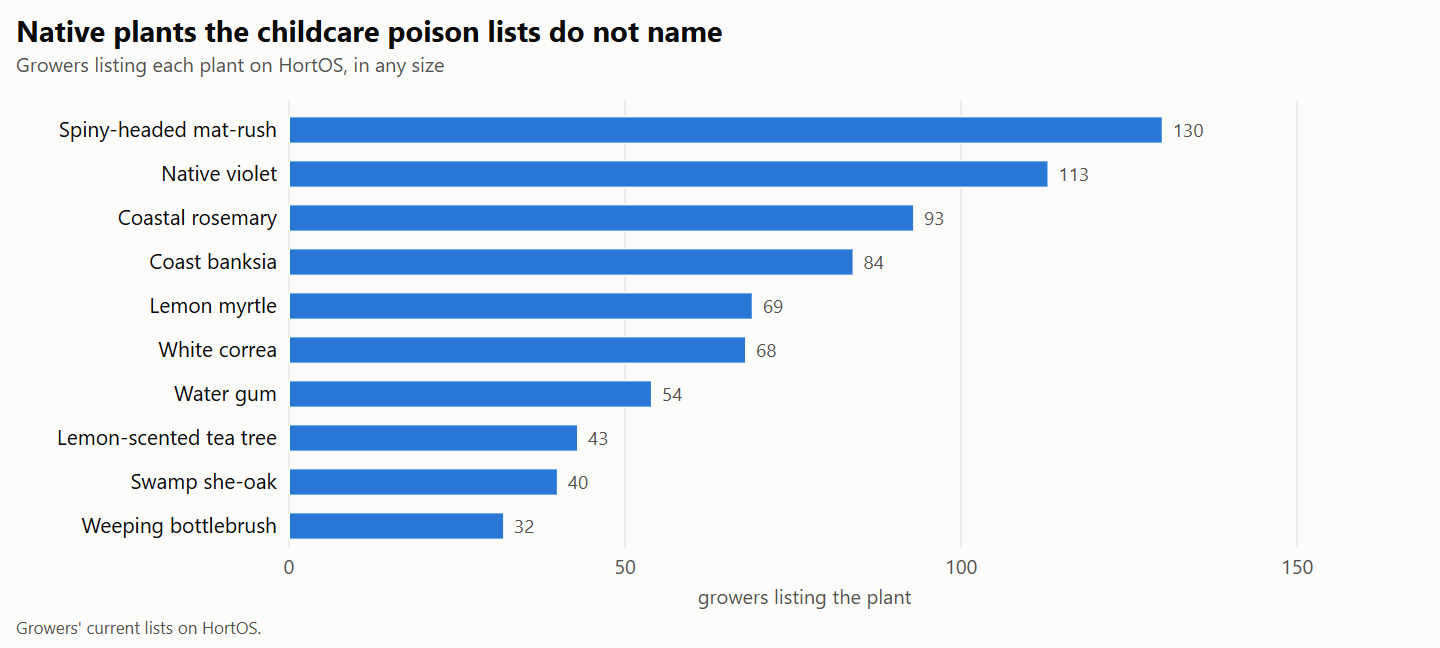
| Plants the lists do not name | The price table on this page has 16 native plants that none of the plant documents names, 16 of them with a median trade price on HortOS. |
What each list says and how it rates a plant
The documents do different jobs. One is a plain list, one is a rating scheme, one is a hospital's factsheet for parents, and one is a regulator's note to educators. The table below has one row for each thing they say that bears on a children's yard, with the document and its year. Every row is from a page read for this guide, and nothing in it is a HortOS figure.
| Authority | What it says | Document and year |
|---|---|---|
| Kidsafe NSW | A list of plants to avoid, by common and botanic name, unrated | Grow me safely, 2014 |
| Queensland Poisons Information Centre, category 1 | Extremely toxic: injury, lasting disability or death possible | Plants and mushrooms, 2026 |
| Queensland Poisons Information Centre, category 2 | Potentially toxic: not for places young children can reach, childcare included | Plants and mushrooms, 2026 |
| Queensland Poisons Information Centre, category 3 | Irritant to skin or eyes through sap, prickles or stinging hairs | Plants and mushrooms, 2026 |
| Queensland Poisons Information Centre, category 4 | Respiratory irritant through pollen or perfume | Plants and mushrooms, 2026 |
| Sydney Children's Hospitals Network | Under-fours carry the higher risk from plants | Factsheet, June 2026 |
| NSW Department of Education | Family day care is told that some plants are poisonous to children | Guidance note, 2022 |
The plain list is the Kidsafe NSW one (2014), from New South Wales. Among the plants it names are foxglove, daphne, English ivy, hellebore, the arum or calla lily, the coral tree, oleander and the white cedar tree. It does not say how harmful each one is.
The ratings come from Queensland. The Queensland Poisons Information Centre (2026) rates both white cedar and pink oleander as extremely toxic, the category it gives to plants that can injure, disable for life or, in some cases, kill. The Sydney Children's Hospitals Network (2026) describes pink oleander as common in Sydney and highly toxic, and says all parts of white cedar trees are toxic.
Native plants are on these pages too. The Queensland Poisons Information Centre (2026) rates the blue flax lily genus Dianella as potentially toxic, and lists the genus Grevillea as an irritant to skin or eyes. The Sydney Children's Hospitals Network factsheet (2026) names grevilleas among plants that can cause allergic dermatitis. The same factsheet says the long, pointed leaves of a yucca can puncture skin and an eardrum, which is an injury and not a poisoning.
On why small children are the concern, the Queensland Poisons Information Centre (2026) says of its category 2 plants that the risk may be greater for toddlers, who taste what they find and have small bodies. An older national record exists as well: the Australian National Botanic Gardens holds the illustrations from a poison plant project of 1984 to 1985 that was never completed.
Native plants the read documents do not name
The next table is the part of the question the lists leave open. Its rows are native shrubs, trees, grasses and groundcovers that many growers list. Each is from a genus that appears on none of these pages as read for this guide: the Kidsafe NSW list (2014), the Sydney Children's Hospitals Network factsheet (2026) and the Queensland Poisons Information Centre page (2026). The rows are a selection of such plants and not all of them. None of these documents clears a plant for a children's service. Plants considered for the table and not shown: 1.
Prices are medians across growers' current trade lists on HortOS: one price per grower, ex GST, freight not included, with the number of growers pricing each size in brackets. Anyone can see the prices on HortOS, and only the trade can order.
| Plant | Growers listing it | Size most growers price | Median (growers pricing) |
|---|---|---|---|
| Spiny-headed mat-rush (Lomandra longifolia) | 130 | 140 mm | $6.50 (65) |
| Coastal rosemary (Westringia fruticosa) | 93 | 140 mm | $6.25 (45) |
| White correa (Correa alba) | 68 | 140 mm | $6.95 (33) |
| Brush cherry lilly pilly (Syzygium australe) | 27 | 200 mm | $18.97 (6) |
| Lilly pilly (Acmena smithii) | 28 | 400 mm | $120.15 (6) |
| Weeping bottlebrush (Callistemon viminalis) | 32 | Tube | $3.50 (8) |
| Lemon-scented tea tree (Leptospermum petersonii) | 43 | 200 mm | $13.50 (11) |
| Coast banksia (Banksia integrifolia) | 84 | 200 mm | $12.50 (25) |
| Hairpin banksia (Banksia spinulosa) | 31 | Tube | $2.24 (9) |
| Tick bush (Kunzea ambigua) | 15 | Tube | $1.88 (8) |
| Water gum (Tristaniopsis laurina) | 54 | 300 mm | $49.50 (13) |
| Lemon myrtle (Backhousia citriodora) | 69 | 400 mm | $137.15 (15) |
| Swamp she-oak (Casuarina glauca) | 40 | Tube | $2.00 (19) |
| Knobby club-rush (Ficinia nodosa) | 30 | Tube | $1.35 (7) |
| Cut-leaf daisy (Brachyscome multifida) | 32 | Tube | $1.77 (10) |
| Native violet (Viola hederacea) | 113 | 140 mm | $6.50 (57) |
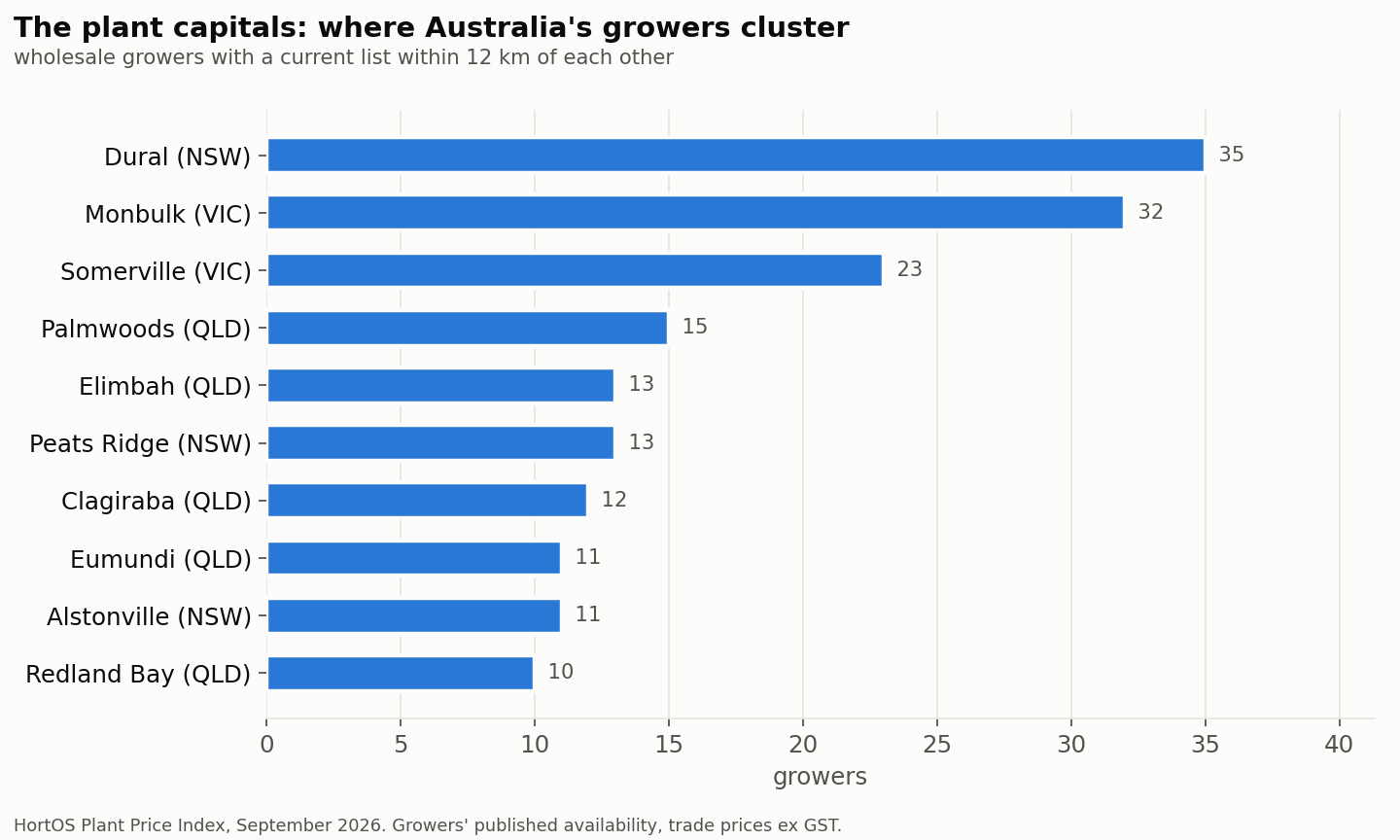
Most of the growers listing the plants in this table are in Victoria and New South Wales. The size shown for each plant is the pot size most growers price; ex ground lines are not counted.
The table runs from strappy plants to trees. Spiny-headed mat-rush is listed by 130 growers, and 65 of them price the 140 mm pot, at a median of $6.50. Native violet, a groundcover, is listed by 113 growers. Among the trees, coast banksia is listed by 84 growers and water gum by 54.
The pot sizes differ from row to row, so two medians in the table are not a comparison between two plants.
What the lists and the figures leave unsaid
A list of plants to avoid is silent about every plant it does not name. The Kidsafe NSW list dates from 2014, and the two health pages were both updated in 2026, so a plant can be on one and missing from another. The price table on this page was matched at the level of the genus. It says nothing about a single species or a named garden form, and nothing about berries, prickles, pollen or a child's own allergy.
The HortOS figures have limits of their own. A grower count is growers listing a plant in any size, not the number of plants in the ground. A median is a trade price for one pot size on one day, and a grower's own price sits above or below it. The directory does not show whether a grower will sell to a children's service directly, which is why the guide to buying from a wholesale grower is the place to read how growers set their terms. It also does not show who checked a plant's identity, so the guide to reading an availability list explains how botanical names and sizes are written on a list.
The table also cannot say that a plant suits a given yard. Soil, shade, climate and the height a tree will reach are outside all four documents and outside the price data.
What to watch for
- Reading a plant's absence from a list as clearance. None of the lists reported here says that an unnamed plant is harmless.
- Treating the Kidsafe NSW list (2014) as a rating. It names plants and gives no grade; the grades reported on this page are those of the Queensland Poisons Information Centre (2026).
- Assuming a native plant is never listed. The Queensland Poisons Information Centre (2026) rates Dianella as potentially toxic and lists Grevillea as an irritant to skin or eyes.
- Matching plants by common name. The Kidsafe NSW list (2014) gives a botanic name for each plant, and two different species in the price table are both sold as lilly pilly.
- Thinking only of plants that are eaten. Two of the Queensland Poisons Information Centre's categories (2026) cover irritation to skin, eyes and breathing, not swallowing.
Getting it right
- Begin with who decides. The approved provider and the state or territory regulatory authority decide what a service may plant, so ask them which plant list they work from.
- Check every proposed plant by botanical name against the lists themselves on the day. The Queensland Poisons Information Centre page was last updated in July 2026 and such pages change.
- Ask the designer or landscaper for the planting schedule with botanical names, so the person who checks the yard for the service can read each name against the lists.
- Ask the grower for the botanical name, the pot size and the trade price ex GST in writing, and ask whether the grower sells to a service or only through a landscaper.
- In New South Wales family day care, ask the service's coordinator how plants are covered in the daily safety checklist that the NSW Department of Education's guidance note (2022) describes.
A word of caution
This page reports what Kidsafe NSW, the Queensland Poisons Information Centre, the Sydney Children's Hospitals Network and the NSW Department of Education published, in the years given beside each. It does not say that any plant is harmless to children, and the plants in its price table are only plants those pages do not name. What a service plants is a matter for its approved provider and its regulatory authority, and a question about a child and a plant is one for a poisons information centre or a doctor.
Sources
- Kidsafe NSW Playground Advisory Unit, Grow me safely: plants to avoid: the 2014 list of plants.
- Sydney Children's Hospitals Network, Poisonous or harmful plants and children factsheet: a hospital factsheet on harmful plants.
- Queensland Poisons Information Centre, Plants and mushrooms (fungi) poisonous to people: toxicity categories, plant by plant.
- NSW Department of Education, Regulatory guidance note: creating child safe environments in family day care: the regulator's family day care note.
- Australian National Botanic Gardens, Poison plant illustrations: illustrations from an unfinished project.
More guides
Buying From a Wholesale Grower When You Are Not in the Trade
Landcare groups, schools, friends groups and landholders can buy from wholesale growers when they order like the trade: in quantity, ahead of the season, on the grower's terms. This page explains who sells to whom, what an ABN and GST change, minimum orders and pooling, tubestock against pots, provenance, lead times, freight and state borders.
Reading a Wholesale Availability List and Pricing a Quote
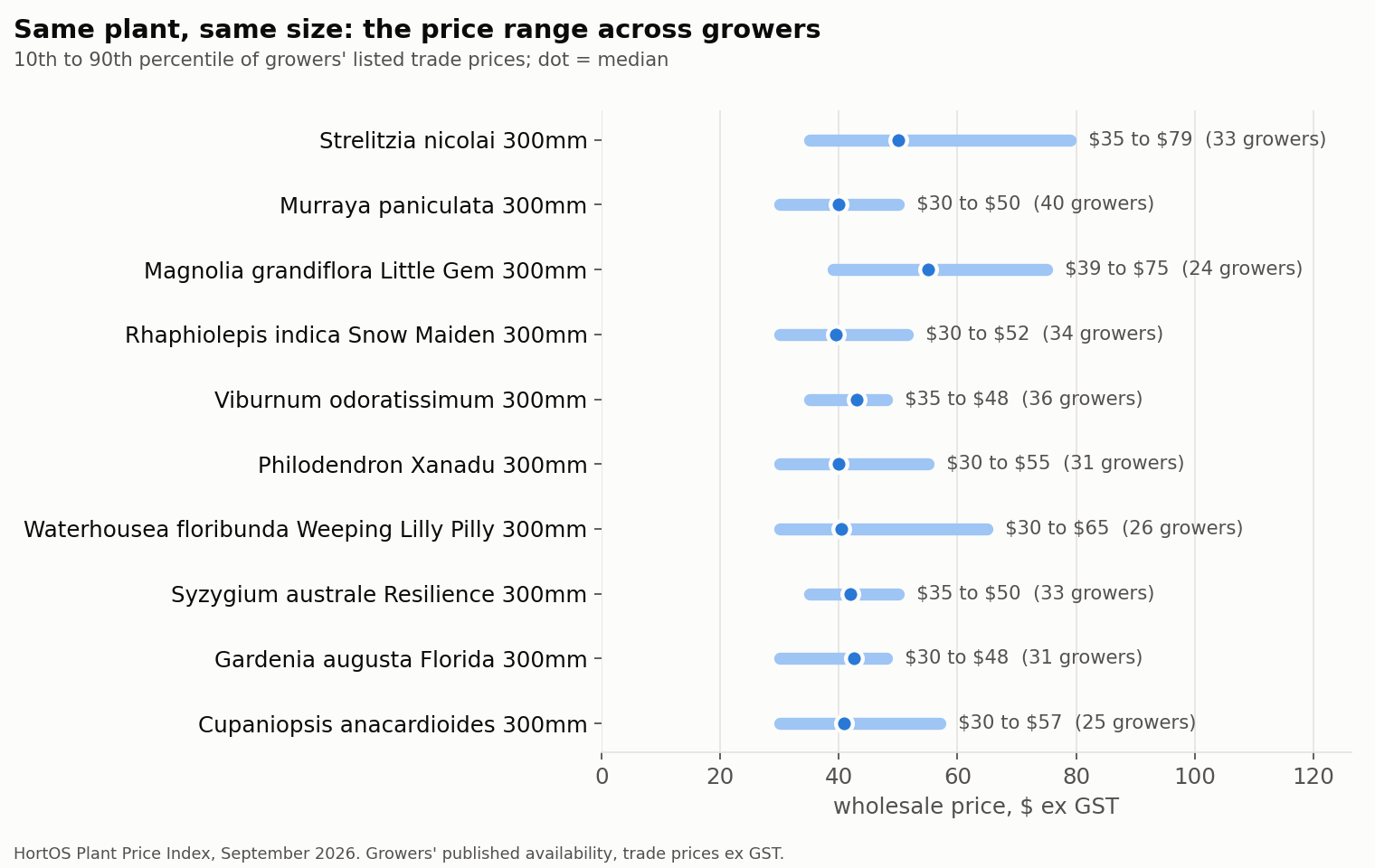
For landscapers, designers, estimators and students: what each column of a wholesale availability list means, how much the same plant at the same size varies between growers and states, how the low, median and high on the price pages are built, and how to carry the plant line of a quote from the list to the client.
Shade trees for schools and playgrounds: sizes and trade prices
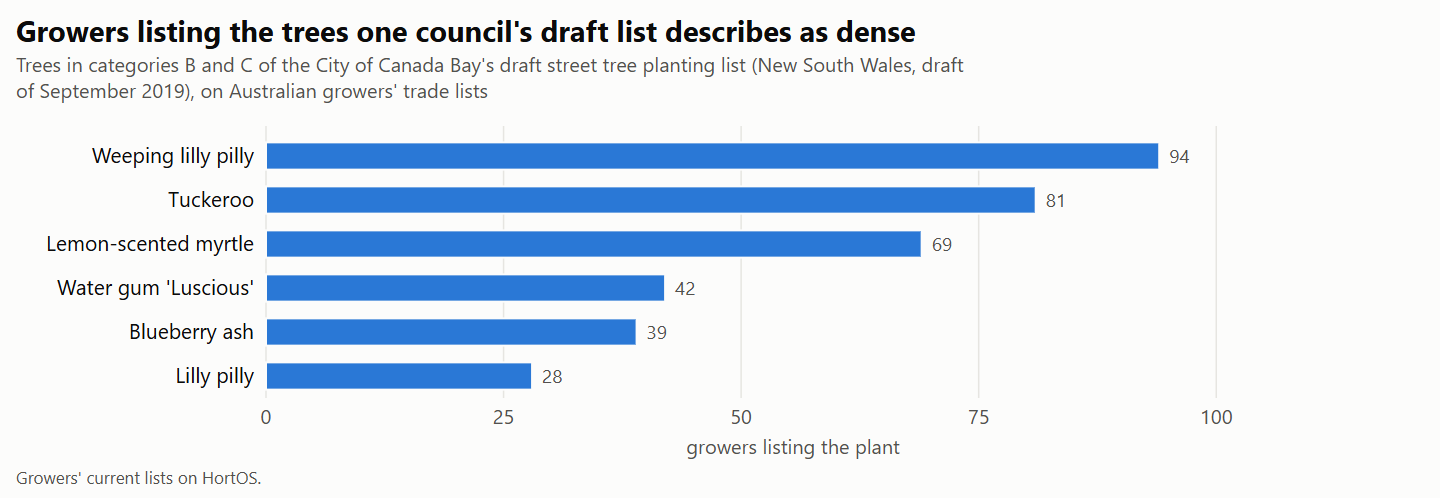
Cancer Council NSW's Guidelines to Shade, Victoria's school building handbook and the NSW Department of Education's design guide give three different answers on the size of shade tree to plant in a school ground. This page sets them side by side, with growers listing trees from one council's draft list and trade medians at three sizes.