Lilies, daylilies and cats, and what Australian growers list
What RSPCA Australia and the U.S. Food and Drug Administration say about true lilies, daylilies and other plants sold as lilies around cats, set beside HortOS figures: how many Australian growers list each named daylily, and grower counts and trade medians for plants the ASPCA (United States, read October 2026) lists as non-toxic to cats.
Updated 5 October 2026. Figures are what the live au.hortosapp.com price and plant pages printed.
On this page
- Quick facts
- Which plants sold as lilies the kidney warning covers
- Named daylilies on Australian growers' lists
- The American list both Australian bodies point to
- Garden plants the ASPCA (United States) lists as non-toxic to cats, on growers' lists
- What a trade list cannot tell a cat owner
- What to watch for
- Getting it right
- A word of caution
- Sources
A cat rescue volunteer is writing the care sheet that goes home with each adopted cat, and wants one line on lilies that a vet would not correct. RSPCA Australia (2024) says lilies of two genera, Lilium and Hemerocallis (the daylilies), are extremely toxic to cats, and that every part of the plant is toxic. The U.S. Food and Drug Administration (2021) says other plants with lily in the name sit outside those two groups and do not cause kidney failure in cats, though they may do other serious harm.
This page reports what RSPCA Australia (2022 to 2024) and the U.S. Food and Drug Administration (2021) say about lilies and cats. HortOS is a free directory of Australian wholesale plant growers with their published availability and trade prices. It adds grower counts for named daylilies, and counts and trade medians for plants on the non-toxic side of the ASPCA's list for cats (United States, read October 2026). None of it is veterinary advice: a cat's veterinarian decides.
Quick facts
| The warning | RSPCA Australia (2024) says lilies of the genera Lilium and Hemerocallis are extremely toxic to cats, and that a suspected poisoning is an emergency for a veterinarian. |
|---|---|
| How little, how fast | RSPCA Australia (2024) says every part of the plant is toxic, pollen included, and that even a small amount can bring on fatal kidney failure, usually 12 to 72 hours after a cat swallows it. |
| Cut flowers | RSPCA Australia (2023) says to check any plant, live or cut, before it comes into the home, and names lilies among the plants common in homes around Christmas that can poison some companion animals. |
| Daylilies on growers' lists | Stella de Oro, the daylily at the head of this page's daylily table, was listed by 10 growers on HortOS, in any size. |
| A plant from the ASPCA list | Star jasmine, which the ASPCA lists as non-toxic to cats (United States, read October 2026), was listed by 89 growers on HortOS. The 140 mm pot was priced by 43 growers at a median of $6.85 ex GST, freight not included. |
| Who decides | RSPCA Australia (2023) says to ask a veterinarian where a plant is in doubt, and names the Australian Animal Poisons Helpline, which it describes as a registered animal charity with a free service for pet owners. |
Which plants sold as lilies the kidney warning covers
RSPCA Australia's Knowledgebase article on lilies and cats, last updated on 18 December 2024, names two genera: Lilium and Hemerocallis. It says leaves, stems, petals and pollen are all toxic, and that vase water that has held lilies is believed to be toxic as well (RSPCA Australia, 2024). Even a small amount can cause fatal kidney failure, usually 12 to 72 hours after the cat swallows it (RSPCA Australia, 2024). The article says the chance of successful treatment rests on spotting the poisoning early and on prompt veterinary care (RSPCA Australia, 2024).
The U.S. Food and Drug Administration's page on lilies and cats, marked current as of 2021, draws the line the table below follows. On that page the kidney warning belongs to two groups only, the true lilies and the daylilies (U.S. FDA, 2021). Other plants with lily in the name fall in neither and, it says, do not cause kidney failure in cats (U.S. FDA, 2021). Some of those others do harm of another kind: the U.S. FDA (2021) rates the gloriosa lily and lily of the valley as very dangerous to cats and dogs. It treats calla lily, peace lily and Peruvian lily as less harmful, and says their signs usually clear without treatment (U.S. FDA, 2021).
Nobody has identified the toxin, the U.S. FDA (2021) says, and it acts on cats alone: a dog that eats a lily may get a minor stomach upset and does not go on to kidney failure. The same page says when the outcome is better. Early veterinary treatment greatly improves a cat's outlook, while a delay of 18 hours or more from the time the plant was eaten generally leaves the kidneys beyond recovery (U.S. FDA, 2021).
The rows below are plants sold as lilies that one of two bodies speaks to in the pages read: RSPCA Australia (2024) and the U.S. FDA (2021). Each row gives one statement by the body it names, with the year. The peace lily has no row of its own: what the U.S. FDA (2021) says of it is the statement in the calla lily row, which it makes of both plants. The table is not every plant sold as a lily, and the common names in the first row are examples only. The U.S. FDA's table of the lilies most dangerous to cats (2021) sets a Lilium name beside the Asiatic, Easter, Stargazer and tiger lilies. The first two botanical names are the genera RSPCA Australia names (2024). The other four are the names the ASPCA files each plant under (United States, read October 2026).
| Plant sold as a lily | Botanical name | What a named authority says, with its year |
|---|---|---|
| True lilies (Asiatic, Easter, Stargazer and tiger lilies among them) | Lilium species | RSPCA Australia, 2024: every part of the plant is toxic; a small amount can bring on kidney failure, generally 12 to 72 hours after it is swallowed |
| Daylilies | Hemerocallis species | RSPCA Australia, 2024: named with Lilium as extremely toxic to cats |
| Calla lily | Zantedeschia aethiopica | U.S. FDA, 2021: calcium oxalate crystals irritate the mouth, tongue and throat when the plant is chewed |
| Lily of the valley | Convallaria majalis | U.S. FDA, 2021: its toxins cause an abnormal heart rhythm that can be life-threatening |
| Gloriosa lily | Gloriosa superba | U.S. FDA, 2021: the roots or tubers may cause multi-system organ failure if chewed |
| Peruvian lily (alstroemeria) | Alstroemeria | U.S. FDA, 2021: mild stomach upset if a large amount is eaten; no kidney failure in cats |
Named daylilies on Australian growers' lists
Growers list daylilies by cultivar name, and the authorities speak of the genus. RSPCA Australia (2024) names Hemerocallis as a whole, and its garden dangers article (RSPCA Australia, 2022) names the day lily among the lilies that can cause acute kidney failure in cats. On the ASPCA's list (United States, read October 2026) the entry for day lilies is for the genus, Hemerocallis spp., and is marked toxic to cats and non-toxic to dogs. Neither RSPCA Australia (2024) nor the ASPCA (United States, read October 2026) separates one cultivar from another.
The table holds every daylily with a cultivar name and a plant page on HortOS. Pages for assorted or colour lots, a line with no cultivar name and names sold under a range name are left out: 6 pages in all. Grower counts are the growers listing each plant on HortOS, in any size. A count here is growers listing the plant, not how many plants exist or how well it suits a site.
| Plant | Growers listing it | States with most growers |
|---|---|---|
| Daylily (Hemerocallis 'Stella de Oro') | 10 | Victoria 8, New South Wales 2 |
| Daylily (Hemerocallis 'Stella Rouge') | 8 | Victoria 4, Queensland 3, Tasmania 1 |
| Daylily (Hemerocallis 'Stella Tangerine') | 8 | Victoria 4, Queensland 3, Tasmania 1 |
| Daylily (Hemerocallis 'Stella Bella') | 7 | Victoria 3, Queensland 2 |
| Daylily (Hemerocallis 'Stella Citron') | 5 | Queensland 2, Victoria 2, Tasmania 1 |
| Daylily (Hemerocallis 'Cranberry Baby') | 4 | Queensland 2, Tasmania 1, Victoria 1 |
| Daylily (Hemerocallis 'Bettlyn') | 3 | Queensland 3 |
| Daylily (Hemerocallis 'On and On') | 2 | Tasmania 1, New South Wales 1 |
| Daylily (Hemerocallis 'Booby Ruby') | 2 | Queensland 2 |
| Daylily (Hemerocallis 'Saucy Rogue') | 1 | New South Wales 1 |
| Daylily (Hemerocallis 'My Reggae Tiger') | 1 | Victoria 1 |
The last column names the states with the most growers listing each plant, three at most, and stops where states tie for the next place.
The counts are small: Stella de Oro heads the table with 10 growers. A median needs three growers pricing the same pot size. Several of these daylilies fall short of that, so the table prints grower counts only and this page quotes no daylily price.
RSPCA Australia (2024) says a cat should be kept away from every kind of lily, as a cut flower, a pot plant or a plant in a garden bed. That sentence is the RSPCA's. The table shows only how many growers list each daylily, and passes no judgement on the plant.
The American list both Australian bodies point to
Both Australian bodies name the same American list. RSPCA Australia (2023) names the ASPCA among its resources: an animal welfare organisation in the United States whose poison control centre keeps lists of plants that are toxic and plants that are not. The Cat Protection Society of NSW (factsheet of April 2025) refers readers to the ASPCA's list for cats as the fuller list of plants and flowers that may endanger a cat.
As read in October 2026, each entry gives a plant's common and scientific names and says which of dogs, cats and horses it is listed as toxic or non-toxic to (ASPCA, United States). One plant can be marked differently for each animal: Lilium is entered as toxic to cats but non-toxic to dogs and to horses (ASPCA, United States, read October 2026).
Garden plants the ASPCA (United States) lists as non-toxic to cats, on growers' lists
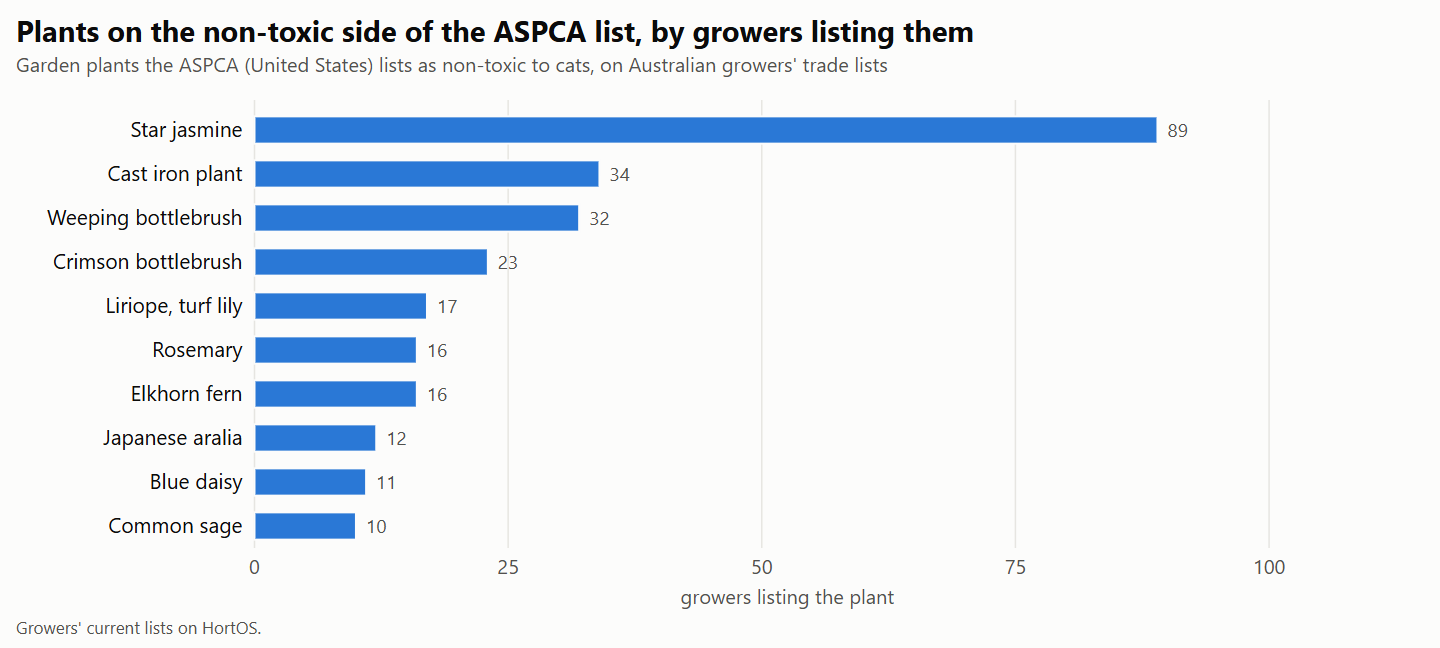
The table shows 13 plants chosen for this page: a climber, shrubs, ferns, herbs, a succulent and perennials. Each has its own entry, by species, on the ASPCA's list for cats and a plant page on HortOS under the same botanical name. All of them are entered as non-toxic to cats on the ASPCA's list (United States, read October 2026). They are a selection: several hundred other entries on the non-toxic side of that list do not appear here.
The rows run from the plant most growers list to the least. Prices are medians across growers' current trade lists on HortOS: one price per grower, ex GST, freight not included, with the number of growers pricing each size in brackets. Anyone can see the prices on HortOS, and only the trade can order.
| Plant | Growers listing it | Size most growers price | Median (growers pricing) |
|---|---|---|---|
| Star jasmine (Trachelospermum jasminoides) | 89 | 140 mm | $6.85 (43) |
| Cast iron plant (Aspidistra elatior) | 34 | 200 mm | $18.10 (22) |
| Weeping bottlebrush (Callistemon viminalis) | 32 | Tube | $3.50 (8) |
| Crimson bottlebrush (Callistemon citrinus) | 23 | Tube | $1.93 (12) |
| Liriope, turf lily (Liriope muscari) | 17 | 140 mm | $6.60 (9) |
| Rosemary (Rosmarinus officinalis) | 16 | 140 mm | $7.20 (4) |
| Elkhorn fern (Platycerium bifurcatum) | 16 | 140 mm | $12.38 (6) |
| Japanese aralia (Fatsia japonica) | 12 | 200 mm | $12.60 (4) |
| Blue daisy (Felicia amelloides) | 11 | 140 mm | $7.30 (5) |
| Common sage (Salvia officinalis) | 10 | 100 mm | $2.60 (3) |
| Hen and chicken fern (Asplenium bulbiferum) | 9 | 140 mm | $9.16 (4) |
| Camellia (Camellia japonica) | 9 | Fewer than three growers | |
| Mexican snowball, hens and chickens (Echeveria elegans) | 6 | Fewer than three growers |
Most of the growers listing the plants in this table are in New South Wales and Victoria. The size shown for each plant is the pot size most growers price; ex ground lines are not counted.
Not every median in the table is well supported. Rosemary was priced in the 140 mm pot by 4 growers and Japanese aralia in the 200 mm pot by 4. Common sage was priced in the 100 mm pot by 3 growers, and hen and chicken fern in the 140 mm pot by 4. A median on so few growers is easily shifted. Camellia and Mexican snowball have no size priced by three growers, so their rows show no median. The medians are national figures, not the price in any one state. Each count is the growers on the one HortOS plant page its row links. Some of these species have other pages on HortOS as well, under a common name or another form of the name, and the growers on those pages are not added in.
Liriope is also sold as turf lily, so one plant with lily in its name sits on the non-toxic side of the ASPCA's list for cats (United States, read October 2026). The guide to the most grown native plants shows which bottlebrushes rank among the natives most growers list, across Australia and in some states.
What a trade list cannot tell a cat owner
A grower's list gives a botanical name, a pot size and a trade price. It gives no toxicity rating, no record of what the plant was treated with, and no proof that the pot holds the species the ASPCA rated. The grower can answer the last two. The guide to reading a wholesale availability list explains each column of a list, the plant's name first.
The first table holds only plants sold as lilies that one of its two bodies speaks to in the pages read, and the daylily table only the cultivars with a name and a plant page. A count of growers does not say how many gardens hold a plant.
The ASPCA's list is American, and the ASPCA (United States, read October 2026) says it does not set out to cover every plant, only those met most often. Read in October 2026, its list for cats had no entry for flax lily (Dianella), Gymea lily (Doryanthes), mat rush (Lomandra) or kangaroo paw (Anigozanthos), so it rates none of them either way (ASPCA, United States).
The grower figures on this page are for plants growers list in pots, not cut flowers. RSPCA Australia (2023) names lilies among the plants common in homes around Christmas that can poison some companion animals, and says to check any plant, live or cut, before it comes indoors. A bunch of lilies from a florist is not something these figures show.
What to watch for
- Trusting the common name. The gloriosa lily and lily of the valley fall outside both kidney-warning groups, yet the U.S. FDA (2021) rates them very dangerous to cats and dogs. The ASPCA (United States, read October 2026) lists palm lily (Cordyline australis) as toxic to dogs and cats.
- Forgetting the daylily. RSPCA Australia (2024) names Hemerocallis beside Lilium, and the U.S. FDA (2021) lists the daylily among the lilies most dangerous to cats.
- Watching only the garden bed. RSPCA Australia (2023) says pollen picked up by brushing against a lily flower can be life threatening for a cat. The Cat Protection Society of NSW (factsheet of April 2025) says many florists and cat owners do not know that lilies are toxic to cats.
- Choosing a replacement by its look. The ASPCA (United States, read October 2026) lists clivia as toxic to dogs and cats.
- Hearing harmless where the list says non-toxic. The ASPCA (United States, read October 2026) says any plant, once eaten, may make a cat or dog vomit or upset its stomach. Its claim for a plant it lists as non-toxic is narrower: the plant is not expected to endanger the animal's life (ASPCA, United States, read October 2026).
Getting it right
- Go through the house and garden and note each plant or bunch of flowers sold as a lily or a daylily, or labelled Lilium or Hemerocallis, the two genera RSPCA Australia names (2024). Find the botanical name of each on the label, the invoice or the grower's list line.
- Check each name against the two genera RSPCA Australia names, Lilium and Hemerocallis (2024), and against the first table on this page. Where a name falls in either genus, what happens to the plant is the household's decision, and the cat's own vet is the person to ask how the warning applies.
- For any other plant, look it up by botanical name on the ASPCA's list, which RSPCA Australia (2023) and the Cat Protection Society of NSW (factsheet of April 2025) both point to. RSPCA Australia (2022) says to check with a vet before a pet has access to any plant.
- Look up who lists a plant from the last table in the grower directory, and ask the grower to confirm its botanical name before ordering. The Cat Protection Society of NSW (factsheet of June 2021) tells cat owners to check with their nursery when planting something new. Whether a grower sells outside the trade is the grower's call, and the wholesale buying guide covers how such orders usually work.
- If lily poisoning is suspected, RSPCA Australia (2024) says it is an emergency that needs veterinary attention at once. The veterinarian decides what is done next.
A word of caution
The toxicity statements here are those of RSPCA Australia (2022 to 2024), the U.S. Food and Drug Administration (2021) and the ASPCA (United States, read October 2026), not of HortOS. Each of those pages was read in October 2026 and may be revised after that. A grower count or a median says how the trade lists a plant, not how an animal reacts to it. What a cat needs is for a veterinarian to decide, and the Australian Animal Poisons Helpline is the service RSPCA Australia (2023) names for information on substances toxic to pets.
Sources
- RSPCA Australia Knowledgebase, Are lilies toxic to cats?: the two genera, timing.
- RSPCA Australia Knowledgebase, Where can I find out about plants that might be poisonous for my pets?: where to check a plant.
- RSPCA Australia Knowledgebase, What garden dangers must I protect my pet from?: garden plants and pets.
- RSPCA Australia Knowledgebase, What are common household dangers for pets?: plants and flowers indoors.
- Cat Protection Society of NSW, Factsheet: Cat-friendly flowers (April 2025): florist flowers and cats.
- Cat Protection Society of NSW, Factsheet: Hazards for your cat (June 2021): plants hazardous to cats.
- U.S. Food and Drug Administration, Lovely Lilies and Curious Cats: A Dangerous Combination: true lilies, daylilies, other lilies.
- ASPCA Animal Poison Control, Toxic and Non-Toxic Plants List: what the list covers.
- ASPCA Animal Poison Control, Toxic and Non-Toxic Plant List: Cats: the full list for cats.
- ASPCA entry, day lilies: the day lily listing.
- ASPCA entry, lily (Lilium species): the true lily listing.
- ASPCA entry, calla lily: the botanical name used.
- ASPCA entry, lily of the valley: the botanical name used.
- ASPCA entry, gloriosa lily: the botanical name used.
- ASPCA entry, Peruvian lily: the botanical name used.
- ASPCA entry, clivia lily: the clivia listing.
- ASPCA entry, palm lily: the Cordyline australis listing.
- ASPCA entry, turf lily: the liriope listing.
More guides
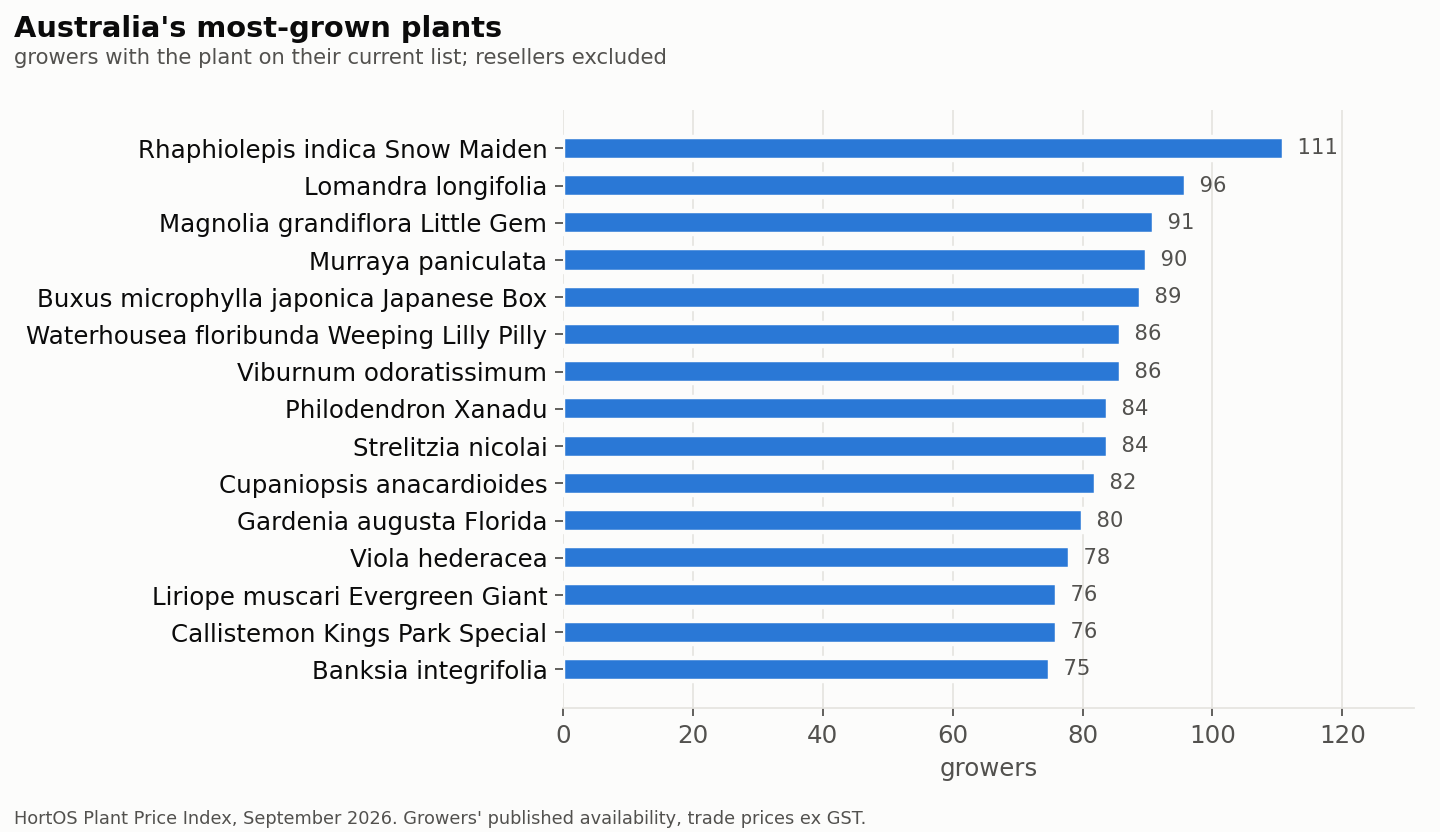
The Most Grown Native Plants in Australia, by State
A data page, not an essay: the Australian native plants held by the most wholesale growers, counted grower by grower and state by state from growers' current lists on HortOS, with the median trade price at the size most growers price. Two paragraphs on what the tables show and what they do not, then the tables, refreshed each edition.
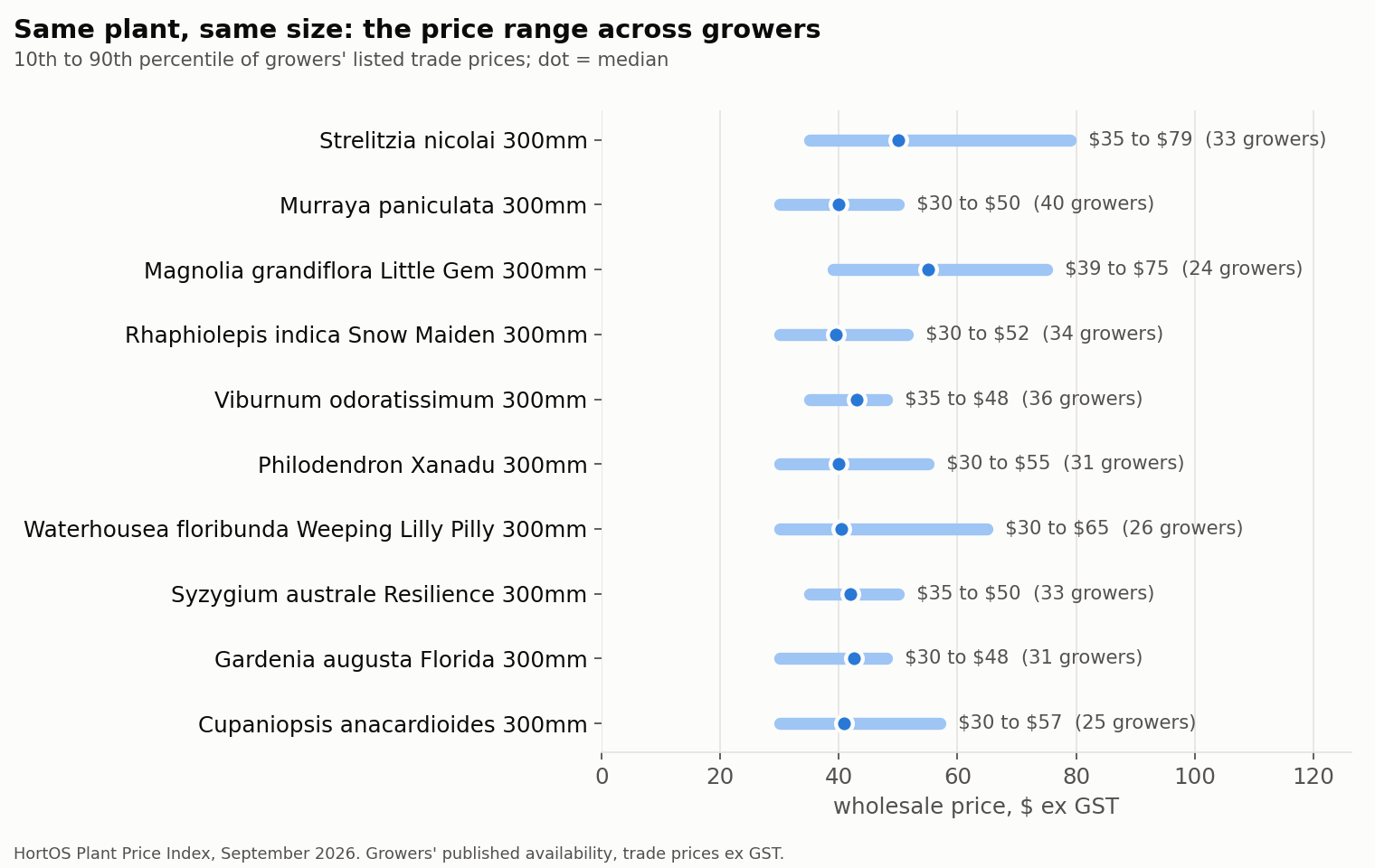
Reading a Wholesale Availability List and Pricing a Quote
For landscapers, designers, estimators and students: what each column of a wholesale availability list means, how much the same plant at the same size varies between growers and states, how the low, median and high on the price pages are built, and how to carry the plant line of a quote from the list to the client.
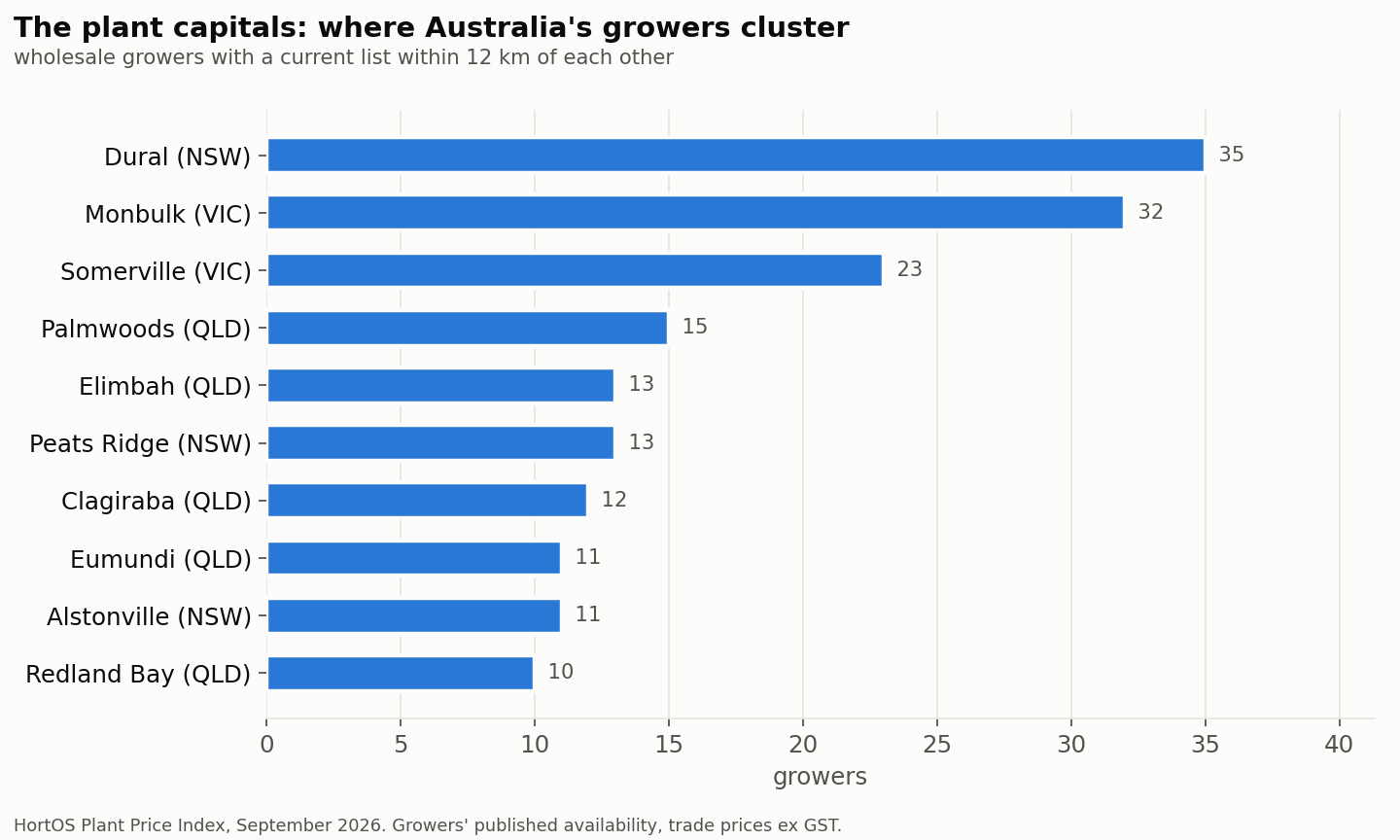
Buying From a Wholesale Grower When You Are Not in the Trade
Landcare groups, schools, friends groups and landholders can buy from wholesale growers when they order like the trade: in quantity, ahead of the season, on the grower's terms. This page explains who sells to whom, what an ABN and GST change, minimum orders and pooling, tubestock against pots, provenance, lead times, freight and state borders.