Dune restoration plants and how many growers list them
A Moreton Bay guide and Tasmania's coastal works manual place dune plants from the seaward sand to the hind dune, and a bushcare plan lists plants for one New South Wales beach. This page sets each list beside the growers listing every plant, gives tube medians for most of the beach list, and reports each source's density or season.
Updated 19 October 2026. Figures are what the live au.hortosapp.com price and plant pages printed.
On this page
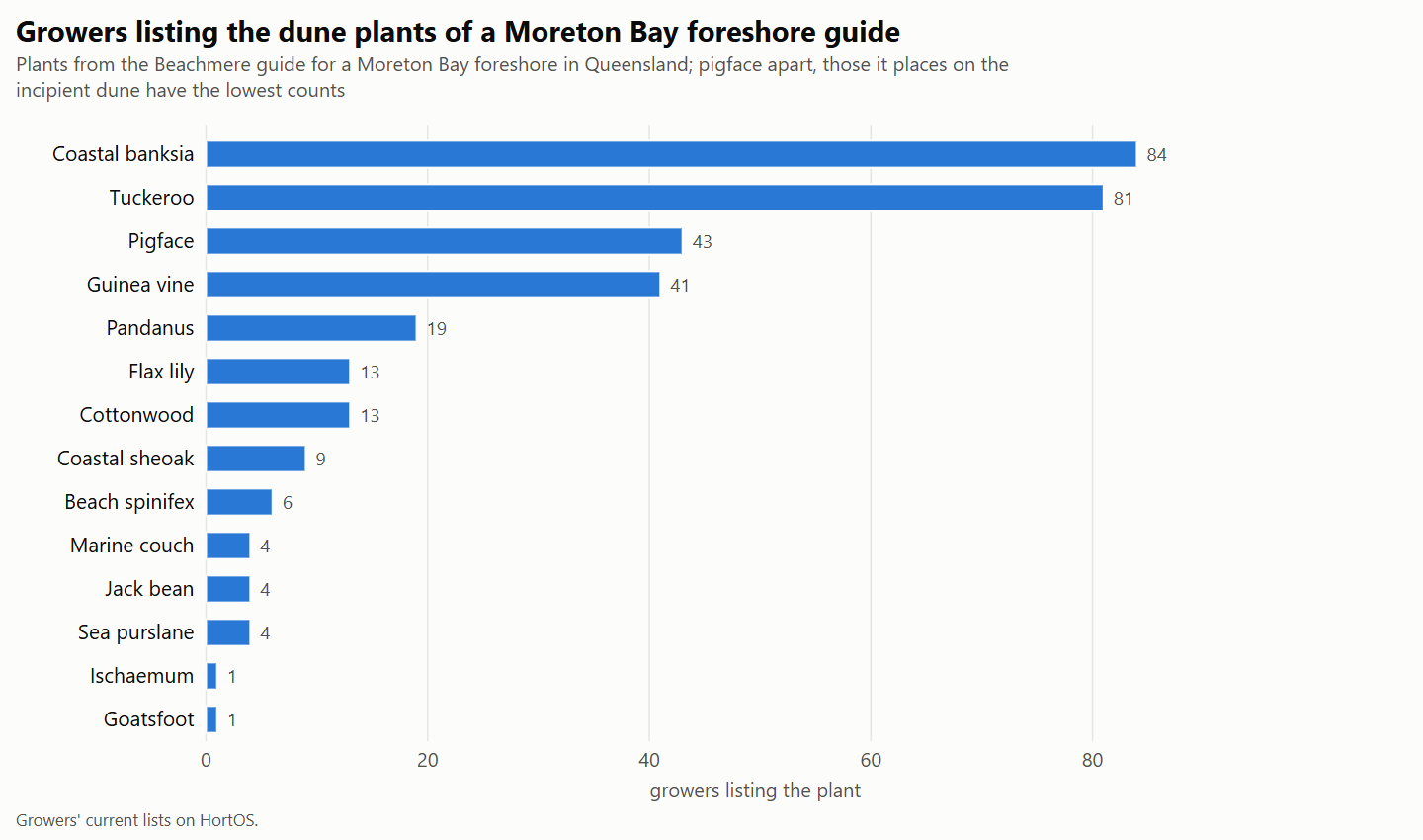
A dune care group with a bare foredune asks which plants go where, and which growers list them. The Beachmere guide (Moreton Bay, Queensland, 2022) and the Tasmanian Coastal Works Manual (2010) both put sand-binding grasses and creepers nearest the sea, with shrubs and trees behind. Pigface apart, the plants the Beachmere guide (Moreton Bay, Queensland, 2022) places on the incipient dune have the lowest grower counts in its table here. Beach spinifex was listed by 6 growers on HortOS, in any size, and coastal banksia by 84.
This page reports what those two documents, a bushcare plan for Huskisson Beach in New South Wales (adopted 2014) and two other councils say about dune plants. It also uses PlantNET, the New South Wales flora database of the Royal Botanic Gardens and Domain Trust, Sydney. It sets their plant lists beside grower counts and tube medians from HortOS, a free directory of Australian wholesale plant growers with their published availability and trade prices. It is not planting advice, and no table here is a species list for another beach.
Quick facts
| What goes onto bare sand first | The Tasmanian Coastal Works Manual (Tasmania, 2010) says only primary species, the sand-binding grasses and succulent creepers, are planted on exposed bare sites, with secondary species usually following in later years. |
|---|---|
| Why low plants come first | The Tasmanian Coastal Works Manual (2010) says grasses and other low plants hold sand better than trees or shrubs, because 90 per cent of wind-borne sand travels within 0.5 metres of the ground. |
| Planting density on two coasts | The Beachmere Foreshore Dune Vegetation Guide (Moreton Bay, Queensland, 2022) gives groundcovers at 2 to 5 plants a square metre as a minimum, and shrubs and trees at 1.5 metre centres. The Huskisson Beach Bushcare Action Plan (Shoalhaven, New South Wales, adopted 2014) gives 3 plants a square metre. |
| Local seed and cuttings | The Tasmanian Coastal Works Manual (2010) says plants for coastal work are to be grown only from seed or cuttings gathered from plants that are local and native to the area. |
| When planting is called for | The Tasmanian Coastal Works Manual (2010) says revegetating a natural area should be needed only where the vegetation is coming back too slowly by itself. |
| Growers listing spinifex | Spinifex sericeus was listed by 6 growers on HortOS, in any size. Its tube median was $3.99 ex GST, across the 4 growers pricing a tube. |
How the sources divide a dune
The Beachmere Foreshore Dune Vegetation Guide (Moreton Bay, Queensland, 2022) describes three bands of vegetation. Its primary band is the grasses and creepers of the incipient dune, which it says trap sand and help the dune build (Queensland, 2022). Its secondary band is the shrubs and small trees that help to hold the foredune, and its tertiary band the taller shrubs and trees of the hind dune that shelter what lies inland (Queensland, 2022).
The Tasmanian Coastal Works Manual, published by Tasmania's Department of Primary Industries, Parks, Water and Environment in December 2010, sorts coastal plants into primary, secondary and tertiary species. Its primary species are the sand-binding grasses and succulent creepers of the loose sand nearest the sea (Tasmania, 2010). Its secondary species are grasses, sedges, herbs and low shrubs that also live near the sea but stand little burial by sand (Tasmania, 2010). The manual says only two plants, spinifex and coast fescue, can grow where sand is piling up fast (Tasmania, 2010).
The City of Gold Coast's fact sheet on exposed coastal dune vegetation (Queensland, 2020) describes the same slope: thin grassland of spinifex and creeping vines just above the tide, rising to open woodland as tall as 12 metres.
Spinifex is in all three plant tables. Sunshine Coast Council (Queensland, page read 2026) says the grass catches wind-blown sand and so helps a dune to form. The council reports that volunteers put thousands of spinifex plants and other native ground covers into the frontal dune at Marcoola in 2014 (Queensland, read 2026). Its undated article says the dune had built a further 20 metres toward the shoreline since that planting (Queensland, read 2026). The Tasmanian Coastal Works Manual (2010) records the other side: in southern Tasmania spinifex is hard to raise and grow, because the plant prefers warmer temperatures.
Other plants change with the coast. The Beachmere guide (Queensland, 2022) and the Huskisson plan (New South Wales, adopted 2014) name the pigface Carpobrotus glaucescens, while the Tasmanian manual (2010) names Carpobrotus rossii. In New South Wales, PlantNET (read 2026) places screw pine, Pandanus tectorius, on exposed headlands and beaches from the Port Macquarie district north.
Two coasts' dune zones beside grower counts
Two of the sources give each plant a place on the dune. The tables keep each source's zone in its own column and add how many growers list the plant, and the states with the most of them. Grower counts are the growers listing each plant on HortOS, in any size. A count here is growers listing the plant, not how many plants exist or how well it suits a site. Neither table has a price column. A median needs three growers pricing a size. Each count, and each median further down, is the figure on the one HortOS page under the botanical name shown. Growers also list some of these species on other HortOS pages, whose names add a common name, a place name or a selection, or use another botanical name, and those pages are not added in.
The first table is for Moreton Bay in Queensland. It takes 14 plants from the Beachmere guide's table of prominent native dune species (Moreton Bay, Queensland, 2022), each given a zone by the guide and matched to a HortOS page for the same species. Rows run from the seaward zone to the hind dune, and the guide's other 5 plants are not shown.
| Plant | Dune zone in the Beachmere guide (Moreton Bay, Qld, 2022) | Growers listing it | States with most growers |
|---|---|---|---|
| Beach spinifex (Spinifex sericeus) | Incipient dune | 6 | Queensland 3, Victoria 2, New South Wales 1 |
| Marine couch (Sporobolus virginicus) | Incipient dune | 4 | Queensland 2, New South Wales 1, Victoria 1 |
| Ischaemum (Ischaemum triticeum) | Fore and incipient dune | 1 | Queensland 1 |
| Pigface (Carpobrotus glaucescens) | Hind, fore and incipient dune | 43 | New South Wales 20, Queensland 19, Victoria 3 |
| Goatsfoot (Ipomoea pes-caprae) | Hind, fore and incipient dune | 1 | Queensland 1 |
| Jack bean (Canavalia rosea) | Hind, fore and incipient dune | 4 | Queensland 4 |
| Sea purslane (Sesuvium portulacastrum) | Hind, fore and incipient dune | 4 | New South Wales 2, Victoria 1, Queensland 1 |
| Flax lily (Dianella congesta) | Hind and fore dune | 13 | Queensland 10, New South Wales 3 |
| Coastal banksia (Banksia integrifolia) | Hind and fore dune | 84 | New South Wales 31, Victoria 25, Queensland 22 |
| Coastal sheoak (Casuarina equisetifolia) | Hind and fore dune | 9 | Queensland 8, Western Australia 1 |
| Cottonwood (Hibiscus tiliaceus) | Hind and fore dune | 13 | Queensland 8, New South Wales 3 |
| Pandanus (Pandanus tectorius) | Fore dune | 19 | Queensland 15, New South Wales 4 |
| Guinea vine (Hibbertia scandens) | Hind dune | 41 | Queensland 15, New South Wales 10, Victoria 10 |
| Tuckeroo (Cupaniopsis anacardioides) | Hind dune | 81 | New South Wales 36, Queensland 31, South Australia 6 |
The last column names the states with the most growers listing each plant, three at most, and stops where states tie for the next place.
The guide names a subspecies for coastal banksia, coastal sheoak and goatsfoot (Queensland, 2022), and each of those rows is the HortOS page for the species. Pigface apart, the plants the guide places on the incipient dune have the lowest counts in the table, and 2 of them rest on a single grower each. The last column names the leading states only, as a pointer to the hubs for Queensland, New South Wales and Victoria.
The second table is for Tasmania. It takes 25 entries from the manual's table of where to plant each species on a coastal dune (Tasmania, 2010), each matched to a HortOS page for the same species or variety, in the manual's order from the sea inland. The manual's other 8 entries are not shown, and counts are on the same basis and date. The manual credits that table, and its note on spinifex in southern Tasmania, to an earlier Community Coastcare handbook.
| Plant | Planting zone in the Tasmanian Coastal Works Manual (2010) | Growers listing it | States with most growers |
|---|---|---|---|
| Spinifex (Spinifex sericeus) | Primary: seaward side of the foredune, in loose sand | 6 | Queensland 3, Victoria 2, New South Wales 1 |
| Native pigface (Carpobrotus rossii) | Primary: seaward side of the foredune, in loose sand | 32 | Victoria 19, South Australia 6, New South Wales 5 |
| Bower spinach (Tetragonia implexicoma) | Primary: seaward side of the foredune, in loose sand | 5 | Victoria 5 |
| Grey saltbush (Atriplex cinerea) | Primary: seaward side of the foredune, in loose sand | 6 | Victoria 3, Western Australia 2, New South Wales 1 |
| Salt grass (Distichlis distichophylla) | Secondary: on the foredune, behind the primary plants | 3 | Victoria 2, South Australia 1 |
| Coast wattle (Acacia sophorae) | Secondary: on the foredune, behind the primary plants | 19 | New South Wales 8, Queensland 5, Victoria 5 |
| Buzzy (Acaena novae-zelandiae) | Secondary: on the foredune, behind the primary plants | 8 | Victoria 8 |
| Native geranium (Pelargonium australe) | Secondary: on the foredune, behind the primary plants | 13 | Victoria 7, New South Wales 3, South Australia 2 |
| Cushion bush (Leucophyta brownii) | Secondary: on the foredune, behind the primary plants (northern Tasmania) | 27 | Victoria 13, Western Australia 6, South Australia 4 |
| Common sagg (Lomandra longifolia) | Secondary: on the foredune, behind the primary plants | 130 | New South Wales 45, Victoria 42, Queensland 34 |
| Running postman (Kennedia prostrata) | Secondary: on the foredune, behind the primary plants | 17 | Victoria 10, Western Australia 4, South Australia 3 |
| Yellow spear grass (Austrostipa flavescens) | Secondary: on the foredune, behind the primary plants | 6 | Victoria 4, Western Australia 1, South Australia 1 |
| Seaberry saltbush (Rhagodia candolleana) | Secondary: on the foredune, behind the primary plants | 6 | Victoria 3, South Australia 2, New South Wales 1 |
| Coast everlasting (Ozothamnus turbinatus) | Secondary: on the foredune, behind the primary plants | 3 | Victoria 3 |
| Coast daisy bush (Olearia axillaris) | Secondary: on the foredune, behind the primary plants (northern Tasmania) | 10 | Western Australia 5, Victoria 3, South Australia 2 |
| White correa (Correa alba) | Secondary: on the foredune, behind the primary plants | 68 | Victoria 39, New South Wales 16, South Australia 6 |
| Coast beard-heath (Leucopogon parviflorus) | Secondary: on the foredune, behind the primary plants | 5 | Victoria 3, New South Wales 2 |
| Silver banksia (Banksia marginata) | Tertiary: behind the foredune crest, once the others are in | 38 | Victoria 24, New South Wales 8, South Australia 4 |
| Boobyalla (Myoporum insulare) | Tertiary: behind the foredune crest, once the others are in | 16 | Victoria 7, South Australia 4, Western Australia 3 |
| Manuka (Leptospermum scoparium) | Tertiary: behind the foredune crest, once the others are in | 7 | Victoria 5, Queensland 2 |
| Drooping she-oak (Allocasuarina verticillata) | Secondary dune | 10 | Victoria 6, South Australia 3, New South Wales 1 |
| Native hop (Dodonaea viscosa subsp. spatulata) | Secondary dune | 2 | South Australia 1, Victoria 1 |
| Silver wattle (Acacia dealbata) | Secondary dune | 18 | Victoria 15, New South Wales 2, Tasmania 1 |
| Prickly box (Bursaria spinosa) | Hind dunes | 24 | New South Wales 11, Victoria 10, Queensland 3 |
| Blackwood (Acacia melanoxylon) | Hind dunes | 25 | Victoria 11, New South Wales 7, Queensland 5 |
The last column names the states with the most growers listing each plant, three at most, and stops where states tie for the next place.
The manual writes coast wattle as Acacia longifolia subsp. sophorae (Tasmania, 2010). PlantNET notes that some authorities rank the wattle as a species in its own right, Acacia sophorae (New South Wales, 2005), and that row is the HortOS page for Acacia sophorae. The manual writes native hop as a variety, Dodonaea viscosa var. spathulata (Tasmania, 2010), and that row is the HortOS page under the subspecies name.
The last column can be read beside the manual's words on provenance. The manual says plants for coastal work are to be grown only from seed or cuttings gathered from plants that are local and native to the area (Tasmania, 2010). It says local provenance plants often differ genetically from the same species grown somewhere else (Tasmania, 2010). In the table, Victoria heads the last column in most rows, and only the silver wattle row names Tasmania there. The hubs for Tasmania and South Australia show the growers in those states.
One New South Wales beach, with tube medians
New South Wales is covered here by one beach. The Huskisson Beach Bushcare Action Plan (Shoalhaven, New South Wales, adopted 2014) carries a list of species suggested for revegetating its dunes, with no zone for each plant. It is one beach's list, not a list for the state.
The table shows 27 plants of that list, each matched to a HortOS page for the same species, or for the genus where the plan names only a genus. The plan's other 6 plants are not shown. Rows run from understorey plants to shrubs and then trees, an order of this page's own that is not a dune zone. Like the Tasmanian manual, the plan writes coastal wattle as a subspecies of Acacia longifolia. It is the one table here with a price column, and the size priced is the tube. Prices are medians across growers' current trade lists on HortOS: one price per grower, ex GST, freight not included, with the number of growers pricing each size in brackets. Anyone can see the prices on HortOS, and only the trade can order.
| Plant | Growers listing it | Tube median (growers pricing) |
|---|---|---|
| Coastal spinifex (Spinifex sericeus) | 6 | $3.99 (4) |
| Pigface (Carpobrotus glaucescens) | 43 | $1.90 (8) |
| Spiny mat rush (Lomandra longifolia) | 130 | $1.60 (41) |
| Native guinea flower (Hibbertia scandens) | 41 | $2.00 (7) |
| Coastal geranium (Pelargonium australe) | 13 | $2.33 (4) |
| Kangaroo grass (Themeda australis) | 4 | Fewer than three growers |
| Native violet (Viola hederacea) | 113 | $1.75 (16) |
| Dusky coral pea (Kennedia rubicunda) | 10 | $2.45 (6) |
| Old man's beard (Clematis aristata) | 7 | $2.50 (3) |
| Flax lilies (Dianella species) | 15 | Fewer than three growers |
| Coastal rosemary (Westringia fruticosa) | 93 | $2.00 (14) |
| Coastal wattle (Acacia sophorae) | 19 | $2.00 (10) |
| Sunshine wattle (Acacia suaveolens) | 19 | $2.50 (11) |
| White correa (Correa alba) | 68 | $2.23 (10) |
| Native fuchsia (Correa reflexa) | 17 | $1.60 (3) |
| Seaberry saltbush (Rhagodia candolleana) | 6 | $1.60 (3) |
| Bearded heath (Leucopogon parviflorus) | 5 | Fewer than three growers |
| Coastal boobialla (Myoporum acuminatum) | 6 | $2.45 (4) |
| Breynia oblongifolia | 12 | $2.51 (6) |
| Pigeon berry ash (Monotoca elliptica) | 1 | Fewer than three growers |
| Rough fruited pittosporum (Pittosporum revolutum) | 10 | $3.00 (7) |
| Blueberry ash (Elaeocarpus reticulatus) | 39 | $2.50 (3) |
| Coastal banksia (Banksia integrifolia) | 84 | $2.22 (16) |
| Old man banksia (Banksia serrata) | 18 | $3.00 (3) |
| Bangalay gum (Eucalyptus botryoides) | 6 | Fewer than three growers |
| Blackbutt (Eucalyptus pilularis) | 13 | $2.00 (7) |
| Swamp mahogany (Eucalyptus robusta) | 22 | $2.00 (11) |
Most of the growers listing the plants in this table are in New South Wales and Victoria.
Of the 27 rows, 22 have a tube median and 5 print "Fewer than three growers". The brackets show how few growers stand behind some of these medians. Spinifex has a tube median of $3.99 across 4 growers, against $1.60 across 41 for spiny mat rush.
A tube median describes only the growers who price a tube: blueberry ash was listed by 39 growers, and 3 of them price a tube. Only the tube is priced in this table. Every median is a national trade median, ex GST, and none is a Shoalhaven price or a price for plants of local provenance.
The kangaroo grass row is the HortOS page for Themeda australis, the name the plan uses; growers also list kangaroo grass under Themeda triandra, which has its own page. The flax lilies row is the page for plants listed under the genus name alone. It does not add up the species pages, and Dianella congesta has its own row in the Queensland table.
The plan, adopted in 2014 with its own review due in 2017, also lists the provision of plants, stakes and guards among the council's support to the bushcare group (Shoalhaven, New South Wales).
Density and season, one source at a time
Three of the sources give a planting density or season, each for its own coast. The table sets them out one source to a row, in this page's words, and none of the figures is a national rule.
| Source and year | Coast it was written for | Planting density it gives | Planting season it gives |
|---|---|---|---|
| Beachmere Foreshore Dune Vegetation Guide (Moreton Bay, Queensland), 2022 | Beachmere foreshore, Moreton Bay, Queensland | Groundcovers at 2 to 5 plants a square metre; shrubs and trees at 1.5 m centres | April to September, the cooler months |
| Huskisson Beach Bushcare Action Plan (Shoalhaven, New South Wales), adopted 2014 | Huskisson Beach dunes (Shoalhaven, New South Wales) | Hardy fore-dune natives at 3 plants a square metre | Autumn and winter |
| Tasmanian Coastal Works Manual, Tasmanian environment department, 2010 | Tasmania's coast | Its vegetation chapter gives no plants per square metre figure; it puts the cover needed to fix sand at 30 to 60 per cent | Late autumn and winter, the usual planting season |
The three do not measure the same thing. The Beachmere guide (Moreton Bay, Queensland, 2022) asks for the highest density possible and gives its groundcover figure as a minimum, while the Huskisson plan (New South Wales, adopted 2014) sets a single rate for hardy fore-dune natives. The vegetation chapter of the Tasmanian Coastal Works Manual (2010) gives no count of plants per square metre. It gives a share of ground covered, which it says varies with the site's exposure to the wind, the kind of plants and how densely they are planted (Tasmania, 2010).
What the directory cannot show a dune group
HortOS shows which growers list a plant, in which sizes and at what trade price. The counts and medians in these tables do not show the following.
- Where the seed or cuttings were collected. A line that carries a place name in its own name sits on a separate HortOS page and is not in these rows. Either way the grower is the one to ask. The Beachmere guide (Moreton Bay, Queensland, 2022) calls local nurseries with expertise in propagating dune plants the best source of native plants for a local area.
- How the plants were grown. The Tasmanian manual (2010) says growing for coastal rehabilitation is unlike growing for ornamental gardens and takes tough plants with deep roots.
- Which subspecies a line is. The Tasmanian manual (2010) asks land managers to learn scientific names, in part because some species have subspecies that may do poorly on the coast.
- How many plants, and by when. A count takes in any size. The Tasmanian manual (2010) says raising plants can take months or longer. It puts plants raised from cuttings at between one and 18 months to reach 100 to 150 mm tall, its height for planting out (Tasmania, 2010).
Each of these is a question for the grower: where the parent plants grow, which subspecies the line is, whether it was raised for coastal planting, and how many can be ready by which month. The guide to buying from a wholesale grower covers tubes, provenance and lead times, and the guide to reading an availability list explains what a list line states. The natives most growers list nationally and in five mainland states are in the guide to the most grown native plants.
The sources also say what planting does not do. The Tasmanian Coastal Works Manual (2010) says tube planting and direct seeding can both be difficult in coastal sand, and that many coastal projects succeed only in part. It says repairs to erosion caused by waves usually fail, and that many dunes move by nature (Tasmania, 2010). On the other side, the Beachmere guide (Moreton Bay, Queensland, 2022) suggests that local native plants, planted and looked after, can take the place of a seawall on its foreshore.
What to watch for
- Carrying a plant list from one coast to another. The pigface is Carpobrotus glaucescens in the Queensland guide (2022) and Carpobrotus rossii in the Tasmanian manual's table (2010).
- Ordering by common name. The Tasmanian manual (2010) asks land managers to learn scientific names because many common names are in use. Spinifex sericeus appears in the three tables as beach spinifex, spinifex and coastal spinifex, and the botanical name ties the rows together.
- Putting shrubs and trees onto bare sand first. The Tasmanian manual (2010) keeps exposed bare sites for its primary species and usually plants secondary species in the following years.
- Reading a count or a median for more than it is. A count is growers listing a plant in any size, not plants ready to order, and a tube median is national and ex GST.
- Treating every bare patch as damage. The Tasmanian Coastal Works Manual (2010) says patches of bare sand and blowouts can be natural, and that some shorebirds, hooded plovers and pied oystercatchers among them, need them for nesting.
Getting it right
- Find out who manages the foreshore and ask before anything is planted. The Beachmere guide (Moreton Bay, Queensland, 2022) tells residents to consult the council before planting on the foreshore outside their own property. The Tasmanian manual (2010) tells land managers planning revegetation to talk with Coastcare and other local community groups.
- Ask that council or land manager for the species list and zones written for the beach in question.
- Write the order by botanical name, with the subspecies where the local list gives one. The Tasmanian manual (2010) says scientific names matter when plants are ordered from a nursery.
- Look up each plant through the links in the tables, then the state hubs linked above or the full directory.
- Ask each grower, in writing, where the seed or cuttings were collected, how the plants were raised, and how many can be ready for the planting month.
- Ask early: the Tasmanian manual (2010) says plants must be ready for a planting season that usually falls in late autumn and winter.
A word of caution
Every zone, density and season on this page is one source's statement for its own coast: the Beachmere guide for Moreton Bay (Queensland, 2022), the Tasmanian Coastal Works Manual (2010) and the Huskisson plan (New South Wales, adopted 2014). None is a national rule, and this page does not set out what any law or permit requires on a foreshore. The council or other body that manages the beach is the one to ask what may be planted there. Grower counts and tube medians are what HortOS showed on one day.
Sources
- Beachmere Foreshore Dune Vegetation Guide (Moreton Bay, Queensland), 2022: dune zones, species, density, planting.
- Tasmanian Coastal Works Manual, Chapter 7, Vegetation management: planting zones, provenance, propagation.
- Tasmanian Coastal Works Manual, Chapter 6, Coastal landscape management: limits of dune stabilisation.
- Tasmanian Coastal Works Manual, title page and Introduction: its publisher and date.
- Sunshine Coast Council, Spinifex: stabilisation and dune builder: spinifex planting at Marcoola.
- City of Gold Coast, Vegetation Type 23 fact sheet: Exposed coastal dune: the foredune plant community.
- Huskisson Beach Bushcare Action Plan (Shoalhaven, New South Wales), adopted 2014: one beach's planting list.
- PlantNET, New South Wales Flora Online: Acacia longifolia subsp. sophorae: coastal wattle names.
- PlantNET, New South Wales Flora Online: Pandanus tectorius: screw pine range.
More guides
Buying From a Wholesale Grower When You Are Not in the Trade
Landcare groups, schools, friends groups and landholders can buy from wholesale growers when they order like the trade: in quantity, ahead of the season, on the grower's terms. This page explains who sells to whom, what an ABN and GST change, minimum orders and pooling, tubestock against pots, provenance, lead times, freight and state borders.
Reading a Wholesale Availability List and Pricing a Quote
For landscapers, designers, estimators and students: what each column of a wholesale availability list means, how much the same plant at the same size varies between growers and states, how the low, median and high on the price pages are built, and how to carry the plant line of a quote from the list to the client.
The Most Grown Native Plants in Australia, by State
A data page, not an essay: the Australian native plants held by the most wholesale growers, counted grower by grower and state by state from growers' current lists on HortOS, with the median trade price at the size most growers price. Two paragraphs on what the tables show and what they do not, then the tables, refreshed each edition.