- Type
- Deciduous perennial
- Height
- 0.3 m to 0.6 m
- Spread
- 0.3 m to 0.6 m
- Flowers
- White, spring to early summer
- Sun
- Full sun (the RHS, NC State, Missouri)
- In Australia
- Not native
Growing persian buttercup
Climate and position. NC State, an American reference, says the hybrids do best where winters are mild and summers cool and dry, and that the plant prefers cool spring weather and goes dormant in summer; the RHS, a British reference, says it needs a dry, dormant period in summer. All three overseas references give full sun. NC State calls it semi-hardy in North Carolina, injured at temperatures a little below freezing, and the RHS rates it H4 on its British scale. No Australian reference read gives a frost rating or climate zone for it.
Soil and water. NC State asks for sandy soil of medium moisture with excellent drainage and says it does not tolerate heavy clay; the Missouri Botanical Garden says it does poorly in unamended heavy clay. The RHS lists loam or sand, well drained, acid to alkaline. Both American references say root rot can occur in wet, poorly drained soil.
Planting and the dormant season. Both American references say to plant the tubers about 5 cm deep and 15 to 20 cm apart, claws down. When the foliage dies down, the two say the tubers can be dug, the tops cut off and the tubers stored dry and cool; the Missouri Botanical Garden adds that they are not easy to store, and that growing the plant as an annual is an option. The RHS says it grows best in containers under unheated glass with good light and air.
Care and pests. NC State and Missouri advise deadheading spent flowers to encourage more. The RHS lists aphids, slugs and snails, and powdery mildews. No Australian reference read covers its pests.
Using persian buttercup
HortFlora says the species was once popular as double, coloured garden cultivars and florists' flowers, and that the many-coloured, double forms florists favour were once grown from tubers and are now also raised from seed. NC State calls the flowers useful for cutting and says the plants are often grown as annuals or in containers as florists' plants. For the garden, the references name beds and borders (NC State, the Missouri Botanical Garden), containers (the Missouri Botanical Garden, the RHS) and the cutting garden (NC State). The two American references space the tubers 15 to 20 cm apart.
What to check before you buy
Growers list the species as Ranunculus asiaticus, and also list the Bloomingdale lines, which the RHS files under Ranunculus asiaticus in its entry for Bloomingdale White Shades, a fully double white that it says may be raised from seed. HortFlora says the species is now generally sold as seed mixes, and calls the Tecolote Hybrids a group of uncertain origin with exceptionally large flowers. In the same entry the RHS describes clusters of claw-like tubers, planted in autumn or spring. The table above shows the sizes growers list. The guide to buying from a wholesale grower says nursery stock sent interstate must meet the receiving state's quarantine entry conditions and may need a plant health certificate.
Cautions
The ASPCA lists buttercups, Ranunculus spp., as toxic to dogs, cats and horses, naming protoanemonin, an irritant. NC State says eating the plant burns the mouth and upsets the stomach, and that contact with the sap can redden and blister the skin; the RHS calls it harmful if eaten and a skin irritant, and advises gloves. HortFlora says most species of the genus are regarded as potentially poisonous to stock.
Used forcut flower
Prices are set by each grower and shown ex GST. Availability is confirmed by the grower at order.
Common questions
- Is Persian buttercup a bulb?
- It grows from tubers. HortFlora calls it a perennial with fibrous and tuberous roots and the RHS a tuberous perennial; the Missouri Botanical Garden files it as a bulb, and both American references say to plant the tubers claws down.
- When does Ranunculus asiaticus flower?
- In spring by HortFlora, and in late spring and early summer by the RHS and NC State. NC State says it does best in cool spring weather and goes dormant in summer.
- How tall does Persian buttercup grow?
- NC State and the Missouri Botanical Garden give 0.3 to 0.6 m tall and wide, with the leaves in a mound to about 0.3 m by Missouri. The RHS puts its maximum height and spread in its 0.1 to 0.5 m class.
- Do the tubers stay in the ground after flowering?
- The plant goes dormant in summer, and the RHS says it needs a dry, dormant period then. NC State and the Missouri Botanical Garden say the tubers can be dug, the tops cut off and the tubers stored dry and cool; Missouri adds that they are not easy to store.
- Are ranunculus flowers single or double?
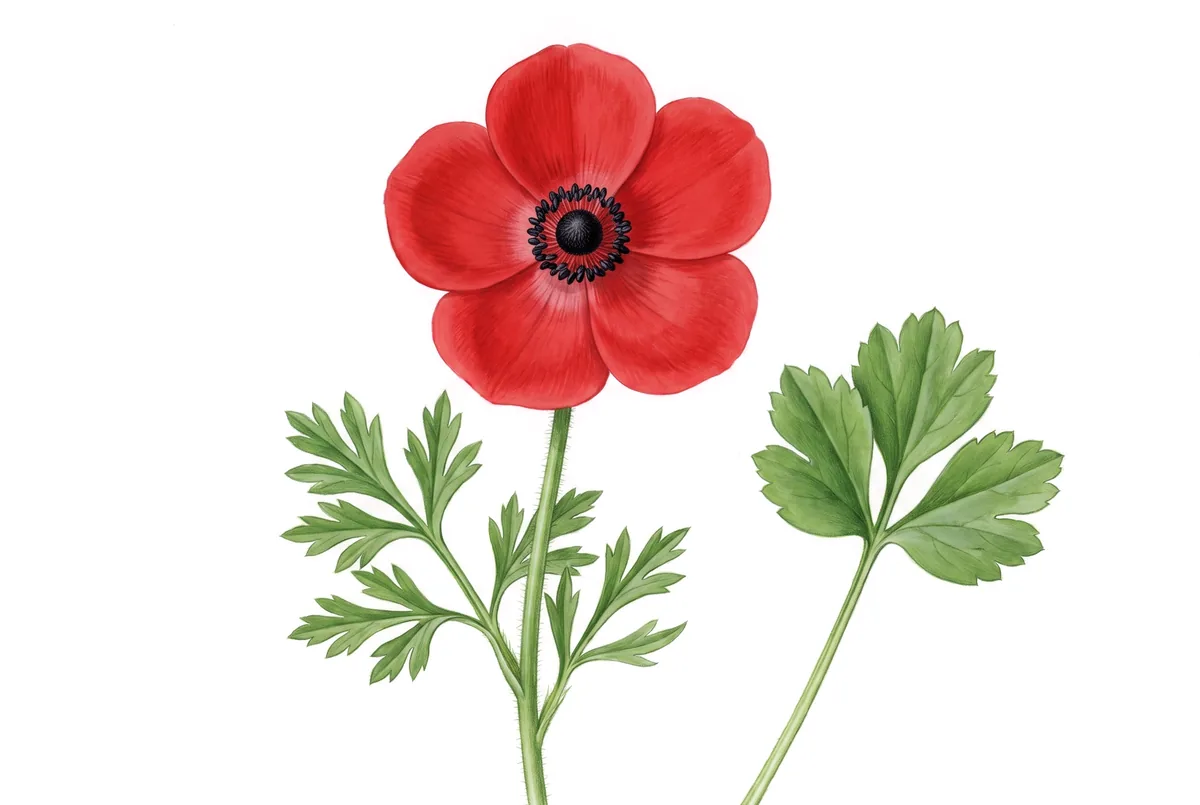
- The species' flowers are single and cup-shaped, with black centres, by the RHS. NC State says the flowers of the hybrids and cultivars are usually semi-double or fully double, and the Missouri Botanical Garden gives the Tecolote strain fully double, peony-like flowers to about 10 cm across.
- Will Persian buttercup grow in clay?
- Not well, by the American references: NC State says it does not tolerate heavy clay, and the Missouri Botanical Garden that it does poorly in unamended heavy clay. Both say root rot can occur in wet, poorly drained soil.
- Is Persian buttercup poisonous?
- Yes. The ASPCA lists buttercups, Ranunculus spp., as toxic to dogs, cats and horses. NC State says the sap can blister the skin, and the RHS advises gloves when handling it.
Sources
- GBIF species match API (Ranunculus asiaticus)
- ASPCA Animal Poison Control, Toxic and Non-Toxic Plants: Buttercup (Ranunculus spp.)
- HortFlora, the Horticultural Flora of South-eastern Australia (Royal Botanic Gardens Victoria): Ranunculus asiaticus, and the genus Ranunculus
- North Carolina State Extension Gardener Plant Toolbox: Ranunculus asiaticus
- Missouri Botanical Garden Plant Finder: Ranunculus asiaticus
- Royal Horticultural Society plant finder: Ranunculus asiaticus
- Royal Horticultural Society plant finder: Ranunculus asiaticus 'Bloomingdale White Shades' (Bloomingdale Series)
- The HortOS catalogue (the names growers list it under)
- The HortOS guide: buying from a wholesale grower (moving nursery stock between states)
The growers, sizes and prices above are live and change as lists arrive. Cite this page: HortOS, Persian buttercup (Ranunculus asiaticus), https://au.hortosapp.com/plants/ranunculus-asiaticus.
Found a fact that is wrong? Tell us and it is checked against its source.