Olive Olea europaea Picual
No grower lists this plant right now
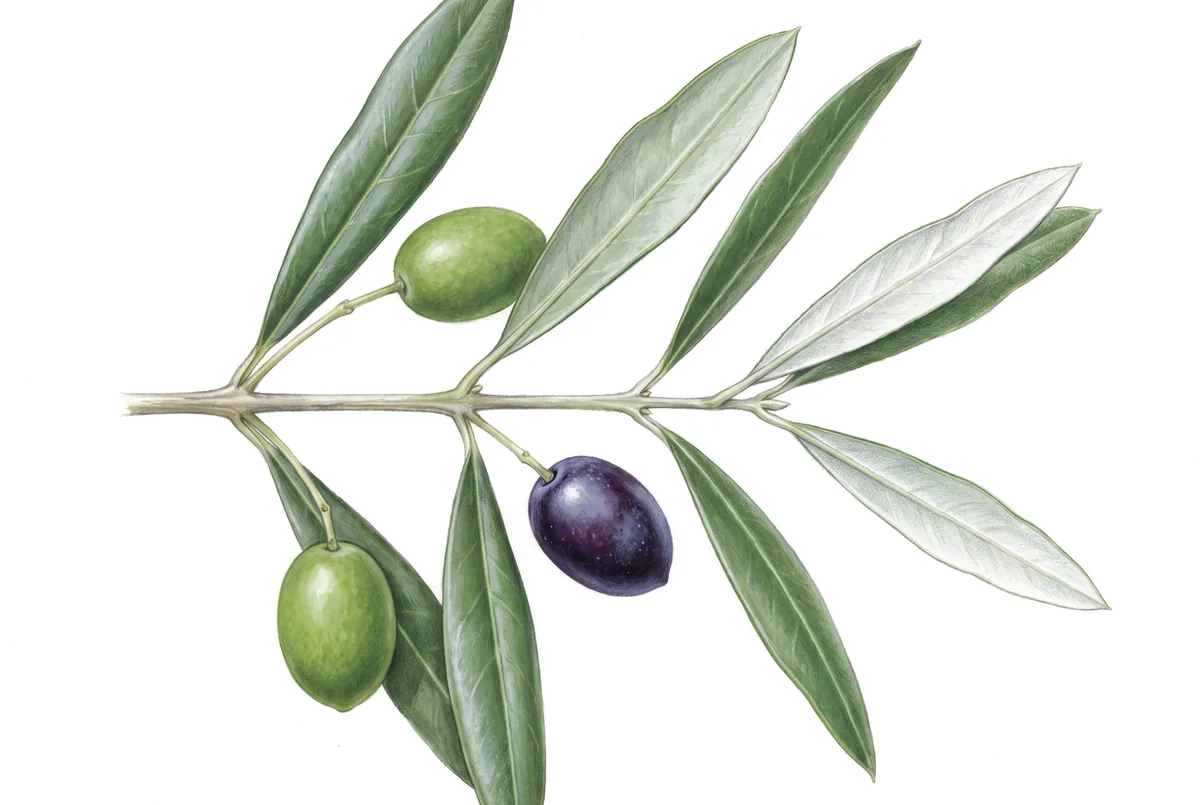
- Type
- Evergreen tree
- Height
- 5 m to 10 m
- Spread
- 4.6 m to 7.6 m
- Growth
- Slow
- Flowers
- Cream, spring to early summer
- Sun
- Full sun
- Drought
- Tolerant
- In Australia
- Naturalised
Growing picual
Climate. The University of California's table rates Picual hardy to cold, where it rates Manzanillo and Frantoio sensitive. That is a Californian rating; no Australian reference read grades the variety for frost. Papers in the OleaDB sheet record it in cultivation in Western Australia, New South Wales, South Australia, Victoria and Queensland.
Habit. The five papers that record its vigour disagree: two give strong, two medium and one weak. Two papers, both entered under the synonym Morcona, record its habit: one gives spreading branches and a dense canopy, the other short internodes. No reference read gives a height or a spread for the variety.
Pollination and cropping. The Californian table lists Picual as self-compatible, with Picudo as a pollenizer, and the papers in the OleaDB sheet give self-compatible or partially self-compatible. Every paper that records its cropping gives good, constant in ten and alternate in eight.
Everything else. Sun, soil, water and what the references say of the olive's pests are on the olive page.
Using picual
Picual is an oil olive in most of the papers OleaDB lists and dual purpose in three. The University of California gives its oil at 24 to 27 per cent with a very high polyphenol content, and notes that oils high in polyphenols have a longer shelf life and are generally more bitter and pungent. The fruit is recorded as elliptic and of medium to high weight. OleaDB files Nevadillo Blanco and Marteño among its synonyms. The other fruiting olives with pages are Frantoio, Mission, Manzanillo and Kalamata.
What to check before you buy
The table above shows the sizes growers list, and root and quality checks are in the nursery plant quality guide. By the Californian table Picual is self-compatible, with Picudo listed as a pollenizer, and the same table notes that most olive varieties set a better crop with cross-pollination. Its hardy rating there is the check for a frosty site, with the caution that the rating was made in California. Stock crossing a state border moves under the state and territory biosecurity rules, and the olive page carries the weed listings: in South Australia olive trees not maintained for harvesting must be controlled.
Olives are declared under the Landscape South Australia Act 2019: landholders must control olive trees that are not maintained for harvesting, and any seedlings. Weeds Australia lists the European olive, subsp. europaea, as a declared weed in South Australia and the African olive, subsp. cuspidata, as declared in New South Wales, South Australia and Western Australia. NSW WeedWise lists the African olive under the general biosecurity duty across New South Wales, with regional measures for the Central Tablelands, Greater Sydney, Hunter and North West under which it should not be bought, sold, moved, carried or released. (Landscape South Australia Act 2019 (Eyre Peninsula Landscape Board fact sheet, Government of South Australia); Weeds Australia weed profiles; NSW WeedWise (NSW Biosecurity Act 2015 and the Regional Strategic Weed Management Plans))
Used forfruit and orchardediblespecimenpots and courtyardshedging and screening
Prices are set by each grower and shown ex GST. Availability is confirmed by the grower at order.
Common questions
- Is Picual an oil olive?
- Yes, in most of the papers the OleaDB germplasm database lists; three call it dual purpose. The University of California's table gives it 24 to 27 per cent oil and a very high polyphenol content, which it says goes with a longer shelf life and a more bitter, pungent oil.
- Does Picual need a pollinator?
- The University of California table lists it as self-compatible, with Picudo as a pollenizer, and the papers in the OleaDB sheet record it as self-compatible or partially so. The table notes that most olives set a better crop with cross-pollination, especially in adverse weather.
- Is Picual frost hardy?
- The University of California table rates it hardy, where it rates Manzanillo and Frantoio sensitive to cold. The rating is Californian, and no Australian reference read grades the variety.
- How big does a Picual olive tree grow?
- No reference read gives a height or a spread for the variety, and the five papers in the OleaDB sheet that record its vigour disagree, from weak to strong. The olive page gives the species' size.
Sources
- GBIF species match API (the species name and family)
- PlantNET, the New South Wales flora online (Royal Botanic Garden Sydney): Olea europaea (the species' leaf and flower)
- Weeds of Australia, Biosecurity Queensland edition (Queensland Government): Olea europaea (the species' foliage, leaf arrangement, flower and bark)
- Weeds Australia (Centre for Invasive Species Solutions): weed profile, European Olive (the species' flower)
- Eyre Peninsula Landscape Board (Government of South Australia): Olive (Olea europaea) fact sheet, the declared weed under the Landscape South Australia Act 2019
- OleaDB, the worldwide olive germplasm database (Institute of Biosciences and BioResources, Italian National Research Council): cultivar sheet PICUAL (what each paper in its bibliography reports)
- University of California Cooperative Extension (Sonoma County): Primary world olive oil cultivars, including several California table varieties for comparison (the cultivar table)
- HortFlora, the Horticultural Flora of South-eastern Australia online (Royal Botanic Gardens Victoria): Olea europaea (the species' flowering season)
- North Carolina State Extension Gardener Plant Toolbox: Olea europaea (the species' leaf texture, scent and bark)
The growers, sizes and prices above are live and change as lists arrive. Cite this page: HortOS, Picual (Olea europaea 'Picual'), https://au.hortosapp.com/plants/olive-olea-europaea-picual.
Found a fact that is wrong? Tell us and it is checked against its source.