Nephrolepis Biserrata
Boston Fern / Fishbone Fern
Part of Nephrolepis: see them all
No grower lists this plant right now
- Type
- Evergreen fern
- Height
- 0.8 m to 2.4 m
- Spread
- 1.2 m to 1.8 m
- Growth
- Fast
- Sun
- Part shade to deep shade by North Carolina State Extension, an American reference, whose text also says it grows well in partial to full sun
- In Australia
- Native
Growing broad sword fern
Where it grows. The Australian tropical ferns key finds it on the ground, occasionally on rock, in rainforest, on rainforest margins and in open forest, and in inland areas usually in creeks and gorges. The Flora of Australia says it grows usually near water or in crevices of rock outcrops, and FloraBase gives sheltered seepage areas on rock faces and in gorge crevices near water. No Australian reference read gives a frost figure or a climate zone; North Carolina State Extension rates it for USDA zones 10a to 11b and grows it indoors outside the tropics.
Light. North Carolina State Extension lists deep shade and part shade in its light ratings, while its text says it grows well in partial to full sun. By the ferns key it takes to cultivation easily, in many kinds of site.
Soil and water. The same extension service asks for moist, well-draining soil, neutral to slightly acid, with some organic matter, though it tolerates poor soil. It calls the fern intolerant of drought, and says yellowing fronds may mean overwatering and dropping fronds either too much or too little water.
Pests. American references report generally no significant pests or diseases apart from the Florida fern caterpillar, and suggest checking for mealybugs, scale, aphids or fern mites before bringing a plant indoors. No Australian reference read covers pests.
Using broad sword fern
In tropical gardens North Carolina State Extension finds a use for it as shade groundcover or a woodland border, and notes it can grow on bigger plants or on rock outcrops there. Away from the tropics the same service grows it in pots and hanging baskets, where it does very well, or as a centrepiece in a large indoor room; in USDA zones 10 and 11 it can go at the back of a garden. Where the tropics are moist it grows rapidly, by that reference, and runs by stolons into large colonies. The ferns key calls it widely cultivated.
No reference read gives a planting distance for massed planting.
The form growers list as Macho has its own page. Other sword ferns on HortOS include fishbone fern and Boston fern.
What to check before you buy
The table above shows the sizes growers list. Growers list the species by name and also as Macho, in hanging baskets and as tissue culture, so check which form a line names. The guide to reading an availability list covers how a line names a species or a selection, and the guide to nursery plant quality what to check before stock leaves the grower. Stock crossing a state border moves under the state and territory biosecurity rules on moving plants and soil.
Cautions
The Australian tropical ferns key says it can be invasive in greenhouse and garden situations and can be a weed. The Flora of Australia, which gives its status as native, also calls it an adventive species, often invasive when cultivated and frequently becoming naturalised. North Carolina State Extension lists it as weedy among its problems.
Used forpots and courtyardsindoor
Prices are set by each grower and shown ex GST. Availability is confirmed by the grower at order.
Common questions
- Is broad sword fern native to Australia?
- Yes. The Australian Plant Census gives it in Western Australia, on Christmas Island, in the Northern Territory and in Queensland, and the Flora of Australia gives its status as native. The ferns key says it is scattered across tropical Queensland, the Northern Territory and Western Australia, usually north of latitude 19 S, and that the species is pantropical.
- How big does Nephrolepis biserrata grow?
- The Flora of Australia gives fronds of 50 to 150 cm in one account and to 2.5 m or more in another, as does the ferns key. North Carolina State Extension gives a plant 0.9 to 2.4 m high and 1.2 to 1.8 m wide, with fronds up to about 2.4 m long. FloraBase gives plants 0.8 to 1 m high in Western Australia.
- How do you tell it from fishbone fern?
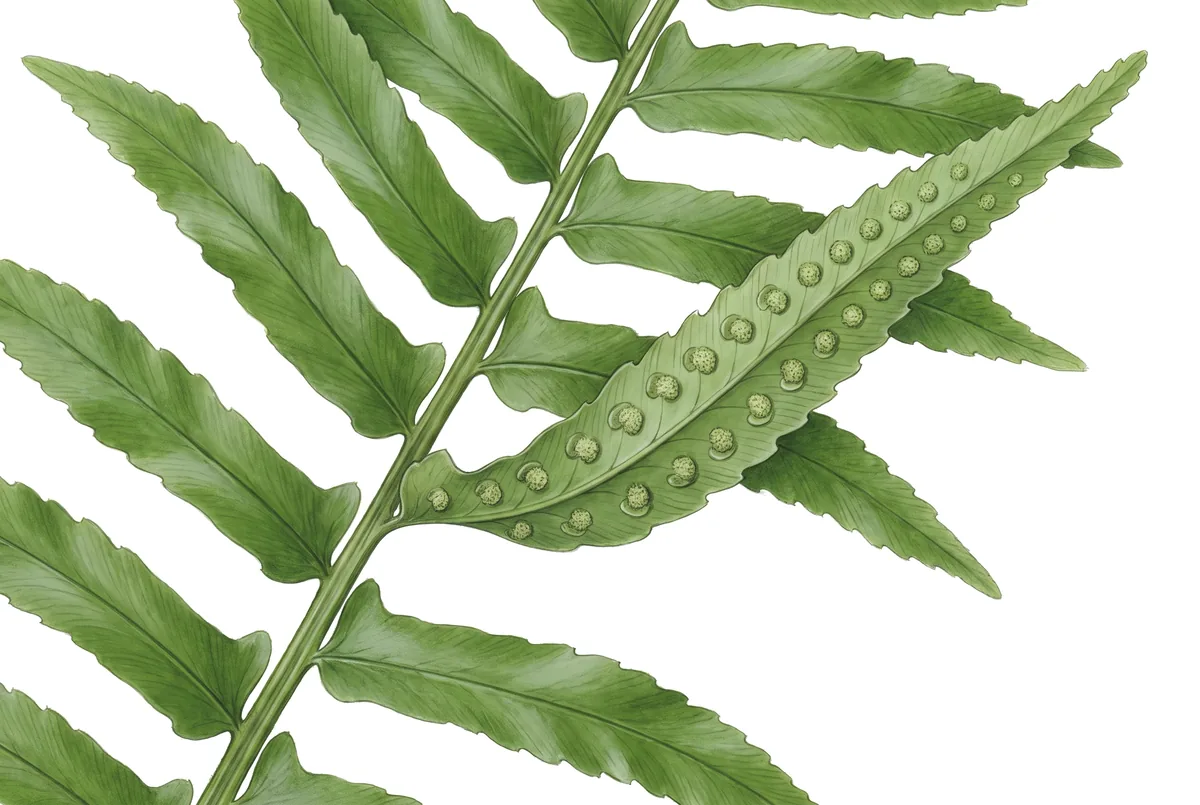
- The key in the Australian tropical ferns flora separates them by the pinnae: in this fern they are longer than 50 mm with a pointed tip, in fishbone fern shorter than 50 mm with a blunt tip and with ears at the base overlapping the frond's axis. The same flora's note on similar species says this fern's pinna margins are relatively entire, without a basal ear. That flora also gives fishbone fern as one of this species' own common names, so read the botanical name on a line sold as fishbone fern.
- Is Macho fern the same plant?
- Macho is sold as Nephrolepis biserrata. North Carolina State Extension says some nurseries label the species macho fern because it is the largest of the sword ferns, and it lists 'Macho' among the cultivars, with giant, cascading bright green fronds that can grow to about 1.2 m long.
- Is it safe for cats and dogs?
- The ASPCA lists sword fern, Nephrolepis biserrata, as non-toxic to dogs, cats and horses.
- What does the name mean?
- By the Flora of Australia, biserrata is from the Latin for twice and saw-toothed: the main teeth of the pinna margins sometimes carry a second, smaller series in the gaps between them. North Carolina State Extension says Nephrolepis joins the Greek for kidney and scale, after the shape of the indusium.
- Which family is Nephrolepis in?
- References differ. GBIF and the Australian tropical ferns key place it in Nephrolepidaceae, the name this page uses, while the Australian Plant Census files the species under Lomariopsidaceae.
Sources
- GBIF species match API
- Australian Plant Census (APC), the National Species List
- FloraBase, the Western Australian Flora (Western Australian Herbarium)
- Atlas of Living Australia
- ASPCA Animal Poison Control, Toxic and Non-Toxic Plants: Sword Fern
- Flora of Australia online (Australian Biological Resources Study): Nephrolepis biserrata
- Australian Tropical Ferns and Lycophytes, online edition (Lucid key)
- North Carolina State Extension Gardener Plant Toolbox (Nephrolepis biserrata)
- The HortOS catalogue (the forms growers list)
- The HortOS guides (reading an availability list; judging nursery plant quality)
The growers, sizes and prices above are live and change as lists arrive. Cite this page: HortOS, Broad sword fern (Nephrolepis biserrata), https://au.hortosapp.com/plants/nephrolepis-biserrata.
Found a fact that is wrong? Tell us and it is checked against its source.