- Type
- Evergreen palm
- Height
- 2 m to 5 m
- Spread
- 2 m to 3 m
- Growth
- Slow
- Flowers
- Green, all year by PlantNET and the Flora of Australia; spring by the SA Plant Selector, and late winter to mid spring by Sustainable Gardening Australia
- Sun
- Shade (PACSOA); shade to filtered sun (Sustainable Gardening Australia); full sun to part shade by the SA Plant Selector
- Drought
- Tolerant
- Frost
- Not generally suited to frosty areas (Sustainable Gardening Australia)
- In Australia
- Native
| Size | Grower | PricePrice ex GST | ||
|---|---|---|---|---|
| Tube | Kumbartcho NurseryTube | Price on application. Sign in to ask the grower. | ||
| 90mm | Kumbartcho Nursery90mm | Price on application. Sign in to ask the grower. |
Also grown by 6 nurseries (no sizes or prices listed)
Enquire with them for sizes and prices.
- Barung LandcareLandsborough, QLD
- Carl's Rainforest NurseryKiama Downs, NSW
- Paten Park Native NurseryThe Gap, QLD
- Port Macquarie Landcare Community NurseryPort Macquarie, NSW
- Sydney Wildflower NurseryHeathcote, NSW
- True Green NurseryMelton, VIC
Growing walking stick palm
Position. PlantNET finds it mainly in warmer rainforest and sometimes in cool-temperate rainforest, and the Flora of Australia usually on basalt soils, from sea level to 1200 m. By Sustainable Gardening Australia it wants shade and shelter and takes filtered sun. PACSOA wants it in good shade, away from hot sun: with only semi-shade its foliage fades to a plainer mid green, and wind browns the leaf tips. The SA Plant Selector lists full sun as well as part shade and says it does best in warmer climates.
Soil and water. The SA Plant Selector asks for moist, well-composted soil and lists clay, loam and sand, acid to alkaline, with moderate supplementary watering; it also ticks drought among what the palm tolerates. Sustainable Gardening Australia advises humus-rich soil that stays moist but drains, plenty of organic matter and mulch, and good watering after planting, and says the palm is more drought tolerant once established.
Frost. Sustainable Gardening Australia counts frost districts out in general, with some evidence it can succeed in a well-chosen microclimate; PACSOA's contributor has heard it will tolerate some frost. No reference read gives a frost figure.
Care. Sustainable Gardening Australia finds it generally free from serious pests and diseases; spent leaves are removed at the base.
Propagation. It is raised from seed. Sustainable Gardening Australia says germination is reliable, over 90 percent, but slow, taking one month to a year; PACSOA says fresh seed, cleaned and soaked for a day, comes up within a month. Both say seedlings are slow and tender at first.
Using walking stick palm
Sustainable Gardening Australia rates it especially good for small courtyards and says its small size and slow growth let it live in a pot almost indefinitely, and the SA Plant Selector also says it can be grown as a pot plant. For a palm kept indoors, Sustainable Gardening Australia advises warmth, low or dappled light and regular time outdoors in shade.
In the wild it often grows in colonies, up to 6 to 8 plants a square metre, beside the Bangalow palm (PACSOA, Sustainable Gardening Australia). No reference read gives a planting distance for gardens.
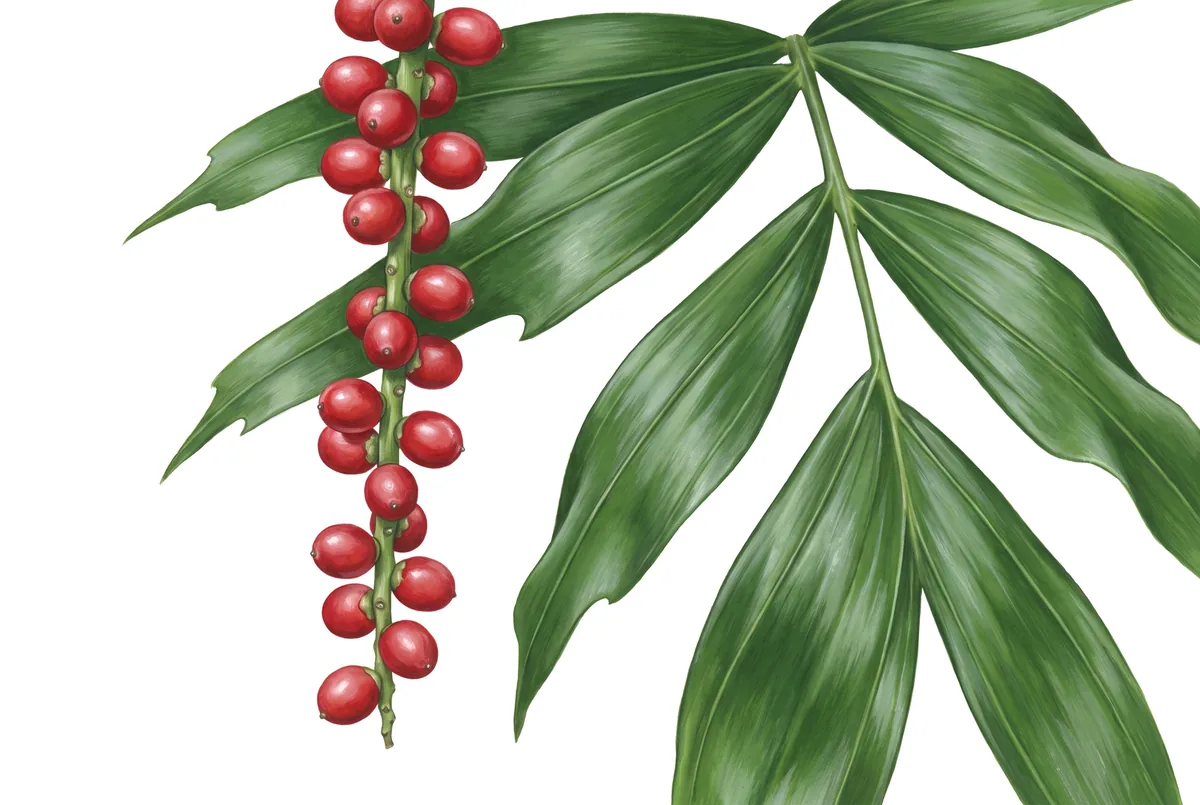
Sustainable Gardening Australia says the berries are edible when bright red and fully ripe, sweet with a peppery aftertaste, and that the new shoots can be eaten too, but cutting them kills the plant. It adds that the berries attract birds and the yellow and orange palm dart butterfly. The name comes from the stem. PlantNET notes that stems make walking sticks, with the knob at the base shaped into a handle, and Sustainable Gardening Australia says the stems went to make sticks for soldiers wounded in the First World War.
What to check before you buy
A line under Walking Stick Palm and a line under the botanical name are the same plant, so prices under either name can be compared as one. Growers write Linospadix monostachya, a spelling the Australian Plant Census treats as an orthographic variant of the accepted Linospadix monostachyos, and also use the name walking stick palm. Sustainable Gardening Australia gives about 5 years to the first flowers and fruit, and PACSOA plants palms out at about 450 mm high. PACSOA also notes that young palms tend to rise up out of the pot and become weakly rooted, and suggests deep pots. The table above shows the sizes growers list, and the pot sizes guide explains the grades; for roots, pests and hardening off see judging nursery plant quality. The guide to buying from a wholesale grower says nursery stock sent interstate must meet the destination state's quarantine entry conditions and may need a plant health certificate.
Used forpots and courtyardsindoor
Prices are set by each grower and shown ex GST. Availability is confirmed by the grower at order.
Common questions
- Who grows Linospadix monostachya wholesale in Australia?
- 1 wholesale grower lists Linospadix monostachya on HortOS right now, each with their own pot sizes and trade prices. They are in Queensland. The growers are named on this page.
- What pot sizes does Linospadix monostachya come in?
- Growers on HortOS list Linospadix monostachya in Tube and 90mm.
- How do I order Linospadix monostachya from these growers?
- HortOS is for the trade. Add the lines you want to a list and send it: each grower gets their part of the order by email, confirms what they have and quotes freight, and nothing is bought until you approve it. Listing, searching and ordering are free.
- Is Walking Stick Palm a cultivar of Linospadix?
- No. Walking stick palm is the common name of the species Linospadix monostachyos in PlantNET, the Flora of Australia and the Atlas of Living Australia, and a line called Linospadix monostachya Walking Stick Palm is the straight species.
- Is walking stick palm an Australian native?
- Yes. The Australian Plant Census gives it in Queensland and New South Wales, and the Flora of Australia calls it endemic to southern Queensland and northern New South Wales, from near Gympie to Taree.
- How tall does walking stick palm grow?
- The SA Plant Selector gives 4 to 5 m high and 2 to 3 m wide, and Sustainable Gardening Australia says it rarely grows taller than 2 m. In the wild PlantNET gives stems mostly 1.3 to 2 m high, occasionally 5 m, and the Flora of Australia 2 to 6 m.
- Does it form a clump?
- The Flora of Australia and PACSOA describe it as solitary, and Sustainable Gardening Australia as single-stemmed, though it often grows in colonies in the wild. The SA Plant Selector calls it a slender clumping palm.
- Will it grow in full sun?
- The SA Plant Selector lists full sun and part shade. Sustainable Gardening Australia favours shade and shelter and says filtered sun will also do, and PACSOA that it does not like hot sun and looks its best in good shade.
- Are the red fruit edible?
- Sustainable Gardening Australia says the berries are edible when bright red and fully ripe, and describes them as sweet with a peppery aftertaste.
- Why is it called walking stick palm?
- PlantNET says the stems are used for walking sticks, the knob at the base carved into the handle, and Sustainable Gardening Australia that walking sticks were made from them for wounded soldiers after the First World War. The Flora of Australia and the Atlas also record the name midgin-bil.
- Is Linospadix monostachya the same plant?
- Yes. The Australian Plant Census accepts Linospadix monostachyos and treats Linospadix monostachya and Linospadix monostachyus as variant spellings; PlantNET lists monostachya as a synonym. Areca monostachya, Kentia monostachya and Bacularia monostachya are older names for it.
Sources
- GBIF species match API
- Australian Plant Census (APC), Council of Heads of Australasian Herbaria: Linospadix monostachyos
- Flora of Australia (Australian Biological Resources Study): Linospadix monostachyos
- PlantNET, the New South Wales flora online (Royal Botanic Garden Sydney): Linospadix monostachyos
- Atlas of Living Australia: Linospadix monostachyos
- Plant Selector+, Botanic Gardens and State Herbarium of South Australia: Linospadix monostachyos
- Sustainable Gardening Australia: edible and useful walking stick palm
- Palm and Cycad Societies of Australia (PACSOA), palm and cycad wiki: Linospadix monostachyos
- The HortOS catalogue (the names growers list it under)
- The HortOS guides (nursery pot sizes; judging nursery plant quality; buying from a wholesale grower)
The growers, sizes and prices above are live and change as lists arrive. Cite this page: HortOS, Walking stick palm (Linospadix monostachyos), https://au.hortosapp.com/plants/linospadix-monostachya.
Found a fact that is wrong? Tell us and it is checked against its source.