- Type
- Perennial
- Height
- 0.3 m to 1.2 m
- Spread
- 0.3 m to 1.5 m
- Flowers
- Straw-brown, spring to summer
- Sun
- Full sun to part shade
- Drought
- Tolerant
- Frost
- Tolerates moderate frost
- In Australia
- Native
Also grown by 16 nurseries (no sizes or prices listed)
Enquire with them for sizes and prices.
- Burringbar Rainforest NurseryBurringbar, NSW
- Carbrook NurserySouth Maclean, QLD
- Firewheel NurseryDorroughby, NSW
- ForsterianaDarawank, NSW
- Harvest Seeds and Native PlantsTerrey Hills, NSW
- Hawkesbury Community NurseryMulgrave, NSW
- Hinterhub - Native Plants and Artisan GiftsQLD
- Hunter Indigenous PlantsBeresfield, NSW
- Kersbrook Landcare NurseryWilliamstown, SA
- Mansfields Propagation NurserySkye, VIC
- Native Seeds Pty LtdEurobin, VIC
- Newcastle Wildflower NurseryGlendale, NSW
- Provincial Plants and LandscapesFairbairn Avenues) Pialligo, ACT
- Sydney Wildflower NurseryHeathcote, NSW
- Visitor Centre & Native Plant NurserySt Ives, NSW
- Yuruga Nursery (Arakai Pty Ltd)QLD
Growing common rush
Position. Full sun to part shade, by South Australia's Plant Selector. It is a plant of wet ground: the Australian National Botanic Gardens profile finds it along stream and river banks, irrigation channels and swamps, usually at the water's edge or in shallow water, and says it favours saturated soil but does not thrive in deep water.
Soil and water. The Selector gives clay, loam or sand of any pH, says it prefers low-lying, moisture-retentive sites but tolerates extended dry periods, and puts its supplementary watering at minimal. The ANBG profile adds that it is recorded as being salt-tolerant, and that its spread on low-lying ground can be an early sign of dryland salinity.
Frost. The Selector lists moderate frost among its tolerances. No reference read gives Australian climate zones for it.
Range. Most of the Atlas of Living Australia's records come from New South Wales, then Queensland and Victoria. The New South Wales flora finds it very common on stream banks and other damp ground, as far inland as near Dubbo and along the Murray valley, and treats the plants of the irrigation areas around Warren, Griffith and Hay as probably introduced. In north-east Queensland the CSIRO rainforest key records it at 600 to 1200 m, in swampy ground, beside roads and in disturbed upland and mountain rainforest.
Upkeep. No reference read gives a pruning regime or names a pest or disease of it. The ANBG profile notes that heavy grazing on the New South Wales south coast shortened the tussocks, with no other effect known.
Using common rush
South Australia's Plant Selector rates common rush as a perennial rush for stabilising riparian zones and estuary banks, in reserves and parks or beside industrial, recreational and urban sites; as habitat for birds and other wildlife; and as appropriate in biofiltration systems and rain gardens. The ANBG profile records it in wetland rehabilitation, in constructed wetlands for treating wastewater, and in landscaping, where its fine, arching stems suit creek and pond banks. The same profile notes that it can provide cover and food for animals such as frogs, and nesting sites for birds, and that yabbies eat the young stems. The Selector adds that Indigenous peoples used its stems and leaves for fibre, among other things for fishing line and baskets. None of the references read gives planting centres. For how a rain garden is sited, built and planted, see the HortOS guide to rain gardens and bioswales; its plant table does not include common rush.
What to check before you buy
The Atlas of Living Australia also files common rush among the names of soft rush (Juncus effusus) and loose-flower rush (Juncus pauciflorus), and the ANBG profile gives mat rush as one of this plant's names, though in the HortOS guides mat rush is part of the name of spiny-headed mat rush, a different plant. Some growers add a provenance, such as basalt; the HortOS guide to restoration planting and local ecotype stock sets out what to ask a grower about where, and from how many plants, the seed was collected. The guide to buying from a wholesale grower lists it among the natives most often listed as tubes, priced at tube and 140 mm. For what to check in the pot, see judging nursery plant quality. Stock crossing a state border moves under the state and territory biosecurity rules.
Cautions
South Australia's Plant Selector notes that common rush can become weedy and form large colonies. The ANBG profile calls it a pasture weed that can become a nuisance in poorly drained irrigation land, and notes that it may obstruct flow in shallow channels, though rarely.
Used forwetland and riparianerosion controlrevegetationpollinators and wildlife
Prices are set by each grower and shown ex GST. Availability is confirmed by the grower at order.
Common questions
- Who grows Juncus usitatus wholesale in Australia?
- 34 wholesale growers list Juncus usitatus on HortOS right now, each with their own pot sizes and trade prices. They are in New South Wales, Queensland and Victoria. The growers are named on this page.
- What pot sizes does Juncus usitatus come in?
- Growers on HortOS list Juncus usitatus in Forestry tube, Hiko, Tube, 40mm, 50mm, 75mm, 100mm, 140mm, 280mm, 300mm and 1 more sizes.
- What does Juncus usitatus cost wholesale?
- The median trade price in a 140 mm pot is $6.75 ex GST, across 10 growers who price it. Prices by pot size and state are on its trade price page.
- How do I order Juncus usitatus from these growers?
- HortOS is for the trade. Add the lines you want to a list and send it: each grower gets their part of the order by email, confirms what they have and quotes freight, and nothing is bought until you approve it. Listing, searching and ordering are free.
- Is common rush a cultivar?
- No. Common rush is the common name of the native species Juncus usitatus, given by VicFlora, the Atlas of Living Australia and South Australia's Plant Selector. A listing under either name is the same plant.
- Is common rush the same plant as soft rush?
- Not always. The Atlas of Living Australia gives soft rush as the main common name of Juncus effusus and lists common rush among that plant's names as well, while the CSIRO rainforest key gives soft rush as a name of Juncus usitatus. Check the botanical name on the label.
- How tall does common rush grow?
- South Australia's Plant Selector gives 0.3 to 1.2 m tall and 0.3 to 1.5 m wide, and the Victorian and New South Wales floras give stem heights and lengths within that range. The CSIRO rainforest key gives stems about 1 to 1.5 m long, longer at the top end than the others.
- Can common rush grow in standing water?
- In shallow water, yes. The Australian National Botanic Gardens profile says it favours saturated soil and shallow water and usually grows at the water's edge, but does not thrive in deep water.
- Is common rush drought tolerant?
- South Australia's Plant Selector lists drought among its tolerances and says it tolerates extended dry periods, though it prefers low-lying, moisture-retentive sites. The ANBG profile reports that horticultural suppliers call it drought tolerant.
- Does common rush spread?
- It can. The Selector warns that it can become weedy and form large colonies, and the ANBG profile suggests that its rhizomes presumably let it spread by vegetative growth. The same profile calls it a pasture weed in poorly drained ground.
- Is common rush native to Australia?
- Yes. The Australian Plant Census gives it as native to Queensland, New South Wales, the ACT and Victoria and naturalised in Western Australia and South Australia, though South Australia's Plant Selector counts it indigenous to the Murray and Southern Lofty regions. The ANBG profile adds that it is also native to New Zealand and New Caledonia.
- When does common rush flower?
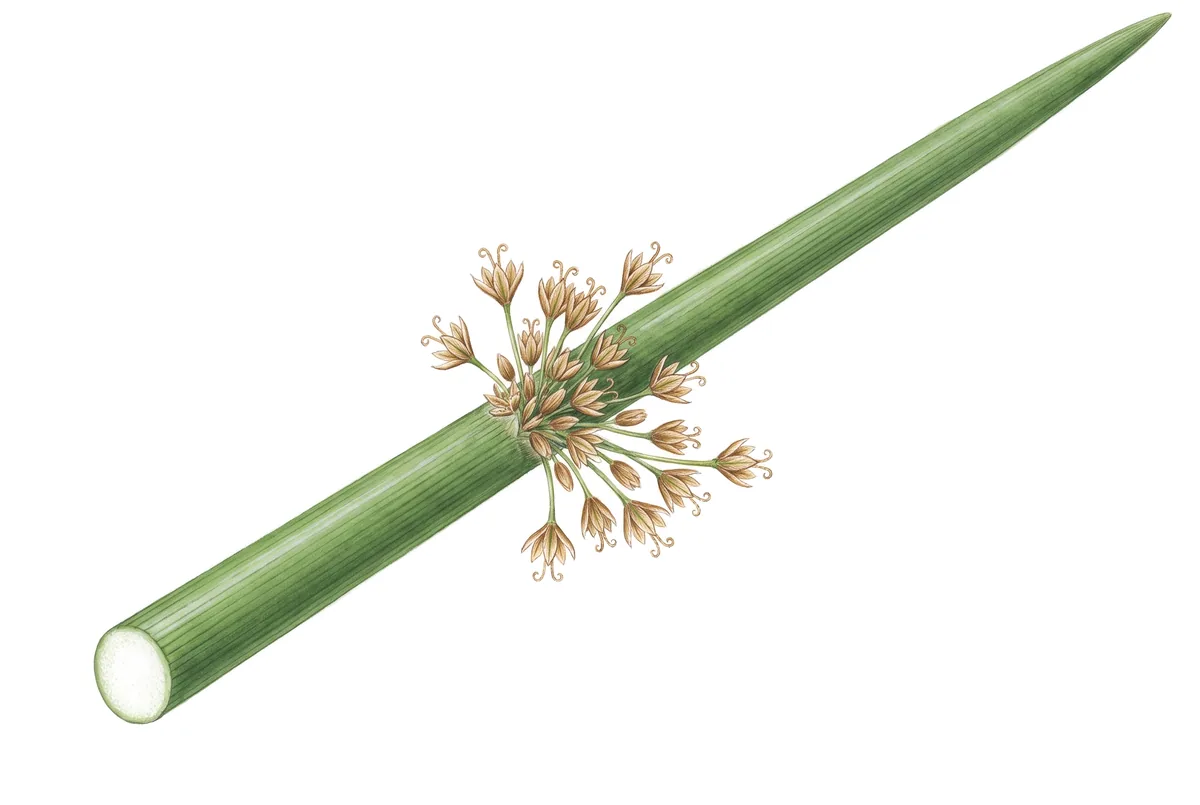
- In spring and summer, by the New South Wales flora and South Australia's Plant Selector; VicFlora gives mostly November to February. The flowers are small and straw-brown, in a loose cluster on the side of the stem, and the ANBG profile notes that old flowers usually stay on the plant all year.
Sources
- GBIF species match API
- PlantNET, the New South Wales flora online (Royal Botanic Garden Sydney), Flora of NSW
- VicFlora, the Flora of Victoria online (Royal Botanic Gardens Victoria)
- Australian Tropical Rainforest Plants, online edition (CSIRO)
- Plant Selector+ (Botanic Gardens and State Herbarium of South Australia, the Green Infrastructure Project), Juncus usitatus
- Australian Plant Census, the APC distribution line
- Atlas of Living Australia (the species and its records by state; a search for the name common rush)
- Australian National Botanic Gardens, Centre for Australian National Biodiversity Research: Taxon Attribute Profiles, Juncus usitatus
- The HortOS catalogue and guides (buying-from-a-wholesale-grower, which lists common rush and names spiny-headed mat rush; restoration-planting-and-local-ecotype-stock; rain-gardens-and-bioswales; judging-nursery-plant-quality)
The growers, sizes and prices above are live and change as lists arrive. Cite this page: HortOS, Common rush (Juncus usitatus), https://au.hortosapp.com/plants/juncus-usitatus.
Found a fact that is wrong? Tell us and it is checked against its source.