Grevillea thelemanniana
Grevillea / Spider Flower
Every Grevillea thelemanniana on HortOS in one place: the plain species and 3 varieties. Pick a size to see it across all of them.
4 growers · 5 sizes · from $2.50 ex GST
- Type
- Evergreen shrub
- Height
- 0.3 m to 1.5 m
- Spread
- 1 m to 2 m
- Flowers
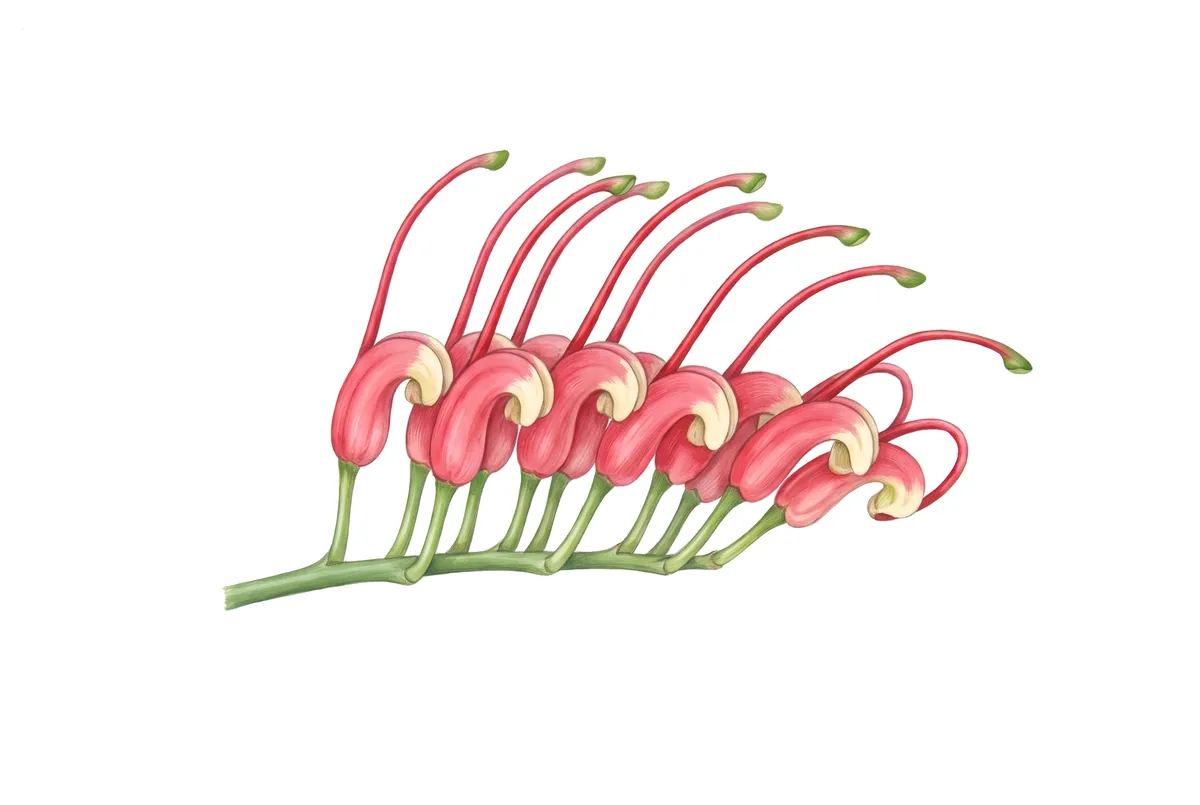
- Pink-red, winter to spring
- Sun
- Full sun (part shade also for 'Red wings'), by South Australia's Plant Selector for its garden forms
- Drought
- Tolerant
- Frost
- Moderate frost
- In Australia
- Native
| Size | Grower | PricePrice ex GST | ||
|---|---|---|---|---|
| Tube | Larkman NurseriesRed WingsTube | $2.75 | ||
| 70mm | Buffalo River NurseryMini Marvel70mm | $5.00 | ||
| 125mm | Winterley Nurseries Pty LtdCompact Green Gem125mm | $2.50 | ||
| 140mm | Bambra Native PlantsRed Wings140mm | $6.50 | ||
| 150mm | Winterley Nurseries Pty LtdCompact Green Gem150mm | $5.50 |
Also grown by 6 nurseries (no sizes or prices listed)
Enquire with them for sizes and prices.
- Bushland Flora Pty LtdMt Evelyn, VIC
- Geographe Community Landcare NurseryAmbergate, WA
- Leschenault Community NurseryBunbury, WA
- Newcastle Wildflower NurseryGlendale, NSW
- Newstead NativesNewstead, VIC
- The Plant Supply CoWA
Growing spider net grevillea
Position and climate. South Australia's Plant Selector gives full sun for its forms of the species, with part shade as well for 'Red wings', and the Australian Native Plants Society says grevilleas in general flower best in open, sunny spots. The Plant Selector rates its forms moderately frost tolerant and ticks drought tolerance, with minimal supplementary watering, and lists them variously for plains, footslopes, hills and the second line back from the coast. No reference read gives a frost figure in degrees.
Soil. The Plant Selector says its forms need well drained soil, loam or sand and for most of them clay too, acid to alkaline. The Australian Native Plants Society says virtually all grevilleas do best in well drained soils and prefer acid ones, and that, like other members of the protea family, they can be harmed by fertiliser high in phosphorus: feed with a low-phosphorus, slow-release fertiliser or not at all. In the wild, by FloraBase and the Flora of Australia, the species grows in winter-wet, low-lying swampy heath on sand and sandy clay.
Pruning. The Plant Selector says its forms respond well to pruning, and the Australian Native Plants Society prunes grevilleas each year by about a third to make them branch and stay bushy.
Propagation. In the wild it regenerates from its lignotuber and from seed, by the Flora of Australia. The Australian Native Plants Society gives seed, cuttings and grafting as the ways grevilleas are grown, with cuttings or grafts used to keep a selection true.
Using spider net grevillea
The garden forms are what the trade uses. South Australia's Plant Selector lists 'Baby' and 'Red Ramble' as low, wide-spreading groundcovers for banks, rock gardens and roadside plantings, and says they suppress weeds and help hold soil. It puts the low 'Red wings' (growers list it as Red Wings) in borders, verges and parks, alone in front of a mixed planting or massed as a low barrier or informal hedge, and the taller, bushy 'Spriggs Form' as a filler or a plant to spill over rocks and retaining walls. It says 'Red wings', 'Baby' and 'Red Ramble' attract birds. The references read give no planting distance.
HortFlora calls the species highly variable, with many horticultural selections. It also notes that the plant once treated as its subspecies obtusifolia, now Grevillea obtusifolia, is sold as 'Gingin Gem'. The Flora of Australia separates the two: G. obtusifolia has every leaf undivided and broader, where this species usually has some leaves divided into lobes.
What to check before you buy
The table above shows the sizes growers list; the guide to nursery pot sizes explains the size ladder. Because the species is sold in forms that run from flat groundcovers to shrubs about a metre high, check which form a line names before matching it to a job; the guide to reading an availability list covers how. Under South Australia's Sewerage Act the Plant Selector records the species as provisionally in schedule 1, needing written approval before it is planted in a street and kept at least two metres from a sewer main or connection. Stock that crosses a state border moves under the state and territory biosecurity rules on moving plants and soil.
Cautions
South Australia's Plant Selector warns on several of its forms that the plant can be a skin irritant, and the Australian Native Plants Society says the foliage of several grevilleas causes contact dermatitis in people who are sensitive to it.
Critically Endangered nationally and in Western Australia, as the Atlas of Living Australia records it; FloraBase gives its Western Australian conservation code as Threatened (Atlas of Living Australia, conservation status (national and Western Australian lists))
Prices are set by each grower and shown ex GST. Availability is confirmed by the grower at order.
Common questions
- Who grows Grevillea thelemanniana wholesale in Australia?
- 4 wholesale growers list Grevillea thelemanniana on HortOS right now, each with their own pot sizes and trade prices. They are in Victoria and South Australia. The growers are named on this page.
- What pot sizes does Grevillea thelemanniana come in?
- Growers on HortOS list Grevillea thelemanniana in Tube, 70mm, 125mm, 140mm and 150mm.
- How do I order Grevillea thelemanniana from these growers?
- HortOS is for the trade. Add the lines you want to a list and send it: each grower gets their part of the order by email, confirms what they have and quotes freight, and nothing is bought until you approve it. Listing, searching and ordering are free.
- How big does spider net grevillea grow?
- The wild species is 0.5 to 1 m high and 1 to 2 m wide by the Flora of Australia, and 0.3 to 1.5 m high by FloraBase. Garden forms differ: South Australia's Plant Selector lists some as flat groundcovers and 'Spriggs Form' as a low shrub up to about a metre.
- When does Grevillea thelemanniana flower?
- In winter and spring: July to October by the Flora of Australia, May to November by FloraBase. South Australia's Plant Selector gives spring and autumn for some of its forms.
- Is Grevillea thelemanniana endangered?
- In the wild, yes. The Atlas of Living Australia records it as Critically Endangered nationally and in Western Australia, and the Flora of Australia confines it to the Cannington, Wattle Grove and Kenwick areas of Perth.
- What do the leaves look like?
- Narrow and 1 to 2.5 cm long, by the Flora of Australia, usually of two kinds on one plant: some undivided and very narrow, others divided into 2 to 5 narrow lobes. The edges roll under, leaving a narrow strip of the silky underside showing.
- How is it different from Grevillea obtusifolia?
- The Flora of Australia calls the two very similar. Grevillea obtusifolia has all its leaves undivided and broader, with the midvein showing as a pale line on top, and a shorter pistil; spider net grevillea usually has some leaves divided and the midvein hidden.
- Does spider net grevillea take frost and dry conditions?
- South Australia's Plant Selector rates its garden forms moderately frost tolerant and ticks drought tolerance, with minimal supplementary watering. No reference read gives a figure in degrees.
Sources
- GBIF species match API
- Australian Plant Census (APC)
- Flora of Australia online (ABRS), Grevillea thelemanniana
- FloraBase, the Western Australian flora (Western Australian Herbarium)
- Atlas of Living Australia, species record and conservation status
- Plant Selector+ (Botanic Gardens and State Herbarium of South Australia), Grevillea thelemanniana 'Spriggs Form'
- Plant Selector+ (Botanic Gardens and State Herbarium of South Australia), Grevillea thelemanniana 'Red wings'
- Plant Selector+ (Botanic Gardens and State Herbarium of South Australia), Grevillea thelemanniana 'Baby'
- Plant Selector+ (Botanic Gardens and State Herbarium of South Australia), Grevillea thelemanniana 'Red Ramble'
- HortFlora, the horticultural flora of south-eastern Australia (Royal Botanic Gardens Victoria)
- Australian Native Plants Society (Australia), Grevillea: background, propagation and cultivation
- The HortOS guides (nursery pot sizes; reading an availability list)
The growers, sizes and prices above are live and change as lists arrive. Cite this page: HortOS, Spider net grevillea (Grevillea thelemanniana), https://au.hortosapp.com/plants/grevillea-thelemanniana.
Found a fact that is wrong? Tell us and it is checked against its source.