Ficus carica Black Genoa
Fig
One of 12 Ficus carica varieties: see them all
13 growers · 12 sizes · from $6.50 ex GST
- Type
- Deciduous tree
- Height
- 3 m to 10 m
- Spread
- 3 m to 9.1 m
- Growth
- Fast
- Flowers
- Green, spring to summer
- Sun
- Full sun by South Australia's Plant Selector+; full sun to part shade by American references
- Drought
- Tolerant
- Frost
- Mature trees withstand quite severe frosts
- In Australia
- Naturalised
| Size | Grower | PricePrice ex GST | ||
|---|---|---|---|---|
| 95mm | Arbour Grove Nursery95mm | $17.50 | ||
| 140mm | Treetop Wholesale Nursery140mm | $6.50 | ||
| 140mm | Monbulk Jindabyne Nursery140mm | $12.50 | ||
| 165mm | Daleys Fruit Tree Nursery165mm | $29.00 | ||
| 180mm | Tara Valley Nursery180mm | $14.65 | ||
| 250mm | Poyntons Nursery250mm | $69.99 | ||
| 300mm | Yandoit Tree Farm Formerly B&T's Trees300mm | $50.00 | ||
| 300mm | Blackall Range Nurseries300mm | $60.00 | ||
| 400mm | Camden Nurseries400mm | $81.77 | ||
| 400mm | Yandoit Tree Farm Formerly B&T's Trees400mm | $100.00 | ||
| 4L | Yandoit Tree Farm Formerly B&T's Trees4L | $10.00 | ||
| 10L | Gale Citrus10L | $25.00 | ||
| 12.5L | Plants Galore12.5L | $13.75 | ||
| 35L | River Road Nursery35L | $199.00 | ||
| Bare root | The Vintage Tree NurseryBare root | $4,400.00 |
Also grown by 6 nurseries (no sizes or prices listed)
Enquire with them for sizes and prices.
- Diversifolius NurseryElanora Heights, NSW
- Faceys NurseryVIC
- Lakeside NurseryStratham, WA
- Mala's NurseryGympie, QLD
- Southern PlantsDromana, VIC
- Yuruga Nursery (Arakai Pty Ltd)QLD
Growing black Genoa
Climate. Queensland's Department of Agriculture and Fisheries calls the edible fig a subtropical plant that also succeeds where winters are fairly mild: it thrives in inland New South Wales, can be grown on the cooler tablelands and needs no winter chilling. It yields best where summers are fairly dry, since summer rain on the coast can split the fruit. Mature trees withstand quite severe frosts, but young trees are very susceptible and should be protected through their first two winters.
Soil and water. The same summary says figs take most soils, from coarse sand to heavy clay, do best well drained and reasonably fertile, ideally at pH 6.0 to 6.5, and are fairly tolerant of moderate salinity. South Australia's Plant Selector+ takes alkaline soil; North Carolina State Extension, an American reference, says the fig does not. The roots are shallow but extensive, so organic mulch helps and digging near the tree can make it sucker. Figs take drier conditions than most fruit trees but still need irrigation: too little water while the fruit develops gives hollow figs, and a sudden rise near ripening splits them.
Pruning. The summary heads a single-stemmed young tree at about 60 cm and keeps three branches as its framework; after that a light winter prune brings on new wood for the main crop, with some older wood left for the breba crop.
Pests. It lists root-knot nematode, worst in sandy soils, dried fruit beetle, Queensland fruit fly, fig blister mite, anthracnose and fig rust on the coast, fig mosaic virus, which spreads through grafting and cuttings, and birds, against which it calls permanent netting necessary.
Using black Genoa
Black Genoa is a fresh-eating fig. The Queensland summary says growers choose it for its high yields and open, spreading habit, and that the fruit stores well and ripens slightly earlier than Brown Turkey. Like the other common figs it sets fruit without pollination and usually gives two crops: a breba crop on the previous season's wood, ripe about December to January, and the main crop on new wood, ripe between February and June. South Australia's Plant Selector+ names Black Genoa among the fig cultivars and lists the species as a feature, shade and fruit tree for urban sites, its fruit eaten fresh, dried or made into jam. Preston Prolific is thought to be a seedling of Black Genoa that arose in Victoria, by the same Queensland summary. The other fig with a page is Brown Turkey, purplish brown in the skin. Fruit trees for a group planting are priced in the community garden planting guide.
What to check before you buy
Check the variety on the line: a list that says only fig does not name the fruit, and Black Genoa's purple skin and dark red flesh are not Brown Turkey's purplish-brown skin and pinkish-brown flesh. The HortOS community garden guide gives 300 mm as the size the most growers price for Black Genoa; the table above shows the sizes growers list. The Queensland summary says figs are traditionally planted as dormant rooted cuttings in late winter or early spring, and that a tree usually begins to bear two to three years after planting. Root and quality checks are in the nursery plant quality guide. In Western Australia the state's shot-hole borer exclusion list recommends leaving the common fig out of government-funded tree planting. Victoria's advisory list of environmental weeds lists the fig, risk rating high, and the Weeds of Australia fact sheet (2016) regards it as an environmental weed in Western Australia and South Australia. Stock crossing a state border moves under the state and territory biosecurity rules.
Cautions
Fig latex irritates the skin: the Queensland summary advises gloves and long sleeves when harvesting, and North Carolina State Extension, an American reference, lists phytophotodermatitis from the milky sap. The Australian Plant Census lists the fig as naturalised in Western Australia, the Northern Territory, South Australia and New South Wales, and doubtfully naturalised in Queensland, Victoria and on Norfolk Island.
Victoria: listed as an environmental weed in the Victorian Government's advisory list of environmental weeds, its impact on natural systems occasionally significant, with extensive potential for further spread and a risk rating of high. The Weeds of Australia fact sheet (2016) regards the fig as an environmental weed in Western Australia and South Australia. (Advisory list of environmental weeds in Victoria, Arthur Rylah Institute (Victorian Government); Weeds of Australia fact sheet, Biosecurity Queensland edition (Identic Pty Ltd, 2016))
Used forfruit and orchardediblespecimenshadepots and courtyards
Prices are set by each grower and shown ex GST. Availability is confirmed by the grower at order.
Common questions
- Who grows Ficus carica Black Genoa wholesale in Australia?
- 13 wholesale growers list Ficus carica Black Genoa on HortOS right now, each with their own pot sizes and trade prices. They are in Victoria, New South Wales, Queensland and the ACT. The growers are named on this page.
- What pot sizes does Ficus carica Black Genoa come in?
- Growers on HortOS list Ficus carica Black Genoa in 95mm, 140mm, 165mm, 180mm, 250mm, 300mm, 400mm, 4L, 10L, 12.5L and 2 more sizes.
- How do I order Ficus carica Black Genoa from these growers?
- HortOS is for the trade. Add the lines you want to a list and send it: each grower gets their part of the order by email, confirms what they have and quotes freight, and nothing is bought until you approve it. Listing, searching and ordering are free.
- What does a Black Genoa fig look like?
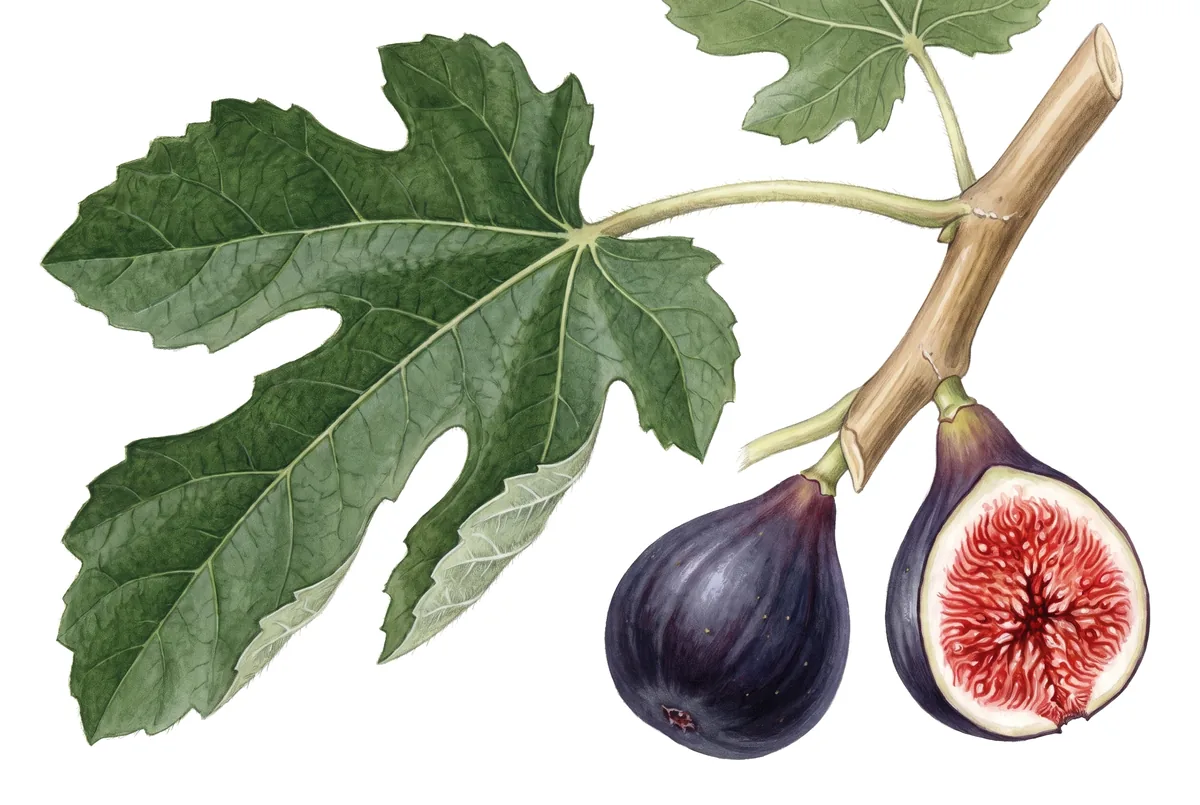
- Large, squat and pear-shaped, with purple skin and dark red flesh, dark purple when mature, by Queensland's Department of Agriculture and Fisheries. HortFlora gives dark skin and red pulp with a sweet, rich flavour.
- Does a Black Genoa fig need a pollinator?
- No. It is a common fig, and the Queensland summary says common figs form their fruit without being pollinated, so the seeds are empty. HortFlora also says the common fig needs no pollination to set the part that is eaten.
- When does Black Genoa fruit?
- Common figs usually crop twice, by the Queensland summary: a breba crop on the previous season's wood, ripe about December to January, and a main crop on new wood, ripe between February and June. It says Black Genoa matures slightly earlier than Brown Turkey.
- Are fig trees frost hardy?
- Mature trees withstand quite severe frosts, by Queensland's Department of Agriculture and Fisheries, but young trees are very susceptible and should be protected in their first and second winters. South Australia's Plant Selector+ also says young trees need frost protection.
- How big does a fig tree grow?
- South Australia's Plant Selector+ gives the species 7 to 9 m high and 3 to 5 m across, and HortFlora to 10 m. The Plant Selector+ says it can be pruned to keep a manageable size and shape.
- Is the fig naturalised in Australia?
- The Australian Plant Census lists it as naturalised in Western Australia, the Northern Territory, South Australia and New South Wales, and doubtfully naturalised in Queensland, Victoria and on Norfolk Island. North Carolina State Extension, an American reference, says it has become invasive in Florida and California.
Sources
- GBIF species match API: Ficus carica
- Plant Selector+ (Botanic Gardens and State Herbarium of South Australia, the Green Infrastructure Project): Ficus carica, Common Fig
- Australian Plant Census (APC), the National Species List: Ficus carica L.
- Department of Primary Industries and Regional Development, Western Australia: Polyphagous Shot Hole Borer Tree Species Exclusion List (biosecurity)
- Advisory list of environmental weeds in Victoria, Arthur Rylah Institute (Victorian Government)
- Weeds of Australia, Biosecurity Queensland edition (Identic Pty Ltd, 2016): Ficus carica
- HortFlora, the Horticultural Flora of South-eastern Australia (Royal Botanic Gardens Victoria): Ficus carica 'Black Genoa'
- HortFlora, the Horticultural Flora of South-eastern Australia (Royal Botanic Gardens Victoria): Ficus carica
- Queensland Government, Department of Agriculture and Fisheries: Queensland Murray-Darling Basin crop summary, Fig
- North Carolina State Extension Gardener Plant Toolbox: Ficus carica
- Missouri Botanical Garden Plant Finder: Ficus carica
- The HortOS guide: What the plants for a community garden cost at trade
The growers, sizes and prices above are live and change as lists arrive. Cite this page: HortOS, Black Genoa (Ficus carica 'Black Genoa'), https://au.hortosapp.com/plants/ficus-carica-black-genoa.
Found a fact that is wrong? Tell us and it is checked against its source.