Crab Apple - Plena Malus ioensis
6 growers · 3 sizes · from $65.00 ex GST
- Type
- Deciduous tree
- Height
- 3 m to 6 m
- Spread
- 2 m to 7 m
- Growth
- Slow
- Flowers
- Pale pink, spring
- Sun
- Full sun to part shade
- Drought
- Moderate
- Frost
- High frost tolerance to minus 10 C (ACT Government; Wyndham City Council also rates it high); light frost (SA Plant Selector)
- In Australia
- Not native
| Size | Grower | PricePrice ex GST | ||
|---|---|---|---|---|
| 400mm | The Advanced Tree Company400mm | $90.00 | ||
| 75L | The Advanced Tree Company75L | $185.00 | ||
| 300mm | Blackall Range Nurseries300mm | $65.00 | ||
| 400mm | South West Advanced Trees400mm | $93.00 | ||
| 400mm | Peninsula Advanced Trees400mm | $85.00 | ||
| 400mm | Kenthurst Nursery400mm | $120.00 | ||
| 400mm | Rochester Nursery400mm | $130.00 |
Growing bechtel crab apple
The ACT Government's sheet gives full sun to part shade; the SA Plant Selector and Wollondilly Shire Council give full sun. The ACT sheet, written for Canberra, rates its frost tolerance high, to minus 10 C, and Wyndham City Council also rates it high, while the Selector lists light frost only. No reference read gives an Australian climate zone.
The Selector lists clay, loam or sand, acid, neutral or alkaline; Wollondilly prefers moist, well-drained, slightly acid soil. The ACT sheet says it needs good drainage and will not take waterlogged soil, while Wyndham rates its tolerance of waterlogging moderate. The references differ on drought: the ACT sheet rates its tolerance high and Wyndham moderate, and the Selector calls it drought tolerant once established while still asking for moderate supplementary watering.
The ACT and Wollondilly sheets call it slow growing and Wyndham's slow at first; the ACT gives it medium longevity. The Selector says it responds to pruning and needs it if a single trunk is wanted, and the ACT sheet that formative pruning can be required for a single trunk with high clearance. Wyndham lists it as susceptible to scale and woolly aphid; the Selector rates it resistant to powdery mildew.
Using bechtel crab apple
The SA Plant Selector gives it two roles. Where rainfall is higher on the Adelaide plains and in the hills, it suits parks, reserves, median strips and the wider verges, alone as a feature or shade tree or in groups for light screening. Narrow verges and nature strips can take it too, as a small street tree, and it can go under power lines. The ACT sheet puts it in parks, shopping centre precincts and home gardens, and in cul-de-sacs where its low branches will not trouble trucks, with at least 15 cubic metres of available soil volume. Both note its value to wildlife: the Selector says it attracts native birds, insects and butterflies, the ACT sheet that it produces significant nectar and attracts bees and birds. The ACT Government's tree sheet rates its flammability very low. For what network operators publish on planting near powerlines, see the guide to trees and shrubs for planting near powerlines.
What to check before you buy
Growers list it under crab apple or under Malus, sometimes with the name Betchel's, and the sizes growers list include standards; the botanical name, Malus ioensis 'Plena', is the check across quotes. It comes with siting rules in two places. In South Australia, the SA Plant Selector notes that it is provisionally classified schedule 1 under that state's Sewerage Act, that written approval is required before planting it in streets or roads, and that it should not go within 2 m of a sewer main or connection. The ACT sheet keeps it 2 m from hydraulic services and away from nature reserves, creeks and watercourses, and warns that fruit drop may be a minor nuisance over paving. For specifying street trees, see the guide to specifying and procuring trees. Plants moving between states travel under the state and territory biosecurity rules on moving plants and soil.
Used forstreet and avenueshadespecimenpollinators and wildlife
Prices are set by each grower and shown ex GST. Availability is confirmed by the grower at order.
Common questions
- Who grows Crab Apple - Plena Malus ioensis wholesale in Australia?
- 6 wholesale growers list Crab Apple - Plena Malus ioensis on HortOS right now, each with their own pot sizes and trade prices. They are in Victoria, Queensland and New South Wales. The growers are named on this page.
- What pot sizes does Crab Apple - Plena Malus ioensis come in?
- Growers on HortOS list Crab Apple - Plena Malus ioensis in 300mm, 400mm and 75L.
- What does Crab Apple - Plena Malus ioensis cost wholesale?
- The median trade price in a 400 mm pot is $93.00 ex GST, across 5 growers who price it. Prices by pot size and state are on its trade price page.
- How do I order Crab Apple - Plena Malus ioensis from these growers?
- HortOS is for the trade. Add the lines you want to a list and send it: each grower gets their part of the order by email, confirms what they have and quotes freight, and nothing is bought until you approve it. Listing, searching and ordering are free.
- Is it Bechtel or Betchel's crab apple?
- Both spellings are in use. HortFlora, Wyndham City Council and Wollondilly Shire Council write Bechtel; the SA Plant Selector and the ACT Government's sheet write Betchel's. HortFlora records that the tree was introduced in 1891 by a nursery of that name at Staunton, Illinois, after it was found in an old fence row about 1840. Wyndham's sheet adds that ioensis means from Iowa.
- How big does Bechtel crab apple grow?
- The references differ. The SA Plant Selector gives 3 to 4 m tall and 2 to 3 m wide, Wyndham City Council typically 4 to 6 m by 5 to 7 m, Wollondilly Shire Council 6 m by 4 to 5 m, and the ACT Government 6 m by 5 m. The Selector and Wyndham call it a small tree and the ACT sheet small to medium; the ACT and Wollondilly sheets call its growth slow, and Wyndham's slow at first.
- What are the flowers like?
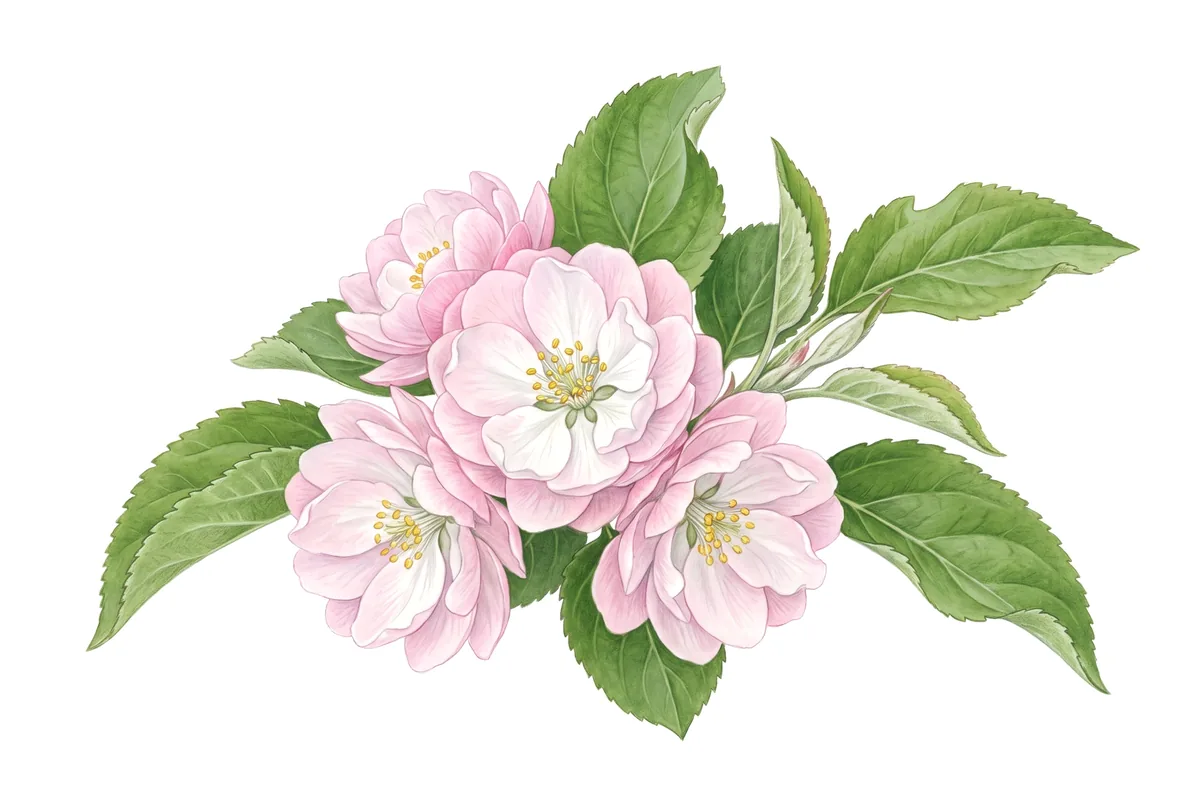
- HortFlora gives them double, 6 cm wide, pale pink and fragrant. Wollondilly's sheet calls them rose-like and fragrant, carried in groups of three to five, with delicate pink outer petals around a white centre and yellow stamens. They open after the leaves: in mid to late October in Canberra, on the ACT sheet, and in late spring on Wyndham's. HortFlora gives the plain species smaller flowers, about 4 cm wide.
- Does Bechtel crab apple set fruit?
- The ACT and Wyndham sheets give a few small green crab apples, and HortFlora gives the species' fruit as green and about 3 cm wide. The ACT sheet notes that fruit drop may be a minor nuisance in pedestrian or paved areas. No reference read says whether the fruit is worth eating.
- How much frost and drought does it take?
- The ACT Government's sheet gives a high frost tolerance to minus 10 C and a high drought tolerance. Wyndham City Council rates frost tolerance high and drought tolerance moderate. The SA Plant Selector lists light frost and calls it drought tolerant once established, with moderate supplementary watering.
- Can it be planted under power lines?
- The SA Plant Selector lists it as suitable for under power lines, and gives it a height of 3 to 4 m. The other Australian references read give heights of up to 6 m, and none of them comments on power lines.
- What is a crab apple?
- HortFlora says the common name crabapple was first used for the non-commercial, sour-fruited species of Malus, a genus from the temperate northern hemisphere in Eurasia and North America. It describes the genus as deciduous or semi-evergreen trees and shrubs, often with thorny side shoots, with alternate, toothed leaves and flat-topped clusters of white, pink or deep rose flowers followed by roundish pomes. Malus ioensis itself comes from the central United States.
- Is Bechtel crab apple native or naturalised in Australia?
- It is not native: its species comes from the central United States. The Australian Plant Census does not hold Malus ioensis; the one species of Malus it holds is Malus domestica. The Atlas of Living Australia has no taxon of that name in its names index, but holds a small number of occurrence records under it from Victoria, New South Wales and Tasmania, some marked introduced and none naturalised.
Sources
- GBIF species match API (the species Malus ioensis)
- Australian Plant Census (APC), the genus Malus (the one species held is Malus domestica; Malus ioensis is not held)
- Atlas of Living Australia, species search (names index) for Malus ioensis: no taxon of that name
- Atlas of Living Australia, occurrence records under the name Malus ioensis (states Victoria, New South Wales and Tasmania; some marked introduced, none naturalised)
- Plant Selector+ (Botanic Gardens and State Herbarium of South Australia), entry 3399, Malus ioensis 'Plena', Betchel's Crabapple
- HortFlora, the Horticultural Flora of South-eastern Australia (Royal Botanic Gardens Victoria): Malus ioensis, with its cultivar 'Plena', Bechtel Crab
- HortFlora, the Horticultural Flora of South-eastern Australia (Royal Botanic Gardens Victoria): the genus Malus
- ACT Government, Design Standards for Urban Infrastructure, Plant Species for Urban Landscape Projects in Canberra: Malus ioensis 'Plena', Betchel's crab apple (tree sheet)
- Wyndham City Council (Victoria), street tree sheet M46: Bechtel Crabapple, Malus ioensis 'Plena'
- Wollondilly Shire Council (New South Wales), Bechtel Crab Apple fact sheet, Malus ioensis 'Plena'
The growers, sizes and prices above are live and change as lists arrive. Cite this page: HortOS, Bechtel crab apple (Malus ioensis 'Plena'), https://au.hortosapp.com/plants/crab-apple-plena-malus-ioensis.
Found a fact that is wrong? Tell us and it is checked against its source.