Buxus microphylla japonica
Japanese Box
One of 6 Buxus microphylla microphylla varieties: see them all
54 growers · 31 sizes · from $1.40 ex GST
- Type
- Evergreen shrub
- Height
- 1 m to 2.6 m
- Spread
- 1 m to 4.5 m
- Flowers
- Green, spring
- Sun
- Full sun to part shade
- Drought
- Tolerant
- Frost
- Moderate frost
- In Australia
- Not native
Some growers show prices to verified trade buyers. Sign in or sign up with your ABN to see them and order.
Also grown by 18 nurseries (no sizes or prices listed)
Enquire with them for sizes and prices.
- Austral NurseryAustral, NSW
- Bonsai Gifts NurseryBelivah, QLD
- Budawang Seeds and NurseryNSW
- Cabbage Tree NurseryDural, NSW
- Coolart NurserySomerville, VIC
- Fernview NurseryCockatoo, VIC
- Freemans Reach GreenhousesFreemans Reach, NSW
- Garden VarietyWatanobbi (Wyong), NSW
- Lakewood PropagationPalmwoods, QLD
- Narangba Nursery - Zephyr ForestKurwongbah, QLD
- PlantbizNSW
- PlantinspirationsTatura, VIC
- Plants MelbourneReservoir, VIC
- Plants for SpacesMelbourne, VIC
- Prince PropagationCurrumbin Valley, QLD
- Scotts TubesNSW
- The Plant Supply CoWA
- The Ruby Plants - Affordable Nursery BrisbaneHolland Park West, QLD
Growing japanese box
The references differ on light. South Australia's Plant Selector gives full sun. The NC State extension toolbox prefers dappled to part shade, saying full shade leaves it leggy and sparse and full sun may redden the foliage. The Missouri Botanical Garden gives full sun to part shade and says the plant thrives in part shade. The Selector notes that the leaves bronze in winter.
The Selector lists clay, loam and sand, acid to alkaline, with minimal supplementary watering, and ticks the plant as tolerating drought. The American references ask for an evenly moist, well-drained soil, slightly acid to slightly alkaline, with mulch over the shallow roots. The toolbox calls it very drought tolerant once established and sensitive to over-fertilising.
The Selector ticks moderate frost. Both American references warn that frost may injure new growth, and Missouri says never to prune before the last spring frost for that reason. It tolerates pruning and shearing, by Missouri.
On growth the references disagree: HortFlora, the horticultural flora of the Royal Botanic Gardens Victoria, calls the variety an open, broad, fast growing shrub, and the toolbox calls it slow.
No Australian reference read covers its pests. American references report leaf miners and box mites, leaf spot and blight, foliage that burns in hot summer sun or harsh winter wind, and root rot in poorly drained soil; Missouri reports that it may self-seed aggressively in optimum conditions there. The Atlas of Living Australia holds records of it in New South Wales.
Using japanese box
The Selector uses it for hedges, formal or informal, and for barriers and screens, kept low by pruning as a border or let grow as a backdrop, and lists it for second line coast, plains and hills. The toolbox says it is commonly used for edging and formal hedges, and that it also suits foundation plantings, shrub borders and use as an accent or specimen. HortFlora calls the boxes ideal plants for topiary, and growers list pre-clipped topiary balls of this variety as their own line. The HortOS nursery industry statistics name Japanese box among the plants the most growers list. No reference read gives a planting density for a hedge. The species itself, which the American references give as a smaller plant of 0.9 to 1.2 m high, is listed as Buxus microphylla microphylla. English box, Buxus sempervirens, is a separate species.
What to check before you buy
Growers write this plant as Buxus microphylla japonica, var. japonica or Japanese box; check that two listings are the same variety before comparing prices. The table above shows the sizes growers list, and the pot sizes guide explains the grades. For roots, pests and hardening off, the plant quality guide sets out what to check. The size references are far apart, the Selector's 1 to 2 m high against the American references' 1.8 to 2.6 m high. The drawbacks the references give are winter bronzing, root rot in poor drainage, foliage burn in hot sun and harsh wind, and toxicity to pets. Stock that crosses a state border moves under the state and territory biosecurity rules on moving plants and soil.
Cautions
The ASPCA lists boxwood, Buxus species, as toxic to dogs, cats and horses. It gives alkaloids as the toxic principle, with vomiting and diarrhoea in dogs and cats, and colic, diarrhoea, respiratory failure and seizures in horses. The NC State toolbox adds that the plant can cause contact dermatitis and rates it a low-severity poison to people.
Prices are set by each grower and shown ex GST. Availability is confirmed by the grower at order.
Common questions
- Who grows Buxus microphylla japonica wholesale in Australia?
- 54 wholesale growers list Buxus microphylla japonica on HortOS right now, each with their own pot sizes and trade prices. They are in New South Wales, Victoria, Queensland, South Australia, Western Australia and the ACT. The growers are named on this page.
- What pot sizes does Buxus microphylla japonica come in?
- Growers on HortOS list Buxus microphylla japonica in Tube, 42mm, 50mm, 70mm, 75mm, 90mm, 100mm, 125mm, 140mm, 180mm and 21 more sizes.
- What does Buxus microphylla japonica cost wholesale?
- The median trade price in a 140 mm pot is $7.11 ex GST, across 26 growers who price it. Prices by pot size and state are on its trade price page.
- How do I order Buxus microphylla japonica from these growers?
- HortOS is for the trade. Add the lines you want to a list and send it: each grower gets their part of the order by email, confirms what they have and quotes freight, and nothing is bought until you approve it. Listing, searching and ordering are free.
- How big does Japanese box grow?
- South Australia's Plant Selector gives 1 to 2 m high and 1 to 1.5 m wide. The NC State toolbox gives 1.8 to 2.6 m high and 3 to 4.5 m wide in its figures, though its own running text says the shrub grows to about 2 m tall; the Missouri Botanical Garden gives 1.8 to 2.4 m high and 3 to 4.5 m wide. The Selector notes it can be pruned as a low border.
- Is Japanese box fast or slow growing?
- The references disagree. HortFlora describes the variety as an open, broad, fast growing shrub. The NC State toolbox calls it slow growing, and the Missouri Botanical Garden calls the species a slow-growing boxwood.
- Does Japanese box need sun or shade?
- South Australia's Plant Selector gives full sun and the Missouri Botanical Garden full sun to part shade. The NC State toolbox prefers dappled to part shade, saying full shade makes it leggy and sparse and full sun may turn the foliage reddish.
- Is Japanese box frost hardy?
- South Australia's Plant Selector ticks it as tolerating moderate frost. The American references warn that a late frost may injure new growth, and advise against pruning before the last spring frost.
- Is Japanese box drought tolerant?
- South Australia's Plant Selector ticks it as tolerating drought and gives its supplementary watering as minimal. The NC State toolbox calls it very drought tolerant once established, while preferring moist, cool soil and heavy mulch around the roots.
- Why does Japanese box turn bronze or red in winter?
- The Selector notes that the leaves bronze in winter. The Missouri Botanical Garden says the foliage usually stays green in winter in shade and usually turns reddish in full sun, with good green colour usually back by the middle of spring.
- Is Japanese box poisonous to dogs and cats?
- The ASPCA lists boxwood, Buxus species, as toxic to dogs, cats and horses, with alkaloids as the toxic principle. It gives vomiting and diarrhoea as the signs in dogs and cats, and colic, diarrhoea, respiratory failure and seizures in horses.
- What is the difference between Japanese box and the straight species?
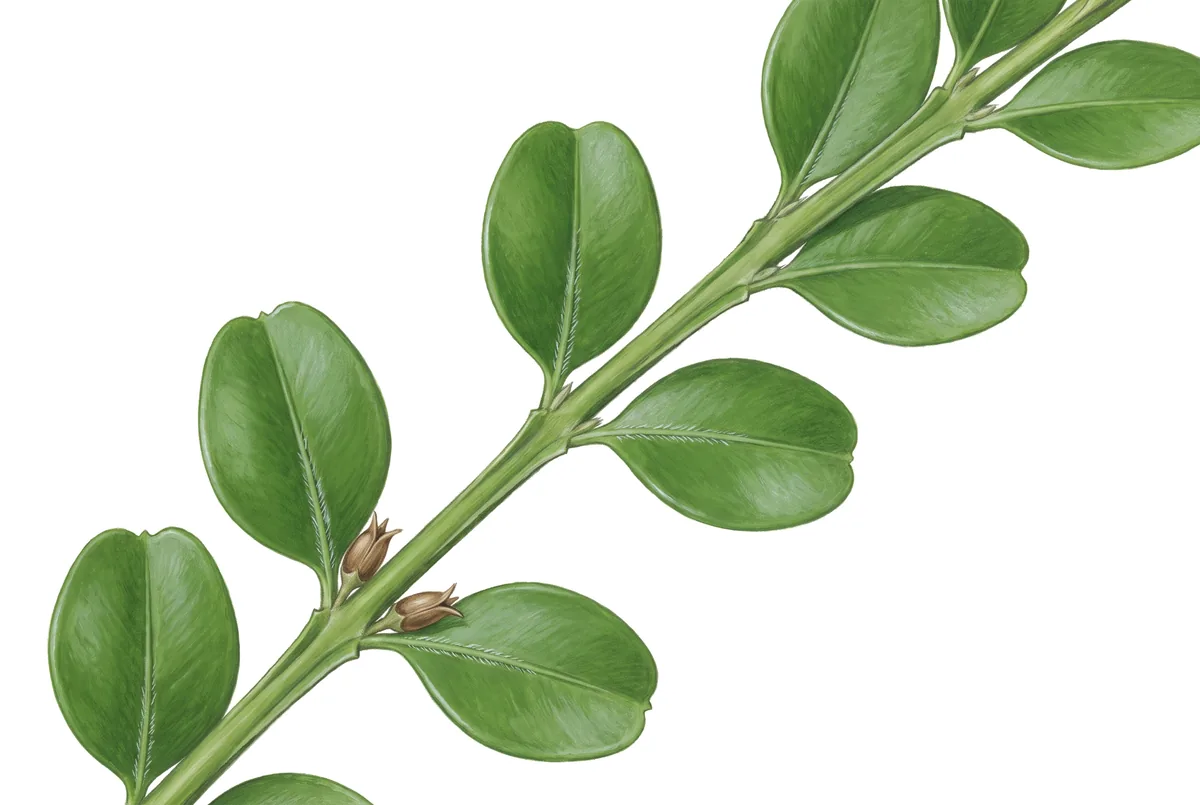
- Japanese box is one of four botanical varieties of Buxus microphylla that HortFlora describes, and HortFlora gives this one glossy, roundish leaves 1 to 1.5 cm long on an open, broad, fast growing shrub. The American references put the variety at a larger plant than the species, as the size answer above sets out. The American references give Japan as its home; the Selector's entry reads Europe and Africa, out of line with the other references read.
Sources
- GBIF species match API (the species name and family)
- GBIF species match API (the variety's name, which GBIF files under the species)
- Plant Selector+ (Botanic Gardens and State Herbarium of South Australia): Buxus microphylla var. japonica, Japanese Box
- Atlas of Living Australia (the species' records)
- ASPCA Animal Poison Control, Toxic and Non-Toxic Plants: Boxwood (Buxus spp.)
- HortFlora, the Horticultural Flora of South-eastern Australia (Royal Botanic Gardens Victoria): Buxus microphylla and its varieties
- HortFlora, the Horticultural Flora of South-eastern Australia (Royal Botanic Gardens Victoria): the genus Buxus
- North Carolina State Extension Gardener Plant Toolbox: Buxus microphylla var. japonica
- Missouri Botanical Garden Plant Finder: Buxus microphylla var. japonica
- North Carolina State Extension Gardener Plant Toolbox and Missouri Botanical Garden Plant Finder: Buxus microphylla (the species' size and growth, for the comparison in the prose; both texts)
- The HortOS guides (nursery industry statistics; nursery pot sizes; nursery plant quality) and the HortOS listings of the species' forms
The growers, sizes and prices above are live and change as lists arrive. Cite this page: HortOS, Japanese box (Buxus microphylla var. japonica), https://au.hortosapp.com/plants/buxus-microphylla-japonica.
Found a fact that is wrong? Tell us and it is checked against its source.