Araucaria heterophylla
Norfolk Island Pine
Part of Araucaria: see them all
25 growers · 21 sizes · from $4.00 ex GST
- Type
- Evergreen conifer
- Height
- 18 m to 30 m
- Spread
- 3.7 m to 18 m
- Growth
- Fast
- Sun
- Full sun
- Drought
- Tolerant
- Salt wind
- Tolerant
- In Australia
- Native
Showing 50 of 58 offers (the smallest sizes first). Show all 58 or pick a size or state above.
Also grown by 12 nurseries (no sizes or prices listed)
Enquire with them for sizes and prices.
- Berkie Palms | Wholesale Plant Nursery in NewcastleEleebana, NSW
- Burringbar Rainforest NurseryBurringbar, NSW
- Carr's Organic Fruit Tree NurseryHarcourt, VIC
- Domenics Palm NurseryMartin, WA
- Ellenby Tree FarmGnangara, WA
- Florafolia (Alstonville Plants)Alstonville, NSW
- Forestvale TreesOakford, WA
- Greener Corner - Melbourne Indoor Plants NurserySouth Melbourne, VIC
- Grove Propagation NurseryOrange Grove, WA
- Newcastle Wildflower NurseryGlendale, NSW
- Sunshine Coast PlantsQLD
- Sydney Wildflower NurseryHeathcote, NSW
Growing norfolk Island pine
Position. Full sun, by the South Australian Plant Selector and by NC State Extension, an American reference, which asks for an open site with ample room for its size. The Plant Selector keeps it for big gardens, parks and public open space.
Soil and water. The Plant Selector prefers well-drained soils and lists clay, loam and sand, acid to alkaline, with minimal supplementary watering, and ticks drought tolerance without a grade. The Flora of Australia, citing a garden reference, says it is wind and salt tolerant and able to grow in deep coastal sands.
Climate. The Plant Selector lists it for the coast and the second line back as well as plains and hills. HortFlora records notable plantings in South Australia, New South Wales, Victoria, the ACT and Tasmania, Hobart and Stanley among them. No Australian reference read gives a frost rating. The Flora of Australia notes that in regions affected by frost it is grown indoors as a potted young tree, and NC State Extension rates it only on the American zone scale.
Pests. NC State Extension reports it generally pest free but susceptible to scale, sooty mould and leaf spot, and tall trees prone to lightning strikes. No Australian reference read covers its pests.
Propagation. From seed, by NC State Extension.
Using norfolk Island pine
The Flora of Australia calls Norfolk Island pine a major signature tree of Australian coastal towns from the earliest days of settlement, often planted in a row along the foreshore, and says the first trees were probably planted as landmarks for shipping; HortFlora says the same. The South Australian Plant Selector calls it stately and upright, and a common sight in plantings by the beach. Young trees are also grown in pots as house plants: the Flora of Australia notes potted young trees grown indoors and its occasional use as a Christmas tree, and NC State Extension treats it as a houseplant for a bright, cool room. No reference read gives a planting distance for an avenue. For a street or park order, the guide to specifying and procuring trees covers the stock standard, the clause and the inspection at the nursery.
What to check before you buy
Norfolk Island Pine on a grower's list is the species, Araucaria heterophylla. The Flora of Australia notes it was long known as Araucaria excelsa, a name since rejected, and that it was once much confused with Araucaria columnaris of New Caledonia, another of the araucarias. Read the botanical name when comparing lines. Allow for a big tree. NC State Extension, an American reference, warns that surface roots can get in the way of mowing or lift paths, that the large cones make litter, and that some residential communities there bar it for the risk of big falling trunks. The table above shows the sizes growers list; the guide to nursery plant quality sets out what to check in the roots and canopy. Stock moving between states travels under the state and territory biosecurity rules like any other plant.
Cautions
On Lord Howe Island it is a weed. The Lord Howe Island Board's weed management strategy lists it in Category 3, to control, and removes regenerating Norfolk Island pines because they can inhibit the regeneration of native vegetation, though it says they tend to spread only locally. The Flora of Australia adds that self-propagating plants occur in coastal areas of the mainland, on foreshores and headlands and in parks and avenues.
Lord Howe Island: a Category 3 weed (control, effectively manage); regenerating Norfolk Island pines are removed because they can inhibit the regeneration of native vegetation (Lord Howe Island Board, Lord Howe Island Weed Management Strategy 2016 to 2025)
Prices are set by each grower and shown ex GST. Availability is confirmed by the grower at order.
Common questions
- Who grows Araucaria heterophylla wholesale in Australia?
- 25 wholesale growers list Araucaria heterophylla on HortOS right now, each with their own pot sizes and trade prices. They are in Queensland, Victoria, New South Wales, Western Australia and South Australia. The growers are named on this page.
- What pot sizes does Araucaria heterophylla come in?
- Growers on HortOS list Araucaria heterophylla in 50mm, 75mm, 90mm, 100mm, 150mm, 170mm, 200mm, 250mm, 300mm, 400mm and 11 more sizes.
- What does Araucaria heterophylla cost wholesale?
- The median trade price in a 300 mm pot is $59.00 ex GST, across 6 growers who price it. Prices by pot size and state are on its trade price page.
- How do I order Araucaria heterophylla from these growers?
- HortOS is for the trade. Add the lines you want to a list and send it: each grower gets their part of the order by email, confirms what they have and quotes freight, and nothing is bought until you approve it. Listing, searching and ordering are free.
- Is Norfolk Island Pine the same as Araucaria heterophylla?
- Yes. Norfolk Island pine is the common name the Australian Plant Census, the Atlas of Living Australia and the South Australian Plant Selector give for Araucaria heterophylla, and a line that says Norfolk Island Pine without a cultivar name is the species. It was long known as Araucaria excelsa, a name the Flora of Australia says has been rejected.
- How tall does a Norfolk Island pine grow?
- The South Australian Plant Selector gives 20 to 30 m high and 8 to 15 m across in planting, and HortFlora about 30 m, narrowing and becoming almost columnar with age. NC State Extension gives cultivated trees about 18 to 30 m, with a spread from about 3.7 to 18 m. The Flora of Australia gives up to 70 m in the wild, with a trunk to 2 m across.
- Is Norfolk Island pine native to Australia?
- To Norfolk Island, by the Australian Plant Census, which gives its distribution as Norfolk Island and, naturalised, Lord Howe Island. The Flora of Australia adds that self-propagating plants now occur in coastal areas of the mainland, on foreshores and headlands and in parks and avenues.
- Does Norfolk Island pine grow by the sea?
- Yes, by the references read. The Flora of Australia, citing a garden reference, calls it wind and salt tolerant and able to grow in deep coastal sands, and the South Australian Plant Selector lists it for the coast and the second line back, often seen in beachside plantings.
- Can a Norfolk Island pine be grown indoors?
- As a young potted tree, yes. The Flora of Australia notes potted young trees grown indoors in regions affected by frost. NC State Extension, an American reference, asks for a bright, cool room and says plants tolerate very low light for a few years but may then drop leaves and lose lower branches.
- Why are the leaves of a young tree different?
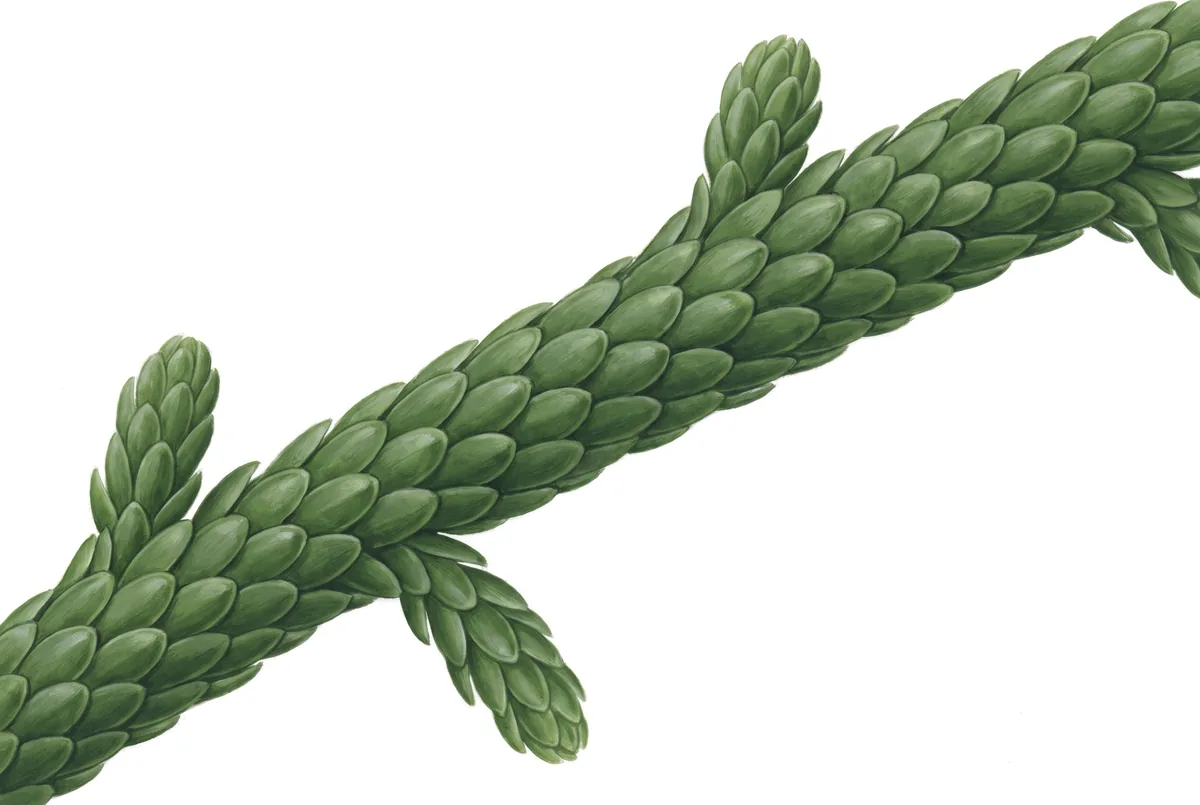
- The name says it: heterophylla means different leaves, by the Flora of Australia, for the change from young to adult foliage. The flora gives juvenile leaves awl-shaped and incurved, about 1 to 1.25 cm long, and mature leaves broadly ovate, 4 to 7 mm long, overlapping in rows around the shoot.
- How big are Norfolk Island pine cones?
- The female cones are near globular, 7.5 to 10 cm long and 8 to 10 cm wide by the Flora of Australia, 7 to 10 cm long and 9 to 12 cm wide by HortFlora, held upright in the top branches, each scale ending in an upturned soft spine. The Flora of Australia says heavy coning is intermittent, every three to five years.
Sources
- GBIF species match API
- Australian Plant Census (APC), the National Species List: Araucaria heterophylla
- Flora of Australia (Australian Biological Resources Study), online edition: Araucaria heterophylla
- PlantNET, the New South Wales flora online (Royal Botanic Garden Sydney): Araucaria heterophylla
- Lord Howe Island Board: Lord Howe Island Weed Management Strategy 2016 to 2025
- Atlas of Living Australia
- HortFlora, the horticultural flora of south-eastern Australia (Royal Botanic Gardens Victoria): Araucaria heterophylla
- Plant Selector+ (Botanic Gardens and State Herbarium of South Australia): Araucaria heterophylla
- North Carolina State Extension Gardener Plant Toolbox: Araucaria heterophylla
- The HortOS catalogue
- The HortOS guides
The growers, sizes and prices above are live and change as lists arrive. Cite this page: HortOS, Norfolk Island pine (Araucaria heterophylla), https://au.hortosapp.com/plants/araucaria-heterophylla.
Found a fact that is wrong? Tell us and it is checked against its source.