What Plants Cost at the Nursery in 2026
The general reference behind every article on what a garden costs: the median trade price ex GST at each pot size, the middle half around it, the spread across growers, the state premium and how it flips with size, what a farm-gate price leaves out, and worked figures for a hedge, a feature tree and a bed of ground covers.
Updated 25 September 2026. Figures from the HortOS Plant Price Index, September 2026 edition, and the live price pages on 24 September 2026; refreshed each edition.

On this page
Every article on what a garden or a landscaping job costs reaches the plants and guesses. The plants are the one line that need not be guessed: Australian wholesale growers publish their prices, and the HortOS Plant Price Index aggregates them every month into a median at each pot size, a range across growers and a median for each state. The idea that matters most is that the trade price of a plant is knowable, that it climbs with size far faster than the pot does, and that it is the smallest part of what a planting costs once freight, planting and care are added.
This page is the general reference behind those articles: the median trade price ex GST at each size from 140 mm to 200 L, the middle half around it, the spread across growers on the most-priced lines, the premium one state pays over another and how it flips with size, what a farm-gate price leaves out, and worked figures for a hedge, a feature tree and a bed of ground covers. Every figure is from the HortOS Plant Price Index, September 2026, compiled from growers' published availability, and the pages this one links hold the detail. It draws on Hort Innovation's nursery industry statistics and the Australian Taxation Office for the context, and it is not a quote.
Quick facts
| The median at each size | 140 mm $7.00, 200 mm $14.00, 300 mm $50.00, 400 mm $110, 25 L $55.00, 45 L $120, 100 L $295, 200 L $650, ex GST (HortOS Plant Price Index, September 2026). |
|---|---|
| The middle half | Half of all priced 300 mm lines sit between $40.00 and $65.00; half of all 100 L lines between $245 and $350. |
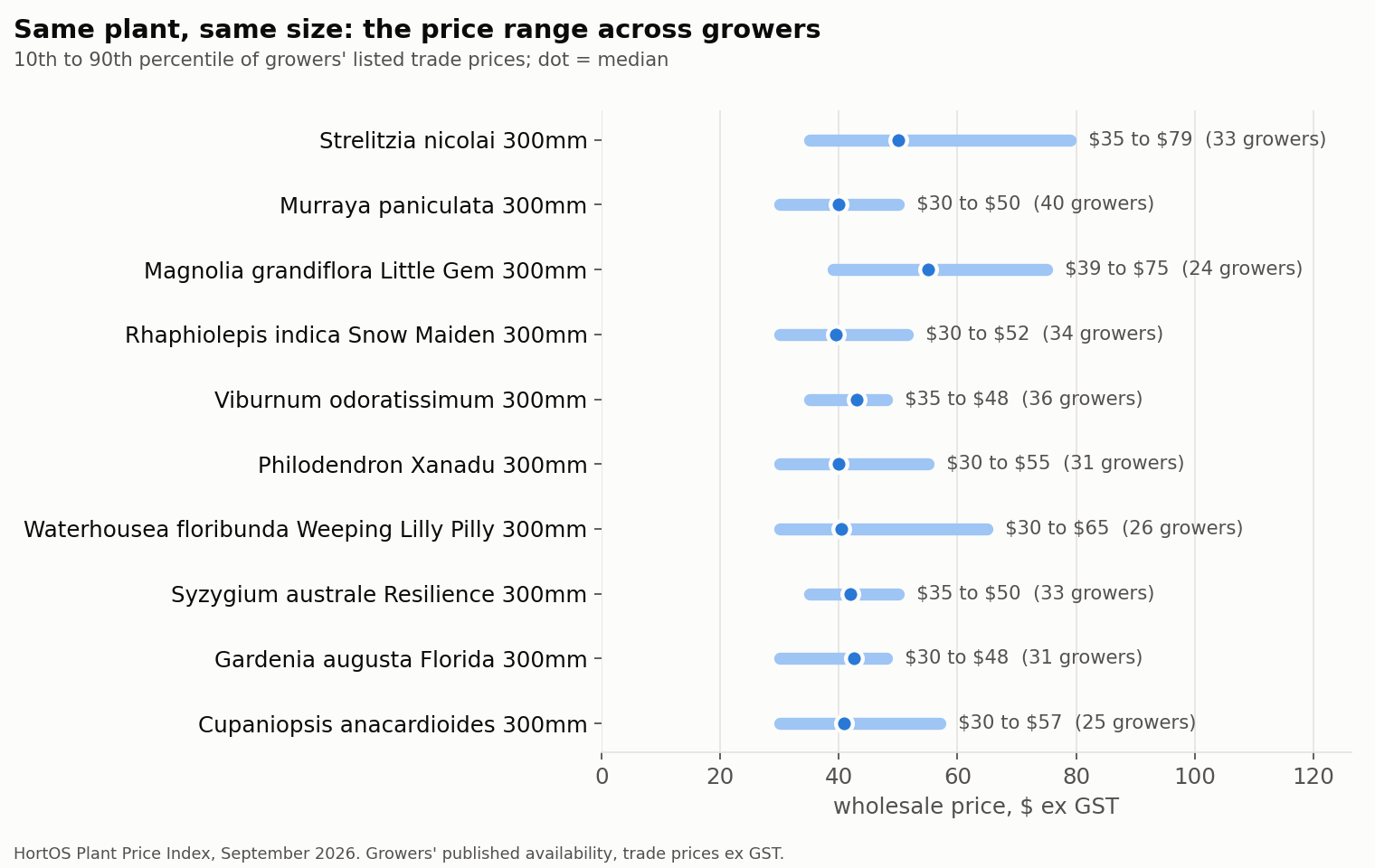
| The spread on one plant | At 300 mm, giant white bird of paradise ran from $35 to $79 across 33 growers between the 10th and 90th percentile; sweet viburnum from $35 to $48 across 36. |
| The state premium | New South Wales 22 per cent above Victoria at 140 mm and 13 per cent below at 300 mm; Queensland 18 per cent above Victoria at 140 mm and 27 per cent below at 300 mm. Queensland was cheapest from 200 mm up. |
| What is left out | GST at 10 per cent unless the buyer is registered, freight, planting, establishment and the contractor's own lines. A street tree's establishment alone runs to four figures (YIMBY Melbourne's model). |
| The industry | Hort Innovation's five-year statistics project put the nursery industry's annual production value at more than $2 billion, from 1,435 production nursery surveys. |
The median at each size, and the middle half
The Index's reference table is the number to start any estimate from. It is the median trade price ex GST across every priced line at each size, one price per grower, trade lists only, with the middle half (the 25th to the 75th percentile) beside it and the median in the three states with enough growers to publish one. The pot sizes guide explains what each size is and the years of growing behind it.
| Size | National median | Middle half | QLD | NSW | VIC |
|---|---|---|---|---|---|
| 140 mm | $7.00 | $6.50 to $8.00 | $7.00 | $7.65 | $6.50 |
| 200 mm | $14.00 | $12.00 to $18.50 | $12.50 | $14.00 | $15.00 |
| 300 mm | $50.00 | $40.00 to $65.00 | $42.00 | $50.00 | $55.00 |
| 400 mm | $110 | $92.00 to $135 | $110 | $130 | $110 |
| 25 L | $55.00 | $40.00 to $70.00 | $52.50 | $42.00 | Not shown |
| 45 L | $120 | $100 to $150 | $100 | $120 | $116.50 |
| 100 L | $295 | $245 to $350 | $240 | $300 | $295 |
| 200 L | $650 | $500 to $800 | $500 | $750 | $595 |
The ladder is the finding. The median doubles from 140 mm to 200 mm, more than triples to 300 mm, doubles again to 400 mm and roughly doubles at each step above, because each rung carries the cost of every rung below it plus another season of media, water and bench space. A plant is not priced by the pot; it is priced by the years. The Index follows three species up the whole ladder, from $18 at 200 mm to $1,915 at 400 L for a Little Gem magnolia.
The spread across growers
A median is the middle of a wide field. The Index measured the field for the ten most-priced lines at 300 mm as the spread from the 10th to the 90th percentile across growers, and the width is the reason a quote should never rest on one list.
| Plant, 300 mm | Growers pricing | 10th percentile | Median | 90th percentile |
|---|---|---|---|---|
| Giant white bird of paradise (Strelitzia nicolai) | 33 | $35.00 | $50.00 | $79.00 |
| Weeping lilly pilly (Waterhousea floribunda) | 26 | $30.00 | $40.45 | $65.00 |
| Little Gem magnolia (Magnolia grandiflora Little Gem) | 24 | $39.00 | $55.00 | $75.00 |
| Tuckeroo (Cupaniopsis anacardioides) | 25 | $30.00 | $40.91 | $57.00 |
| Philodendron Xanadu | 31 | $30.00 | $40.00 | $55.00 |
| Indian hawthorn (Rhaphiolepis indica Snow Maiden) | 34 | $30.00 | $39.50 | $51.50 |
| Orange jessamine (Murraya paniculata) | 40 | $30.00 | $40.00 | $50.00 |
| Gardenia augusta Florida | 31 | $30.00 | $42.50 | $48.00 |
| Lilly pilly (Syzygium australe Resilience) | 33 | $35.00 | $42.00 | $50.00 |
| Sweet viburnum (Viburnum odoratissimum) | 36 | $35.00 | $42.95 | $48.00 |
The plants that every grower produces in volume, the hedging lilly pillies, viburnum and murraya, have the tightest spreads; the feature plants, the bird of paradise and the magnolia, the widest. The availability list guide explains how to price a line against that spread.
The state premium, and how it flips with size
The Index compared growers state against state on the same plant and size, matched line by line, and found that the premium is not a fixed number. At 140 mm New South Wales was 22.4 per cent dearer than Victoria across 107 matched lines, dearer on 102 of them, and Queensland 18.1 per cent dearer than Victoria across 43. At 300 mm the order reversed: New South Wales 13.3 per cent cheaper than Victoria across 20 lines, and Queensland 26.5 per cent cheaper across 14. Victoria was the cheapest state at 140 mm and Queensland the cheapest from 200 mm up. The likely reason is the one the trade would give: Victoria's growers turn out small stock in enormous volume for the southern market, and Queensland's climate grows a 300 mm plant in a season less. Whatever the cause, the practical rule is to price in the state the job is in, at the size the schedule says, and never to carry one state's premium across sizes.
What a farm-gate price leaves out
- GST. Every trade price is ex GST. The Australian Taxation Office requires a business to register at $75,000 of turnover and a non-profit at $150,000; a registered buyer claims the 10 per cent back, an unregistered one pays it.
- Freight. Never in the list price. Tubes and 140 mm stock travel by the tray; advanced trees travel by the truck, and getting a 200 L tree from the truck to the hole can cost as much as the tree.
- Planting and establishment. The plant is the cheap part. YIMBY Melbourne's street tree cost model, built from the analysis Living Melbourne commissioned using Hort Innovation's tree costing tool, puts the establishment of a standard street tree planting at $1,113 and its cost over 30 years at $2,654; the street trees guide sets that against the tree's own price.
- The contractor's lines. Labour, soil, mulch, irrigation, guards, the warranty and the margin are the landscaper's own and are not on any list. This page prices plants, not landscaping.
Worked figures
- A hedge. The Index's hedge calculator prices a 30 metre lilly pilly hedge at about $636 in plants at 200 mm (50 plants, 0.6 metres apart), $1,596 at 300 mm (38 plants, 0.8 metres) and $3,000 at 45 L (30 plants, a metre apart), ex GST at the September 2026 medians. Seven hedge species at three sizes are on the hedge cost guide.
- A feature tree. At the national medians a 100 L tree is $295 and a 200 L tree $650, ex GST at the farm gate; the species the trade grows at those sizes, and what each costs, are on the street trees guide.
- A bed of ground covers. A hundred spiny-headed mat rush (Lomandra longifolia) at the 140 mm median of $6.50 on the live price page on 24 September 2026 is $650; a hundred native violet (Viola hederacea) at $6.50 the same. At the national 140 mm median of $7.00, a bed of 200 ground covers is $1,400 ex GST.
- A screen. Twenty 45 L weeping lilly pilly (Waterhousea floribunda) at a metre, at the live 45 L median of $100 on 24 September 2026, is $2,000 ex GST.
Every one of those figures can be checked against the live price pages, and a quote you have been given can be set against the current medians with the price check.
What to watch for
- Reading a median as a quote. It is the middle of a range across growers on one date; a grower's price sits anywhere in the range.
- Carrying a premium across sizes. The state that is dearest at 140 mm is not the dearest at 300 mm.
- Adding GST twice, or not at all. Trade prices are ex GST; a quote to an unregistered client should say so and add it.
- Pricing the plants and calling it the job. Freight, planting and care are the larger part of any planting budget.
- Quoting a figure without its edition. The Index is monthly; a September 2026 median is a September 2026 median.
Getting it right
- Start from the median at the size the schedule names, in the state the job is in.
- Check the plant's own price page for the spread and the number of growers behind it, and price against three growers where the money is.
- Add GST as the client's status requires, then freight, then the planting and establishment lines that are yours.
- Label every figure with its edition or the date the live page was read.
A word of caution
The medians on this page are aggregates of growers' published lists on one date; the live price pages change as lists arrive, so a figure there may differ from the September 2026 edition. The cost model quoted is YIMBY Melbourne's reading of Living Melbourne's analysis, not a contractor's price. GST is the Australian Taxation Office's rule and an accountant's question. On stock, sizes and dispatch dates, the grower's word is the one that counts.
Sources
- Hort Innovation, nursery industry statistics 2020-21 to 2024-25: the industry's production value.
- Australian Taxation Office, registering for GST: the thresholds.
- YIMBY Melbourne, selecting and costing street trees: establishment and 30-year costs.
More guides
Nursery Pot Sizes Explained: Millimetres, Litres and Gallons
Australian growers name a pot by its rim diameter up to 400 mm and by its volume in litres above that, while American growers use gallon classes. This guide explains each step of the ladder, the approximate height and age behind it, how to convert between systems, and what the trade pays at every size.
Reading a Wholesale Availability List and Pricing a Quote
For landscapers, designers, estimators and students: what each column of a wholesale availability list means, how much the same plant at the same size varies between growers and states, how the low, median and high on the price pages are built, and how to carry the plant line of a quote from the list to the client.

Street Trees and Canopy: What Advanced Stock Costs and Who Holds It
The advanced-tree story from the HortOS Plant Price Index as a standing page: the trees the trade grows for streets and parks, the farm-gate median at 45, 100 and 200 litres, how many growers in each state hold advanced stock, why lead times run to years, and what a council pays for a street tree against a giveaway.