School garden grants in Australia and when each last ran
A dated record of Australian school garden programs: who could apply, what each gave in its latest round and its status when the funder's page was read on 5 October 2026. A second table shows grower counts and median trade prices for native species on Brisbane City Council's school plant list.
Updated 5 October 2026. Figures are what the live au.hortosapp.com price and plant pages printed.
On this page
A teacher or a parents' association planning a garden bed or a native planting asks which programs pay for school gardens and when they take applications. The answer that matters most is one of timing. When the funders' pages were read on 5 October 2026, every money grant in this record was closed, awarded or between rounds. A school plans for the next round from the dates of the last one. One program, a council's yearly plant allocation, was inside its claim window.
This page draws on the program pages of Junior Landcare, Landcare Australia, the Victorian Schools Garden Program, Planet Ark, the ACT Government, Green Adelaide, the Government of Western Australia and Brisbane City Council. Its GST statements are the Australian Taxation Office's. It adds figures from HortOS, a free directory of Australian wholesale plant growers with their published availability and trade prices. It is a dated record, not a list of grants open today, and it is not tax advice.
Quick facts
| Victorian Junior Landcare and Biodiversity Grants | Landcare Australia reports that the 2026 Victorian round awarded $394,305 to 102 projects; Junior Landcare gives 27 March 2026 as the day applications closed. |
|---|---|
| Woolworths Junior Landcare Grants | Junior Landcare says the 2024 national round funded 1,041 projects with up to $1,000 each. Its grants page showed no round open when read on 5 October 2026. |
| Victorian Schools Garden Program | The program's 2026 entries in Victoria opened on 2 March and closed on 24 April 2026. Its nursery vouchers are redeemed at retail nurseries that belong to Nursery and Garden Industry of Victoria. |
| ACT Community Garden Grants | The ACT Government's Round Twelve guidelines (2026) fund between $2,000 and $10,000, GST exclusive, for each organisation. The round closed on 18 August 2026. |
| Brisbane school plants | Brisbane City Council (Queensland, 2026) gives schools from prep to year 12 up to 50 native plants a year at no charge, claimed from August to October. |
| GST | The Australian Taxation Office (2026) describes GST as a tax of 10% on most goods and services. Trade prices on this page are ex GST. |
When each program last ran
The table below is compiled from the funders' own pages. Each row is one program that names schools among those who can apply, with what it gave in its latest round and its status on the day its page was read. It is not every program in Australia, and every status is true of 5 October 2026 and no later.
| Program | Open to | What it gives | Status when read, 5 October 2026 | Authority and year |
|---|---|---|---|---|
| Victorian Junior Landcare and Biodiversity Grants | Victorian schools, kindergartens and childcare centres, plus Scouts, Girl Guides and youth groups (2021 round wording) | A total of $394,305 shared by 102 projects in 2026 | Closed 27 March 2026 and awarded | Junior Landcare, Victoria, 2026 |
| Woolworths Junior Landcare Grants | Australian primary schools and early learning centres | Up to $1,000 a project; 1,041 projects funded in the 2024 round | No round open; the 2024 round is the latest listed | Junior Landcare, 2024 and 2026 |
| Victorian Schools Garden Program grants | Victorian government, Catholic and independent schools; some categories take kindergartens | Nursery vouchers of $500 or $1,000, or garden products | Entries for 2026 ran from 2 March to 24 April | Victorian Schools Garden Program, 2026 |
| The Seedling Bank | Schools and community groups nationwide | Money for native seedlings | Applications closed | Planet Ark, 2026 |
| ACT Community Garden Grants | ACT schools, community groups, owners' corporations and other not-for-profit bodies | Between $2,000 and $10,000 for each organisation, GST exclusive | Round Twelve closed 18 August 2026 | ACT Government, 2026 |
| Grassroots Grants | Individuals, schools, community and sporting groups and others in Adelaide | Between $2,000 and $200,000 for a local project | Closed; successful applicants due in October 2026 | Green Adelaide, South Australia, 2026 |
| Free Native Plants program, schools for Arbor Day | Brisbane schools, prep to year 12 | Up to 50 native plants a year at no charge | Schools claim from August to October each year | Brisbane City Council, Queensland, 2026 |
The Victorian round of 2026 was the ninth, Landcare Australia reports. When the 2021 round was announced, Junior Landcare put the grant at up to $5,000 for Victorian applicants. The list of 2026 Victorian awards on Junior Landcare's page shows none above $5,000.00 and none below $1,000.00. One primary school project funded in Victoria in 2026 plans a trail of 600 native plants, Junior Landcare says; its page does not say how much of that award is for plants. Growers by town in that state are on the Victorian hub.
The Victorian Schools Garden Program (Victoria, 2026) describes its grants as seed funding for a school to start a garden or repair an old one. A nursery voucher is redeemed at a retail nursery that belongs to Nursery and Garden Industry of Victoria, before the voucher's expiry date. The program's 2026 guidelines for Victorian schools say vouchers reach schools by mid June and run until December of that year. They list plants and seedlings among the things a grant pays for, and cap gardening equipment at half the value of the grant.
The ACT Government's 2026 guidelines list schools among eligible applicants and also say an applicant must not be a government agency. The ACT Government's grants page (2026) records that one primary school parents and citizens association received $8,000 in the tenth round for garden beds, fruit trees and edible native plants. In South Australia, Green Adelaide's page said in 2026 that its Grassroots Grants had closed, with successful applicants to be named in October 2026. The Government of Western Australia's page said in 2026 that the first round of its Let's Grow Grants ran from 12 February to 30 June 2026 for schools and community groups in urban Perth and Peel. A second round had not been announced.
What growers list from one council's school plant list
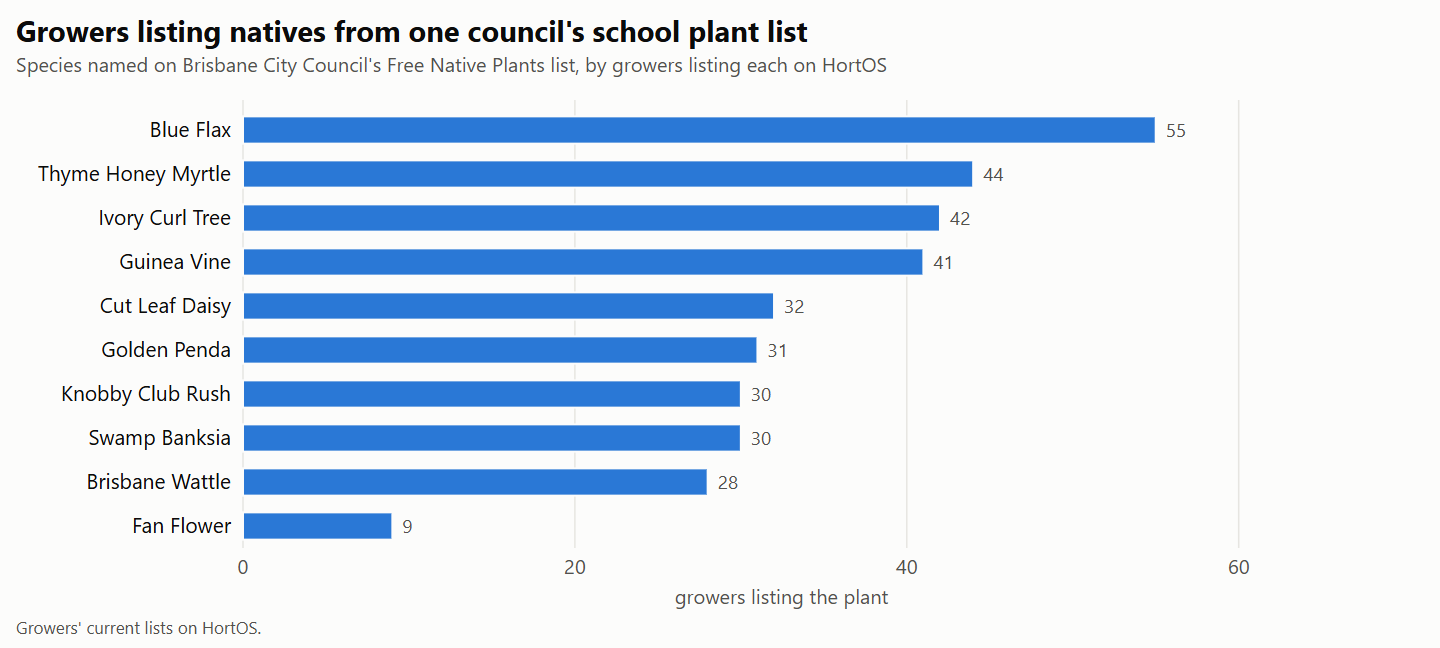
Brisbane City Council's Free Native Plants program is the one program in the table that gives schools plants and publishes which plants. The next table takes the entries on the council's list, as read in 2026, that are named as a single species with a page of their own on HortOS, in the council's order. That makes 11 rows; 15 entries on the council's list are not shown. Prices are medians across growers' current trade lists on HortOS: one price per grower, ex GST, freight not included, with the number of growers pricing each size in brackets. Anyone can see the prices on HortOS, and only the trade can order.
| Plant | Growers listing it | Size most growers price | Median (growers pricing) |
|---|---|---|---|
| Cut Leaf Daisy (Brachyscome multifida) | 32 | Tube | $1.77 (10) |
| Fan Flower (Scaevola aemula) | 9 | Fewer than three growers | |
| Native Violet (Viola banksii) | 6 | Fewer than three growers | |
| Blue Flax (Dianella caerulea) | 55 | 140 mm | $6.75 (22) |
| Knobby Club Rush (Ficinia nodosa) | 30 | Tube | $1.35 (7) |
| Guinea Vine (Hibbertia scandens) | 41 | 140 mm | $7.15 (17) |
| Swamp Banksia (Banksia robur) | 30 | 140 mm | $7.25 (10) |
| Thyme Honey Myrtle (Melaleuca thymifolia) | 44 | 140 mm | $7.00 (17) |
| Golden Penda (Xanthostemon chrysanthus) | 31 | 45 L | $93 (9) |
| Ivory Curl Tree (Buckinghamia celsissima) | 42 | 100 L | $230 (11) |
| Brisbane Wattle (Acacia fimbriata) | 28 | Tube | $2.00 (13) |
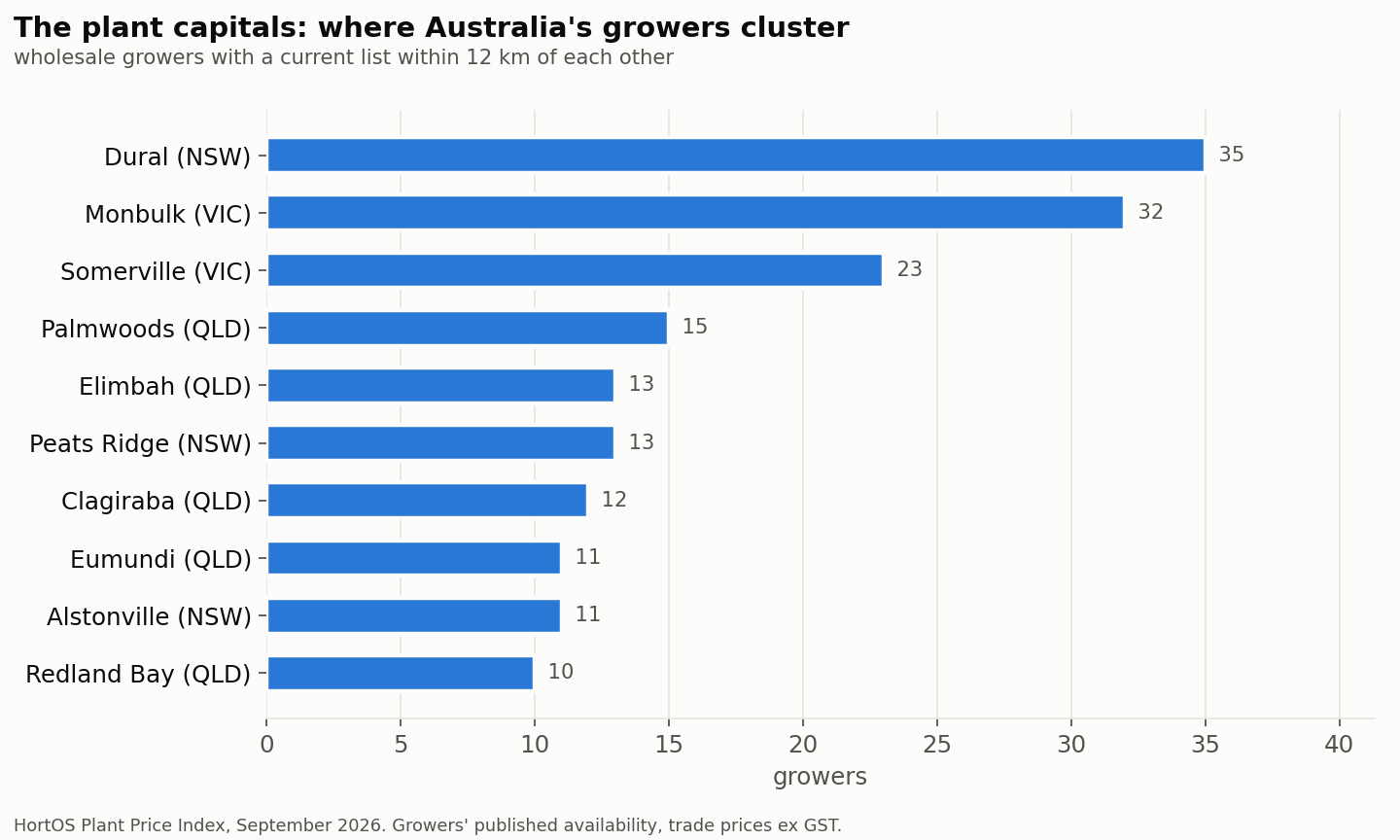
Most of the growers listing the plants in this table are in Queensland and New South Wales. The size shown for each plant is the pot size most growers price; ex ground lines are not counted.
The size changes from row to row, so the medians cannot be read down the column as like for like. The median for Golden Penda (Xanthostemon chrysanthus), $93, is for a 45 L tree, while rows above it are priced as tubes and 140 mm pots. Fan Flower (Scaevola aemula) and Native Violet (Viola banksii) show a grower count alone. A median needs three growers pricing a size. The figure for Knobby Club Rush (Ficinia nodosa) rests on 7 growers.
Brisbane City Council (Queensland, 2026) says it hands out its plants in 90 mm or 140 mm pots, so the sizes in the table are the ones growers price most, not the ones the council gives. The council also says its range is chosen for Brisbane soils and a subtropical climate. Planet Ark (Australia, 2026) recommends natives that are local to the area and suggests asking a local native nursery or the council's Bushcare team. Growers near the council's own area are on the Queensland hub.
A school that buys from a wholesale grower pays the grower's trade price plus freight and GST. The guide to buying from a wholesale grower covers who a grower sells to and on what terms, which each grower decides. The Australian Taxation Office (2026) says organisations registered for GST generally claim credits for the GST in the price of what they buy for their business. The ACT Government's Round Twelve guidelines (2026) say a grant recipient registered for GST can claim the GST it pays on goods and services for its project as input tax credits. The ACT Government's page for schools (2026) says smaller plants such as tubes are cheaper and soon outgrow larger ones, though they may need more protection from students. The guide to nursery pot sizes sets out what a tube, a 140 mm pot and a 45 litre bag each are, the sizes a grower's quote will name.
What this record does not show
The program table is not a complete list. It holds no program from New South Wales, Tasmania or the Northern Territory, and a status in it is true only of the day the page was read.
The page does not show what any grant buys. A grant, a voucher and a council's plant allocation each follow the funder's own rules. The second table shows what growers list and the median of their published trade prices. It does not show what a school would pay delivered, whether a grower sells to a school, or whether a plant suits a site outside Brisbane.
For a native planting the directory cannot show where a plant's seed was collected, whether a line is the straight species, or how it was grown. A school asks the grower those three things in writing before it orders.
What to watch for
- Reading a past round as a current one. Every date here is from a round that has run. The funder's page is the only place a new round is announced.
- Carrying last round's amount into a new budget. The Victorian grant amount on this page comes from the 2021 announcement and the 2026 award list, not from a rule for the next round.
- Treating a voucher as money. The Victorian Schools Garden Program's voucher is spent where and when the program says, and its guidelines limit what it pays for.
- Taking a Brisbane plant list interstate. The council chose its plants for its own soils and climate, so it is a Brisbane list, not a national one.
- Reading a trade price as a delivered price. Freight and GST sit on top, and a median is not a quote.
Getting it right
- Read the funder's own page for the next round, and ask the funder who can apply and what the money may be spent on. The funder decides both.
- Ask the school's finance office whether the school or its parents' association is registered for GST. The Australian Taxation Office decides how GST applies.
- Ask the local council's Bushcare team or a local native nursery which species are local to the site, as Planet Ark suggests.
- Ask each grower whether it sells to a school, its minimum order, the pot size and the freight, and get the quote in writing. The ACT Government's 2026 guidelines say its assessors look for quotes or other evidence behind each cost in a budget.
- Check the school's own rules for plantings near play areas. The ACT Government's page for schools (2026) tells schools to check whether a planting will draw bees to a place students use often.
A word of caution
Each program on this page belongs to its funder: Junior Landcare and Landcare Australia, the Victorian Schools Garden Program, Planet Ark, the ACT Government, Green Adelaide, the Government of Western Australia and Brisbane City Council. Their pages will change. Questions about a round go to the funder, questions about GST to the Australian Taxation Office or the school's finance office, and questions about a plant or a price to the grower.
Sources
- Junior Landcare, Junior Landcare Grants: open and recent grant rounds.
- Landcare Australia, Winners for The 2026 Victorian Junior Landcare and Biodiversity Grants Announced: the 2026 Victorian round's total.
- Junior Landcare, 2026 Victorian Junior Landcare and Biodiversity Grants: closing date and award list.
- Junior Landcare, 2024 Woolworths Junior Landcare Grants: the 2024 national round.
- Junior Landcare, Schools, kindergartens and youth groups encouraged to apply for Victorian Junior Landcare and Biodiversity Grants: the 2021 round's terms.
- Victorian Schools Garden Program, Grants: who can enter, 2026 dates.
- Victorian Schools Garden Program, Grant Categories: voucher values and redemption rule.
- Victorian Schools Garden Program, Grant Entry Guidelines: what a grant pays for.
- Planet Ark, The Seedling Bank: native seedling funding for schools.
- Planet Ark, National Tree Day, Need Help: choosing plants local to an area.
- ACT Government, Climate Choices, Community Garden Grants: round status and past recipients (copyright Australian Capital Territory, CC BY 4.0).
- ACT Government, ACT Community Garden Grants Program, Guidelines for applicants, Round Twelve 2026-27: eligibility, amounts and GST treatment.
- ACT Government, Climate Choices, Living infrastructure in schools: plant choice for school grounds (copyright Australian Capital Territory, CC BY 4.0).
- Green Adelaide, Grassroots Grants: who applies, amounts, round status.
- Government of Western Australia, Let's Grow Grants: round one dates and applicants.
- Brisbane City Council, Free Native Plants program: school allocation, pot sizes, species.
- Australian Taxation Office, How GST works: the GST rate and credits.
More guides
Buying From a Wholesale Grower When You Are Not in the Trade
Landcare groups, schools, friends groups and landholders can buy from wholesale growers when they order like the trade: in quantity, ahead of the season, on the grower's terms. This page explains who sells to whom, what an ABN and GST change, minimum orders and pooling, tubestock against pots, provenance, lead times, freight and state borders.

Nursery Pot Sizes Explained: Millimetres, Litres and Gallons
Australian growers name a pot by its rim diameter up to 400 mm and by its volume in litres above that, while American growers use gallon classes. This guide explains each step of the ladder, the approximate height and age behind it, how to convert between systems, and what the trade pays at every size.
Shade trees for schools and playgrounds: sizes and trade prices
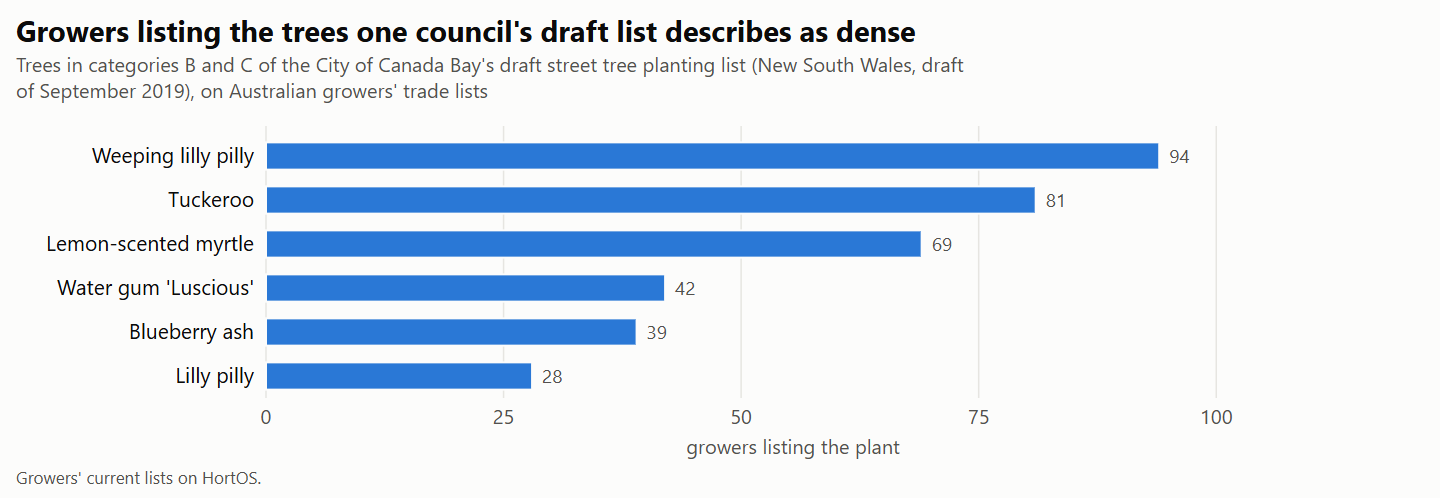
Cancer Council NSW's Guidelines to Shade, Victoria's school building handbook and the NSW Department of Education's design guide give three different answers on the size of shade tree to plant in a school ground. This page sets them side by side, with growers listing trees from one council's draft list and trade medians at three sizes.