Climate ready trees: what researchers rate and who lists them
What three bodies of Australian work say about trees for hotter decades: Which Plant Where, the City of Sydney's Tree Species List and the City of Melbourne's report on future temperatures. With how many growers list each tree named in both councils' documents, where the evidence differs on one tree, and what a grower count leaves unsaid.
Updated 12 October 2026. Grower counts are what the live au.hortosapp.com plant pages printed.
On this page
A council's urban forest officer drawing up next year's planting list asks which trees Australian research backs for hotter decades, and whether growers list them. Every Australian rating of a tree for a hotter climate belongs to one place and one set of years. Which Plant Where (Macquarie University, Australia, 2021) classes a species one postcode at a time, and the City of Melbourne's report (Victoria, 2016) says its list is not designed for cities with a different temperature profile.
This page reports three bodies of work: Which Plant Where, the City of Sydney's Urban Forest Strategy and Tree Species List (New South Wales, 2023), and the City of Melbourne's report on future temperatures (Victoria, 2016). It adds how many growers list each tree, from HortOS, a free directory of Australian wholesale plant growers with their published availability and trade prices. It rates no tree, prints no prices and is not a planting list for any site: the council or the project's arborist decides what is planted.
Quick facts
| The national tool | Which Plant Where (Macquarie University, Australia, method article of 2021) sorts every postcode into one of three classes for a species (unsuitable, marginal, suitable), for 2030, 2050 and 2070. |
|---|---|
| Sydney's list | The City of Sydney's Tree Species List (New South Wales, 2023) holds 300 tree species and rests on a 2050 climate scenario for the City's own area. |
| Melbourne's report | The City of Melbourne's 2016 report (Victoria) rated 2,104 tree species against temperatures for 2040 and 2090, and says its list is not designed for greater Melbourne or for cities with a different temperature profile. |
| Warming so far | Australia has warmed by 1.51 degrees Celsius on average, give or take 0.23, since its national record began in 1910 (CSIRO and the Bureau of Meteorology, State of the Climate 2024). |
| Time to grow | Which Plant Where's guide to ordering trees (Australia, 2021) says a tree can take 12 to 18 months to grow from seed to a 45 litre container, depending on species and climate. |
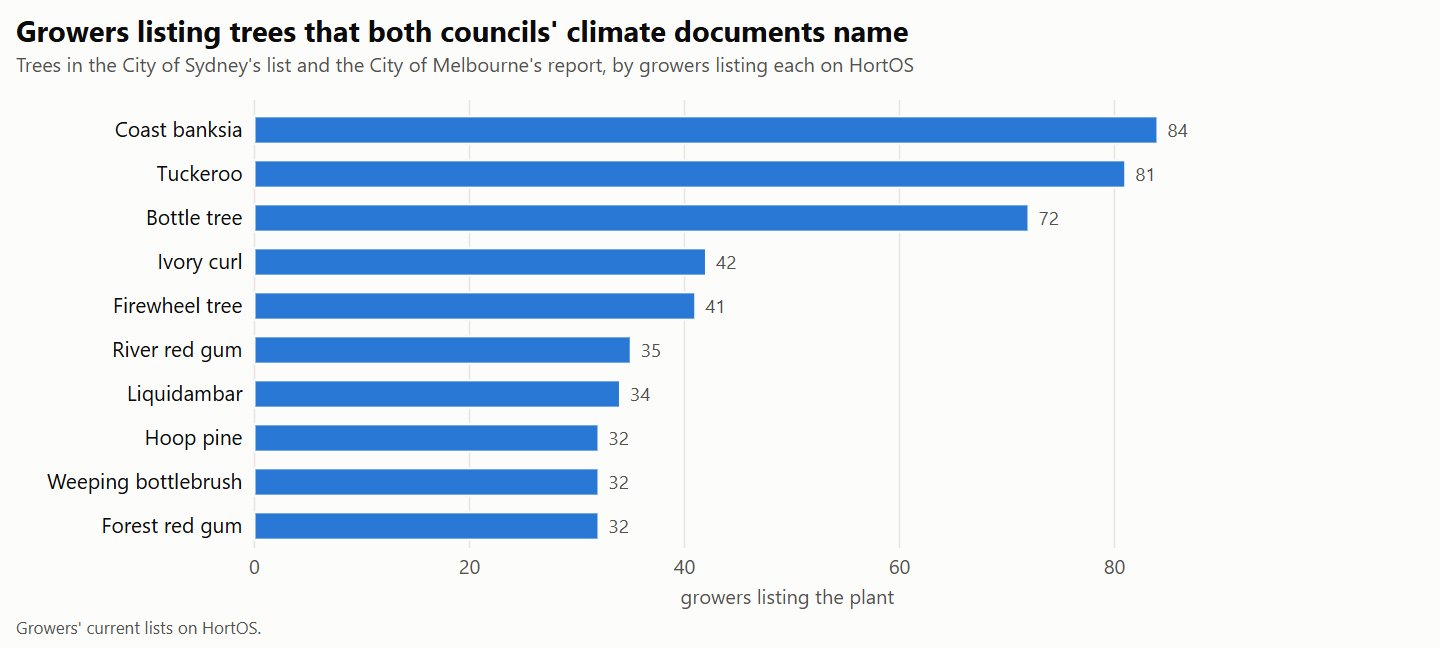
| Growers listing the trees | Of the 34 trees in this page's table, coast banksia had the most growers on HortOS: 84 listed it, in any size. |
One national tool and two councils' documents
State of the Climate 2024 (CSIRO and the Bureau of Meteorology, Australia) projects air temperatures that keep rising, with hot extremes more frequent and cold extremes rarer. Which Plant Where (Australia, 2021) says its research shows over half the species now planted in Australian towns and cities are already at risk from heat and drought.
Which Plant Where describes itself as a subscription service that costs nothing to join (Australia, page read October 2026). For each species the tool puts a postcode in one of its three classes, using ten sets of climate data that stand in for 2030, 2050 and 2070 (Which Plant Where, Australia, 2021). The project's final report (Hort Innovation, Australia, 2022) says 1,373 species, native and exotic, were modelled across 2,670 postcodes. The tool's method article states two limits (Which Plant Where, Australia, 2021). Some species may live, and even do well, in postcodes it has classed as marginal or unsuitable. The climate matching also leaves out soil type, pests and pathogens.
The City of Sydney built its Tree Species List on a forecast for its own area. Its strategy (New South Wales, 2023) says research points to a Sydney climate by 2050 that resembles today's Grafton, on the state's North Coast. How well a species could adapt to that climate was a key factor in drawing up the list (City of Sydney, New South Wales, 2023).
The table sets out, document by document, where each piece of evidence applies and the years it looks to. Each row is one document read for this page, with its year.
| Evidence and year | Where it applies | Looks ahead to |
|---|---|---|
| Which Plant Where selection tool (Macquarie University; method article of 2021) | Australia, one postcode at a time | 2030, 2050 and 2070 |
| Which Plant Where glasshouse testing (grower guide of 2021) | Climate-controlled glasshouses at two universities, Macquarie and Western Sydney | No future year: test results |
| Which Plant Where street tree survey (article of 2021) | Penrith, western Sydney, New South Wales | No future year: an observed heat event |
| Which Plant Where Living Labs (article of 2021) | Ten planting sites in four states, from the Sunshine Coast to Canberra | No future year: monitoring over time |
| City of Sydney Tree Species List (Urban Forest Strategy, 2023) | City of Sydney local area, New South Wales | 2050 |
| City of Melbourne future urban forest report (University of Melbourne authors, 2016) | City of Melbourne, Victoria | 2040 and 2090 |
Where the evidence differs on the same tree
The City of Melbourne's report, dated 2016, gives each species a colour for current temperatures, for 2040 and for 2090 (Victoria). Green means the species grows elsewhere at temperatures like Melbourne's, so the report does not treat it as vulnerable in that scenario (City of Melbourne, Victoria, 2016). Two groups were the most exposed: trees from colder parts of the world, and trees with a narrow natural climate range, a group that takes in many local and other Australian natives (City of Melbourne, Victoria, 2016).
The same tree can come out differently under each body of work. Tuckeroo (Cupaniopsis anacardioides) is rated green in all three scenarios of the City of Melbourne's report (Victoria, 2016), and it is on the City of Sydney's list (New South Wales, 2023). A Which Plant Where fact sheet of June 2020, printed in the project's final report (Hort Innovation, Australia, 2022), gives tuckeroo as an example of a plant that copes poorly when heat and drought arrive together. The same fact sheet adds that such plants still have a place with care: in shade, in cooler pockets or closer to the coast.
London plane (Platanus x acerifolia) shows how dated statements can differ. A City of Sydney media release of December 2022 (New South Wales) said many species the city had relied on would not survive a hotter, more humid 2050, and named the London plane. The City's Tree Species List of 2023 (New South Wales) names London plane among its trees for future planting. The City of Melbourne's report (Victoria, 2016) rates it green at current, 2040 and 2090 temperatures. This page reports all three statements and takes no side.
A heatwave supplied evidence of another kind. Penrith, in western Sydney, reached 48.9 degrees Celsius on 4 January 2020, and the Which Plant Where team then checked more than 5,500 street trees (Which Plant Where, New South Wales, 2021). Exotic deciduous trees fared much worse than evergreen natives, and a resurvey a year later found most of the damaged trees had recovered (Which Plant Where, New South Wales, 2021).
Trees named in both councils' documents, on growers' lists
The rows are 34 trees named in both the City of Sydney's Tree Species List (New South Wales, 2023) and the City of Melbourne's report (Victoria, 2016). The Melbourne report rates every species it names, and each tree's rating is in the report, not in this table. A row is a selection from the trees the two documents share, not a recommendation for any site.
Grower counts are the growers listing each plant on HortOS, in any size. A count here is growers listing the plant, not how many plants exist or how well it suits a site. The table prints no prices. A median needs three growers pricing a size. In 45 litre, 100 litre and 200 litre containers, too few of these trees met that test for a price column to stand.
| Plant | Growers listing it | States with most growers |
|---|---|---|
| Coast banksia (Banksia integrifolia) | 84 | New South Wales 31, Victoria 25, Queensland 22 |
| Tuckeroo (Cupaniopsis anacardioides) | 81 | New South Wales 36, Queensland 31, South Australia 6 |
| Bottle tree (Brachychiton rupestris) | 72 | Queensland 27, Victoria 24, New South Wales 17 |
| Ivory curl (Buckinghamia celsissima) | 42 | Queensland 27, New South Wales 12, South Australia 2 |
| Firewheel tree (Stenocarpus sinuatus) | 41 | Queensland 25, New South Wales 10, Victoria 3 |
| River red gum (Eucalyptus camaldulensis) | 35 | Victoria 23, South Australia 5 |
| Liquidambar (Liquidambar styraciflua) | 34 | Victoria 14, New South Wales 10 |
| Hoop pine (Araucaria cunninghamii) | 32 | Queensland 19, New South Wales 6, Victoria 5 |
| Weeping bottlebrush (Callistemon viminalis) | 32 | New South Wales 10, Victoria 8, Queensland 8 |
| Forest red gum (Eucalyptus tereticornis) | 32 | New South Wales 15, Queensland 13, Victoria 4 |
| Moreton Bay fig (Ficus macrophylla) | 32 | Queensland 12, New South Wales 10, Victoria 7 |
| Bunya pine (Araucaria bidwillii) | 29 | Queensland 17, New South Wales 6, Victoria 6 |
| Brisbane golden wattle (Acacia fimbriata) | 28 | New South Wales 14, Queensland 13, Victoria 1 |
| Port Jackson fig (Ficus rubiginosa) | 27 | New South Wales 12, Queensland 11 |
| Brush cherry (Syzygium australe) | 27 | Queensland 15, Victoria 7, New South Wales 5 |
| Crimson bottlebrush (Callistemon citrinus) | 23 | New South Wales 14, Victoria 7 |
| Hills weeping fig (Ficus microcarpa var. hillii) | 23 | New South Wales 11, Queensland 6, Victoria 6 |
| London plane tree (Platanus x acerifolia) | 21 | Victoria 12, New South Wales 4, Queensland 2 |
| Chinese elm (Ulmus parvifolia) | 21 | Victoria 8, New South Wales 7, South Australia 3 |
| Black tea-tree (Melaleuca bracteata) | 20 | Queensland 16, New South Wales 3, Tasmania 1 |
| Small-leaved fig (Ficus obliqua) | 18 | Queensland 15, New South Wales 2, Victoria 1 |
| Queensland lacebark (Brachychiton discolor) | 14 | Queensland 8, New South Wales 3, Victoria 2 |
| Flooded gum (Eucalyptus grandis) | 13 | Queensland 9, New South Wales 2 |
| Weeping fig (Ficus benjamina) | 13 | Victoria 6, Queensland 6, New South Wales 1 |
| Crepe myrtle (Lagerstroemia indica) | 12 | New South Wales 5, Victoria 3 |
| Golden rain tree (Koelreuteria paniculata) | 11 | Victoria 4, New South Wales 3, South Australia 2 |
| White cypress pine (Callitris columellaris) | 7 | Queensland 6, New South Wales 1 |
| Himalayan cypress (Cupressus torulosa) | 5 | Victoria 3, New South Wales 1, Tasmania 1 |
| Mediterranean cypress (Cupressus sempervirens) | 4 | New South Wales 2, Victoria 1, Queensland 1 |
| Arizona ash (Fraxinus velutina) | 4 | New South Wales 2, the Australian Capital Territory 1, Victoria 1 |
| Wilga (Geijera parviflora) | 3 | Victoria 2, Queensland 1 |
| Oriental plane tree (Platanus orientalis) | 3 | Victoria 1, Western Australia 1, South Australia 1 |
| Carob (Ceratonia siliqua) | 2 | New South Wales 1, South Australia 1 |
| Bottlebrush hakea (Hakea francisiana) | 2 | Victoria 1, South Australia 1 |
The last column names the states with the most growers listing each plant, three at most, and stops where states tie for the next place.
Coast banksia (Banksia integrifolia) heads the table with 84 growers, and tuckeroo follows with 81. At the other end, 2 trees were each listed by two growers. For some trees the biggest pot size with a median rests on fewer than five growers, coast banksia and tuckeroo among them, one reason this page leaves prices to each tree's own page. The guide to street trees and canopy carries medians in advanced sizes for the trees most growers price there, tuckeroo among them.
What a grower count leaves unsaid
A count covers that plant's page in any pot size, from a tube up. It is not a count of growers with a 45 litre or 100 litre tree, not a number of trees and not a delivery date. Only the grower can say what it can deliver, at what size and when.
A cultivar, or a second spelling of a botanical name, has its own plant page on HortOS, and its growers are not added in. The crepe myrtle row counts the species page alone. London plane also has a page under Platanus acerifolia, so its count in the table may run low.
The City of Sydney's Street Tree Master Plan (New South Wales, 2023) says the trees it plants are generally super advanced, and that species on trial can be hard to find in the sizes, numbers and season a planting needs. With a short lead time, Which Plant Where's guide to ordering trees (Australia, 2021) expects species substitutions, which it accepts where the contract allows for them.
The page carries two councils' documents and no list for any other city. For a site elsewhere it has only the national tool to point to, which works postcode by postcode (Which Plant Where, Australia, 2021). No rating here covers the planting site itself: its soil, its paving, its water or the quality of the tree delivered.
What to watch for
- Carrying a council's rating to another place. The City of Melbourne's report (Victoria, 2016) says its list is not designed for greater Melbourne or for cities with a different temperature profile, and the City of Sydney's list (New South Wales, 2023) is built for its own area.
- Treating native as the same thing as climate ready. The City of Melbourne's report (Victoria, 2016) found many native trees among the species most exposed to rising temperatures. The Penrith survey (Which Plant Where, New South Wales, 2021) found evergreen natives fared better than exotic deciduous trees in one heatwave.
- Taking a grower count as a count at planting size. The count covers any pot size, and each tree's own page shows which sizes its growers price.
- Blaming the species for an early loss. At the Living Lab sites, losses in the first year appeared to be linked to planting technique or poor nursery material (Which Plant Where, Australia, 2021).
Getting it right
- Look up each candidate species for the site's postcode in Which Plant Where, whose subscribers see suitability maps for 2030, 2050 and 2070 (Which Plant Where, Australia, page read October 2026).
- Ask the council whether it has its own species list or urban forest strategy. The council decides what is planted on its streets and in its parks.
- Open the page of each tree on the shortlist and note which sizes are priced and by how many growers. The hubs for New South Wales, Victoria and Queensland show growers by state, and the guide to reading an availability list explains each column of a grower's list.
- Ask each grower the sizes and numbers it can grow by the planting date, and the lead time. Which Plant Where's guide (Australia, 2021) calls a growing contract set up well ahead of planting best practice.
- Ask whether the supply contract allows substitute species. Which Plant Where's guide (Australia, 2021) expects substitutions when the lead time is short, and the designer or the council decides which are accepted.
A word of caution
The ratings reported here belong to Which Plant Where, the City of Sydney and the City of Melbourne, each for its own place and years, and HortOS rates no tree. The council's urban forest team or the project's arborist decides what suits a site, and the grower answers for sizes, numbers and dates. Counts are what HortOS showed, and they change as growers update their lists.
Sources
- Which Plant Where, How it works: free sign-up and suitability maps.
- Which Plant Where, how a species is judged climate ready for a location: method and limits of the ratings.
- Which Plant Where, What tree growers need from you (guide): ordering trees, lead times, contracts.
- Which Plant Where, Failures are Important Too: Penrith street trees after heat.
- Which Plant Where, Lessons from our Living Labs: monitored planting sites, early losses.
- City of Sydney, Urban Forest Strategy 2023: the species list and its method.
- City of Sydney, Urban forest strategy (page): the size of the list.
- City of Sydney, Street tree master plan 2023: selection criteria and trial species.
- City of Sydney, media release, Growing Sydney's sprawling urban forest: the 2050 climate and species choice.
- City of Melbourne, The City of Melbourne's Future Urban Forest: Identifying vulnerability to future temperatures: species rated for 2040 and 2090.
- CSIRO and Bureau of Meteorology, State of the Climate 2024, Report at a glance: observed warming and projections.
- Hort Innovation, Which plant where, when and why database for growing urban green space, final report: modelling numbers and glasshouse examples.
More guides

Street Trees and Canopy: What Advanced Stock Costs and Who Holds It
The advanced-tree story from the HortOS Plant Price Index as a standing page: the trees the trade grows for streets and parks, the farm-gate median at 45, 100 and 200 litres, how many growers in each state hold advanced stock, why lead times run to years, and what a council pays for a street tree against a giveaway.
Reading a Wholesale Availability List and Pricing a Quote
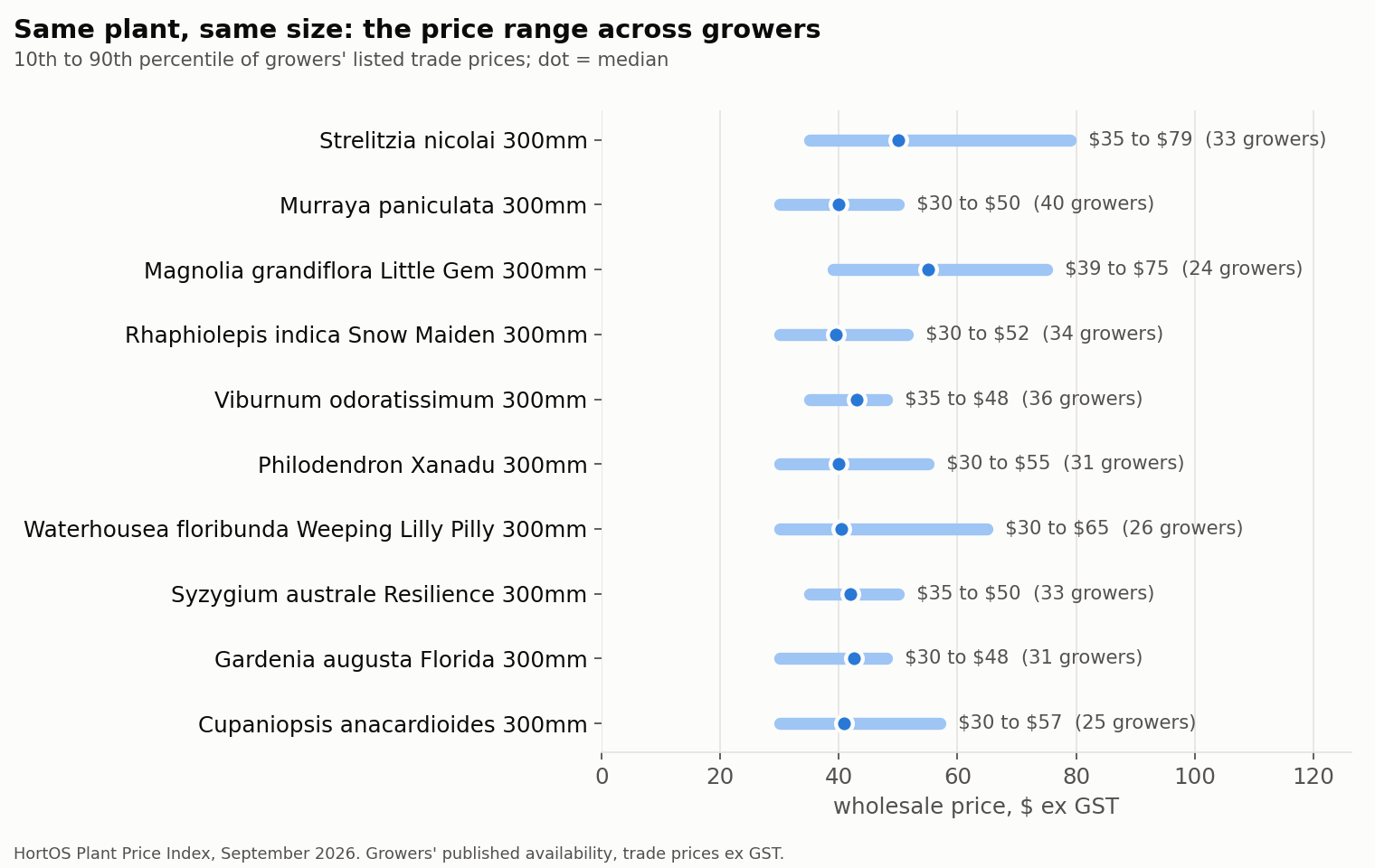
For landscapers, designers, estimators and students: what each column of a wholesale availability list means, how much the same plant at the same size varies between growers and states, how the low, median and high on the price pages are built, and how to carry the plant line of a quote from the list to the client.
Dune restoration plants and how many growers list them
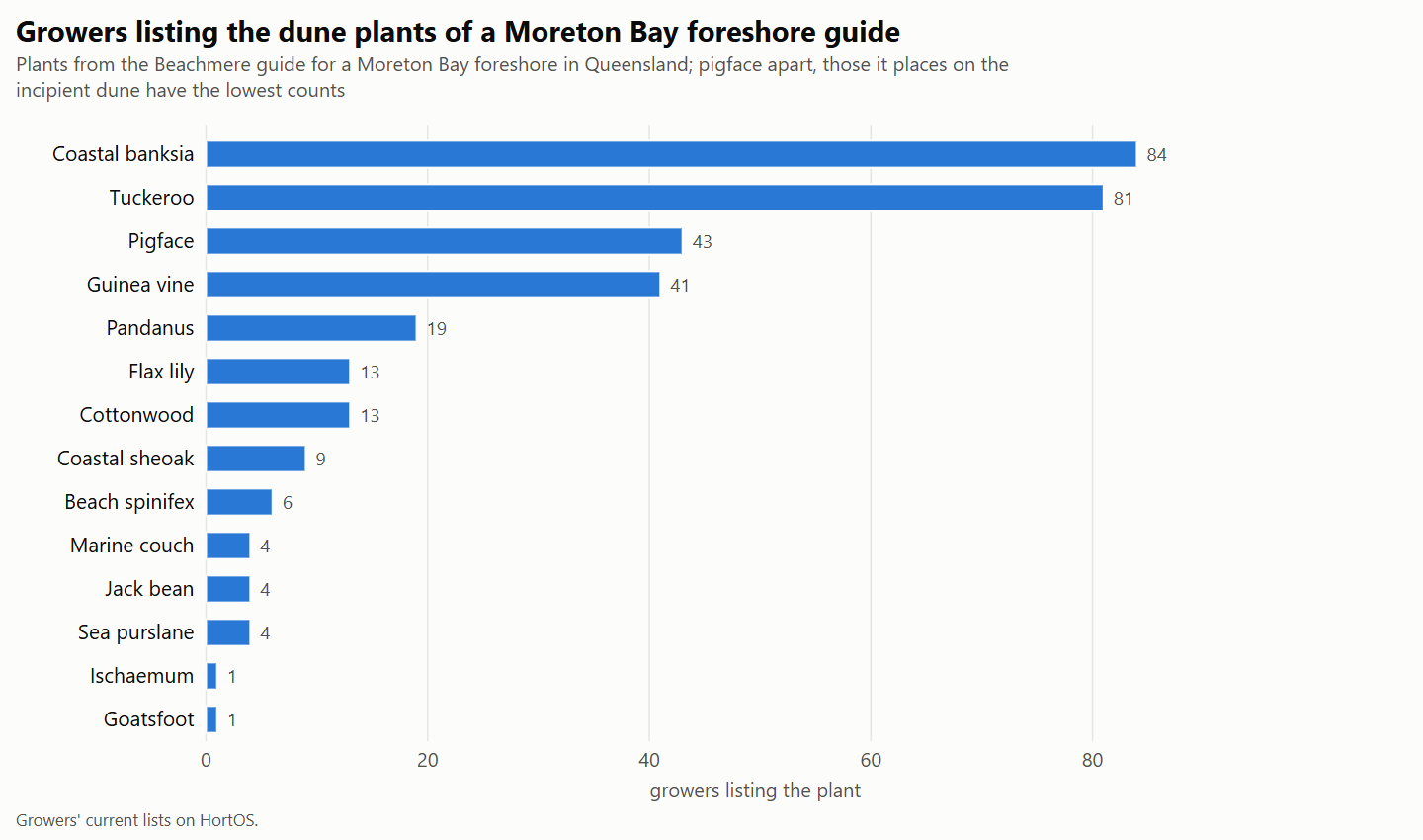
A Moreton Bay guide and Tasmania's coastal works manual place dune plants from the seaward sand to the hind dune, and a bushcare plan lists plants for one New South Wales beach. This page sets each list beside the growers listing every plant, gives tube medians for most of the beach list, and reports each source's density or season.