Pyrus betulaefolia
Pear
Grown by 1 nursery · no sizes or prices listed
- Type
- Deciduous tree
- Height
- 6 m to 9 m
- Growth
- Fast
- Flowers
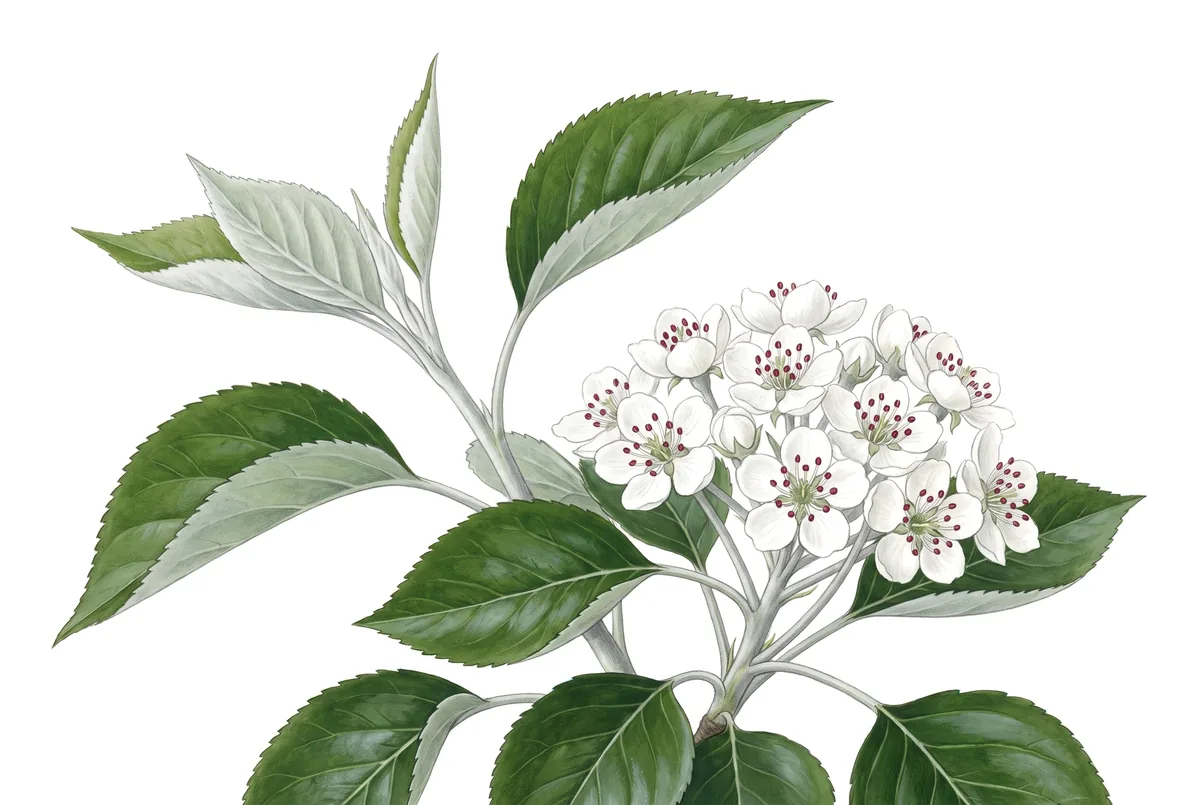
- White, spring, by Flora of China's flowering month; the fruit follows in late summer to early autumn
- Sun
- Sunny positions
- In Australia
- Not native
Also grown by 1 nursery (no sizes or prices listed)
Enquire with them for sizes and prices.
- Ellenby Tree FarmGnangara, WA
Growing birch-leaved pear
In the wild it grows on open slopes and plains from sea level to 1800 m, by Flora of China, which calls it a common tree in northern China and says the tree is often planted in gardens and parks in China for ornament and prefers sunny, dry, sandy, loamy soils. In China it flowers in spring and fruits in late summer to early autumn. No Australian reference read gives the species itself a frost, drought or soil rating; Australian references cover its selection, Southworth Dancer, on its own page. Flora of China describes the tree as often spinescent, and Trees and Shrubs Online says its quick, graceful growth and its small fruits, not crowned by the calyx teeth, are its chief marks. The Australian Plant Census holds no Pyrus betulifolia among the pears it lists.
Using birch-leaved pear
Flora of China says the species is usually used as a stock for grafting pear cultivars, and Trees and Shrubs Online that it is used in China as a stock for fruiting pears, its own fruit appearing to be of no value. Trees and Shrubs Online records it as introduced to Kew in 1882 from seed. Growers also list its selection Southworth Dancer, which has its own page and the full account of the tree.
What to check before you buy
Its selection Southworth Dancer is listed under its own name; buy by the full name, check which of the two a grower lists, and read that page for size and form. Do not buy it for fruit: Trees and Shrubs Online says its fruit appears to be of no value. The guide to specifying and procuring trees covers advanced stock.
Prices are set by each grower and shown ex GST. Availability is confirmed by the grower at order.
Common questions
- Is Pyrus betulaefolia the same as Pyrus betulifolia?
- Yes. GBIF matches the spelling betulaefolia to Pyrus betulifolia Bunge, the accepted name; betulaefolia is the spelling the HortOS listings use.
- Where does the birch-leaved pear come from?
- From China, where Flora of China lists it from Anhui, Gansu, Guizhou, Hebei, Henan, Hubei, Jiangsu, Jiangxi, Liaoning, Inner Mongolia, Shaanxi, Shandong, Shanxi, Xizang and Zhejiang, and from Laos, on open slopes and plains from sea level to 1800 m. It calls it a common tree in northern China.
- Does the birch-leaved pear fruit?
- Its fruit is a small brown pome 5 to 10 mm across with pale dots, by Flora of China. Trees and Shrubs Online says it appears to be of no value as fruit.
- Is the birch-leaved pear used as a rootstock?
- Flora of China says it is usually used as a stock for grafting pear cultivars, and Trees and Shrubs Online says the same of its use in China.
Sources
- GBIF species match API (Pyrus betulifolia, matched from the spelling betulaefolia)
- Australian Plant Census (APC): the pears it holds
- Flora of China (eFloras): Pyrus betulifolia
- Flora of China (eFloras): the genus Pyrus
- Trees and Shrubs Online (International Dendrology Society, from Bean's Trees and Shrubs Hardy in the British Isles): Pyrus betulifolia
- Royal Horticultural Society plant finder: Pyrus betulifolia, birch-leaved pear
The growers, sizes and prices above are live and change as lists arrive. Cite this page: HortOS, Birch-leaved pear (Pyrus betulifolia), https://au.hortosapp.com/plants/pyrus-betulaefolia.
Found a fact that is wrong? Tell us and it is checked against its source.