Prunus avium 'Van'
Flowering Cherry / Flowering Plum
One of 13 Cherry - Van Prunus avium varieties: see them all
5 growers · 13 sizes · from $16.99 ex GST
- Type
- Deciduous tree
- Flowers
- White, spring, by NC State for the sweet cherry; Van blooms with Bing, by UC Davis Foundation Plant Services, in pollination period III of Oregon State's chart
- Sun
- Full sun, by NC State for the sweet cherry
- Frost
- Frost can damage the flowers
- In Australia
- Not native
| Size | Grower | PricePrice ex GST | ||
|---|---|---|---|---|
| 120mm | Poyntons Nursery120mm | $16.99 | ||
| 165mm | Daleys Fruit Tree Nursery165mm | $59.00 | ||
| 300mm | High Standards Nursery300mm | $29.90 | ||
| 400mm | High Standards Nursery400mm | $62.00 | ||
| 500mm | High Standards Nursery500mm | $88.00 | ||
| 25L | Winter Hill Tree Farm25L | Price on application. Sign in to ask the grower. | ||
| 30L | Bigga Trees30L | $110.00 | ||
| 45L | Winter Hill Tree Farm45L | Price on application. Sign in to ask the grower. | ||
| 75L | Winter Hill Tree Farm75L | Price on application. Sign in to ask the grower. | ||
| 100L | Winter Hill Tree Farm100L | Price on application. Sign in to ask the grower. | ||
| 200L | Winter Hill Tree Farm200L | Price on application. Sign in to ask the grower. | ||
| 400L | Winter Hill Tree Farm400L | Price on application. Sign in to ask the grower. | ||
| 1000L | Winter Hill Tree Farm1000L | Price on application. Sign in to ask the grower. |
Also grown by 4 nurseries (no sizes or prices listed)
Enquire with them for sizes and prices.
- Fruit Tree ManMidland, WA
- Lakeside NurseryStratham, WA
- Newman's NurseryTea Tree Gully, SA
- Silk Trees and PlantsPort Macquarie, NSW
Growing sweet cherry
NC State gives the sweet cherry full sun. UC Davis Foundation Plant Services calls the Van tree vigorous and upright, very cold hardy and hardier than Bing, and gives it USDA zones 4 to 9, an American scale. The NSW Department of Primary Industries climate factsheet for cherry, written for Lapins, says the trees need enough winter chill while dormant for good bud burst and flowering, that frost can damage the flowers, and that extreme heat lowers fruit firmness and size. No Australian reference read names Van or grades its frost or heat tolerance here.
NC State asks for moisture-retentive soil with good drainage and says the sweet cherry will not tolerate wet soils. No reference read gives a drought rating.
The NSW factsheet says netting reduces fruit damage from wind, hail, birds and bats. From overseas references: UC Davis's record notes some susceptibility to canker in Van and calls its fruit somewhat resistant to cracking, less susceptible than Lambert; NC State lists bacterial canker, brown rot, leaf curl, powdery mildew and shot-hole among the sweet cherry's diseases, and aphids, fruit flies and scale among its insects.
Using sweet cherry
Van is grown for its fruit, which UC Davis Foundation Plant Services lists for the fresh market, canning, freezing and cooking; HortScience says it became popular in North America and Europe. It needs a pollinator. Oregon State's compatibility chart puts it in compatibility group II and pollination period III, the period it shares with Bing, and says every variety outside its self-fertile category needs a polliniser blooming at the same time. UC Davis's record names Bing, Lambert, Napoleon, Rainier, Sam and the self-fertile Stella and Lapins among its pollinators, and calls Van an excellent pollinator for Bing and Lambert. Pollination Aware, the Australian industry case study, says varieties with similar flowering times should be planted together. UC Davis also gives Lapins as Van crossed with Stella.
What to check before you buy
Growers list it as Cherry Tree Van. It is a fruiting sweet cherry, not an ornamental flowering cherry, and by Oregon State's chart it needs a polliniser variety blooming at the same time. The table above shows the sizes growers list. For root and canopy checks see the guide to judging nursery plant quality, and for ordering ahead of the dormant season the guide to lead times and pre-orders. Stock crossing a state border travels under the state and territory biosecurity rules on moving plants and soil.
Cautions
For cherries (Prunus spp.), the ASPCA lists the plant as toxic to dogs, cats and horses: its entry says the stems, leaves and seeds contain cyanide, particularly as they wilt.
Used forfruit and orchardedible
Prices are set by each grower and shown ex GST. Availability is confirmed by the grower at order.
Common questions
- Who grows Prunus avium 'Van' wholesale in Australia?
- 5 wholesale growers list Prunus avium 'Van' on HortOS right now, each with their own pot sizes and trade prices. They are in Victoria, New South Wales and Western Australia. The growers are named on this page.
- What pot sizes does Prunus avium 'Van' come in?
- Growers on HortOS list Prunus avium 'Van' in 120mm, 165mm, 300mm, 400mm, 500mm, 25L, 30L, 45L, 75L, 100L and 3 more sizes.
- How do I order Prunus avium 'Van' from these growers?
- HortOS is for the trade. Add the lines you want to a list and send it: each grower gets their part of the order by email, confirms what they have and quotes freight, and nothing is bought until you approve it. Listing, searching and ordering are free.
- Is Van cherry self-fertile?
- No. UC Davis Foundation Plant Services records it as not self-compatible, and Oregon State's chart leaves it out of the self-fertile category, so it needs a polliniser that blooms at the same time.
- Will Van pollinate Bing?
- UC Davis's record calls Van an excellent pollinator for Bing and Lambert and gives the same bloom time as Bing. Oregon State's chart puts the two in different compatibility groups, Van in group II and Bing in group III, and in the same pollination period.
- What do Van cherries look like?
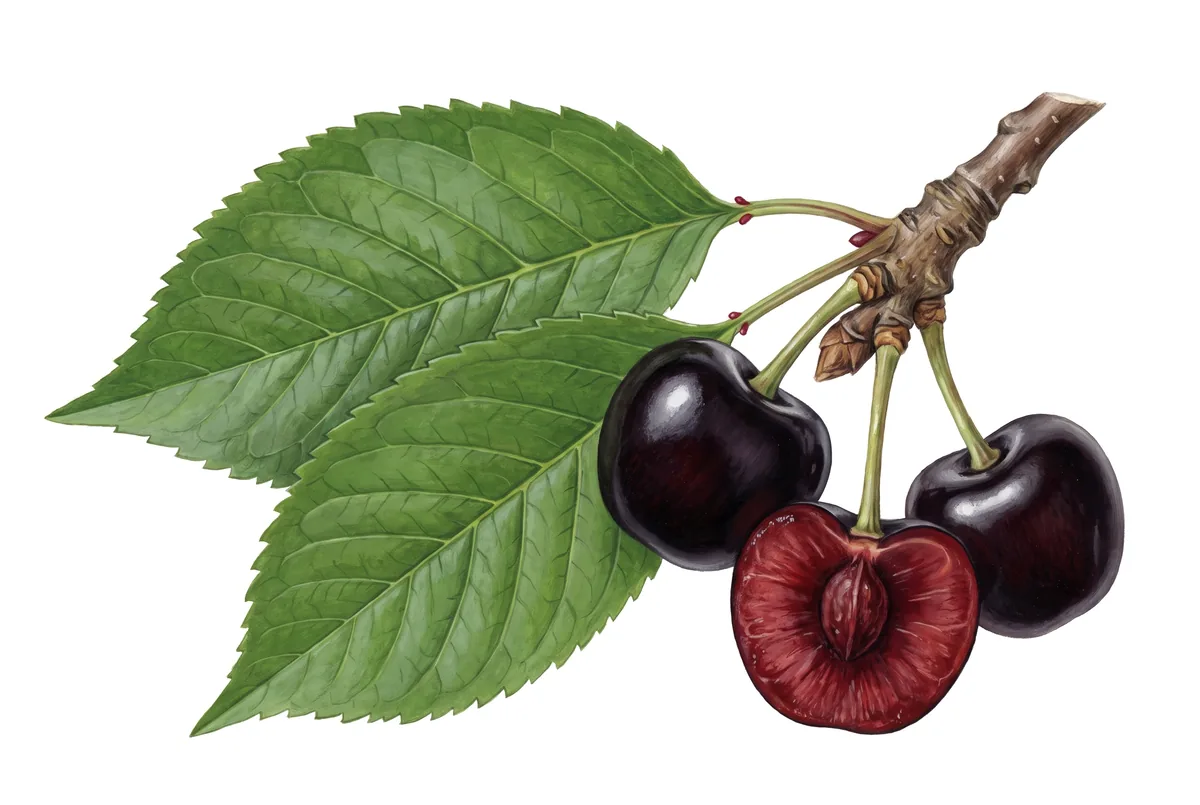
- UC Davis Foundation Plant Services describes a medium-sized, sweet cherry of the Bing type, blocky with a short stem, with black skin of a bright lustre and dark red flesh.
- When does Van ripen?
- In the same season as Bing, by UC Davis Foundation Plant Services, which records its bloom and ripening times as level with Bing's.
- Where does the Van cherry come from?
- Canada. UC Davis records it as an open-pollinated seedling of Empress Eugenie from the Summerland research station in British Columbia, introduced in 1944, and HortScience calls it the first cultivar named from Summerland.
Sources
- GBIF species match API (Prunus avium)
- Australian Plant Census (APC), Council of Heads of Australasian Herbaria: Prunus avium
- ASPCA Animal Poison Control, Toxic and Non-Toxic Plants: Cherry (Prunus spp.)
- UC Davis Foundation Plant Services, Fruit and Nut Tree Cultivars: Prunus avium 'Van'
- UC Davis Foundation Plant Services, Fruit and Nut Tree Cultivars: Prunus avium 'Lapins' (its parentage)
- HortScience (American Society for Horticultural Science), 1995: Sweet cherry breeding in Canada, 1915 to 1995 (abstract)
- Oregon State University Extension Service, EM 9484: Sweet cherry compatibility and bloom timing chart for commercial growers
- HortFlora, the Horticultural Flora of South-eastern Australia (Royal Botanic Gardens Victoria): Prunus avium, sweet cherry
- NSW Department of Primary Industries, Climate Vulnerability Assessment factsheet: cherry (Lapin)
- Pollination Aware, the case study for cherry (Rural Industries Research and Development Corporation, published by Plant Health Australia)
- North Carolina State Extension Gardener Plant Toolbox: Prunus avium, sweet cherry
- The HortOS guides (judging-nursery-plant-quality; lead-times-pre-orders-and-contract-growing)
- The HortOS catalogue (the name growers list Van under)
The growers, sizes and prices above are live and change as lists arrive. Cite this page: HortOS, Sweet cherry (Prunus avium 'Van'), https://au.hortosapp.com/plants/prunus-avium-van.
Found a fact that is wrong? Tell us and it is checked against its source.