Philodendron
Philodendron
Every Philodendron on HortOS in one place: 95 plants, the species and their varieties together. Pick a size to see it across all of them.
117 growers · 43 sizes · from $1.80 ex GST
- Type
- Perennial
- Height
- 0.9 m to 9 m
- Spread
- 0.3 m to 4.5 m
- Flowers
- White, spring or summer, depending on the species; houseplants usually do not flower
- Sun
- Bright indirect light; direct sun can scorch the leaves
- Frost
- Very sensitive to cold by the NC State toolbox
- In Australia
- Not native
Some growers show prices to verified trade buyers. Sign in or sign up with your ABN to see them and order.
Showing 50 of 567 offers (the smallest sizes first). Show all 567 or pick a size or state above.
Also grown by 1 nursery (no sizes or prices listed)
Enquire with them for sizes and prices.
- Plant BiotechCoes Creek, QLD
Growing philodendron
The NC State extension toolbox, which treats the genus as houseplants, gives bright indirect light and says direct sun can scorch the leaves, though some kinds need more light than others.
The toolbox gives moist, well-drained soil high in organic matter, and names overwatering as a cause of root rot.
The toolbox gives 18 to 29 C as the ideal range and calls the plants very sensitive to cold, so draughts are to be avoided; it says they prefer high humidity but usually adapt to that of an average home. It places the genus in USDA zones 10 to 12. No Australian reference read rates the genus for cold.
Pruning may be needed to keep the shape, the toolbox says, and a root-bound plant is repotted, best in spring. HortFlora gives stem cuttings and layers, and occasionally seed, as the ways it is propagated.
The toolbox, an American reference, says to watch for aphids, mealybugs, scale, spider mites and banded greenhouse thrips, and that leaf spots can be prevented by more air movement and by keeping the leaves dry.
Using philodendron
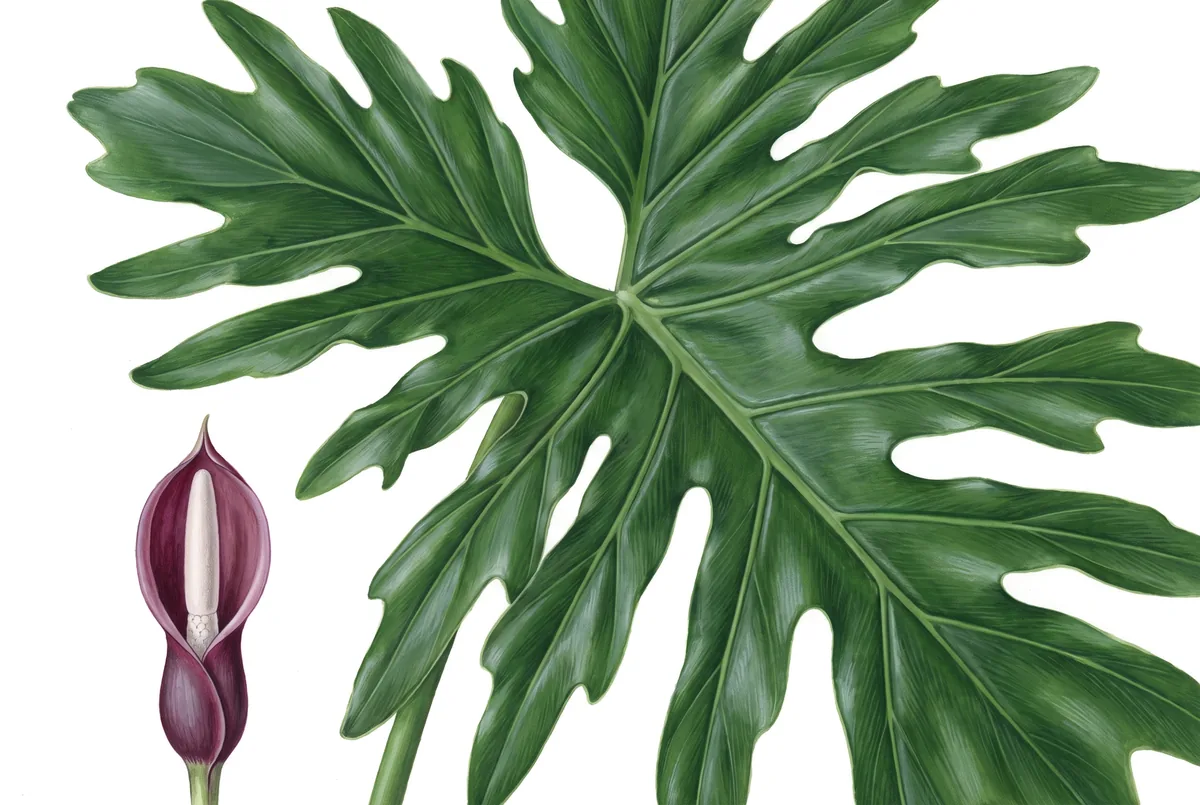
HortFlora says philodendrons are grown for their bold foliage, chiefly in pots indoors and in the gardens of warm climates. The NC State toolbox uses both the climbing and the self-heading kinds as houseplants for the home or office, in containers and hanging baskets, and on patios. For the garden it names the tree philodendron, used in warmer climates as a foundation plant, and Xanadu, a dense, low, spreading form that takes full or part sun. Among the self-heading hybrids it names Birkin. The toolbox gives the genus as 0.9 to 9 m tall and 0.3 to 4.5 m wide depending on the species, so each form's own page gives its figures.
What to check before you buy
Read the form on the list first. HortFlora warns that identification is complicated by the difference between juvenile and adult leaves and by hybrids, and that some of the plants on sale are cultivars of uncertain hybrid background. The table above shows the sizes growers list, and the pot sizes guide explains the grades. For roots, pests and hardening off, see the guide to judging nursery plant quality. Stock crossing a state border moves under the state and territory biosecurity rules on moving plants and soil. The drawbacks the references name are sensitivity to cold and toxicity.
Cautions
The ASPCA lists Philodendron species as toxic to dogs, cats and horses. It gives the toxic principle as insoluble calcium oxalates and the clinical signs as oral irritation, pain and swelling of the mouth, tongue and lips, excessive drooling, vomiting (not in horses) and difficulty swallowing. HortFlora says of the genus that it can be poisonous, and the NC State toolbox adds that the sap can irritate skin.
Used forindoorpots and courtyards
Prices are set by each grower and shown ex GST. Availability is confirmed by the grower at order.
Common questions
- Who grows Philodendron wholesale in Australia?
- 117 wholesale growers list Philodendron on HortOS right now, each with their own pot sizes and trade prices. They are in Queensland, New South Wales, Victoria, Western Australia, South Australia, Tasmania, the ACT and the Northern Territory. The growers are named on this page.
- What pot sizes does Philodendron come in?
- Growers on HortOS list Philodendron in Tube, 42mm, 66mm, 70mm, 75mm, 80mm, 90mm, 95mm, 100mm, 120mm and 33 more sizes.
- How do I order Philodendron from these growers?
- HortOS is for the trade. Add the lines you want to a list and send it: each grower gets their part of the order by email, confirms what they have and quotes freight, and nothing is bought until you approve it. Listing, searching and ordering are free.
- What is the difference between a climbing and a self-heading philodendron?
- The NC State toolbox divides the genus in two. Climbing or vining kinds have aerial roots that attach to a surface such as a pole or trellis. Non-climbing or self-heading kinds grow upright, with very short stems and the leaves held in a rosette.
- How big does a philodendron get?
- It depends on the species. The NC State toolbox gives the genus as 0.9 to 9 m tall and 0.3 to 4.5 m wide, with leaves from about 8 cm to about 0.9 m long. Each named form's own page gives its size.
- How many kinds of philodendron are there?
- The references read disagree. HortFlora gives 350 to 400 species, the Missouri Plant Finder around 500 and the NC State toolbox over 600, all from tropical America. HortFlora adds that hybrids and cultivars of uncertain background are sold as well.
- Are philodendrons poisonous to cats and dogs?
- The ASPCA lists Philodendron species as toxic to dogs, cats and horses because of insoluble calcium oxalates, with oral irritation, swelling of the mouth, tongue and lips, drooling, vomiting and difficulty swallowing as the signs.
- Do philodendrons flower?
- They can. HortFlora describes a whitish spadix inside a spathe that is mostly green or white, followed by a white to orange or red berry. The NC State toolbox says flowering comes in spring or summer depending on the species, and that houseplants usually do not flower.
- Are philodendrons native to Australia?
- No. HortFlora gives the genus as coming from the wet forests of tropical America.
Sources
- GBIF species match API
- Atlas of Living Australia (species search for Philodendron: the common name)
- ASPCA Animal Poison Control, Toxic and Non-Toxic Plants: Philodendron Pertusum (Philodendron spp)
- HortFlora, the Horticultural Flora of South-eastern Australia (Royal Botanic Gardens Victoria): Philodendron, the genus treatment
- North Carolina State Extension Gardener Plant Toolbox: Philodendron (the genus)
- Missouri Botanical Garden Plant Finder: Philodendron 'Winterbourn' XANADU (its paragraph on the genus)
- The HortOS guides (nursery pot sizes; judging nursery plant quality)
The growers, sizes and prices above are live and change as lists arrive. Cite this page: HortOS, Philodendron (Philodendron), https://au.hortosapp.com/plants/philodendron.
Found a fact that is wrong? Tell us and it is checked against its source.