Peperomia clusiifolia
Every Peperomia clusiifolia on HortOS in one place: the plain species and 2 varieties. Pick a size to see it across all of them.
7 growers · 5 sizes · from $5.25 ex GST
- Type
- Evergreen perennial
- Height
- 0.15 m to 0.3 m
- Spread
- 0.15 m to 0.3 m
- Growth
- Slow
- Flowers
- Greenish white, spring and summer
- Sun
- Bright indirect light to partial shade
- Frost
- Tolerates low temperatures but not being frozen (RHS H2: 1 to 5 C)
- In Australia
- Not native
| Size | Grower | PricePrice ex GST | ||
|---|---|---|---|---|
| 105mm | Empire Wholesale NurseryRed Edge105mm | $5.25 | ||
| 130mm | Garden View Nursery At Regal GardensRed Edge130mm | $17.99 | ||
| 150mm | EchéRed Edge150mm | Price on application. Sign in to ask the grower. | ||
| 180mm | Tango TreesJelly (Jellie)180mm | $12.50 | ||
| 200mm | Sprout Wholesale NurseryRed Edge200mm | $14.00 | ||
| 200mm | Crystal Waters NurseryRed Edge200mm | $13.00 | ||
| 200mm | Logans NurseryJelly (Jellie)200mm | $15.00 | ||
| 200mm | Logans NurseryRed Edge200mm | $15.00 |
Growing red edge peperomia
The references read are overseas: North Carolina State Extension in the United States and the RHS in Britain, both writing for a plant grown indoors. No reference read gives an Australian climate zone.
North Carolina State Extension says it prefers bright, indirect sunlight and will tolerate low light, and lists dappled light and partial shade; the RHS gives partial shade.
North Carolina State Extension recommends a moist, well-drained, loamy mix, says to avoid overwatering and cold draughts, and warns that overwatering can cause root rot and that wetting the leaves can bring leaf spots. The RHS gives loam that is moist but well drained, or well drained, acid to alkaline. North Carolina State Extension says it is slow growing and will not need repotting very often.
The RHS rates it H2, a plant that tolerates low temperatures but does not survive being frozen, with a minimum of 1 to 5 C; North Carolina State Extension gives the American hardiness zones 10 to 12. Neither is an Australian rating.
The RHS calls it generally free of pests and diseases. North Carolina State Extension still lists mealybugs, spider mites, aphids, scale, fungus gnats and whiteflies to watch for. The RHS says no pruning is required, though it can be trimmed to keep it compact. North Carolina State Extension propagates it by leaf or stem cuttings, the RHS by division or leaf cuttings.
Using red edge peperomia
Both references treat it as a houseplant. North Carolina State Extension lists it for containers, houseplants, patios and interiorscapes and as an accent, and calls it low maintenance and easy to grow; the RHS recommends it for houseplants, conservatories and greenhouses and calls it a tolerant indoor plant. North Carolina State Extension describes four cultivars, each with a coloured leaf edge: pink and cream in 'Jelly', which deepens to red as it ages; a faint red in 'Red Margin'; red and pink, with cream, in the grey-green 'Variegata'; and yellow and pink in 'Ginny'. The wider genus is set out on the peperomia page.
What to check before you buy
Growers list the species and its named forms side by side, so read the full name on the line: Jelly (or Jellie), Red Edge and Emerald are listed separately. The RHS gives baby rubber plant as another common name for this species, and the ASPCA uses the same name for Peperomia obtusifolia, which has its own page as baby rubber plant; check the botanical name on a quote. The table above shows the sizes growers list. What to look for in the pot, the roots and for pests is in the guide to nursery plant quality. Stock crossing a state border moves under the state and territory biosecurity rules on moving plants and soil.
Cautions
The ASPCA lists red edge peperomia, Peperomia clusiifolia, as non-toxic to dogs, cats and horses.
Used forindoorpots and courtyards
Prices are set by each grower and shown ex GST. Availability is confirmed by the grower at order.
Common questions
- Who grows Peperomia clusiifolia wholesale in Australia?
- 7 wholesale growers list Peperomia clusiifolia on HortOS right now, each with their own pot sizes and trade prices. They are in Queensland and New South Wales. The growers are named on this page.
- What pot sizes does Peperomia clusiifolia come in?
- Growers on HortOS list Peperomia clusiifolia in 105mm, 130mm, 150mm, 180mm and 200mm.
- How do I order Peperomia clusiifolia from these growers?
- HortOS is for the trade. Add the lines you want to a list and send it: each grower gets their part of the order by email, confirms what they have and quotes freight, and nothing is bought until you approve it. Listing, searching and ordering are free.
- Is red edge peperomia safe for cats and dogs?
- The ASPCA, the American animal poison control list, enters red edge peperomia (Peperomia clusiifolia) as non-toxic to dogs, cats and horses.
- How big does Peperomia clusiifolia grow?
- North Carolina State Extension gives 6 inches to 1 foot high and wide, about 0.15 to 0.3 m, and calls it slow growing; the RHS gives it as an upright perennial to about 30 cm.
- What do the leaves of red edge peperomia look like?
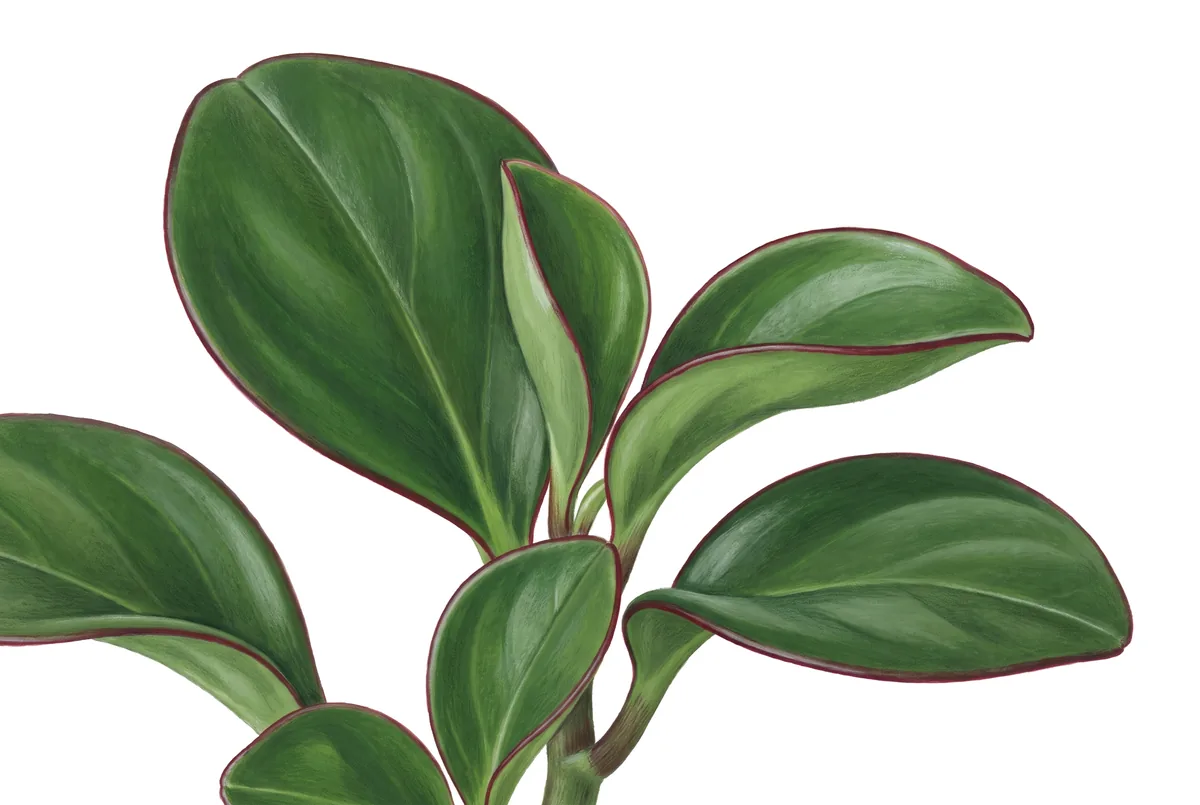
- Stiff and succulent-like, glossy deep green with a dark red or maroon margin, by North Carolina State Extension, which calls them elliptical, entire-edged and hairless. The RHS calls them rounded, glossy dark green with a fine dark red edge.
- Does Peperomia clusiifolia flower?
- It can. The RHS says very narrow, greenish-white flower spikes appear in spring and summer; North Carolina State Extension describes small, long, narrow greenish-white spikes and says that as a houseplant it rarely flowers.
- How much light does red edge peperomia need?
- Bright, indirect light by North Carolina State Extension, which says it also tolerates low light; the RHS gives partial shade.
- Where does Peperomia clusiifolia come from?
- Jamaica, by North Carolina State Extension and the RHS, so it is not an Australian native; both references write for it as a houseplant.
- How do you propagate red edge peperomia?
- By leaf or stem cuttings, by North Carolina State Extension; the RHS gives division or leaf cuttings.
Sources
- GBIF species match API
- ASPCA Animal Poison Control, Toxic and Non-Toxic Plants: Red Edge Peperomia
- ASPCA Animal Poison Control, Toxic and Non-Toxic Plants: Blunt Leaf Peperomia (Peperomia obtusifolia), for the name baby rubber plant
- North Carolina State Extension Gardener Plant Toolbox: Peperomia clusiifolia
- RHS Plants: Peperomia clusiifolia, red edge peperomia
- The HortOS catalogue (the names growers list it under) and the HortOS guide to nursery plant quality
The growers, sizes and prices above are live and change as lists arrive. Cite this page: HortOS, Red edge peperomia (Peperomia clusiifolia), https://au.hortosapp.com/plants/peperomia-clusiifolia.
Found a fact that is wrong? Tell us and it is checked against its source.