Origanum vulgare subsp. hirtum
Oregano
One of 3 Origanum vulgare varieties: see them all
6 growers · 5 sizes · from $2.99 ex GST
- Type
- Deciduous perennial
- Height
- 0.15 m to 1 m
- Spread
- 0.1 m to 0.5 m
- Growth
- Moderate
- Flowers
- White, summer to autumn
- Sun
- Full sun or part shade, by the RHS and North Carolina State Extension; full sun by the Missouri Plant Finder
- In Australia
- Not native
Some growers show prices to verified trade buyers. Sign in or sign up with your ABN to see them and order.
| Size | Grower | PricePrice ex GST | ||
|---|---|---|---|---|
| 50mm | JD Plant Farm50mm | $3.50 | ||
| 70mm | Tavistock Nursery70mm | Price on application. Sign in to ask the grower. | ||
| 85mm | Sandy Creek Plant Farm Pty Ltd85mm | $2.99 | ||
| 95mm | Romantic Nursery95mm | $8.00 | ||
| 95mm | Heritage Nursery95mm | $8.99 | ||
| 100mm | Wells Design Landscapes and Gardens100mm | Price shown to verified trade buyers. Sign in with your ABN to see it. |
Also grown by 3 nurseries (no sizes or prices listed)
Enquire with them for sizes and prices.
- Canberra ColourNSW
- Jackpot NurseryBiarra (Toogoolawah / Esk District), QLD
- Scotts TubesNSW
Growing greek oregano
The RHS gives full sun or part shade, and North Carolina State Extension the same; the Missouri Plant Finder gives full sun.
The RHS grows it in a well-drained, alkaline soil by its cultivation note (its table allows acid, neutral or alkaline), on chalk, loam or sand. The Missouri Plant Finder gives average, dry to medium, well-drained soil and says it does very well in gritty, sandy loams. North Carolina State Extension says it takes a range of soils, sandy gravel and clay among them, and that oregano plants tolerate heat and drought; those are American observations, and no Australian reference read gives a drought rating or a frost figure.
HortFlora, the horticultural flora of south-eastern Australia, describes it among the subspecies of oregano in cultivation in Australia, two of which it says are commonly found. The RHS rates it H4, hardy through most of the United Kingdom, and the American references give USDA zones 4 to 8, an American scale.
The RHS cuts it back in autumn; the two American references shear it back regularly before flowering, the Missouri Plant Finder to keep it tidy and bring on new leaves, and North Carolina State Extension says the leaf flavour is best just before flowering. The RHS raises it from seed or by division in autumn or spring.
The RHS, a British reference, calls it generally disease-free, though open to leafhoppers. North Carolina State Extension, an American reference, adds root rot in wet, poorly drained soil, fungal diseases, aphids, leaf miners and spider mites.
Using greek oregano
Greek oregano is a kitchen herb first. North Carolina State Extension and the Missouri Plant Finder say its leaves have a hot, spicy flavour (much more flavourful than the plain species' leaves, by the Plant Finder), and that it is the oregano most often sold dried for the spice rack; North Carolina State Extension uses the leaves fresh or dried in sauces, soups, stews, salads and dressings. HortFlora adds that dried bunches of its flowering stems are sold in delicatessens as rigani matso. Both American references give it little ornamental value. For planting, North Carolina State Extension suggests the front of a border or a mass along a slope and lists it for containers and patios, the Missouri Plant Finder lists it as a ground cover (no reference read gives planting centres for ground cover or massing; North Carolina State Extension gives only the space a plant needs), and the RHS suggests patio and container planting, rock gardens and Mediterranean, cottage and wildlife gardens. The RHS also names it among its plants for pollinators.
What to check before you buy
The name oregano covers more than one plant. HortFlora says it is not restricted to this subspecies, and the Missouri Plant Finder that it names a flavour rather than one genus or species, so the subspecies name is what to match on a list; plain oregano, Origanum vulgare as a whole, has its own page. The RHS lists Origanum heracleoticum L. as a synonym; HortFlora takes that name only in a sense not Linnaeus's. Where the leaves are wanted for cooking, the Missouri Plant Finder advises plants raised from cuttings of proven flavour, since seed-grown plants sometimes have little aroma or flavour. The table above shows the sizes growers list, and what to check in a pot is in the guide to nursery plant quality. Stock crossing a state border moves under the state and territory biosecurity rules on moving plants and soil.
Cautions
The ASPCA's plant list, an American register, gives oregano, Origanum vulgare hirtum (Greek oregano), as toxic to dogs, cats and horses: it is a gastrointestinal irritant and causes mild vomiting and diarrhoea.
Prices are set by each grower and shown ex GST. Availability is confirmed by the grower at order.
Common questions
- Who grows Origanum vulgare subsp. hirtum wholesale in Australia?
- 6 wholesale growers list Origanum vulgare subsp. hirtum on HortOS right now, each with their own pot sizes and trade prices. They are in Victoria, South Australia and the ACT. The growers are named on this page.
- What pot sizes does Origanum vulgare subsp. hirtum come in?
- Growers on HortOS list Origanum vulgare subsp. hirtum in 50mm, 70mm, 85mm, 95mm and 100mm.
- How do I order Origanum vulgare subsp. hirtum from these growers?
- HortOS is for the trade. Add the lines you want to a list and send it: each grower gets their part of the order by email, confirms what they have and quotes freight, and nothing is bought until you approve it. Listing, searching and ordering are free.
- Is Greek oregano the same as oregano?
- It is one subspecies of it. GBIF accepts Origanum vulgare subsp. hirtum within the oregano species, Origanum vulgare, and HortFlora calls the species extremely variable, divided into geographical subspecies whose characters overlap.
- How tall does Greek oregano grow?
- The references differ. North Carolina State Extension and the Missouri Plant Finder call it compact, about 0.15 to 0.23 m tall and 0.3 to 0.46 m wide, while the RHS gives a height of 0.5 to 1 m and a spread of 0.1 to 0.5 m.
- What colour are Greek oregano flowers?
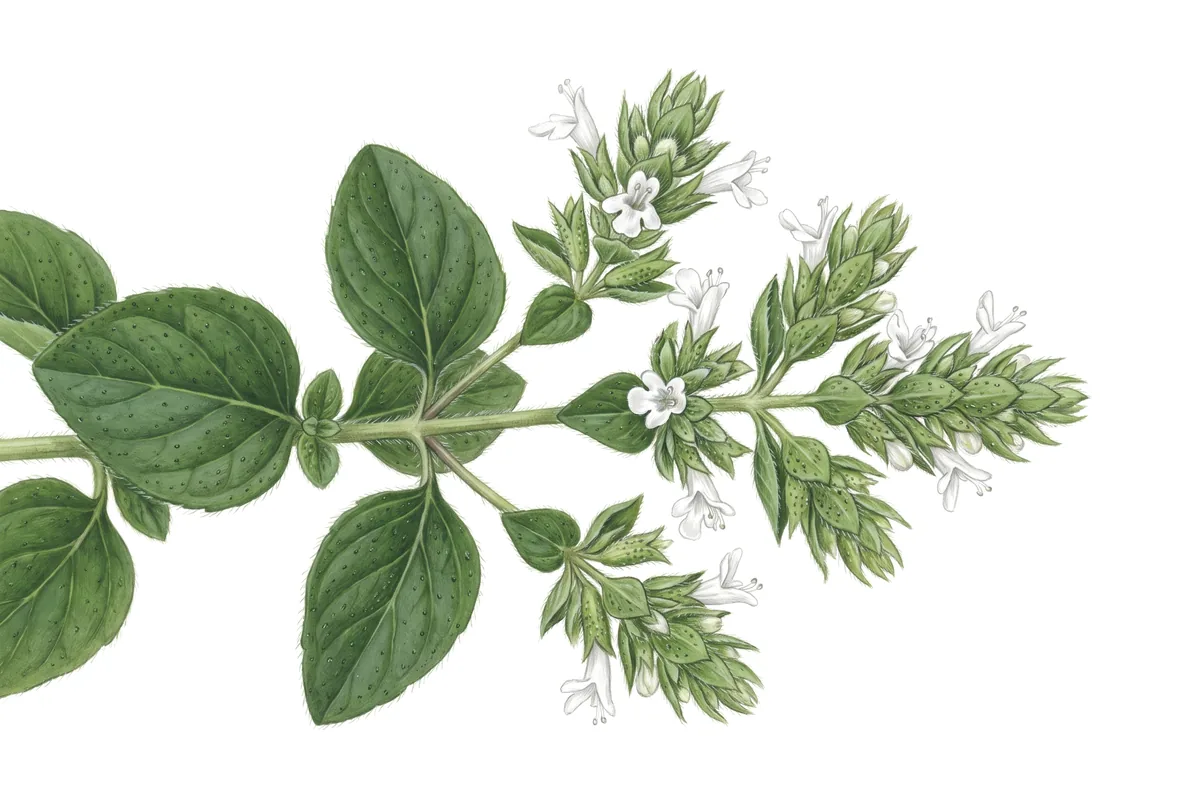
- White, by HortFlora, the RHS, North Carolina State Extension and the Missouri Plant Finder: small flowers in short spikes from summer into autumn. HortFlora gives the subspecies vulgare, wild marjoram, purple bracts, an often purple calyx and a pink corolla, against this subspecies' hairy bracts, green calyx and white corolla.
- Are Greek oregano leaves hairy?
- HortFlora describes them as conspicuously hairy and gland-dotted, and the Missouri Plant Finder says the name hirtum comes from the Latin for hairy. North Carolina State Extension's entry records no hairs on the leaf but a hairy stem.
- Is Greek oregano toxic to pets?
- The ASPCA lists it as toxic to dogs, cats and horses, as a gastrointestinal irritant that causes mild vomiting and diarrhoea. That is an American register.
- Where does Greek oregano come from?
- From the eastern Mediterranean, by HortFlora; the Missouri Plant Finder gives Greece, Turkey and the Aegean Islands, and North Carolina State Extension Greece and Turkey. In Australia, HortFlora describes it among the subspecies of oregano in cultivation, and the Australian Plant Census lists the species, Origanum vulgare, only as doubtfully naturalised in New South Wales.
Sources
- GBIF species match API (Origanum vulgare subsp. hirtum)
- Australian Plant Census (APC): Origanum vulgare, the species
- ASPCA (American Society for the Prevention of Cruelty to Animals) toxic and non-toxic plants list: Oregano (Origanum vulgare hirtum)
- HortFlora, the Horticultural Flora of South-eastern Australia (Royal Botanic Gardens Victoria): Origanum vulgare and its subspecies
- Royal Horticultural Society, plant profile: Origanum vulgare subsp. hirtum (Greek oregano), a British reference
- North Carolina State Extension Gardener Plant Toolbox: Origanum vulgare subsp. hirtum (Greek oregano), an American reference
- North Carolina State Extension Gardener Plant Toolbox: Origanum vulgare, the species, an American reference
- Missouri Botanical Garden Plant Finder: Origanum vulgare subsp. hirtum (Greek oregano), an American reference
- The HortOS guides (judging nursery plant quality)
The growers, sizes and prices above are live and change as lists arrive. Cite this page: HortOS, Greek oregano (Origanum vulgare subsp. hirtum), https://au.hortosapp.com/plants/origanum-vulgare-subsp-hirtum.
Found a fact that is wrong? Tell us and it is checked against its source.