Fraxinus angustifolia raywood Claret Ash
Ash
11 growers · 6 sizes · from $60.00 ex GST
- Type
- Deciduous tree
- Height
- 10 m to 15 m
- Spread
- 6 m to 20 m
- Growth
- Moderate
- Flowers
- Green, winter to spring
- Sun
- Full sun to part shade
- Drought
- High
- Frost
- High frost tolerance to minus 10 C (ACT Government); moderate frost (SA Plant Selector)
- In Australia
- Not native
| Size | Grower | PricePrice ex GST | ||
|---|---|---|---|---|
| 400mm | Arboretum Farm400mm | $75.00 | ||
| 400mm | ILandscape.com.au400mm | $180.00 | ||
| 45L | The Advanced Tree Company45L | $95.00 | ||
| 400mm | Blackall Range Nurseries400mm | $125.00 | ||
| 330mm | South West Advanced Trees330mm | $60.00 | ||
| 400mm | South West Advanced Trees400mm | $90.00 | ||
| 400mm | Billabong Garden Complex400mm | $90.00 | ||
| 45L | Urban Tree Growers45L | $110.00 | ||
| 75L | Urban Tree Growers75L | $176.00 | ||
| 100L | Urban Tree Growers100L | $220.00 | ||
| 100L | Undercover Nursery100L | $300.00 | ||
| 330mm | Eumundi Roses330mm | $100.00 | ||
| 400mm | Eumundi Roses400mm | $150.00 | ||
| 45L | Camden Nurseries45L | $136.32 | ||
| 500L | Alpine Treemovals500L | Price on application. Sign in to ask the grower. |
Growing claret ash
The SA Plant Selector gives full sun or part shade, NC State full sun. The ACT Government's sheet says it suits every part of Canberra and has performed consistently across the city, above all in street plantings, and gives a high frost tolerance to minus 10 C; the Selector lists moderate frost. NC State, an American reference, rates it for USDA zones 5 to 8, an American scale; no Australian reference read gives a climate zone.
The Selector lists clay, loam or sand soils, acid to alkaline, and names lime among what it tolerates; the ACT sheet says it takes all of Canberra's soils but suffers dieback without enough moisture. The Selector lists drought among its tolerances and asks for minimal supplementary watering, and the ACT sheet gives very good drought tolerance.
The ACT sheet gives a moderate growth rate and a medium to long life, where NC State calls the growth rapid. The ACT sheet reports very few pest and disease problems and the City of Burnside calls it free of them, but HortFlora says trees are prone to a disease it calls ash dieback after about 30 years.
NC State gives grafting as the way to propagate it, and the ACT sheet says it can be grafted onto ash rootstocks of Fraxinus velutina or F. excelsior, velutina stock appearing to raise drought tolerance and root deeper once established.
Using claret ash
The South Australian and ACT references both list it as a street and shade tree. The Selector says it is often planted as a specimen for shade and for streets, in parks and reserves, on open sites and along wide streetscapes. The ACT sheet lists streets and avenues, shade in shopping centres and urban parks, and requires at least 70 cubic metres of available soil volume. The City of Burnside lists it as a large street or reserve tree. The ACT sheet rates its flammability extremely low, and the Selector says it develops low flammability when kept in its best growing conditions. Both keep it back from water: the ACT asks that it not be planted near nature reserves, creeks or watercourses, and the Selector, as for every deciduous tree, that its litter not reach waterways. No reference read gives avenue spacing; for writing a street tree order, see the guide to specifying and procuring trees.
What to check before you buy
In South Australia, the state's declared weed page for desert ash names Fraxinus angustifolia, the species, and names no subspecies or cultivar as excepted: it must not be sold or traded in any way in any landscape region. Claret ash appears under several names, Fraxinus angustifolia 'Raywood', F. angustifolia subsp. oxycarpa 'Raywood' and the older F. oxycarpa 'Raywood', and HortFlora notes the cultivar name is often misspelled 'Raywoodii', the spelling on the City of Burnside's sheet. HortFlora says a claret ash can generally be told, even in winter, by the change at the graft: smooth grey bark above, the stock's dark, fissured bark at the base below. The ACT sheet's note on velutina stock is a reason to ask which rootstock a grower uses. For roots, pests and hardening off at the nursery, see the guide to judging nursery plant quality. Plants moving between states travel under the state and territory biosecurity rules on moving plants and soil.
Cautions
The SA Plant Selector warns of a potentially invasive root system, advises against narrow streetscapes and recommends planting no closer than 3.5 m to a sewer main or connection; the ACT sheet says vigorous roots can lead to maintenance issues. South Australia's declared weed page names Fraxinus angustifolia, with no subspecies or cultivar excepted, as a declared weed that must not be sold or traded in any landscape region, and points to the regional landscape boards for advice.
South Australia's declared weed page for desert ash names Fraxinus angustifolia, the species, and names no subspecies or cultivar as excepted: it must not be sold or traded in any way in any of the state's landscape regions, and in the Green Adelaide, Hills and Fleurieu and Kangaroo Island regions land owners must take reasonable steps to kill plants and prevent their spread. (Primary Industries and Regions SA (PIRSA), declared weeds in South Australia)
Prices are set by each grower and shown ex GST. Availability is confirmed by the grower at order.
Common questions
- Who grows Fraxinus angustifolia raywood Claret Ash wholesale in Australia?
- 11 wholesale growers list Fraxinus angustifolia raywood Claret Ash on HortOS right now, each with their own pot sizes and trade prices. They are in Victoria, Queensland and New South Wales. The growers are named on this page.
- What pot sizes does Fraxinus angustifolia raywood Claret Ash come in?
- Growers on HortOS list Fraxinus angustifolia raywood Claret Ash in 330mm, 400mm, 45L, 75L, 100L and 500L.
- What does Fraxinus angustifolia raywood Claret Ash cost wholesale?
- The median trade price in a 400 mm pot is $90.00 ex GST, across 5 growers who price it. Prices by pot size and state are on its trade price page.
- How do I order Fraxinus angustifolia raywood Claret Ash from these growers?
- HortOS is for the trade. Add the lines you want to a list and send it: each grower gets their part of the order by email, confirms what they have and quotes freight, and nothing is bought until you approve it. Listing, searching and ordering are free.
- Where did the claret ash come from?
- HortFlora tells it this way: about 1910 a plum-coloured seedling was noticed among ash seedlings, allegedly of Austrian origin, in a nursery at Aldgate in the Adelaide Hills. The original tree was raised on a property called Raywood, and by 1949 it stood 13 m tall, with grafts made onto F. ornus and buds onto F. excelsior. It has been in the British nursery trade since about 1928 and available in North America since 1956, though only widely so there from 1979. The SA Plant Selector, for its part, traces the material it was selected from to south-eastern Europe and Asia Minor.
- What is the difference between claret ash and desert ash?
- Both are Fraxinus angustifolia. HortFlora says the name desert ash has generally been used in Australia for subsp. angustifolia, while claret ash is 'Raywood', a selection of subsp. oxycarpa, and the only form of that subspecies the trade appears to offer. VicFlora says the naturalised plants belong to subsp. angustifolia, with yellowish autumn leaves, and that subsp. oxycarpa differs in its hairy midribs beneath the leaves. HortFlora gives the species' home as southern and eastern Europe and the Balkans, and says it grows wild in drier areas and also on riverbanks, floodplains and in deciduous woods.
- Is claret ash a weed?
- South Australia's declared weed page names Fraxinus angustifolia, the species, with no subspecies or cultivar excepted: it must not be sold or traded in any of the state's landscape regions, and land owners in three regions must control it. On naturalisation, the Australian Plant Census records subsp. oxycarpa only as doubtfully naturalised in South Australia, VicFlora says that subspecies is cultivated but not naturalised in Victoria, and the species as a whole is naturalised in five states and the ACT. NC State, an American reference, says 'Raywood' is reported to produce only male flowers and so no fruit, though some trees have produced female flowers and fruit.
- How big does a claret ash grow?
- The SA Plant Selector gives 10 to 15 m tall and 6 to 7 m wide, the ACT Government 15 m by 12 to 15 m, and the City of Burnside 10 to 15 m with a crown 15 to 20 m across. NC State, an American reference, gives up to about 24 m, out of line with the Australian references, but generally about 12 to 15 m tall.
- How much frost and drought does claret ash take?
- The ACT Government's sheet gives a high frost tolerance to minus 10 C and very good drought tolerance, with dieback where moisture runs short. The SA Plant Selector lists moderate frost and drought among its tolerances and asks for minimal supplementary watering.
- How close to a sewer can claret ash be planted?
- The SA Plant Selector notes that it is not classified under South Australia's Sewerage Act but recommends planting it no closer than 3.5 m to any sewer main or connection. It also advises against narrow streetscapes because of its potentially invasive root system, and the ACT sheet requires at least 70 cubic metres of available soil volume.
- When do claret ash leaves colour?
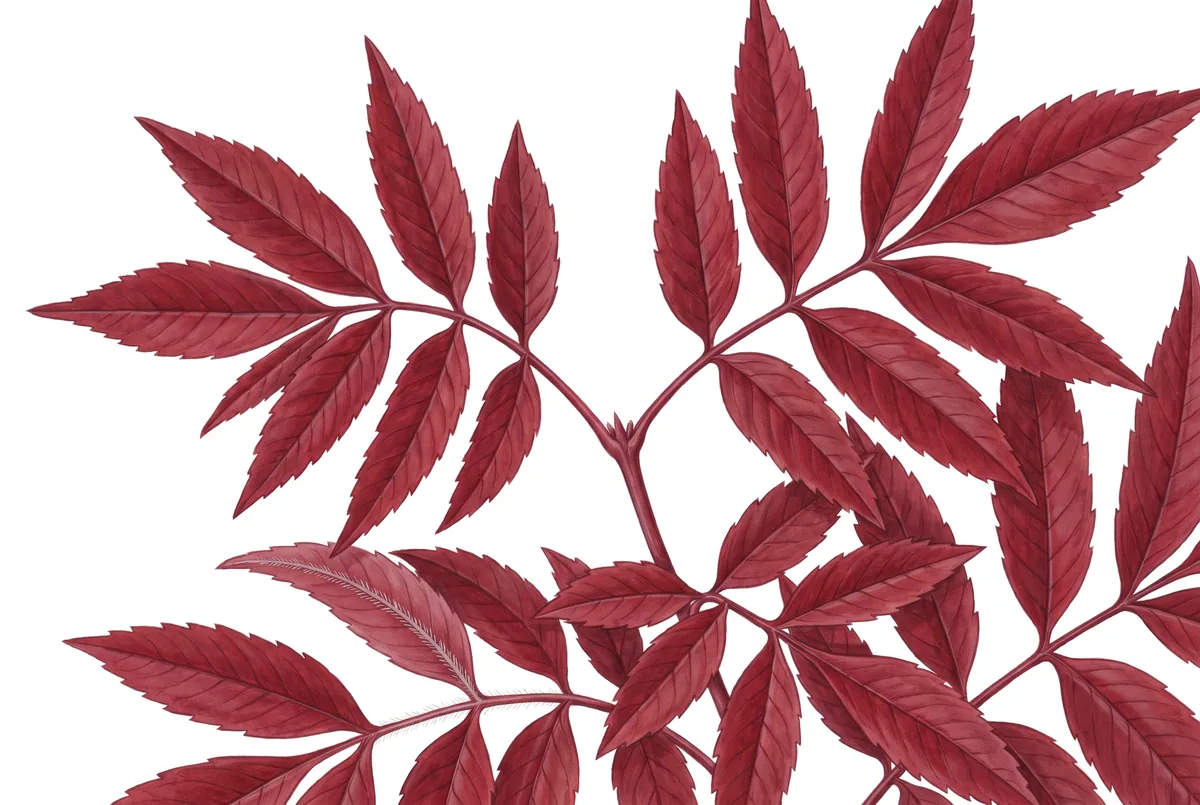
- In autumn, from dark green to claret on the ACT and South Australian references, claret red on the ACT sheet; Burnside adds bronze, and VicFlora calls the colour purplish. HortFlora says trees grown from cuttings of the original still stand near Bridgewater in the Adelaide Hills, where it calls their autumn foliage outstanding in April and May.
Sources
- GBIF species match API (the species Fraxinus angustifolia)
- Australian Plant Census (APC), Fraxinus angustifolia subsp. oxycarpa (APC Dist.: SA, doubtfully naturalised)
- Australian Plant Census (APC), Fraxinus angustifolia (APC Dist.: WA, SA, NSW, ACT, Vic and Tas naturalised; Qld doubtfully naturalised)
- PlantNET, the New South Wales flora online (Royal Botanic Garden Sydney): the genus Fraxinus with its key
- VicFlora, the Flora of Victoria (Royal Botanic Gardens Victoria): Fraxinus angustifolia subsp. angustifolia, Desert Ash, with its note on the claret ash
- VicFlora, the Flora of Victoria (Royal Botanic Gardens Victoria): Fraxinus angustifolia, the species page and its note on the three subspecies
- Plant Selector+ (Botanic Gardens and State Herbarium of South Australia), entry 17880, Fraxinus angustifolia ssp. oxycarpa 'Raywood'
- Primary Industries and Regions SA (PIRSA), declared weeds in South Australia: Desert ash, Fraxinus angustifolia
- HortFlora, the Horticultural Flora of South-eastern Australia (Royal Botanic Gardens Victoria): Fraxinus angustifolia, with subsp. angustifolia, subsp. oxycarpa and 'Raywood'
- ACT Government, Design Standards for Urban Infrastructure, Plant Species for Urban Landscape Projects in Canberra: Fraxinus angustifolia subsp. oxycarpa 'Raywood', Claret Ash (tree sheet)
- City of Burnside (South Australia), Tree Species Fact Sheet: Claret Ash, written Fraxinus oxycarpa 'Raywoodii'
- North Carolina Extension Gardener Plant Toolbox (NC State Extension, an American reference): Fraxinus angustifolia subsp. oxycarpa 'Raywood'
The growers, sizes and prices above are live and change as lists arrive. Cite this page: HortOS, Claret ash (Fraxinus angustifolia subsp. oxycarpa 'Raywood'), https://au.hortosapp.com/plants/fraxinus-angustifolia-raywood-claret-ash.
Found a fact that is wrong? Tell us and it is checked against its source.