Davallia solida var. Fejeensis (Rabbits Foot)
Rabbits Foot Fern
Part of Davallia: see them all
No grower lists this plant right now
- Type
- Evergreen fern
- Height
- 0.3 m to 0.9 m
- Spread
- 0.3 m to 1.2 m
- Growth
- Moderate
- Sun
- Part shade, out of direct sun (Missouri); good indirect light, dappled sun or part shade (NC State)
- In Australia
- Not native
Growing rabbit's foot fern
Light. The Missouri Botanical Garden, an American reference, gives part shade and says to avoid direct sun. NC State Extension, another, gives good indirect light, dappled sun or part shade.
Potting mix and water. NC State asks for a peat-based mix kept moist, the top allowed to dry a little between waterings. Missouri says to water regularly in the growing season and a little less from autumn to late winter. NC State finds it copes with dry air better than other ferns do, though it looks better in humid air; Missouri says it can be difficult where humidity is low.
Warmth. HortFlora, the Royal Botanic Gardens Victoria's horticultural flora, says it needs shelter and warmth. NC State says it does not tolerate cold, wants temperatures above about 13 C, and is kept as a houseplant where winters are colder than USDA zone 10; both American references rate it for zones 10 to 12. No Australian reference read gives a frost figure.
Pests. NC State reports no significant problems but says to watch for spider mites, mealybugs and scale; Missouri says to watch for scale and that botrytis and aerial blights may occur.
Propagation. NC State roots rhizome tips carrying one or two fronds, pinned onto moist mix inside a plastic bag in bright light; new fronds show it has rooted. Missouri advises dividing seldom, because rhizome creeping is wanted.
Using rabbit's foot fern
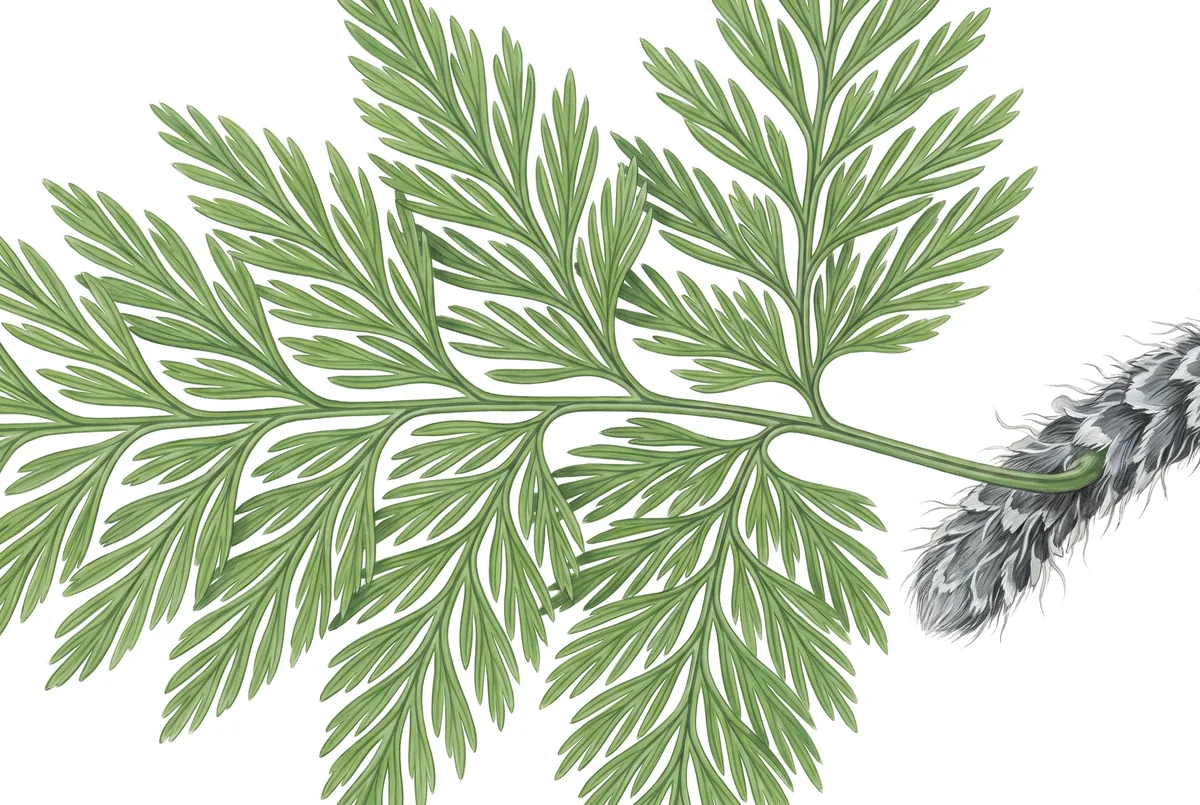
It is a basket and pot fern. Missouri calls it best in hanging baskets and lists containers too; NC State lists containers, hanging baskets and houseplants. HortFlora says the genus is often grown in hanging baskets, and that its rhizomes often look like animal paws, which is where the common names come from; NC State says the rhizomes spilling over the rim resemble a rabbit's feet. Missouri adds that plants become more attractive with age. Two named forms appear in the references read: 'Dwarf Ripple', a miniature with finely cut fronds (NC State), and 'Plumosa', with narrow, feather-like segments (Missouri; HortFlora lists it too).
What to check before you buy
Growers list this fern as Davallia solida var. fejeensis, and Davallia feejensis is listed separately. GBIF accepts Davallia fejeensis and treats var. fejeensis as its synonym; HortFlora keeps it as a species from Fiji and describes it as extremely variable, a plant at times mistaken for D. solida. VicFlora notes that a 1994 revision placed it within D. solida, that its much narrower final segments give a lacier frond, and that more work is needed to settle whether it is distinct. The name Davallia solida belongs to Australia's own hare's foot fern, native by the Australian Plant Census to Queensland, New South Wales and Victoria. The table above shows the sizes growers list. What to look for in the roots, the fronds and for pests before stock leaves the grower is set out in the guide to nursery plant quality. Stock that crosses a state border moves under the state and territory biosecurity rules on moving plants and soil.
Used forpots and courtyardsindoor
Prices are set by each grower and shown ex GST. Availability is confirmed by the grower at order.
Common questions
- Is rabbit's foot fern the same as Davallia solida?
- Not by GBIF, which accepts Davallia fejeensis from Fiji as a species of its own and treats Davallia solida var. fejeensis as its synonym. HortFlora also keeps D. fejeensis as a species, and NC State Extension gives D. solida var. fejeensis as its former name. VicFlora notes that a 1994 revision placed it within D. solida and that whether it is distinct still needs work.
- How big does a rabbit's foot fern get?
- The Missouri Botanical Garden gives 0.3 to 0.9 m high and 0.3 to 1.2 m across. NC State Extension gives fronds about 46 to 61 cm long.
- Is rabbit's foot fern safe for cats and dogs?
- The ASPCA lists rabbit's foot fern, which it gives as Davallia spp., as non-toxic to dogs and cats. NC State Extension tags it non-toxic for cats, dogs and horses.
- Why is it called rabbit's foot fern?
- For its rhizomes. NC State Extension says the rhizomes spilling over the rim resemble a rabbit's feet, and HortFlora that the scaly rhizomes of the genus often resemble animal paws, hence its common names.
- Can it be grown outdoors?
- HortFlora says it needs shelter and warmth. The American references rate it for USDA zones 10 to 12 and say it does not tolerate cold.
- How is it propagated?
- NC State Extension roots rhizome tips carrying one or two fronds, pinned onto moist mix. The Missouri Botanical Garden advises dividing plants seldom, since the creeping rhizome is wanted, and HortFlora gives spores or division for the genus.
Sources
- GBIF species match API (Davallia fejeensis)
- GBIF species match API (Davallia solida var. fejeensis matched as a synonym of Davallia fejeensis)
- VicFlora, Flora of Victoria (Royal Botanic Gardens Victoria): Davallia solida
- Australian Plant Census (APC): Davallia solida
- PlantNET, the New South Wales flora online (Royal Botanic Garden Sydney): Davallia solida
- ASPCA Animal Poison Control, Toxic and Non-Toxic Plants: Rabbit's Foot Fern (Davallia spp.)
- HortFlora, the Horticultural Flora of South-eastern Australia (Royal Botanic Gardens Victoria): Davallia fejeensis
- HortFlora, the Horticultural Flora of South-eastern Australia (Royal Botanic Gardens Victoria): the genus Davallia
- Missouri Botanical Garden Plant Finder: Davallia fejeensis
- North Carolina State Extension Gardener Plant Toolbox: Davallia fejeensis
- The HortOS catalogue (the names growers list Davallia ferns under)
- The HortOS guides (judging nursery plant quality)
The growers, sizes and prices above are live and change as lists arrive. Cite this page: HortOS, Rabbit's foot fern (Davallia fejeensis), https://au.hortosapp.com/plants/davallia-solida-fejeensis-rabbits-foot.
Found a fact that is wrong? Tell us and it is checked against its source.