Crassula arborescens subsp. undulatifolia Max Cook
Jade Plant
No grower lists this plant right now
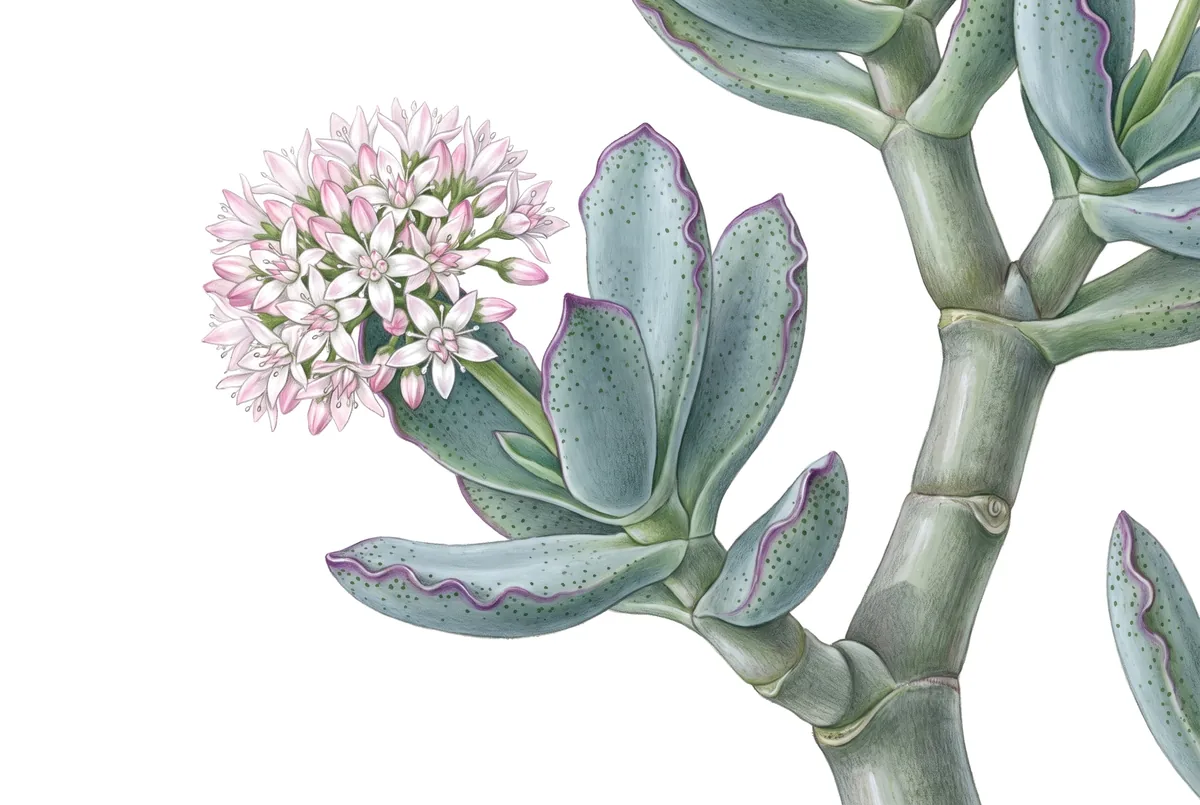
- Type
- Evergreen succulent
- Height
- 0.6 m to 2 m
- Flowers
- White, spring to summer
- Sun
- Full sun to part shade
- Drought
- Tolerant
- Frost
- Takes a light frost
- In Australia
- Not native
Growing ripple jade
Full sun to part shade, by the NC State toolbox. LLIFLE says it does well in filtered sun and takes some shade, that the leaves stay greener in shade and can turn pinkish in harsh sun, that it can scorch if moved from shade into full sun too quickly, and that it gets leggy in deep shade.
LLIFLE asks for a sandy, gritty soil and says good drainage matters because it is prone to root rot; the NC State toolbox asks for a succulent mix in a clay pot with several drainage holes, watered only once the plant has dried out. LLIFLE calls it very dry tolerant and warns that cold, wet soil in winter can cost it its roots.
LLIFLE says to protect it from frost to prevent scarring, and gives it hardy to -5 C, at times -7 C, for short periods in dry soil; both references give USDA zones 9 to 11.
The NC State toolbox names mealybugs and scale insects; LLIFLE names mealybugs, and scale only rarely. The NC State toolbox roots stem cuttings dried for 24 to 48 hours; LLIFLE adds leaves and seed.
The NC State toolbox and LLIFLE disagree on its speed, slow by the first and moderately fast by the second.
Using ripple jade
LLIFLE gives it for pots, the house and bonsai as well as the open garden, where it suits a hot, dry rockery or a sunny patio; the NC State toolbox lists it for containers and rock gardens. The toolbox counts the rippled leaves attractive all year, though the plant rarely flowers in a container; LLIFLE says a plant in flower, in spring to summer, is almost completely covered. Where frost is likely, LLIFLE grows it in pots in an intermediate greenhouse or conservatory.
What to check before you buy
Check what the label covers. The name Max Cook appears on growers' lists but in no reference read, so whether it is one clone or a trade name for the subspecies cannot be settled here. LLIFLE treats the plant long sold as Blue Bird, or Crassula portulacea 'Blauwe Vogel', as the same as this subspecies, while HortFlora calls Blue Bird of uncertain identity, possibly this subspecies; Blue Bird has its own page. The straight species has thick, rounded leaves by LLIFLE, up to about 7.5 cm long and 2.5 to 7.5 cm wide by the NC State toolbox; ripple jade's are 8 to 15 mm broad, twisted and wavy-edged by LLIFLE. The table above shows the sizes growers list. What to look for in the roots and for pests before stock leaves the grower is in the guide to nursery plant quality.
Cautions
The ASPCA lists Crassula arborescens, the species, as toxic to dogs and cats, with nausea and retching as the signs; the entry is for the species, and the NC State toolbox tags this subspecies a problem for cats.
Used forpots and courtyardsindoor
Prices are set by each grower and shown ex GST. Availability is confirmed by the grower at order.
Common questions
- What is Crassula Max Cook?
- It is a name growers list for Crassula arborescens subsp. undulatifolia, the ripple jade. The facts on this page are the subspecies' facts from LLIFLE, the NC State toolbox and the New Zealand Plant Conservation Network.
- How is ripple jade different from silver jade plant?
- In the leaf. LLIFLE describes the subspecies' leaves as elliptic to tongue-shaped, thinner, twisted and erect, with wavy purple edges, where the straight species has thick, rounded leaves; the New Zealand Plant Conservation Network also gives the subspecies elliptic, undulate, erect leaves.
- Is ripple jade the same as Crassula Blue Bird?
- LLIFLE says the plant sold as Blue Bird, first described as Crassula portulacea 'Blauwe Vogel' and long thought a hybrid, is the same as Crassula arborescens subsp. undulatifolia. HortFlora is more cautious and calls Blue Bird's identity uncertain, possibly this subspecies.
- How big does ripple jade grow?
- LLIFLE gives a branched pseudo-tree 0.6 to 2 m tall in its description and 60 to 90 cm in its summary line. The NC State toolbox gives up to about 1.2 m and notes it rarely flowers in a container.
Sources
- GBIF species match API
- New Zealand Plant Conservation Network: Crassula arborescens subsp. arborescens
- Australian Plant Census (APC): search for Crassula arborescens
- Atlas of Living Australia
- ASPCA Animal Poison Control Center, Toxic and Non-Toxic Plants: Silver Jade Plant (Crassula arborescens)
- LLIFLE, the Encyclopedia of Succulents: Crassula arborescens subsp. undulatifolia
- North Carolina State Extension Gardener Plant Toolbox: Crassula arborescens ssp. undulatifolia
- North Carolina State Extension Gardener Plant Toolbox: Crassula arborescens
- HortFlora, the Horticultural Flora of South-eastern Australia (Royal Botanic Gardens Victoria): Crassula 'Blue Bird'
- The HortOS catalogue
The growers, sizes and prices above are live and change as lists arrive. Cite this page: HortOS, Ripple jade (Crassula arborescens subsp. undulatifolia), https://au.hortosapp.com/plants/crassula-arborescens-undulatifolia-max-cook.
Found a fact that is wrong? Tell us and it is checked against its source.