Codiaeum Variegatum
2 growers · 2 sizes · from $12.00 ex GST
- Type
- Evergreen shrub
- Height
- 0.6 m to 5 m
- Spread
- 0.6 m to 1.8 m
- Flowers
- White
- Sun
- Full sun to part shade
- Frost
- Frost tender: an American reference (North Carolina State Extension) suggests it outdoors where it is protected from frost and brings it in at 10 C (50 F)
- In Australia
- Native
| Size | Grower | PricePrice ex GST | ||
|---|---|---|---|---|
| 125mm | Bamboo Land Pty Ltd125mm | $12.00 | ||
| 200mm | Lumpys Nursery & Landscape Yard200mm | $37.98 |
Also grown by 2 nurseries (no sizes or prices listed)
Enquire with them for sizes and prices.
- Kerada Tubestock NurseryCooroy, QLD
- Killuke Nursery Pty LtdHead, NSW
Growing croton
In the wild. The Australian Plant Census accepts two varieties here: var. moluccanum, native to Queensland, and var. variegatum, which it records in Queensland as naturalised. The CSIRO rainforest key describes the native variety, which it calls garden croton, as a shrub usually 1 to 3 m tall in the understorey of lowland and upland rainforest on Cape York Peninsula and in north-east Queensland, from near sea level to 800 m. By its account the shrub is commonest where the rainforest is driest, and on young basalt soils. HortFlora gives var. variegatum, under which it files the named cultivars it describes, as cultivated through the tropics and not known in the wild.
Position, soil and water. No Australian reference read gives growing conditions, so these come from North Carolina State Extension, an American reference. It gives full sun or part shade, in a well-drained soil rich in humus, and says the leaves colour best in bright light with some direct sun, while too much shade may cost the plant its lower leaves. It waters liberally from spring to autumn and sparingly in winter, and gives the plant a rest with less water from autumn to late winter.
Cold. The same reference rates it for USDA zones 11 and 12, suggests it outdoors where it is protected from frost, and brings plants indoors when the temperature reaches 10 C (50 F). No reference read gives croton a frost rating on an Australian scale.
Pests and propagation. North Carolina State Extension reports that spider mites sometimes limit its use indoors to the short term. HortFlora gives cuttings or seed for the genus.
Using croton
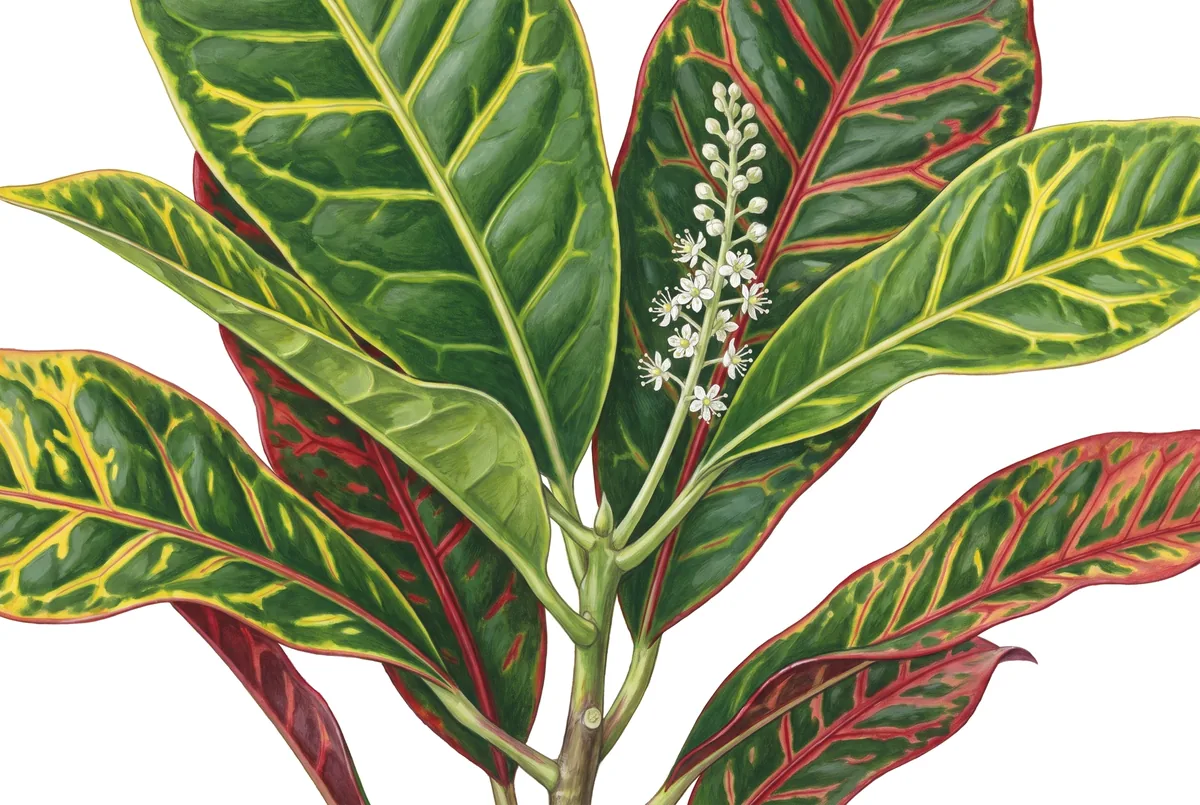
Croton is grown for its leaves: North Carolina State Extension says the wild type is plain glossy green and the cultivars, of which it counts hundreds, are grown for their variegated foliage. Writing for the United States, it suggests croton, where it is protected from frost, as a foundation plant, a hedge or a specimen, and also in containers and as a houseplant. The Queensland Poisons Information Centre describes it as cultivated for its colourful foliage in tubs or in the garden. No reference read gives planting centres for a croton hedge. Growers' lines under the plain name have pages of their own, Croton and the mixed Assorted Croton, beside the named cultivars.
What to check before you buy
On a list, croton appears as the plain species and under cultivar names, and the leaf is what tells them apart. HortFlora separates the cultivars it describes by leaf shape, margin and colour alone, from the narrow, purple and red mottled leaf it gives 'Captain Kid' to the wavy, oak-leaf-like burgundy, green, red and yellow leaf of 'Petra'. Quote the same name across growers before comparing prices; the table above shows the sizes growers list. What to look for in the roots, the stem and canopy and for pests is set out in the guide to nursery plant quality. Stock moving between states travels under the state and territory biosecurity rules like any other plant.
Cautions
The Queensland Poisons Information Centre lists croton as potentially toxic and an irritant to skin or eyes: chewing the leaves, bark or roots causes a burning feeling in the mouth, and contact with the clear sap has caused dermatitis and eczema. For any eye exposure it says to rinse with water for 15 minutes and seek urgent medical help. North Carolina State Extension adds that the sap stains fabric permanently and advises washing the hands thoroughly after handling it.
Used forspecimenhedging and screeningpots and courtyardsindoor
Prices are set by each grower and shown ex GST. Availability is confirmed by the grower at order.
Common questions
- Who grows Codiaeum Variegatum wholesale in Australia?
- 2 wholesale growers list Codiaeum Variegatum on HortOS right now, each with their own pot sizes and trade prices. They are in Queensland and New South Wales. The growers are named on this page.
- What pot sizes does Codiaeum Variegatum come in?
- Growers on HortOS list Codiaeum Variegatum in 125mm and 200mm.
- How do I order Codiaeum Variegatum from these growers?
- HortOS is for the trade. Add the lines you want to a list and send it: each grower gets their part of the order by email, confirms what they have and quotes freight, and nothing is bought until you approve it. Listing, searching and ordering are free.
- Is croton native to Australia?
- Yes, in part. The Australian Plant Census records Codiaeum variegatum as native and naturalised in Queensland: var. moluccanum is native there, in the rainforests of Cape York Peninsula and north-east Queensland by the CSIRO key, and var. variegatum is recorded as naturalised. HortFlora files the named cultivars it describes under var. variegatum.
- How tall does a croton grow?
- The references differ. North Carolina State Extension gives 0.6 to 2.4 m high and 0.6 to 1.8 m wide, and about 0.9 m indoors; the Queensland Poisons Information Centre gives a shrub to 1.8 m; HortFlora gives the garden variety to 5 m. The CSIRO key gives the native variety usually 1 to 3 m in the wild.
- Is croton poisonous?
- The Queensland Poisons Information Centre lists it as potentially toxic and an irritant to skin or eyes. Chewing the leaves, bark or roots burns the mouth, and the clear sap has caused dermatitis and eczema.
- Can croton take frost?
- No reference read gives it a frost rating on an Australian scale. North Carolina State Extension, an American reference, rates it for USDA zones 11 and 12, suggests it outside where it is protected from frost and brings it indoors at 10 C (50 F).
- Does croton flower?
- Yes, but it is grown for its leaves. North Carolina State Extension describes small male and female flowers on separate slender spikes at the branch tips: the male flowers white with five small petals and 20 to 30 stamens, the female yellowish without petals. The CSIRO key puts both sexes on the one plant in the native variety. A three-lobed capsule with three seeds follows.
- Why do croton leaves look so different from plant to plant?
- HortFlora says a great number of named and unnamed cultivars exist, differing in leaf width, margin waviness, colour and variegation; it gives the garden variety's leaves as 25 to 320 mm long and 7 to 70 mm wide. North Carolina State Extension says leaf size, shape and colour vary with the cultivar.
Sources
- GBIF species match API
- Australian Plant Census (APC), the National Species List: Codiaeum variegatum and its varieties var. variegatum and var. moluccanum
- Atlas of Living Australia: Codiaeum variegatum
- Australian Tropical Rainforest Plants, online edition (CSIRO): Codiaeum variegatum var. moluccanum
- Queensland Poisons Information Centre (Queensland Health): Codiaeum (Codiaeum variegatum)
- HortFlora, the horticultural flora of south-eastern Australia (Royal Botanic Gardens Victoria): Codiaeum variegatum var. variegatum and its cultivars, and the genus Codiaeum
- North Carolina State Extension Gardener Plant Toolbox: Codiaeum variegatum
The growers, sizes and prices above are live and change as lists arrive. Cite this page: HortOS, Croton (Codiaeum variegatum), https://au.hortosapp.com/plants/codiaeum-variegatum.
Found a fact that is wrong? Tell us and it is checked against its source.