Chamaerops humilis
European Fan Palm
Part of Chamaerops: see them all
VIC: 2 growers · 6 sizes · from $22.00 ex GST
- Type
- Evergreen palm
- Height
- 1.8 m to 5 m
- Spread
- 1.8 m to 6.1 m
- Growth
- Slow
- Flowers
- Golden yellow, spring
- Sun
- Full sun to part shade
- Drought
- Tolerant
- Frost
- Tolerates heavy frost (the SA Plant Selector)
- In Australia
- Naturalised
| Size | Grower | PricePrice ex GST | ||
|---|---|---|---|---|
| 200mm | Dinsan Nursery200mm | $22.00 | ||
| 200mm | True Green Nursery200mm | $25.00 | ||
| 300mm | Dinsan Nursery300mm | $77.00 | ||
| 300mm | True Green Nursery300mm | $135.00 | ||
| 45L | True Green Nursery45L | $355.00 | ||
| 120L | True Green Nursery120L | $1,600.00 | ||
| 200L | True Green Nursery200L | $1,900.00 | ||
| 230L | True Green Nursery230L | $2,900.00 |
Also grown by 5 nurseries (no sizes or prices listed)
Enquire with them for sizes and prices.
- Florafolia (Alstonville Plants)Alstonville, NSW
- Mullumbimby Palms NurseryMullumbimby, NSW
- Premier Palms NurseryMariginiup, WA
- Sunshine Coast PlantsQLD
- Sydney and Central Coast PalmsMartinsville, NSW
Growing european fan palm
Position. South Australia's Plant Selector gives full sun. The two American references say it prefers a bright, sunny position but tolerates part shade, that too much shade makes it lose its compact shape, and that it grows best in Mediterranean-type climates. The Plant Selector lists it for coastal and second-line coastal landscapes as well as plains, footslopes and hills.
Soil and water. The Plant Selector lists clay, loam and sand, acid to alkaline, with minimal supplementary watering, and ticks drought among what it tolerates. North Carolina State Extension says any soil type suits it if it drains well, and that once established it withstands drought and heat. The Missouri Botanical Garden prefers rich, moist, well-drained soil and consistent moisture, and says to avoid overly moist soil.
Frost. The Plant Selector ticks heavy frost and notes that the palm tolerates cold and frost. The Missouri Botanical Garden, an American reference, says it takes brief winter dips to about -9 to -7 C, and both American references rate it on the American zone system only. No Australian reference read gives a figure in degrees.
Growth and pruning. North Carolina State Extension rates its growth slow. Both American references say that with the suckers removed it grows as a single-trunked tree; Missouri adds that unpruned it keeps a shrubby form.
Pests. The Missouri Botanical Garden, an American reference, reports no serious insect or disease problems; both American references name mealybugs, scale and spider mites to watch for (indoors, by North Carolina State Extension), and North Carolina State Extension warns that overwatering can cause root and stem rot. No Australian reference read covers pests.
Using european fan palm
South Australia's Plant Selector describes European fan palm as Europe's only native palm, hardy enough for garden beds or containers, and a tree that gives foliage contrast. The Missouri Botanical Garden gives it as a specimen plant, a barrier, a group accent for a corner of the landscape and a container plant for patios, decks and foundation areas, and says it may be grown indoors as a houseplant, where it typically matures to about 1.5 m. North Carolina State Extension adds that commercial landscapes use it often because its slow growth keeps upkeep low, and suggests it for foundation planting and for formal, winter and drought-tolerant gardens. North Carolina State Extension allows 1.8 to 7.3 m of space for each plant.
What to check before you buy
Growers list this palm as European fan palm; the Missouri Botanical Garden also calls it Mediterranean fan palm. North Carolina State Extension notes variation in leaf colour, in leaf shape and texture and in how heavily the leaf stalks are armed, and names a variety, var. cerifera, with waxy, silvery leaves, and a cultivar, 'Volcano', with stiff, nearly erect leaves, so check whether a line names the species or a selection. HortFlora says most plants sucker to form clumps and some have single trunks, so check which form a line offers. The table above shows the sizes growers list; the guide to nursery pot sizes explains the size ladder, and the guide to nursery plant quality what to check before stock leaves the grower. Stock that crosses a state border moves under the state and territory biosecurity rules on moving plants and soil.
Cautions
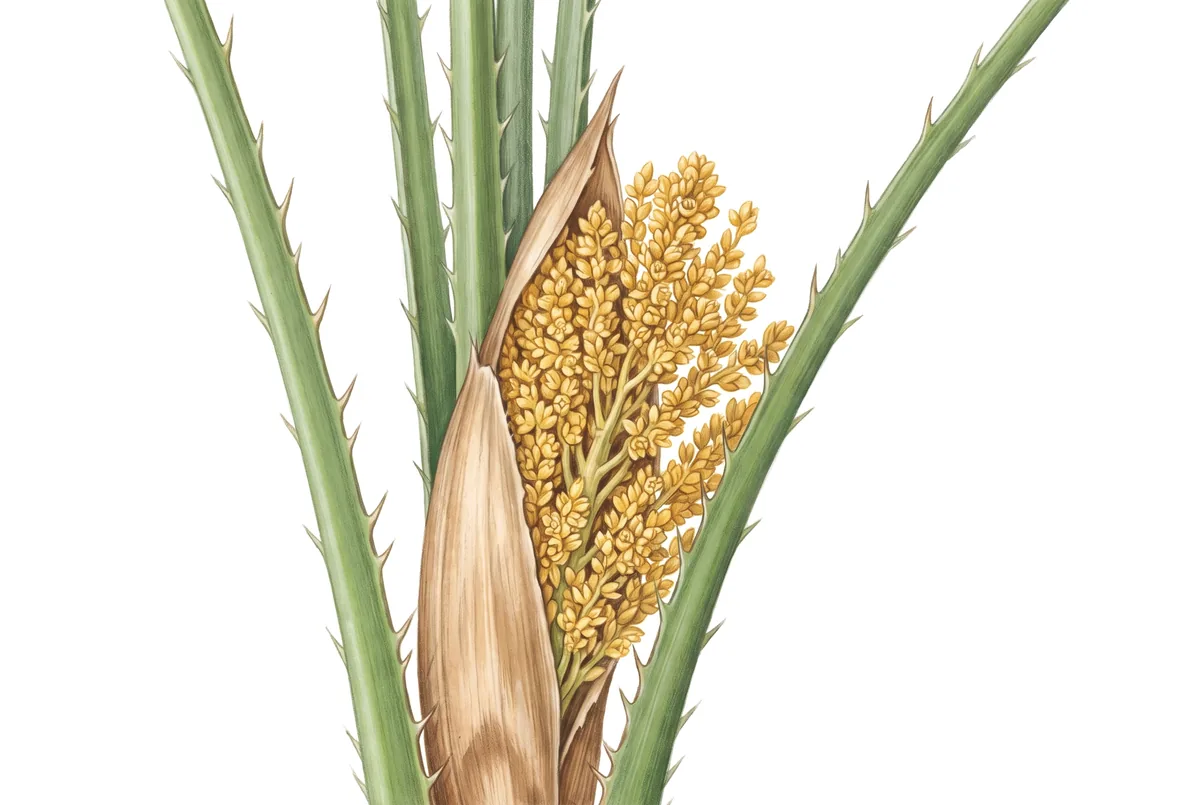
The leaf stalks are armed. HortFlora calls it a prickly palm and describes short, forward-pointing spines along the slender leaf stalks, and North Carolina State Extension numerous sharp, needle-like spines.
Prices are set by each grower and shown ex GST. Availability is confirmed by the grower at order.
Common questions
- Who grows Chamaerops humilis wholesale in Australia?
- 8 wholesale growers list Chamaerops humilis on HortOS right now, each with their own pot sizes and trade prices. They are in Queensland, New South Wales and Victoria. The growers are named on this page.
- What pot sizes does Chamaerops humilis come in?
- Growers on HortOS list Chamaerops humilis in Tube, 200mm, 250mm, 300mm, 400mm, 500mm, 45L, 90L, 110L, 120L and 4 more sizes.
- What does Chamaerops humilis cost wholesale?
- The median trade price in a 300 mm pot is $135.00 ex GST, across 3 growers who price it. Prices by pot size and state are on its trade price page.
- How do I order Chamaerops humilis from these growers?
- HortOS is for the trade. Add the lines you want to a list and send it: each grower gets their part of the order by email, confirms what they have and quotes freight, and nothing is bought until you approve it. Listing, searching and ordering are free.
- Is European fan palm native to Australia?
- No. HortFlora gives its home as southern Europe and northern Africa, and the Missouri Botanical Garden the western Mediterranean from Morocco, Algeria and Tunisia to Spain, Portugal, France and Italy. The Australian Plant Census records it as naturalised in South Australia, and the Atlas of Living Australia holds records of it in South Australia and Queensland.
- How big does European fan palm grow?
- South Australia's Plant Selector gives 4 to 5 m high and as wide. The Missouri Botanical Garden and North Carolina State Extension give 1.8 to 4.6 m high and 1.8 to 6.1 m wide, and Missouri says it typically stays about 1.5 m when grown indoors in a container.
- Is European fan palm frost hardy?
- South Australia's Plant Selector ticks heavy frost among what it tolerates. North Carolina State Extension, an American reference, calls it one of the most cold-hardy palms, and the Missouri Botanical Garden, another, gives brief winter dips to about -9 to -7 C. No Australian reference read gives a figure in degrees.
- Does European fan palm have spines?
- Yes. HortFlora describes short, forward-pointing spines on the slender leaf stalks, and North Carolina State Extension numerous sharp, needle-like spines on stalks it gives as about 0.9 to 1.2 m long.
- Can European fan palm be grown with a single trunk?
- Yes. Both American references say that removing the suckers trains it to a single-trunked tree form, and North Carolina State Extension adds that some cultivars naturally have a single, erect trunk. HortFlora says most plants sucker to form clumps.
- Does European fan palm need much water?
- South Australia's Plant Selector gives minimal supplementary watering and ticks drought among what it tolerates. The Missouri Botanical Garden says it does best with consistent moisture but has some drought tolerance once established, and to avoid overly moist soil; North Carolina State Extension says overwatering can cause root and stem rot.
- What are the flowers and fruit like?
- HortFlora describes golden yellow flowers, the sexes mostly on separate plants, in a dense cluster about 30 cm long among the leaves, followed by round reddish-brown fruit about 2 cm long that become rancid. The Missouri Botanical Garden calls the flowers and fruit somewhat inconspicuous.
Sources
- GBIF species match API
- Australian Plant Census (APC), Chamaerops humilis
- Atlas of Living Australia, Chamaerops humilis
- Plant Selector+, Botanic Gardens and State Herbarium of South Australia
- HortFlora, the horticultural flora of south-eastern Australia (Royal Botanic Gardens Victoria)
- Missouri Botanical Garden Plant Finder
- North Carolina State Extension Gardener Plant Toolbox
- The HortOS catalogue (the name growers list it under)
- The HortOS guides (nursery pot sizes; judging nursery plant quality)
The growers, sizes and prices above are live and change as lists arrive. Cite this page: HortOS, European fan palm (Chamaerops humilis), https://au.hortosapp.com/plants/chamaerops-humilis.
Found a fact that is wrong? Tell us and it is checked against its source.