Berberis thunbergii
Every Berberis thunbergii on HortOS in one place: the plain species and 9 varieties. Pick a size to see it across all of them.
7 growers · 3 sizes · from $6.00 ex GST
- Type
- Deciduous shrub
- Height
- 0.9 m to 3 m
- Spread
- 1.2 m to 2.1 m
- Flowers
- Yellow, mainly late spring to early summer
- Sun
- Full sun to part shade, by the NC State toolbox
- In Australia
- Not native
Growing japanese barberry
The New South Wales flora says it is widely grown, with several well known cultivars whose leaves can be deep purple, yellow, dark green, pink or variegated, many with strong autumn colour. The species' own leaves turn red to orange in autumn, by the NC State toolbox.
The NC State toolbox gives full sun to part shade, a range of soils from clay to sand, and lists it as resistant to heat, drought, urban conditions and some shade, and slightly salt tolerant; it gives USDA zones 4a to 8b. Those are American ratings and an American scale; no Australian reference read grades its frost or drought tolerance. The same toolbox lists anthracnose, root rot, bacterial leaf spot, wilt, scale, weevils, barberry webworm and aphids as problems in America.
In Australia the Australian Plant Census records it as doubtfully naturalised in New South Wales, and the New South Wales flora records it as locally naturalised at Mount Wilson, in the understorey of tall open eucalypt forest. In North Carolina it is listed as invasive: the NC State toolbox says it spreads by root suckers into thickets and that birds carry the seed.
Using japanese barberry
Japanese barberry's coloured-leaf cultivars have pages of their own. The NC State toolbox does not recommend the species there because of its invasiveness, and names sterile cultivar groups that it says perform well without being invasive. Its wildlife value there, by the same toolbox, is the berries birds eat, and settlers once used the plant to make dye. No reference read gives an Australian use or a planting distance for a hedge.
What to check before you buy
Growers list Japanese barberry mostly as named forms with coloured leaves; the table above shows the sizes growers list, and the forms have their own pages. The stems carry sharp spines at every node, 5 to 18 mm long by the New South Wales flora. If the stock crosses a state border, the state and territory biosecurity rules on moving plants and soil apply to this plant like any other.
Cautions
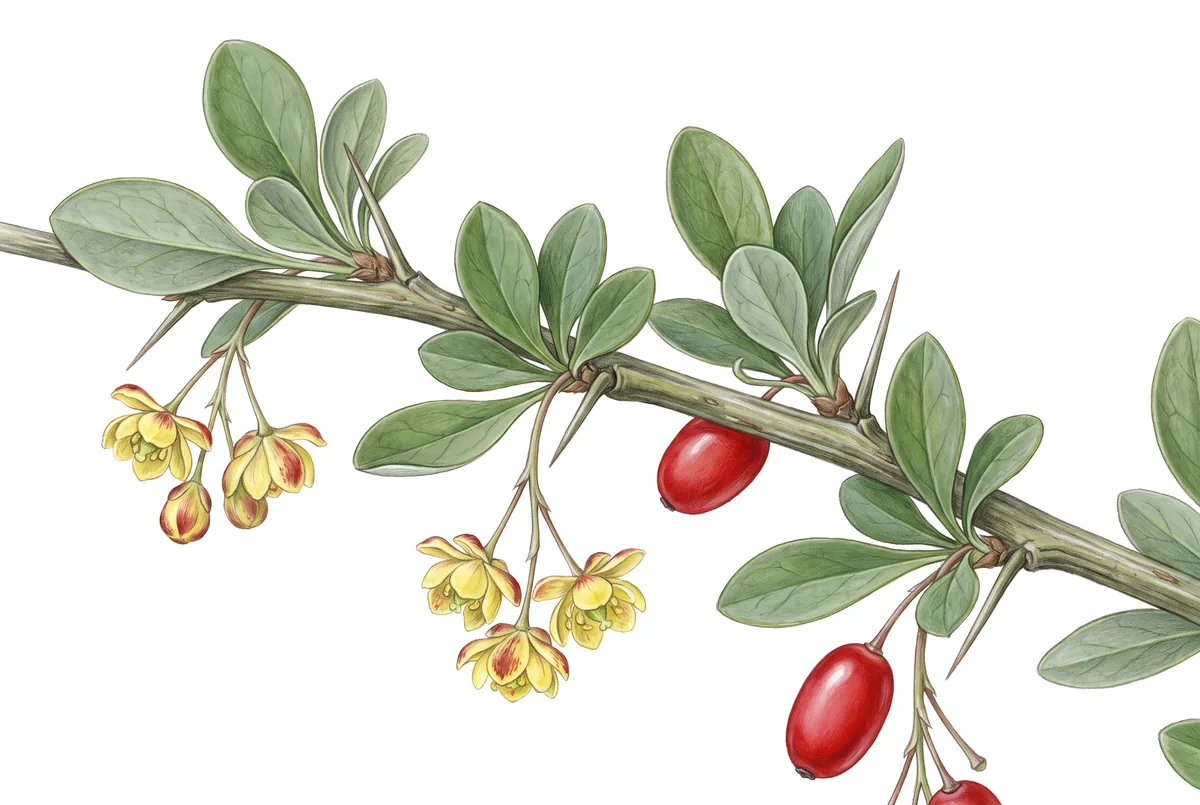
Thorns. Each node of the stem carries a spine 5 to 18 mm long, occasionally three-forked, by the New South Wales flora; the NC State toolbox lists spines among its problems and calls it a problem for children.
Prices are set by each grower and shown ex GST. Availability is confirmed by the grower at order.
Common questions
- Who grows Berberis thunbergii wholesale in Australia?
- 7 wholesale growers list Berberis thunbergii on HortOS right now, each with their own pot sizes and trade prices. They are in Victoria and Queensland. The growers are named on this page.
- What pot sizes does Berberis thunbergii come in?
- Growers on HortOS list Berberis thunbergii in 100mm, 140mm and 200mm.
- How do I order Berberis thunbergii from these growers?
- HortOS is for the trade. Add the lines you want to a list and send it: each grower gets their part of the order by email, confirms what they have and quotes freight, and nothing is bought until you approve it. Listing, searching and ordering are free.
- Is Japanese barberry a weed in Australia?
- The Australian Plant Census records it as doubtfully naturalised in New South Wales, and the New South Wales flora records it as locally naturalised at Mount Wilson. In North Carolina the NC State toolbox lists it as invasive.
- How big does Berberis thunbergii grow?
- The New South Wales flora gives a shrub to 1 m, rarely to 3 m. The NC State toolbox gives 0.9 to 1.8 m tall and 1.2 to 2.1 m wide.
- Does Japanese barberry have thorns?
- Yes. A single spine 5 to 18 mm long, sometimes three-forked, sits at each node of the stem, with a cluster of small leaves above it.
- What colour are the flowers and berries?
- The flowers are yellow stained red, to about 10 mm across, in late spring to early summer, by the New South Wales flora; the NC State toolbox gives about 8 to 13 mm. The berries are shiny red ellipsoids to 8 mm long by the flora, about 8 to 25 mm by the toolbox, which says they often persist into winter.
Sources
- GBIF species match API
- PlantNET, the New South Wales flora online (Royal Botanic Garden Sydney): Berberis thunbergii
- Australian Plant Census (APC), the National Species List: Berberis thunbergii
- Atlas of Living Australia
- North Carolina State Extension Gardener Plant Toolbox: Berberis thunbergii
- The HortOS listing
The growers, sizes and prices above are live and change as lists arrive. Cite this page: HortOS, Japanese barberry (Berberis thunbergii), https://au.hortosapp.com/plants/berberis-thunbergii.
Found a fact that is wrong? Tell us and it is checked against its source.