Atriplex nummularia
Old Man Saltbush
Part of Atriplex: see them all
20 growers · 5 sizes · from $1.45 ex GST
- Type
- Evergreen shrub
- Height
- 1 m to 3 m
- Spread
- 2 m to 4 m
- Flowers
- Brown, spring and summer by the South Australian Plant Selector+; throughout the year by the Australian National Botanic Gardens
- Sun
- Full sun
- Drought
- Tolerant
- Salt wind
- Tolerant
- Frost
- Moderate frost
- In Australia
- Native
Also grown by 24 nurseries (no sizes or prices listed)
Enquire with them for sizes and prices.
- Birds in the Bush Indigenous Plant NurseryBalliang, VIC
- Blyth Tree FarmKatanning, WA
- Chatfields Tree NurserySouth Tammin, WA
- Geographe Community Landcare NurseryAmbergate, WA
- Hamel NurseryWest Coolup, WA
- Harvest Seeds and Native PlantsTerrey Hills, NSW
- Hay Plains Landcare (Nursery & Demonstration Site)Hay, NSW
- Humphris NurseryMooroolbark, VIC
- Jackpot NurseryBiarra (Toogoolawah / Esk District), QLD
- Kersbrook Landcare NurseryWilliamstown, SA
- Linwood Tree Nursery (Linwood Trees)Burren Junction (Narrabri/Walgett District), NSW
- McKindlays Riverine NurseryNSW
- Native Seeds Pty LtdEurobin, VIC
- Nature NeedsWerribee South, VIC
- Newcastle Wildflower NurseryGlendale, NSW
- Newstead NativesNewstead, VIC
- Paten Park Native NurseryThe Gap, QLD
- Provenance Indigenous PlantsSalisbury Park, SA
- Regen NurseriesBangholme, VIC
- State Flora NurseryBelair, SA
- Tamworth Regional LandcareWest Tamworth, NSW
- The Drylands Permaculture Farm & NurseryGeraldton, WA
- The Plant Supply CoWA
- Trees For Life / Betty Westwood NurseryLockleys, SA
Growing old man saltbush
Position. Full sun, by the South Australian Plant Selector+; the Australian National Botanic Gardens says it does best in a well-drained position that is sunny for most of the day.
Soil. The Plant Selector+ lists clay, loam and sand, acid, neutral or alkaline, and ticks lime and soil salinity among what it tolerates. The Australian National Botanic Gardens calls it very adaptable; in the wild it is usually, though not always, on saline clay soils in low-lying country such as flood plains, and the NSW flora finds it usually on heavy soils in or around seasonally inundated areas and floodways.
Water. The Plant Selector+ gives no supplementary watering. The Australian National Botanic Gardens says it can take severe droughts as well as periodic flooding.
Frost, salt and fire. The Plant Selector+ ticks moderate frost, salt spray, drought and fire, and the Australian National Botanic Gardens calls it frost and salt tolerant. No reference read gives a frost figure in degrees.
Pruning. It recovers well after heavy defoliation, which the Australian National Botanic Gardens says makes it very suitable for pruning.
Pests. The same reference reports red legged earth mite in some areas, which malforms new shoots, and a native saltbush scale that attacks now and then and is normally controlled by its natural enemies.
Propagation. From cuttings or seed, by the Australian National Botanic Gardens. The seed is sown in its fruiting bracteoles, after rubbing them by hand under running water for several minutes or soaking them for at least an hour, best in autumn, early winter or spring. Cuttings go into sand and potting mix with plenty of ventilation and no mist, which invites a leaf-spotting fungus.
Using old man saltbush
The South Australian Plant Selector+ lists it for exposed coastal and desert dune sites, for soil and sand control on roadsides, verges, fire breaks, parks and reserves, and for revegetating saline ground in farming districts; it adds that along roadsides the reflected silver foliage makes the edge easier to see, and that it can be planted as an informal hedge or windbreak. The same reference notes it as a fire retardant plant as per the SA Country Fire Service, and asks readers to contact the service for more. The Australian National Botanic Gardens says it has often been grown as fodder for cattle and sheep and planted near homesteads for shelter, and that pruned into a hedge its silver foliage stands out against darker plants in a garden. No reference read gives a planting distance for a hedge or windbreak. In South Australia the Plant Selector+ lists it as indigenous to the Adelaide region and to eight of the state's botanical regions, from Lake Eyre and the Nullarbor to Kangaroo Island and the South East.
What to check before you buy
Growers list this plant as old man saltbush and as Atriplex nummularia; they are the same species, so compare them as one line. Male and female flowers are mostly on separate plants, by the NSW flora, and a search of the Australian Plant Census returns several subspecies names under the species; check the botanical name on a quote if a project names a subspecies. The table above shows the sizes growers list. What to look for in the roots and for pests before stock leaves the grower is set out in the guide to nursery plant quality, and lead times for larger orders in the guide to lead times and contract growing. Stock moving between states travels under the state and territory biosecurity rules like any other plant.
Cautions
The South Australian Plant Selector+ notes that it should not be planted closer than 2 m to any sewer main or connection, and that it is provisionally classified schedule 1, Regulation 24.2 under the Sewerage Act, with written approval required before planting it in streets or roads.
Used forhedging and screeningwindbreakcoastalerosion controlrevegetation
Prices are set by each grower and shown ex GST. Availability is confirmed by the grower at order.
Common questions
- Who grows Atriplex nummularia wholesale in Australia?
- 20 wholesale growers list Atriplex nummularia on HortOS right now, each with their own pot sizes and trade prices. They are in New South Wales, Victoria, Western Australia, Queensland and South Australia. The growers are named on this page.
- What pot sizes does Atriplex nummularia come in?
- Growers on HortOS list Atriplex nummularia in Forestry tube, Tube, 130mm, 140mm and 200mm.
- What does Atriplex nummularia cost wholesale?
- The median trade price in a 140 mm pot is $8.83 ex GST, across 6 growers who price it. Prices by pot size and state are on its trade price page.
- How do I order Atriplex nummularia from these growers?
- HortOS is for the trade. Add the lines you want to a list and send it: each grower gets their part of the order by email, confirms what they have and quotes freight, and nothing is bought until you approve it. Listing, searching and ordering are free.
- Is old man saltbush a cultivar?
- No. Old man saltbush is a common name of the species Atriplex nummularia, used by the Atlas of Living Australia, the South Australian Plant Selector+ and the Australian National Botanic Gardens. GBIF also gives giant saltbush and bluegreen saltbush as English names for it.
- How big does old man saltbush grow?
- The South Australian Plant Selector+ gives 1 to 3 m high and 2 to 4 m across. The NSW flora gives a shrub 2 to 3 m high, the Australian National Botanic Gardens up to 3 m high and 2 to 4 m wide, and it is the largest of the Australian saltbushes.
- What do the leaves and flowers look like?
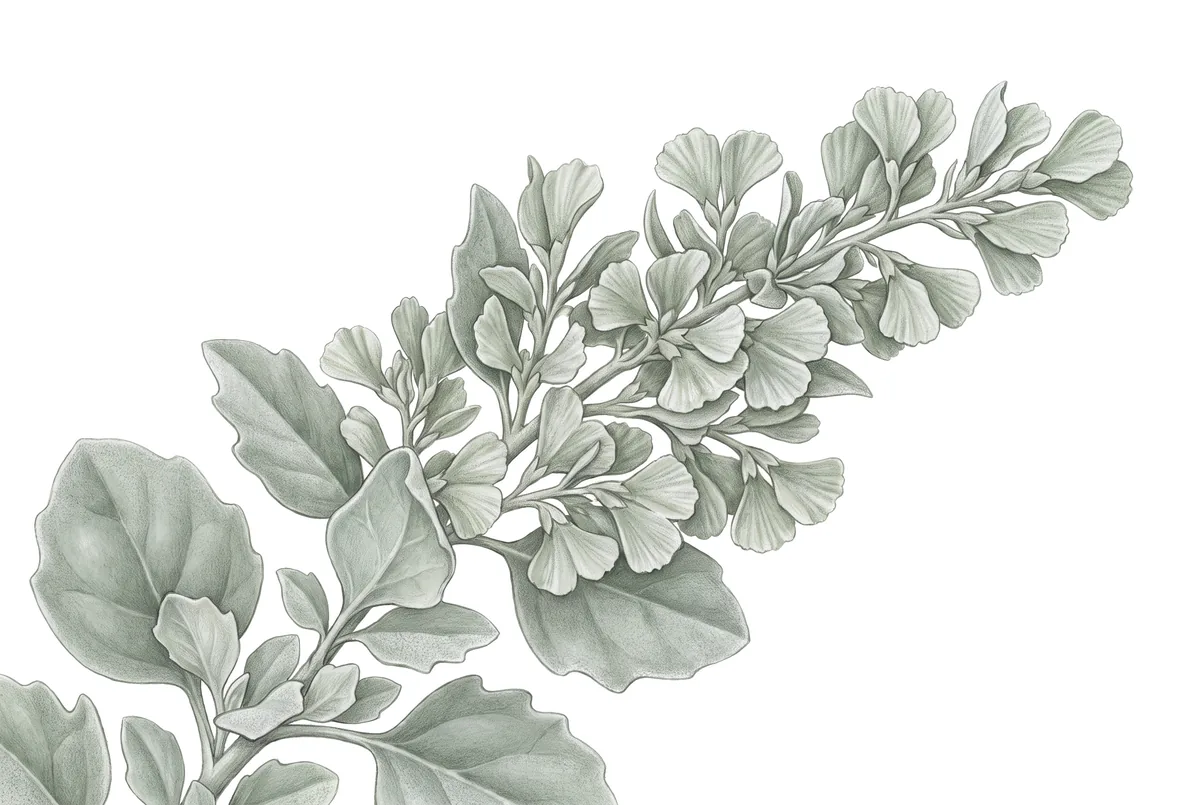
- The leaves are silvery grey with a scaly coating, broad-ovate to almost circular or elliptic, 10 to 40 mm long across the references, with margins entire to wavy or toothed. The flowers are tiny, brown by the Plant Selector+, and wind pollinated, the male and female mostly on separate plants.
- Is old man saltbush native to Australia?
- Yes. The NSW flora gives it in the drier areas of every mainland state, and the Atlas of Living Australia holds records of it in every mainland state and the Northern Territory, with one in Tasmania.
- Will old man saltbush grow in salty soil?
- Yes. The South Australian Plant Selector+ ticks soil salinity and salt spray and lists it for revegetating saline ground in farming districts, and the Australian National Botanic Gardens calls it salt tolerant and usually finds it on saline clay soils in the wild.
- Is old man saltbush fire retardant?
- The South Australian Plant Selector+ notes it as a fire retardant plant as per the SA Country Fire Service and asks readers to contact the service for more. No other reference read rates it for fire.
- Why is it called nummularia?
- By the Australian National Botanic Gardens, nummularia refers to leaves shaped like a coin, nummus in Latin, and Atriplex comes from the Latin for orache, a plant once used in place of spinach.
Sources
- GBIF species match API
- GBIF species API: vernacular names
- Australian Plant Census (APC), the National Species List
- PlantNET, the New South Wales flora online (Royal Botanic Garden Sydney), Flora of NSW
- Atlas of Living Australia
- Australian Plant Name Index (APNI) and Australian Plant Census (APC), the National Species List
- Plant Selector+, Botanic Gardens and State Herbarium of South Australia
- Australian National Botanic Gardens, Growing Native Plants
- Plants and Fungi of south western NSW, an interactive key (Lucidcentral)
- CRC LEME (Cooperative Research Centre for Landscape Environments and Mineral Exploration), Fowlers Gap plant information
The growers, sizes and prices above are live and change as lists arrive. Cite this page: HortOS, Old man saltbush (Atriplex nummularia), https://au.hortosapp.com/plants/atriplex-nummularia.
Found a fact that is wrong? Tell us and it is checked against its source.