Asplenium nidus
Birds Nest Fern
Every Asplenium nidus on HortOS in one place: the plain species and 5 varieties. Pick a size to see it across all of them.
Part of Asplenium: see them all
25 growers · 16 sizes · from $1.50 ex GST
- Type
- Evergreen fern
- Height
- 0.9 m to 1.5 m
- Spread
- 0.6 m to 0.9 m
- Growth
- Slow
- Sun
- Part shade to shade (the Missouri Botanical Garden; North Carolina State Extension; both American references)
- Frost
- Vulnerable to cold
- In Australia
- Native
Some growers show prices to verified trade buyers. Sign in or sign up with your ABN to see them and order.
Also grown by 11 nurseries (no sizes or prices listed)
Enquire with them for sizes and prices.
- Alpine Nurseries AlstonvilleAlstonville, NSW
- Burringbar Rainforest NurseryBurringbar, NSW
- Collina NurseryMurwillumbah, NSW
- Flora PlantOakford, WA
- Florafolia (Alstonville Plants)Alstonville, NSW
- ForsterianaDarawank, NSW
- Natural Green NurseryPimpama, QLD
- Newcastle Wildflower NurseryGlendale, NSW
- Sunshine Coast PlantsQLD
- Sydney Wildflower NurseryHeathcote, NSW
- The Plant Supply CoWA
Growing bird's nest fern
Climate. The Australian Native Plants Society calls Asplenium nidus a tropical plant, vulnerable to cold, that must be grown in a glasshouse in temperate regions, and HortFlora says it needs shelter and warmth. Australian Tropical Ferns and Lycophytes finds it more tolerant of hot tropical conditions than the other bird's nest fern, Asplenium australasicum. No Australian reference read gives a frost figure. In America, North Carolina State Extension says it cannot tolerate frost and will not survive below about 4 degrees C, and the Missouri Botanical Garden says plants grown outdoors prefer a minimum of 10 degrees C and usually tolerate brief dips to about 3 degrees C. In the wild it grows on tree trunks or rocks in rainforest and vine forest.
Light, soil and water. Australian Tropical Ferns and Lycophytes says to grow it as it advises for A. australasicum: under glass or in a semi-shaded garden, on a tree, in a basket, pot or the ground, a container holding a coarse, free-draining epiphyte mix and big enough to keep a mature plant stable. The Missouri Botanical Garden gives part shade to full shade and North Carolina State Extension dappled sun or part shade; both ask for a moist soil that drains well and for good humidity, and Missouri says to keep the soil evenly moist. North Carolina State Extension warns that too much sun may turn it yellow or stop its growth.
Pests. Australian Tropical Ferns and Lycophytes says it is particularly susceptible to white scale. American references add slugs, snails, mealybugs, bacterial leaf diseases and leaf nematode; Missouri says chemical insecticides will damage the plant.
Using bird's nest fern
Bird's nest fern is a foliage plant for shade, containers and interiors. Australian Tropical Ferns and Lycophytes calls it a widely cultivated ornamental fern with many horticultural varieties. The Missouri Botanical Garden thinks highly of it indoors, given bright light out of direct sun and a humid room, and says one plant alone makes a good specimen; North Carolina State Extension adds containers, hanging baskets and mass plantings outdoors in the tropics, and plants grown on tree trunks.
Both American references give a plant 0.9 to 1.5 m high and 0.6 to 0.9 m across, and the Missouri Botanical Garden says fronds on indoor container plants usually stay much shorter than those outdoors. North Carolina State Extension allows 0.9 to 1.8 m of space for each plant.
What to check before you buy
The table above shows the sizes growers list. Two native Asplenium species are sold as bird's nest fern, and HortFlora says the name Asplenium nidus is frequently misapplied to the plant now correctly named Asplenium australasicum; the Australian Native Plants Society calls the two easily confused. That society says A. australasicum tolerates at least moderate frost, while A. nidus needs a glasshouse in temperate regions. The Flora of Australia tells A. nidus by its midrib, flat or gently rounded beneath and raised above, and Australian Tropical Ferns and Lycophytes gives the other's midrib as strongly keeled beneath. The Asplenium australasicum bird's nest fern has its own page, and named forms of A. nidus such as 'Crispy Wave' and 'Osaka' are listed under their own names. What to check before stock leaves the grower is in the guide to nursery plant quality. Stock crossing a state border moves under the state and territory biosecurity rules on moving plants and soil.
Prices are set by each grower and shown ex GST. Availability is confirmed by the grower at order.
Common questions
- Who grows Asplenium nidus wholesale in Australia?
- 25 wholesale growers list Asplenium nidus on HortOS right now, each with their own pot sizes and trade prices. They are in Queensland, New South Wales, Victoria, South Australia, Tasmania and the Northern Territory. The growers are named on this page.
- What pot sizes does Asplenium nidus come in?
- Growers on HortOS list Asplenium nidus in Tube, 66mm, 90mm, 100mm, 120mm, 125mm, 140mm, 150mm, 165mm, 170mm and 6 more sizes.
- What does Asplenium nidus cost wholesale?
- The median trade price in a 125 mm pot is $9.75 ex GST, across 4 growers who price it. Prices by pot size and state are on its trade price page.
- How do I order Asplenium nidus from these growers?
- HortOS is for the trade. Add the lines you want to a list and send it: each grower gets their part of the order by email, confirms what they have and quotes freight, and nothing is bought until you approve it. Listing, searching and ordering are free.
- Is Asplenium nidus the same plant as Asplenium australasicum?
- No. They are two species, both native and both called bird's nest fern. HortFlora says the name A. nidus is frequently misapplied to A. australasicum, and Australian Tropical Ferns and Lycophytes tells them apart by the midrib beneath the frond: rounded in A. nidus, strongly keeled in A. australasicum.
- Is Asplenium nidus native to Australia?
- Yes. The Flora of Australia gives it as native and places it in north-eastern Queensland from Cape York south to Tully, and the Australian Plant Census gives its distribution as Queensland and Christmas Island. It is also generally taken to range from Madagascar to the islands of the tropical Pacific, though the Flora says its limits outside Australia are uncertain.
- Can Asplenium nidus be grown outdoors in a temperate garden?
- The Australian Native Plants Society says it is vulnerable to cold and must be grown in a glasshouse in temperate regions, and HortFlora says it needs shelter and warmth. No Australian reference read gives a frost figure. American references do: North Carolina State Extension says it will not survive below about 4 degrees C, and the Missouri Botanical Garden says plants outdoors prefer at least 10 degrees C and usually tolerate brief dips to about 3 degrees C.
- How long are the fronds of Asplenium nidus?
- The Flora of Australia gives the blade 90 to 150 cm long and 8.5 to 25 cm wide, and Australian Tropical Ferns and Lycophytes 90 to 125 cm by 8.5 to 15 cm. The Missouri Botanical Garden says fronds on indoor container plants usually stay much shorter.
- Does bird's nest fern need full sun?
- No. The Missouri Botanical Garden gives part shade to full shade and says to avoid direct sun, and North Carolina State Extension says too much sun may turn it yellow or stop its growth. Australian Tropical Ferns and Lycophytes suggests a greenhouse or a semi-shaded garden.
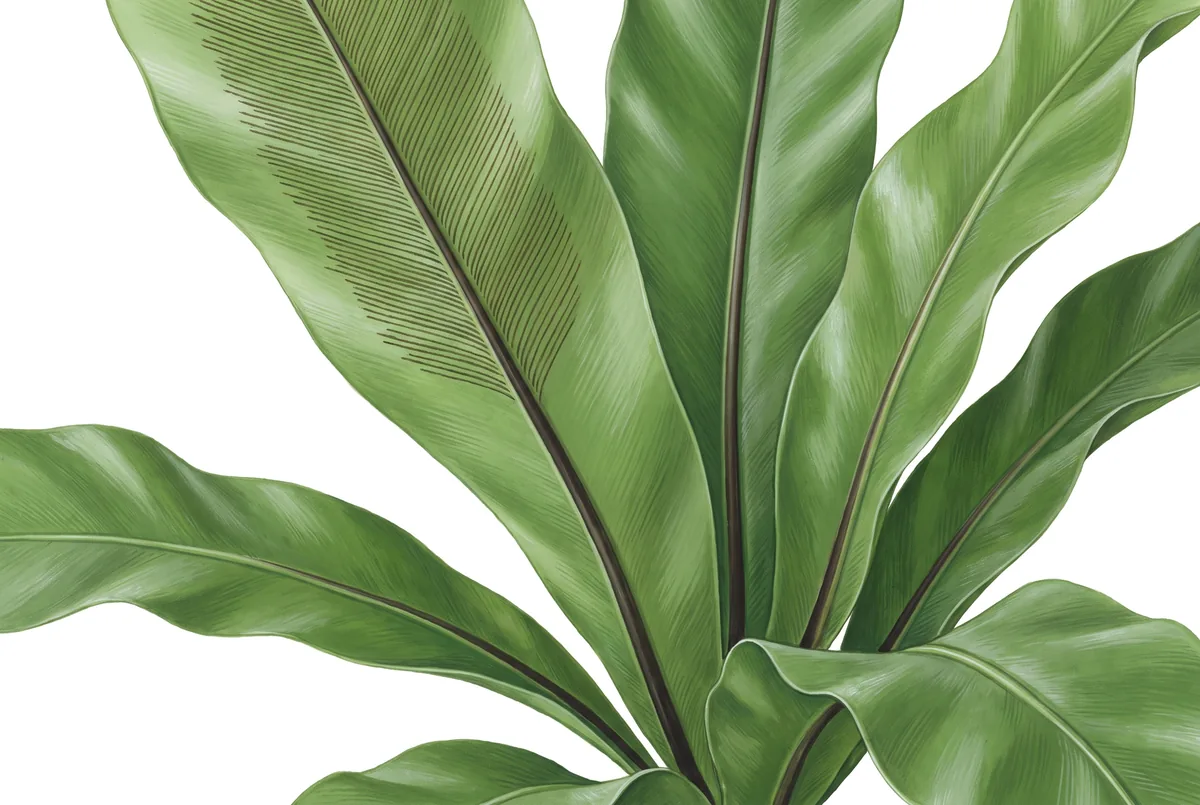
- What are the dark lines under the fronds?
- The sori, which carry the spores. The Flora of Australia describes them as very numerous and close together, running out from the midrib, the longest 18 to 40 mm, and usually covering less than half the width of the blade.
- Why does bird's nest fern collect leaves in its centre?
- The Flora of Australia says the radiating fronds trap litter at their base. Australian Tropical Ferns and Lycophytes adds that the rosette funnels rain and debris into the roots, which hold water into dry periods.
Sources
- GBIF species match API
- Australian Plant Census (APC)
- Flora of Australia (Australian Biological Resources Study), Asplenium nidus
- Australian Tropical Ferns and Lycophytes (Australian Tropical Herbarium), Asplenium nidus and Asplenium australasicum
- Atlas of Living Australia
- HortFlora, Horticultural Flora of South-eastern Australia (Royal Botanic Gardens Victoria), Asplenium nidus
- Australian Native Plants Society (Australia), plant profile of Asplenium australasicum
- Missouri Botanical Garden Plant Finder (Asplenium nidus)
- North Carolina State Extension Gardener Plant Toolbox (Asplenium nidus)
- The HortOS catalogue (the name growers list it under)
- The HortOS guide to judging nursery plant quality
The growers, sizes and prices above are live and change as lists arrive. Cite this page: HortOS, Bird's nest fern (Asplenium nidus), https://au.hortosapp.com/plants/asplenium-nidus.
Found a fact that is wrong? Tell us and it is checked against its source.