Agave parryi var. truncata
Agave
Part of Agave: see them all
Grown by 2 nurseries · no sizes or prices listed
- Type
- Evergreen succulent
- Flowers
- Yellow, summer in the wild (Missouri Botanical Garden's line for the species, repeated on its page for the variety)
- Sun
- Full sun (Missouri Botanical Garden and the RHS); some light shade (Missouri Botanical Garden)
- In Australia
- Not native
Also grown by 2 nurseries (no sizes or prices listed)
Enquire with them for sizes and prices.
- Architectural by NatureChinderah, NSW
- Peek GardenMoorooduc, VIC
Growing artichoke agave
Missouri Botanical Garden gives the variety the same care as the species: full sun or some light shade, a sandy or gritty soil with sharp drainage, and dry conditions, with root rot the risk in wet or badly drained ground. The RHS gives full sun and loam or sand that drains freely.
Its cold hardiness is rated only on overseas scales: USDA zones 7 to 10 by Missouri and H2 by the RHS, which in Britain keeps it under glass over winter. Llifle, which calls the species one of the most cold-hardy agaves, says var. truncata may need protection in the coldest areas. Missouri says the species has reportedly come through winters down to about -29 C when the cold is dry. No Australian reference read gives a frost or drought rating.
The RHS says it needs no pruning and is raised from seed, because it rarely offsets. Missouri, an American reference, names slugs and snails and the agave weevil as problems; the RHS, a British reference, names scale insects.
Using artichoke agave
Missouri Botanical Garden gives the variety the species' uses: containers where winters are too cold, borders, mass plantings, and a specimen or accent. For the variety the RHS suggests containers on a patio, gravel and coastal gardens, subtropical schemes, informal and cottage gardens, and courtyards in the city. Llifle names rock gardens, succulent gardens, borders and Mediterranean-style landscapes for the species and its varieties. Llifle describes the plants as usually solitary. For spacing, North Carolina State Extension gives the species 0.3 to 0.9 m of space to plant each one.
What to check before you buy
Growers list it as Agave parryi var. truncata, beside the plain species. Missouri Botanical Garden separates the two by stature, leaf length and the abrupt leaf tip, giving the variety leaves 15 to 30 cm long; Llifle gives the variety leaves 10 to 30 cm long against 25 to 50 cm for the species. The references disagree on its overall size: Missouri's figures are about 0.6 to 0.9 m high and 0.6 to 1.2 m across, though its text calls the variety smaller all round than the species, while the RHS places it in its 0.1 to 0.5 m height and spread class. Brisbane City Council lists Agave spp. as locally significant pest vegetation under its Natural Assets Local Law. Read a grower's line for the full name, and see the guide to nursery pot sizes for the container grades. Stock that crosses a state border moves under the state and territory biosecurity rules on moving plants and soil.
Cautions
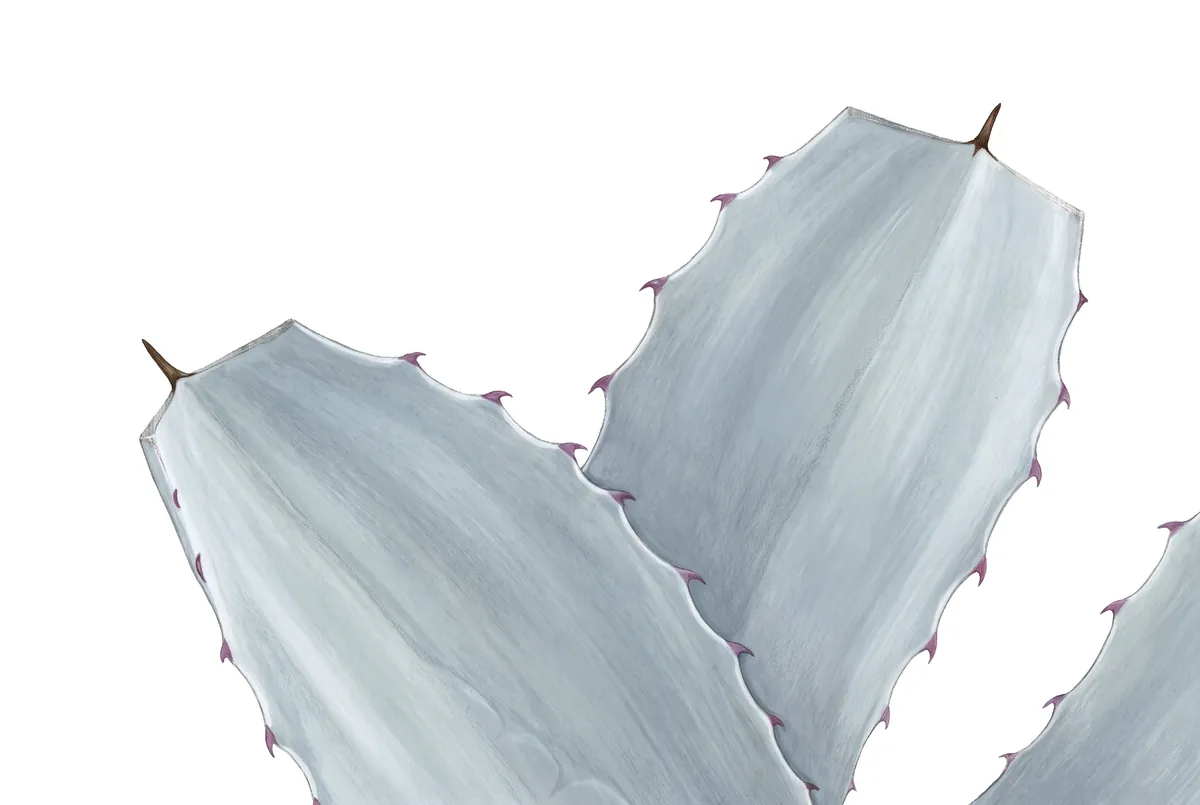
Each leaf ends in a short dark spine and the margins carry downward-curving teeth (the RHS; Llifle), and Missouri Botanical Garden's card lists thorns. The RHS, a British reference, calls the variety a skin irritant, advises gloves when handling it, and says it is harmful to dogs and cats if eaten.
Agave spp. is on Brisbane City Council's list of locally significant pest vegetation species managed under its Natural Assets Local Law (Brisbane City Council, list of locally significant pest vegetation species managed under the Natural Assets Local Law)
Prices are set by each grower and shown ex GST. Availability is confirmed by the grower at order.
Common questions
- What does truncata mean?
- Missouri Botanical Garden says the name refers to the truncate leaf tips, which can be used to tell the variety from the straight species. Llifle describes the tip as short-pointed to cut off square.
- Is it a cultivar or a botanical variety?
- A botanical variety. GBIF accepts Agave parryi var. truncata Gentry, and the RHS, Missouri Botanical Garden and Llifle all list it as a variety of Agave parryi. Llifle says it is known in the wild only from around its type locality on the Durango and Zacatecas border in Mexico.
- Does var. truncata form offsets?
- Rarely. The RHS says it rarely produces offsets and is propagated by seed, and Llifle says it hardly suckers, though it notes some plants sucker freely from long rhizomes.
- How big are the leaves?
- Llifle gives them 10 to 30 cm long, sometimes only 7 to 15 cm, and 7 to 12 cm wide, with marginal teeth 4 to 8 mm long and a terminal spine 2 to 2.5 cm long. The RHS gives leaves to 30 cm.
- Does it flower?
- Rarely, and once. The RHS says a mature plant may send up a tall spike with branching clusters of small yellow flowers, red-tinted in bud, after which the rosette dies. Llifle gives the stalk 4 to 6 m tall.
Sources
- GBIF species match API: Agave parryi var. truncata
- Missouri Botanical Garden Plant Finder: Agave parryi var. truncata
- Royal Horticultural Society (RHS) plant finder: Agave parryi var. truncata
- LLIFLE, Encyclopedia of Living Forms: Agave parryi var. truncata
- LLIFLE, Encyclopedia of Living Forms: Agave parryi (the species' leaf length, for the comparison)
- North Carolina State Extension Gardener Plant Toolbox: Agave parryi (its list of varieties and its space to plant)
- The HortOS catalogue (the lines growers list under Agave parryi)
- Brisbane City Council, list of locally significant pest vegetation species managed under the Natural Assets Local Law
- The HortOS guides (nursery pot sizes)
The growers, sizes and prices above are live and change as lists arrive. Cite this page: HortOS, Artichoke agave (Agave parryi var. truncata), https://au.hortosapp.com/plants/agave-parryi-truncata.
Found a fact that is wrong? Tell us and it is checked against its source.