Acer palmatum
Japanese Maple
Every Acer palmatum on HortOS in one place: the plain species and 88 varieties. Pick a size to see it across all of them.
Part of Acer: see them all
63 growers · 37 sizes · from $3.50 ex GST
- Type
- Deciduous tree
- Height
- 3 m to 7.5 m
- Spread
- 3 m to 7.5 m
- Flowers
- Reddish purple, mid spring
- Sun
- Dappled shade by the North Carolina toolbox; full sun to part shade with afternoon shade in hot districts by the Missouri Plant Finder; the leaves scorch in full sun where the soil dries
- Frost
- Young leaves sensitive to frost
- In Australia
- Not native
Some growers show prices to verified trade buyers. Sign in or sign up with your ABN to see them and order.
Showing 50 of 535 offers (the smallest sizes first). Show all 535 or pick a size or state above.
Also grown by 26 nurseries (no sizes or prices listed)
Enquire with them for sizes and prices.
- Balashi Flowers & NurseryDoreen, VIC
- Bell River NurserySpring Creek, NSW
- Bonsai Art NurseryHeatherton, VIC
- Cedar Nursery + DesignArmidale, NSW
- Drouin NurseryDrouin, VIC
- Engel Advanced Trees and Bamboo AdelaideHumbug Scrub, SA
- Florafolia (Alstonville Plants)Alstonville, NSW
- Garden View Nursery At Regal GardensAnnangrove, NSW
- Granton PlantsGranton, TAS
- Nightingale's Nest and NurseryKojonup, WA
- PlantNet AustraliaNorth Lakes, QLD
- PlantbizNSW
- Plants for SpacesMelbourne, VIC
- Provincial Plants and LandscapesFairbairn Avenues) Pialligo, ACT
- Quality Plants Online MelbourneMelbourne, VIC
- River Road NurseryOaks Estate, ACT
- Rockbank NurseryRockbank, VIC
- Small Tree FarmBalingup, WA
- Sunshine Coast PlantsQLD
- Tablelands Trees & ShrubsCooma, NSW
- The Beach Willow Nursery & CafeMount Duneed, VIC
- The Plants ProjectCaulfield, VIC
- Treekeepers NurseryNSW
- True Green NurseryMelton, VIC
- Woodlea Nursery PTY Ltd.Springfield, TAS
- Yalca Fruit TreesNathalia, VIC
Growing japanese maple
Position. The North Carolina toolbox plants it in dappled shade, out of drying wind. The Missouri Plant Finder allows full sun to part shade: full sun in the cooler north of its American range, some afternoon shade in the hotter south, shelter from strong wind, and no hot, dry sites. Both warn of leaf scorch, the toolbox from too much sun, wind or drought, Missouri on new leaves in hot-summer sun when the soil dries.
Soil and water. An evenly moist, well-drained soil high in organic matter, the toolbox says; Missouri adds slightly acid, says sandy loam suits it, and uses mulch to hold moisture and keep the roots cool. The toolbox's description says it is not drought tolerant, though the same page's attribute list ticks drought; no Australian reference read rates it.
Climate. Both references grow it in the American zones 5 to 8. The toolbox calls the young leaves frost-sensitive, and Missouri says it leafs out early, so a late spring frost can damage the new growth. No reference read gives an Australian frost figure. The Australian Plant Census records it only as doubtfully naturalised, in Victoria.
Pruning. Missouri keeps it to a minimum, and where a cut is needed makes it between late autumn and mid winter, as spring or summer cuts often bleed.
Problems. The American accounts list aphids, scale, leaf rollers, leafhoppers, borers and mites; anthracnose, leaf spots, verticillium wilt and root rots; late-frost damage; and chlorosis on high-pH soil.
Using japanese maple
The two references give its garden uses: a specimen or accent tree, alone or in a group, an understorey tree in dappled shade, a tree beside a walkway, the edge of a woodland garden, a screen, and bonsai. Missouri says Japanese maples are generally grown for their foliage and shape. The toolbox lists close to fifty named forms, and those growers list on HortOS have pages of their own. Missouri describes Bloodgood as a non-dissected form with deep reddish-purple summer leaves, and the toolbox says the name Atropurpureum is used for many red-leaved seedlings. Sango Kaku, formerly sold as Senkaki, is grown for the pink bark of its young twigs in winter. The dissected forms, which Missouri calls laceleaf or cutleaf maples, are smaller and often cascading: Inaba Shidare has purple-red, lace-like leaves, and the toolbox's laceleaf page lists Viridis as a cascading dwarf with bright green lacy leaves.
What to check before you buy
The table above shows the sizes growers list, and the trade prices by size are on the price page. A line that says Japanese maple or Acer palmatum with no cultivar name is the species; a named form carries its name. The toolbox says most cultivars are grafted and Missouri that the cultivars are quite variable, but no reference read says whether the plain species on a list is raised from seed or grafted, so ask the grower which the line is. The HortOS guide to judging nursery plant quality covers roots, pests and hardening off. Stock crossing a state border moves under the state and territory biosecurity rules. The drawbacks in the references: scorch in hot sun, wind or dry soil, tender young leaves in a late frost, and a long American list of pests and diseases.
Used forspecimenhedging and screening
Prices are set by each grower and shown ex GST. Availability is confirmed by the grower at order.
Common questions
- Who grows Acer palmatum wholesale in Australia?
- 63 wholesale growers list Acer palmatum on HortOS right now, each with their own pot sizes and trade prices. They are in Victoria, New South Wales, Queensland, Western Australia, the ACT, Tasmania and South Australia. The growers are named on this page.
- What pot sizes does Acer palmatum come in?
- Growers on HortOS list Acer palmatum in Tube, 90mm, 140mm, 165mm, 200mm, 250mm, 300mm, 330mm, 400mm, 500mm and 27 more sizes.
- What does Acer palmatum cost wholesale?
- The median trade price in a 400 mm pot is $147.00 ex GST, across 12 growers who price it. Prices by pot size and state are on its trade price page.
- How do I order Acer palmatum from these growers?
- HortOS is for the trade. Add the lines you want to a list and send it: each grower gets their part of the order by email, confirms what they have and quotes freight, and nothing is bought until you approve it. Listing, searching and ordering are free.
- Is Japanese maple on a list the same as Acer palmatum?
- Yes. A listing of Japanese maple with no cultivar name is the species, Acer palmatum Thunb., the name the Australian Plant Census accepts. Named forms such as Bloodgood or Sango Kaku carry their cultivar names.
- How big does a Japanese maple grow?
- The Missouri Plant Finder gives 3 to 7.5 m, infrequently to 12 m, and the North Carolina toolbox 4.5 to 7.5 m high and 3 to 7.5 m wide. The toolbox's description calls growth slow to moderate; its trait list says slow.
- Does a Japanese maple need shade?
- The North Carolina toolbox plants it in dappled shade. The Missouri Plant Finder allows full sun where summers are mild and asks for some afternoon shade where they are hot, and both say the leaves scorch when sun, wind or dry soil are too much.
- Is Japanese maple drought tolerant?
- Not by the North Carolina toolbox's description, which says it is not, although the same page's attribute list ticks drought. The Missouri Plant Finder asks for a soil kept consistently moist under mulch. No Australian reference read rates it.
- When do you prune a Japanese maple?
- As little as possible, the Missouri Plant Finder says. Where a cut is needed, make it between late autumn and mid winter, because spring or summer cuts often bleed heavily.
- What colour does a Japanese maple turn in autumn?
- Yellow, bronze, purple or red by the North Carolina toolbox, the colour varying with the cultivar; the Missouri Plant Finder gives the species shades of yellow, red-purple and bronze.
- Is Japanese maple naturalised in Australia?
- The Australian Plant Census records it only as doubtfully naturalised, in Victoria, so HortOS gives it as an exotic. Of the records the Atlas of Living Australia flags, all but one are marked introduced. The toolbox's line that it self-seeds and can become weedy is about the United States.
- What do the flowers and seeds look like?
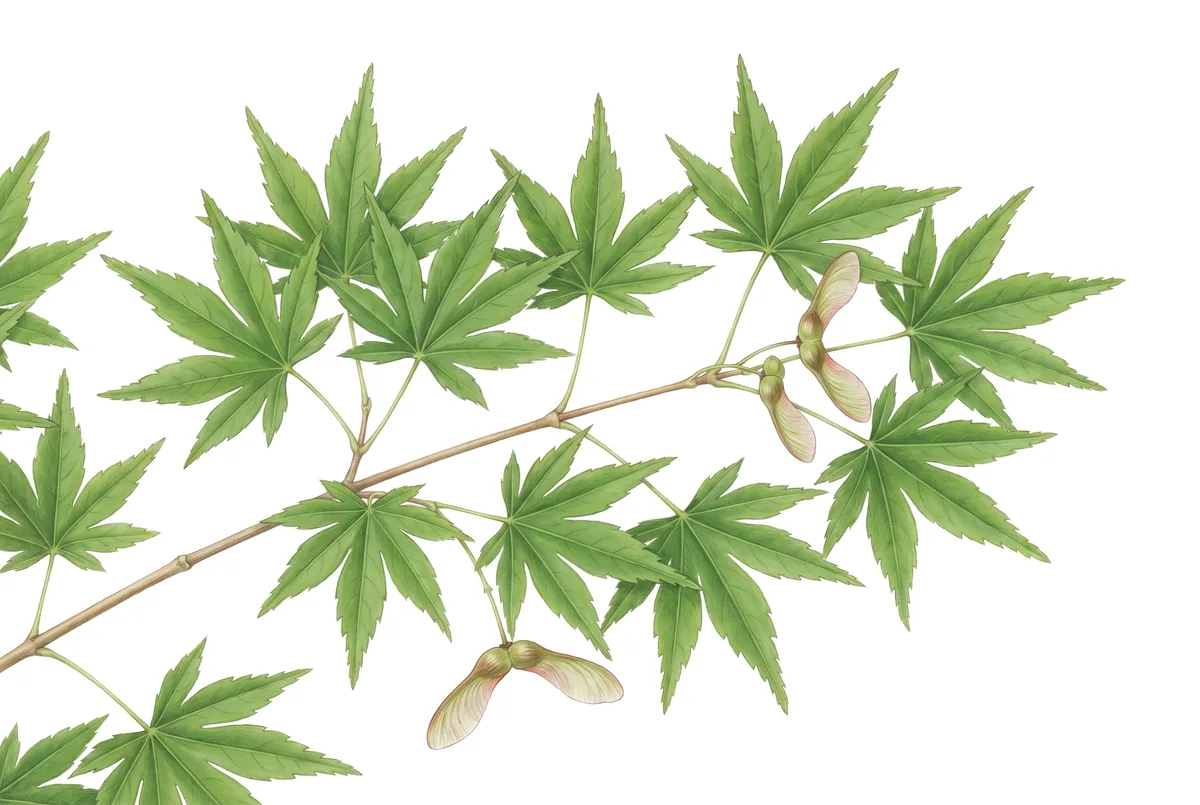
- Small reddish-purple flowers in umbels in mid spring, attractive close up but not showy from a distance, the Missouri Plant Finder says. Paired winged seeds to about 2 cm follow and ripen in autumn; the toolbox says the wings curve in to an arch and turn reddish.
Sources
- GBIF species match API
- Atlas of Living Australia (the species page, with the Australian Plant Census as name authority)
- Australian Plant Census (Council of Heads of Australasian Herbaria): Acer palmatum Thunb.
- North Carolina State Extension Gardener Plant Toolbox
- Missouri Botanical Garden Plant Finder: Acer palmatum
- Missouri Botanical Garden Plant Finder: Acer palmatum var. dissectum 'Inaba-shidare'
- Missouri Botanical Garden Plant Finder: Acer palmatum 'Sango-kaku'
- Missouri Botanical Garden Plant Finder: Acer palmatum 'Bloodgood'
- North Carolina State Extension Gardener Plant Toolbox: Acer palmatum 'Atropurpureum' and Acer palmatum var. dissectum (the named forms, not the species)
- The HortOS guide to nursery plant quality: roots, pests and hardening off
The growers, sizes and prices above are live and change as lists arrive. Cite this page: HortOS, Japanese maple (Acer palmatum), https://au.hortosapp.com/plants/acer-palmatum.
Found a fact that is wrong? Tell us and it is checked against its source.